
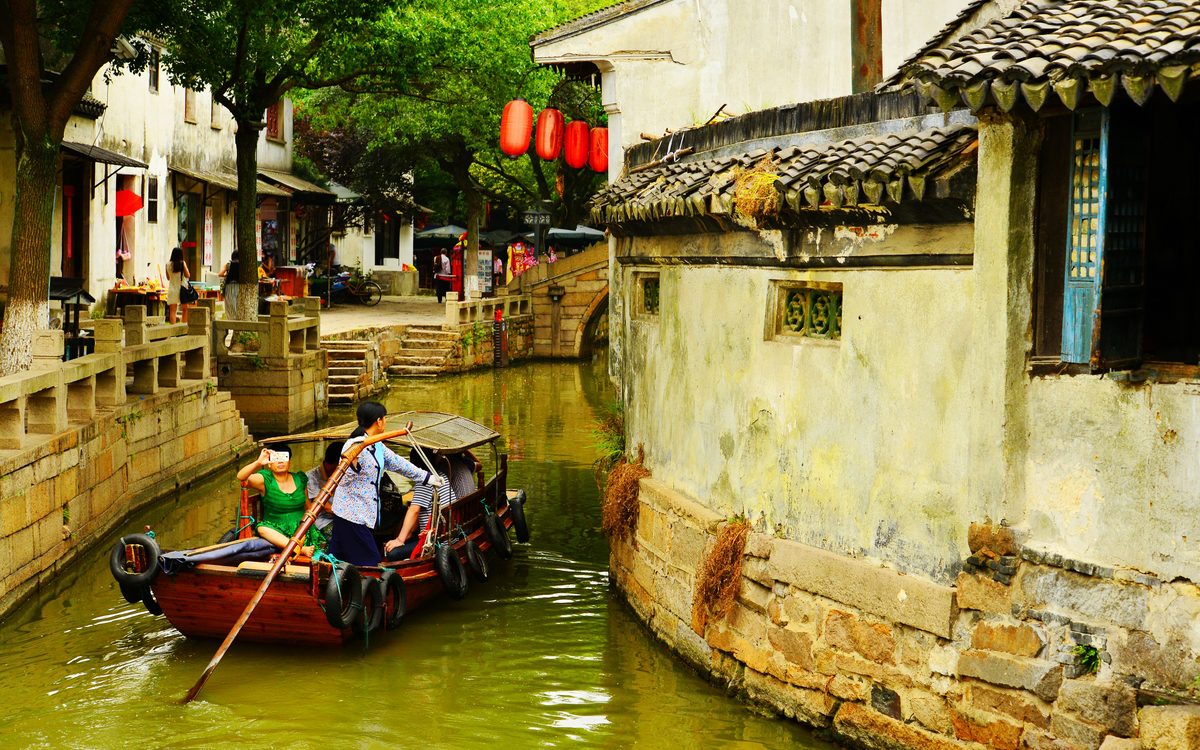
01Living Is Not Old
What is a living old town in China, as opposed to a tourist one?
An old Chinese town is not the same thing as a living one, and this page is about the second kind.
The test is simple and the survey behind this page applied it to every candidate in the country. A town is alive when the old houses, the old street plan and the people who live there today still share one space: when someone walks home with vegetables through a Ming (明), 14th to 17th century gate, when the teahouse under a Qing (清), 17th to early 20th century roof is full of local old men, when the barber and the grocer on the corner have been there for decades. It is not alive because it has a heritage plaque, a five-A rating or a well-known name. The survey's own phrase is that history there is a container for life, not a backdrop for it.
By that test the survey kept some five hundred places across all thirty-one mainland provinces, from a whole walled county town to a single lane of tenements inside a modern city, and it sorted them into four shapes: the old city, the old town, the historic street, and the old neighbourhood inside a big city, which is a large group after the towns. It set aside another seventy-odd well-known places as tourist towns, rebuilt or emptied, and lists them separately so that nobody sells them as living. Nearly three quarters of what it kept scores as both alive and lightly commercialised, and the survey says plainly that this is the result of its own selection, not a description of China's old towns in general.
Two things follow for a visitor. One is that a well-known name is a poor guide: the survey's top eleven include places many foreigners have never heard of, and its list of emptied-out towns includes several that every guidebook recommends. The other is that the question to ask at any old town is not "how old" but "who still lives here", and the answer is visible at seven in the morning.
The rest of this page is arranged by that answer. How to tell the main street from the lane behind it; the eleven places that pass every test; the walled towns, the water towns, the old quarters of the big cities, the merchant ports, the living quarters of local peoples; the hundred that China loves and the English internet has not found; the well-known ones, honestly; and how long to give each.
02The Second Lane
How is real life found in a Chinese old town?
Every Chinese old town has a street for visitors and a lane for residents, and the whole art of visiting one is knowing which is which.
The survey scores the two things separately. One score is for life: whether residents still live there, whether the fabric is real, whether there is a market, a trade, a festival, a night that belongs to the neighbours. The other is for commerce, on a scale from almost none to almost nothing else. Put the two together and every place falls into one of four boxes: alive and quiet, alive and busy, empty and quiet, empty and busy. The opening box is the hidden treasure. The second is the well-known town that is still worth it. The third is the ruin with a plaque. The fourth is the tourist street, and the survey moves the worst of those out of its core list altogether.
The well-known towns that pass are almost all in the second box, and they pass for one reason. Pingyao (平遥)'s south street (南大街) is lanterns and souvenir shops; the lanes behind it hold ten thousand residents. Pingjiang Road (平江路) in Suzhou (苏州), in Jiangsu (江苏), is a promenade; the lane one block east is washing on poles. Xi'an (西安)'s Muslim Street (回民街) is a line of tourists; Sajinqiao (洒金桥), one street over, is a line of locals for cured beef early in the morning. Chengdu (成都)'s Kuanzhai Alley (宽窄巷子) is a brand; Paotongshu Street (泡桐树街) beside it is a neighbourhood. The survey's three rules, which this site adopts, are: judge the buildings on the main street and the life in the second and third lane parallel to it; find the wet market (菜市场), because that is where the town is anchored; and go before nine or after nine at night, because the daytime belongs to the visitors.
Commerce is not the enemy. A town at level four or five on the scale, with a busy main street, can still be entirely alive two lanes back, and Pingyao, Quanzhou (泉州), Chaozhou (潮州), Shaoxing (绍兴) and the Lhasa (拉萨) Barkhor (八廓街) all score that way. Shops do not kill a town. Removal does: the residents are bought out or moved out and the houses become stock. The survey's cards record which towns subsidised their people to stay and which cleared them, and that single fact predicts everything else.
So the question at the gate is never "is it commercial". It is "where is the lane", and "who is buying vegetables in it".
| Box | Life | Commerce | What it is | Examples |
|---|---|---|---|---|
| Alive and quiet | high | low | the hidden treasure | Shaxi · Lili · Qikou · Weishan · Changting · Qingzhou |
| Alive and busy | high | high | well known, still worth it: go early, leave the main street | Barkhor · Pingyao · Quanzhou · Kashgar · Shaoxing · Chaozhou · Lijiang · Dali · Xi'an Muslim quarter |
| Empty and quiet | low | low | history without a life | decayed towns, single-monument quarters |
| Empty and busy | low | high | kept on the list with a label | Hongcun · Xitang · Zhouzhuang · Gulangyu · Tunxi · Taiping Street · Shangxiajiu |
| Off the list | none | all | built or emptied for visitors | Wuzhen west · Songcheng · Nianhuawan · Luoyi · Taierzhuang · Huangling |
03The Eleven
Which old towns in China suit a foreign visitor?
The survey found eleven places in China that pass every test at the top level, and the list is not the one a guidebook would give.
Three are well known. Pingyao (平遥), the complete Ming-Qing county town in Shanxi (山西), walled and inhabited, where the merchant banks and the residents' courtyards still share the same streets. The Barkhor (八廓街) in Lhasa (拉萨), the circuit of lanes around the Jokhang (大昭寺), which the survey ranks at the top in the whole country because faith there is the shape of the day: the circumambulation at dawn, the sweet-tea house (甜茶馆) at noon, and none of it staged. And the hutongs (胡同) around the Bell and Drum Towers (钟鼓楼) in Beijing, the one part of the capital's old city that is both easy for a new visitor and still lived in.
Three are known and underrated. Quanzhou (泉州), the old port in Fujian (福建) that the survey calls half incense and half smoke: a temple every few steps and a market between them, a World Heritage (世界遗产) city since 2021 where the listing changed little in the lanes. Kashgar (喀什)'s old city, the mud-brick quarter with its high houses, alive and Uyghur (维吾尔族), busy and still itself. Shaoxing (绍兴)'s old streets along the canals, where a Tang-dynasty bridge is still the way to the wet market (菜市场).
Five are barely known outside China. Chaozhou (潮州), which the survey calls an underrated living museum of southern life, with its morning market, its gongfu tea (工夫茶) and its floating bridge (广济桥). Shaxi (沙溪) in Yunnan (云南), the last surviving market town of the tea-horse road, with a Friday market that the villages still come down to. Lili (黎里), a water town near Suzhou (苏州) in Jiangsu (江苏) with close to ten thousand residents and over a hundred covered lanes and almost no shops, the survey's model of a real water town. Linhai (临海), the old prefecture city of Taizhou with its wall and its Ziyang Street (紫阳街). And Yangmeizhu Lane (杨梅竹斜街) behind Qianmen (前门) in Beijing, restored without evicting anyone, which the survey holds up as the way a street can be renewed.
What the eleven share is density of life, whatever their age or fame, and in many of them the main street is commercial and the lanes are not. The one with the quietest main street is Lili. The one with the loudest is Pingyao. They pass the same test.
| Place | Kind | Commerce | Known abroad | Difficulty |
|---|---|---|---|---|
| Barkhor and old-town lanes, Lhasa | living neighbourhood | 4 | high | moderate |
| Pingyao | walled city | 4 | high | easy |
| Quanzhou old city | old city | 3 | medium | easy |
| Kashgar old city | walled city | 4 | medium | moderate |
| Shaxi | market town | 2 | medium | moderate |
| Shaoxing old streets | old city | 3 | medium | easy |
| Chaozhou | walled city | 3 | low | easy |
| Bell and Drum Tower hutongs, Beijing | living neighbourhood | 3 | high | very easy |
| Lili | water town | 1 | very low | moderate |
| Linhai, Taizhou prefecture city | walled city | 3 | low | easy |
| Qianmen and Yangmeizhu Lane, Beijing | historic street | 4 | high | very easy |
04The Walled County Town
Which walled old cities in China still have people living inside?
The commonest living old town in China is a county seat that never lost its wall, and the survey holds a hundred and seventy of them.
Pingyao (平遥) is the model and the exception. Roughly ten thousand people still live inside the wall, down from several times that before the World Heritage (世界遗产) listing, and they stay because the local government pays them to: a subsidy for keeping and repairing an old courtyard house. The result is a town where the merchant banks of the nineteenth century, the county yamen, the temples and the residents' vegetable market are all inside one circuit of wall, entered for nothing, with a single pass for the sights. It is also the busiest of the walled towns, and the survey's advice is the one it gives everywhere: the south street (南大街) is for the lanterns, the lanes east and west of it are for the town.
The others are quieter and the survey ranks several of them nearly as high. Langzhong (阆中) in Sichuan (四川), with its examination hall and its vinegar works. Jianshui (建水) in Yunnan (云南), whose old city has a Confucian temple the size of a park and a street of purple-clay (紫砂) potters. Shexian (歙县), the old seat of the Huizhou merchants, whose fish-weir street the survey scores as almost entirely residential. Shouxian (寿县) in Anhui, inside a well-preserved Song-dynasty wall in the country, seven kilometres round, where the town within is simply a working county town. Qingzhou (青州) in Shandong (山东), free to enter, with an old Muslim street eight hundred years old and some twenty thousand people still living inside. Zhengding (正定), an hour from Beijing, with real Sui (隋), late 6th to early 7th century and Tang (唐), 7th to early 10th century buildings and a free old town full of residents. Yulin (榆林), on the edge of the Ordos (鄂尔多斯) desert, with six gate-towers riding its main street and ninety-odd lanes of residents, which the survey lists as one of the country's least-known walled towns.
Two cautions the cards carry. The old city of Datong (大同), in Shanxi (山西), was rebuilt on a large scale from 2008 and is argued about; the survey keeps it because the Liao and Jin temples are real and people live inside. And Kashgar (喀什)'s old city, walled in mud rather than brick, is the one on this list where a visitor will feel very foreign, and the survey scores it among the top four in the country for exactly that reason.
How long. A walled town is a full day by the survey's nine-slot model, which the eleventh block gives; the wall at golden hour is the last slot but one, before the night market.
05Water Towns, True and False
Which Chinese water towns are real, and which are tourist towns?
The water town is the Chinese old town a foreigner is likely to visit and the one the survey is hard on.
The false kind is easy to describe. The residents have gone, the houses along the canal are shops and guesthouses under one management, the night is a lighting show, and the survey calls it a tourist town rather than a living one. By its test the western half of Wuzhen (乌镇) is the clearest case, and it is not in the core list at all. Zhouzhuang (周庄)'s main streets and Xitang's bar street (西塘酒吧街) score as emptied, though both towns keep a card because a few residents still appear on the canal at seven in the morning and the outer town is full of people. The survey's honesty here is the point: it does not say these places are bad, it says they are no longer lived in, and it sends the visitor two towns over.
The true kind is quieter and has a wet market (菜市场). Lili (黎里), near Suzhou (苏州) in Jiangsu (江苏), is the survey's model: close to ten thousand residents, more than a hundred covered lanes off the canal, a commerce score of one, and a place in the survey's top eleven. Xinshi (新市), in Deqing, is where the survey sends a visitor at half past five in the morning for the mutton noodles and the rice wine the old men drink with them, and the West River market after. Anchang (安昌), outside Shaoxing (绍兴), hangs its cured meat (腊味) and sausages along the canal for the town's own winter. Nanxun (南浔), Tongli (同里) and Luzhi (甪直) are in the middle: well known, ticketed, with a busy core, and with real lanes and real residents one bridge away, which the survey scores as still worth it. Jinxi (锦溪), Qiandeng (千灯) and Mudu (木渎) near Suzhou, Xinchang (新场), Fengjing (枫泾) and Jinze (金泽) outside Shanghai, and Tangqi (塘栖) and Xixing (西兴) on Hangzhou (杭州)'s canal fill out the list, many of them known to nobody abroad.
How to tell in five minutes. The survey's test for a water town is the same as for any town, applied to the canal: is there washing on the steps, is the boat carrying vegetables or tourists, is the shop selling to the street or to the visitor. The false water town fails all three by nine in the morning, and the true one passes them all at six.
06Inside the Modern City
Where can old-town life be found inside Beijing, Shanghai or Guangzhou?
A visitor with three hours in a Chinese metropolis does not need to leave it to find an old town. Over a hundred of the survey's places are neighbourhoods inside the big cities.
They are the least known and the easiest. Nearly all are free, walkable, on the metro, and rated by the survey as very easy or easy for a visitor with no Chinese. What they lack is a name: nobody flies to China for Bugaoli (步高里), but Bugaoli, a 1930s lane compound in the old French Concession, is where Shanghai people still live in old houses, and the survey puts it at the top for the city. The rule of the second lane applies with full force here, because the well-known street is always the wrong one. In Beijing that street is Nanluoguxiang; the hutongs (胡同) around the Bell and Drum Towers (钟鼓楼), the East Fourth (东四) lanes and the Muslim quarter (回坊) of Niujie (牛街) are the ones still lived in. In Xi'an (西安) the Muslim Street (回民街) is the tourist one and Sajinqiao (洒金桥) is the local one. In Chengdu (成都) it is Kuanzhai Alley (宽窄巷子) and Paotongshu Street (泡桐树街). In Fuzhou (福州) it is the front of the Three Lanes (三坊七巷) and the back of them.
The survey gives a half-day street for twenty gateway cities, and the pattern repeats: Guangzhou (广州)'s Xiguan (西关) and Enning Road (恩宁路) with the morning tea (早茶) and the dried-seafood street; the lanes east of Pingjiang Road (平江路) in Suzhou (苏州), Jiangsu (江苏), at dawn; Nanjing (南京)'s Old Gate West (老门西), the last undeveloped Ming lanes south of the city; Wuhan (武汉)'s lane compounds (里份), the city's version of Shanghai's; Qingdao (青岛)'s courtyard tenements in the old Chinese quarter; Harbin (哈尔滨)'s Daowai (道外) with its baroque fronts and northern courtyards and its morning market; Hangzhou (杭州)'s Xiaohe Street (小河直街) on the canal, which the survey calls far more original than Hefang Street; Xiamen (厦门)'s Eighth Market (八市), a very lively old market in the country by its count; Kunming (昆明)'s Wenming Street (文明街) with the flower-and-bird market.
The three-hour formula. Breakfast where the neighbours eat, forty minutes. A wet market (菜市场) or morning market, forty. The two or three lanes behind the main street, an hour. One old shop, one craft or one neighbourhood temple, half an hour. Something from a stall to take away. The survey wrote it for a visitor between a landing and a hotel, and this site uses it as an opening product a visitor buys.
07Merchant Towns and Ports
Which Chinese merchant and river towns still work at their old trades?
The towns the survey rates as very alive are often the ones that made or moved something, and still do.
The craft towns are the clearest case, because the trade is the life. Shenhou (神垕), in Henan (河南), is a town in China where the Jun-ware (钧瓷) kilns never went out; the lanes are paved with shards and the potters are at the wheel. Chenlu (陈炉), on the loess above Tongchuan, has fired Yaozhou ware (耀州瓷) for fourteen centuries, and its walls are built of stacked jars. Yincheng (荫城) in Shanxi (山西) was the iron town of the north for two thousand years and has five families of smiths left, still making hoes and sickles with almost no tourism at all. Jianshui (建水)'s purple-clay (紫砂) street, Jingdezhen (景德镇)'s old kiln lanes, and Tongren (同仁)'s Regong (热贡) quarter, where by the survey's count tens of thousands of people paint thangkas for a living, are the same story in clay and paint. A visitor who wants to watch something being made rather than sold goes to these, and this site's page on things made by hand takes it from there.
The river ports are the second family, and they are much photographed places in the survey. Qikou (碛口), on the Yellow River in Shanxi, was the port where boats met camel trains, and its cave houses climb the bank with the villagers still in them; the survey calls it Pingyao (平遥) without the crowds. Hekou (河口) in Jiangxi (江西) was an early town on the tea road to Russia and keeps seven hundred Ming and Qing buildings and a pontoon bridge where women still beat their washing. Gongtan (龚滩) hangs its stilt houses over a gorge of the Wu River; Heijing (黑井) in Yunnan (云南) made salt for twelve centuries and produced thirteen scholars. Shedian (赊店) and Jingziguan (荆紫关) on the Henan-Hubei border, Yaowan (窑湾) on the Grand Canal (大运河), Hexia (河下) at Huai'an (淮安), Zhoucun (周村)'s old commercial street in Shandong (山东) where the old-name shops are the original ones: the list runs to over sixty towns whose reason for being was a road, a river or a market, and whose life did not stop when the trade did.
Two things make these good-value towns on the page. They are almost all free, and they are almost all unknown in English; the survey marks many of them as Very Low on its foreign awareness scale and puts several on its hidden-thirty list. The cost is distance: a few are a long drive from anywhere, and the cards say which.
08Living Quarters of Local Peoples
Which quarters of China's smaller peoples are still lived in, and how should a visitor behave?
Fifty-odd of the survey's places are quarters of the smaller peoples where people still live, and the survey draws a hard line between those and the villages built to perform.
The line is residence. A living quarter has houses with families in them, a market, a place of worship in daily use, and a trade; a performance village has a stage, entry fees and costumes on a timetable. The survey keeps the former and sends the latter to its register of tourist towns, and this site's page on shows covers what happens on the stage. The ethics the survey attaches, which this site adopts, are three: do not stage a photograph, do not disturb worship, and ask before photographing a person.
The west has the great ones. The Barkhor (八廓街) in Lhasa (拉萨) is the survey's top-scoring place in China: a circuit of lanes around the Jokhang (大昭寺) walked clockwise from before dawn, with the sweet- tea houses full by mid-morning. Kashgar (喀什)'s old city, Kuqa (库车)'s old town where four fifths of the residents are the original families and each lane has a trade, Hotan (和田)'s walled quarter, the blue lanes of Kazanqi (喀赞其) in Yining (伊宁), all Uyghur (维吾尔族) and all inhabited. Linxia (临夏)'s eight quarters and thirteen lanes in Gansu (甘肃), where five thousand Hui (回族) households refused to move and the mosques and lanes are as they were. Wuzhong (吴忠) in Ningxia (宁夏), where the survey counts close to eight hundred morning-tea houses and a Hui grandfather sits two hours over a pot of eight-treasure tea (八宝茶). Beijing's own Niujie (牛街), the capital's densest Hui neighbourhood, with its mosque and its halal market.
The south has the villages. Zhaoxing (肇兴) in Guizhou (贵州), a very large Dong (侗族) village in China, with five drum towers (鼓楼) and five wind-and-rain bridges, where the grand chorus (侗族大歌) is still sung by the villagers and the indigo cloth still dries on the rails. Chengyang (程阳)'s eight villages nearby. Taoping (桃坪羌寨), the two-thousand-year-old Qiang (羌族) fortress village in Sichuan (四川) with its watchtowers and water channels under the houses, still lived in. Xizhou (喜洲) on the Dali (大理) plain, the Bai (白族) town of courtyards and tie-dye (扎染), and Weishan (巍山) south of it, ninety per cent original residents by the survey's count. Xijiang (西江千户苗寨), the thousand-household Miao (苗族) village, which the survey keeps with a warning: the viewing terrace and the old street are all guesthouses, the six thousand people live further up the hill.
How to visit one. Market day if there is one: Shaxi (沙溪)'s Friday, Kashgar's Sunday livestock market. Early, for the same reason as everywhere else on this page. And with the leisure page open, because the difference between watching a Dong chorus and being pulled into a circle dance (锅庄) is the difference between this page and that one.
09Loved at Home, Unknown Abroad
Which Chinese old towns do foreigners never hear about?
Almost nine in ten of the places on this page have little or no English information, and the survey set out to find the hundred among them that Chinese travellers love.
The measure is a gap. On one axis the survey scores how much a place means at home: its life, its heritage, its food, its standing in Chinese travel. On the other it scores how much the English internet knows: guidebooks, forums, maps, reviews. A hundred and four places score high on the former and near zero on the latter, and the survey calls them the sweet spot; it then picked thirty, five from each region, as the ones to develop at the start.
The thirty read like a map of a China foreigners have not visited. Lili (黎里) and Shaxi (沙溪), both in the top eleven. Qikou (碛口) on the Yellow River. Changting (长汀), the Hakka (客家) capital in Fujian (福建) with thousands of traditional buildings and a street where the blacksmith and the tofu maker still trade. Qingzhou (青州) and Shenhou (神垕) and Yincheng (荫城), from the blocks above. Shouxian (寿县) inside its Song wall, and Bozhou (亳州)'s north quarter, the herbal-medicine capital with tens of thousands of households unmoved. Xinshi (新市)'s dawn noodles. Yulin (榆林)'s six gate-towers. Linxia (临夏), Kuqa (库车), Wuzhong (吴忠) and Tongren (同仁) from the west. Hekou (河口), Qianyang (黔阳), Hongjiang (洪江) and Liukeng (流坑) in the middle of the country, the last a single-clan village of seven thousand with over two hundred Ming and Qing houses still lived in. Yangloudong (羊楼洞), where the tea road began and the granite paving keeps four centuries of wheelbarrow ruts. Songkou (松口), the port the Hakka left for Southeast Asia from; Chikan (赤坎) in Zhanjiang with its French-era arcades; Puqian (铺前) in Hainan (海南) with an S-shaped arcade street; Danzhou (儋州), an island town in Guangxi (广西) with no road bridge because the villagers refused one. Weishan (巍山), Gongtan (龚滩), Huili (会理), Heijing (黑井), Taoping (桃坪羌寨) and Zhaoxing (肇兴) in the southwest.
Why the gap exists is worth saying. These towns have no English name that a search engine recognises, no foreign-language signage, and no reason to have either: nobody came. The survey's rule for this site is to say so rather than pad it out, and to treat "no English information" as the reason to go rather than the reason not to.
What they are not. They are not remote for the sake of it: Qingzhou is an hour from Qingdao (青岛), Zhengding (正定) an hour from Beijing, Xinshi under an hour from Hangzhou (杭州). They are simply off the list, and this page is the list.
10The Well-Known Ones, Honestly
Is Wuzhen real? Is Hongcun? Which well-known old towns are tourist towns?
Several of the well-known old towns in China are on this page with a warning label, and seventy more are not on it at all.
The warning label is the survey's fourth box: high commerce, low life. Hongcun (宏村) in Anhui, a much painted village in China, receives several million visitors a year by the survey's count and has moved many of its villagers out to service them; the buildings are real and the survey keeps it for them. Xidi, inscribed in 2000 as the other half of the same World Heritage (世界遗产) nomination, went the other way: more than three hundred Ming (明), 14th to 17th century and Qing (清), 17th to early 20th century houses stand, 124 of them intact, and families still live behind the doors. The two villages are twenty minutes apart, which makes the comparison walk below a short one. Xitang's bar street (西塘酒吧街), Zhouzhuang (周庄)'s core, Tunxi (屯溪)'s old street in Huangshan (黄山), Changsha (长沙)'s Taiping Street (太平街), Guangzhou (广州)'s Shangxiajiu (上下九), Chengdu (成都)'s Huanglongxi (黄龙溪), Shanghai's Qibao (七宝), Gulangyu (鼓浪屿) in Xiamen (厦门): all kept, all marked. The survey's phrase is that they are not places not to go; they are places not to be sold as living. A visitor who wants the architecture of Hongcun or the colonial history of Gulangyu should go and should know what they are buying.
The seventy-two outside the list are a different thing: they were built, or rebuilt, for the visitor. Wuzhen (乌镇)'s western half, cleared of residents and run as one estate. The Song theme park in Hangzhou (杭州) and the Tang-themed resort at Wuxi (无锡), built in the 1990s and 2010s on nothing older. Luoyi (洛邑古城) in Luoyang (洛阳), opened in 2017; Taierzhuang (台儿庄), rebuilt on a battlefield in 2008; Luanzhou (滦州古城), Huangling (篁岭) with its staged autumn drying, the film-set towns, the theme villages, the Xi'an (西安) Tang street (大唐不夜城) and the Urumqi (乌鲁木齐) bazaar building. This site's pages on shows and on shopping cover several of these for what they are, a stage or a market; this page does not, because nobody lives in them.
How to use the register. The survey's own suggestion, which this site takes up as a product, is the comparison walk: Lili (黎里) against Wuzhen, Pingyao (平遥) against a rebuilt street, the back of Ciqikou (磁器口) against its front. An hour in each is the fastest lesson in the difference between an old town and a set.
And one correction to the guidebooks. A well-known old town in a foreigner's China is often an emptied one. The survey's top eleven contains no water town a foreigner has heard of, and its emptied list contains many of the ones they have.
11Three Hours, a Day, Two Days
How long should be spent in a Chinese old town, and how is it planned?
The survey wrote its towns up as products, and the shapes it gives are the ones this site sells.
Three hours is the city neighbourhood between a landing and a hotel: breakfast with the neighbours, the wet market (菜市场), the lanes behind the main street, one old shop or temple, and something from a stall. The survey gives the walk for eight gateway cities; Beijing's runs from the Drum Tower through the lanes behind Yandai Xiejie (烟袋斜街) to the snack street at Huguosi (护国寺), Xi'an (西安)'s from the Sajinqiao (洒金桥) breakfast stalls to the Drum Tower, Lhasa (拉萨)'s once round the Barkhor (八廓街) and into a sweet-tea house (甜茶馆).
Half a day is the new visitor's version, with a guide and a task card for a visitor with no Chinese: find three unfamiliar vegetables, have a photograph taken with a craftsman. The survey's shortlist is the Bell and Drum Tower (钟鼓楼) hutongs (胡同), Xi'an's Muslim quarter (回坊), Guangzhou (广州)'s Xiguan (西关), the lanes off Pingjiang Road (平江路), Chengdu (成都)'s Shaocheng (少城), the back of Fuzhou (福州)'s Three Lanes (三坊七巷), and Shanghai's Bugaoli (步高里).
A day is a walled town, in nine slots from seven in the morning: breakfast in the lane, the market, the lanes proper, an old shop or craft, lunch where the residents eat, a teahouse or a temple, the second quarter of the town, the golden-hour walk on the wall or the river, the night market, and the lit main street or a local opera to finish. The survey wrote out three: Pingyao (平遥), with the vinegar works and the lacquer (漆器) workshop in the afternoon and the wall at half past five; Quanzhou (泉州), from rice-noodle paste at seven through the West Street (西街) market, the twin pagodas, the incense shops on Zhongshan Road (中山路), the mosque, the flower-crowned fishing village at Xunpu (蟳埔), and a nanyin (南音) teahouse at eight; Chaozhou (潮州), from the West Horse Road (西马路) market through the lanes behind the arches, the potters, a gongfu-tea lesson, the floating bridge (广济桥), and the night-market rice noodles.
Two days is a base with something around it, and the survey names eight: Shaxi (沙溪) with the Shibao Mountain (石宝山) song fair and the Bai (白族) villages; Jianshui (建水) with the Tuanshan (团山) houses and the narrow-gauge train; Langzhong (阆中) with the shadow puppets; Shaoxing (绍兴) with Anchang (安昌) and the rice-wine town; Shexian (歙县) with Chengkan (呈坎) and the ink and inkstone workshops; Zhenyuan (镇远) with the Dong (侗族) villages; Xizhou (喜洲) with the tie-dye (扎染) of Zhoucheng; Kashgar (喀什) with the Sunday livestock market.
And the long ones. Five themed routes, north to south and west to east, and a fourteen-day opening visit that pairs a monument with a living quarter in every city: the Forbidden City (故宫) with the hutongs, the Terracotta Army (兵马俑) with the Muslim quarter, the pandas with a Chengdu teahouse, Erhai (洱海) with Xizhou, and out through Quanzhou, Chaozhou and Guangzhou's West Gate (西关). Every day of it is on a card, and the cards say how long the train is.
12PreeChina, and What It Is Not
What does PreeChina arrange in China's old towns?
- Much of this page can be walked alone. What we add is the lane that would not be found, and the towns nobody has written up in English.
- The three-hour walk, in any gateway city, from the hotel door, with someone who knows which lane and which stall.
- The half day for an opening visit, with the task card and the craftsman.
- The full day in a walled town, on the nine slots, with the vinegar works or the potter booked and the teahouse arranged rather than found.
- Hidden China. The sweet-spot towns of the ninth block, in small groups, with the honesty the survey asks for: no English on the ground, and that is the point.
- The comparison walk. Lili (黎里) in the morning and Wuzhen (乌镇) in the afternoon, or the back of Ciqikou (磁器口) against its front, for anyone who wants to see the difference with their own eyes.
- The quarters of local peoples, with the three rules, and with a local host, because a market day in Kashgar (喀什) or a drum-tower evening in Zhaoxing (肇兴) is not something to walk into cold.
- What this page is not.
- Not the theme parks. The seventy-two built or emptied places are on the register and on the pages for shows and shopping where they belong; this page lists them to say so.
- Not the monument route. The Forbidden City (故宫), the Great Wall (长城) and the Terracotta Army (兵马俑) are on their own pages; this page is the afternoon after them.
- Not the market or the park. Where a lane has a morning market, the markets page has its timetable; where an old town is inside a scenic area (景区) with a gate, the parks page has the entry details. This page says whether anyone lives there.
- Not a village on a stage. The performance villages are on the page for shows.
- Not a promise of English. Nine in ten of these places have none, and the cards say so.