
01What Began Here, and What Still Happens
Which temples in China are worth visiting, and what actually happens in them?
The well-known temples of China are mostly root houses. A school of thought or practice began in each of them, and in many of them it is still taught. Two questions are worth asking of any temple before a visit: what started here, and what still happens here. The former answers why it matters; the latter answers what will be seen.
What started here is usually a lineage. Buddhism entered China at the White Horse Temple (白马寺) in Luoyang (洛阳) in the year 68, by tradition; the Tiantai school of it was founded at Guoqing (国清寺) on Mount Tiantai (天台山) in the sixth century and crossed to Japan from there; Chan (禅宗), which the world knows as Zen (禅), began at Shaolin (少林寺), and so, the story goes, did kung fu; tai chi (太极拳) is said to have begun on Wudang (武当山). In Tibet (西藏) an early monastery was Samye (桑耶寺), in 779, and the school that dominates Tibetan Buddhism today was founded by a man born on the spot where Kumbum (塔尔寺) now stands. The temple of Confucius (孔庙) at Qufu (曲阜) is the root house of a teaching that ran the Chinese state for two thousand years, and it is the temple of a teacher, not of a god.
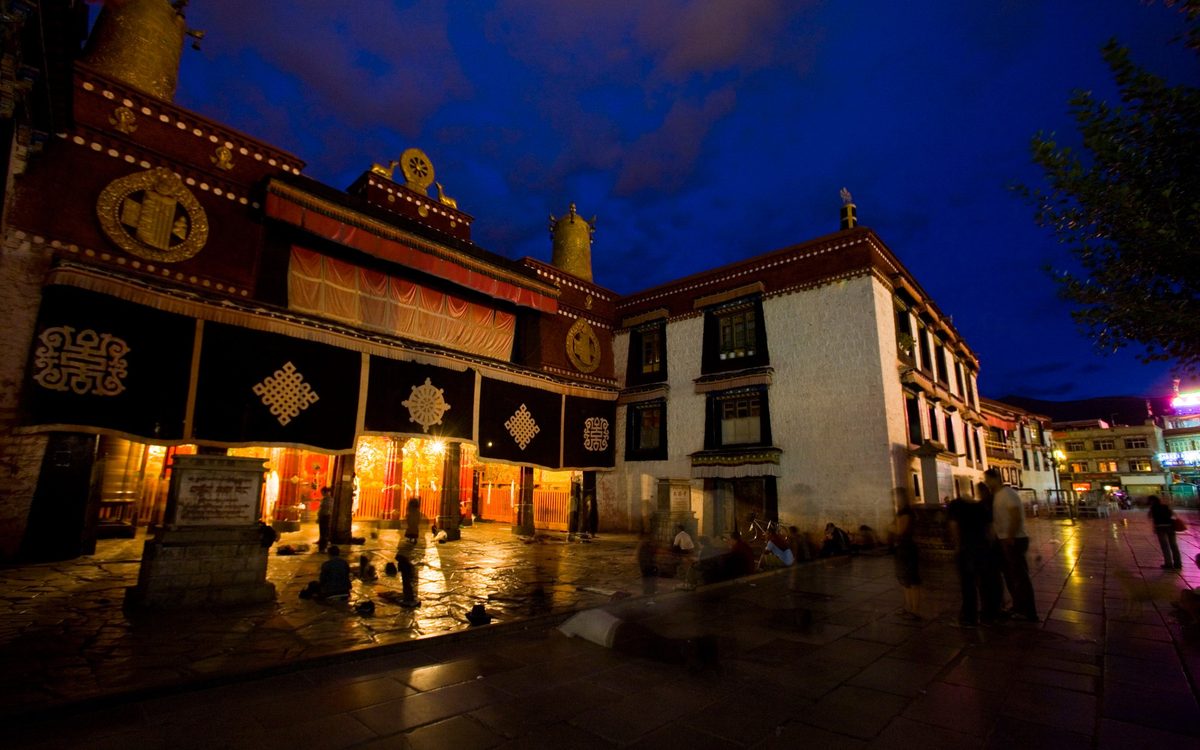
What still happens is the visit. At Sera (色拉寺) outside Lhasa (拉萨) monks debate every afternoon, clapping and stamping; at the Jokhang (大昭寺) pilgrims prostrate themselves in the square from before dawn; at Labrang (拉卜楞寺) in the Gansu (甘肃) grasslands the monastery is a university with a course of fifteen years; at Shaolin the monks drill and perform; at Guoqing the monks are simply at work; at the Great Mosque (清真大寺) in Xi'an (西安) the courtyards close to visitors for Friday prayers; at the cathedral in Guangzhou (广州) there is mass on Sunday morning. Two places on the page no longer do anything of the kind and are museums, the crypt at Famen (法门寺) with the Buddha's finger bone and the Russian cathedral in Harbin (哈尔滨), and the page says so.
Six faiths share the English word temple. Of the survey's twenty-two, six are Chinese Buddhist, nine are Tibetan Buddhist, one is Confucian, two are Taoist, two are mosques and two are churches. The Chinese words differ, the buildings differ, and the manners differ, which is the subject of the next section.
Three rules hold everywhere. Walk clockwise around anything that is walked around; do not photograph inside a hall unless a sign allows it, and never photograph a person at prayer; and cover shoulders and knees in a mosque. Beyond that, each temple prints its own rules at the gate, and this page repeats them where they matter.
This page takes no view on any of the six faiths. It says who does what where, when they do it, and how to be in the room without being in the way.
02Six Faiths, One Word
How can a visitor tell a Buddhist temple from a Taoist or Confucian one, a mosque, or a Tibetan monastery?
English calls all of them temples. Chinese uses at least four words, and the buildings show which is which before a sign is read.
A Buddhist temple, si in Chinese, is a line of halls on a north-south axis. Gate, a hall of guardian kings, the main hall with the Buddha, a hall of scripture behind, side halls for bells and drums, and monks' quarters at the back: the pattern the survey calls the seven halls of a monastery, laid out at Yonghegong (雍和宫) in Beijing as clearly as anywhere. Roofs are grey or yellow tile, the smell is incense, and the figures are many.
A Taoist temple, guan or gong, looks the same and is not. The axis and the courtyards are alike; the difference is in the details. Look for an octagonal pavilion of the eight trigrams (八卦), as at Qingyang (青羊宫) in Chengdu (成都), for figures of the immortals rather than Buddhas, for priests with their hair in a topknot, and on Wudang (武当山) for the imperial yellow that the Ming (明), 14th to 17th century emperor who built it allowed nowhere else outside his palace.
A Confucian temple, miao, has no god in it. The temple at Qufu (曲阜) is a palace: red walls, yellow tile, a hall the size of a throne room with carved dragon pillars, and inside it a tablet with a teacher's name. There are no monks. The rites that were held here were the state's, and the atmosphere is that of a court rather than a church.
A Chinese mosque has no dome, and a Central Asian one does. The Great Mosque (清真大寺) in Xi'an (西安) is four courtyards of timber halls and steles along an east-west axis, so that the prayer hall faces Mecca, with Arabic carved into Chinese woodwork and no minaret a visitor would recognise; the survey calls it a fine example of the Chinese style. Id Kah (艾提尕尔清真寺) in Kashgar (喀什), at the other end of the Silk Road, has the arched gateway, the tiled facade and the pillared hall of Samarkand. Both are working mosques.
A Tibetan monastery, a gompa, is a town on a hillside. White walls, a band of dark red below the roofline, gilded roofs on the main halls, and around them the lanes and houses of the colleges where the monks live and study; Drepung (哲蚌寺) above Lhasa (拉萨) is a very large one, and the survey calls it a white city. Inside, the halls are dark, hung with silk, and smell of butter (酥油) lamps. Yonghegong in Beijing is the same faith in a Chinese building, which is why it confuses people.
And two churches, one Byzantine in red brick with green onion domes in Harbin (哈尔滨), one Gothic in grey granite in Guangzhou (广州), which need no explanation except that they are there.
The words matter because the manners do. In a Buddhist or Taoist hall incense may be lit but need not be; in the Confucian temple nobody expects anything; in a mosque dress is modest and prayer time is kept clear; in a gompa the walk is clockwise, hats come off indoors and cameras stay down; in a church seating is free outside mass. The next sections give the details for each.
| Kind | Chinese word | What is seen | Example on this page | Manners |
|---|---|---|---|---|
| Chinese Buddhist | si | axis of halls, guardian kings, Buddha hall, incense | White Horse · Guoqing · Shaolin | incense optional; no photos in halls |
| Tibetan Buddhist | gompa | white walls, red band, gold roofs, colleges on a hillside | Drepung · Labrang · Tashilhunpo | clockwise, hat off, camera down |
| Taoist | guan / gong | same axis, trigram pavilion, immortals, priests in topknots | Qingyang · Wudang | as Buddhist |
| Confucian | miao | palace: red walls, yellow tile, a tablet with a name | Qufu | none |
| Mosque | qingzhensi | Chinese courtyards with no dome, or Central Asian gateway and pillared hall | Xi'an · Kashgar | modest dress; out at prayer |
| Church | jiaotang | Byzantine brick or Gothic granite | Harbin · Guangzhou | sit anywhere outside mass |
03Where Buddhism Came In
Where did Buddhism enter China, and where can the Buddha's finger bone be seen?
Three temples on the plain and in the hills of the east mark how Buddhism arrived, took a Chinese form, and was adopted by the throne. One is a working monastery, one is a rebuilt shrine with an early pagoda, and one is a museum over a crypt.
The White Horse Temple (白马寺), Luoyang (洛阳), is where it starts. By tradition two Indian monks arrived at the Han (汉), 2nd century BC to 3rd century AD capital in the year 68 with scriptures on a white horse, and the temple founded for them is counted as the opening temple of Buddhism in China and the ancestor of every monastery since. What stands is Ming (明), 14th to 17th century and Qing (清), 17th to early 20th century, rebuilt many times; what is old is the platform, some Song (宋), 10th to 13th century stone and a brick pagoda of the twelfth century outside the wall that the survey calls one of the old ones in the country. Beside the old courtyards, in the last twenty years, Indian, Burmese and Thai governments have built halls in their own styles, so that the place is now a small park of Asian Buddhism. Twelve kilometres from the city, an hour and a half.
Guoqing (国清寺), on Mount Tiantai (天台山), is where Buddhism became Chinese. In 598, at the foot of the mountain in Zhejiang, the monk Zhiyi (智顗) founded a school of Buddhism organised on a Chinese rather than an Indian plan, and two centuries later a Japanese monk studied here and took it home as Tendai (天台宗), whose great monastery above Kyoto still counts Guoqing as its root. The buildings are Qing; a plum tree in the yard is said to be Sui (隋), late 6th to early 7th century and still flowers; a brick pagoda outside is sixth century. There is no souvenir stall, the monks keep the old hours, and the survey calls it one of the few living monasteries in the country that is not also a tourist site. Five kilometres from Tiantai county town, a hundred and fifty from Hangzhou (杭州).
Famen (法门寺), west of Xi'an (西安), is where the throne took Buddhism over. In 1987, when a collapsed pagoda was being cleared, a sealed crypt was found under it containing a finger bone venerated as the Buddha's and, by the survey's count, two and a half thousand objects the Tang (唐), 7th to early 10th century emperors had sent down with it: gold and silver, Persian glass, fine silk of the dynasty and the celadon ware whose secret was lost for a thousand years. The Tang court brought the relic to the capital seven times in procession. The site today is a museum and a modern hall, and the survey rates it one of the great finds of the century. A hundred and twenty kilometres from Xi'an, two to three hours.
Read the three in order and the story emerges: a foreign teaching arrives at the capital, a Chinese monk in the hills gives it a Chinese shape, and an emperor buries its relic in gold. Everything else on this page comes after.
04Shaolin and Wudang
What is the difference between Shaolin and Wudang, and what is real there?
Two mountains, one Buddhist and one Taoist, gave the world its two Chinese martial arts. Both are on every visitor's list, both are crowded, and both reward knowing what is old and what is show.
Shaolin (少林寺), on Mount Song (嵩山) outside Dengfeng (登封), is the root house of Chan (禅宗). The monastery was founded in 495 for an Indian teacher; the story goes that another, Bodhidharma (达摩), sat facing a wall in a cave above it for nine years, and that from his sitting came the school of Buddhism the world knows by its Japanese name, Zen (禅). The other story, that the monks' exercise became kung fu (功夫) and that thirteen of them saved a Tang (唐), 7th to early 10th century emperor, is on every wall and in every film since the one of 1982 that made the place a name in every country. What is old is the forest of brick pagodas where the monks are buried, a very large such cemetery in China by the survey's account, and the layout; the halls were burned in 1928 and rebuilt. What is show is the drill: monks and students perform in a hall on a timetable, and the evening spectacle in the valley is on the page on shows. The site was inscribed in 2010 with the other monuments of the Song mountains. Two to three hours for the temple and the pagoda forest; eighty kilometres from Zhengzhou.
Wudang (武当山), in the mountains of north-west Hubei (湖北), is the Taoist palace. The Ming (明), 14th to 17th century emperor Yongle (永乐), having built the Forbidden City (故宫), sent the same standard of work south in 1412 and spent twelve years covering the seventy-two peaks of Wudang with temples to the god of the north, in imperial yellow, with a hall of gilded bronze on the summit that the survey calls very large. It was inscribed in 1994. The martial art here is tai chi (太极拳), which tradition attributes to a Taoist of the mountain, Zhang Sanfeng (张三丰), and which is practised at dawn on the terraces by priests and by students from abroad. The visit is a climb or a cable car (索道) to the Golden Hall (金顶) and a day or two among the temples on the way; the survey allows one to two days, and the mountain has its own railway station an hour from Shiyan.
The survey's own comparison is worth carrying up both mountains: Shaolin uses the body to enter meditation, Wudang uses it to enter long life; one teaches a sudden breakthrough, the other a slow cultivation; one is loud, one is quiet. Foreigners who want to train rather than watch can do either, and that is arranged on the page for things learned by hand, not here.
05The Buddhist Mountain
How is Mount Wutai visited, and why does it matter?
China has four Buddhist mountains, each the seat of one bodhisattva, and Wutai (五台山) in Shanxi (山西) is the widely known one of them and the one inscribed as world heritage. It is also a place where Chinese and Tibetan Buddhism share a valley, and where two very old wooden buildings happen to stand.
What it is. A ring of five flat peaks, the peaks rising above three thousand metres, around a valley at the centre that holds forty-seven temples by the survey's count and a small town of monks, pilgrims, hotels and vegetarian restaurants. Monasteries have stood here since the Han (汉), 2nd century BC to 3rd century AD, by the survey's account; the great ones in the valley, Xiantong (显通寺) with its bronze hall and Tayuan (塔院寺) with the white stupa that is the mountain's emblem, are Ming (明), 14th to 17th century and Qing (清), 17th to early 20th century. The mountain is dedicated to the bodhisattva of wisdom, and the survey notes that it is cold: snow in summer is not unusual, and the old name is the Mountain of Clear Coolness.
Two Buddhisms in one valley. Wutai is a mountain in China where the temples of the Chinese tradition, called green temples (青庙) for their monks' robes, stand beside the temples of the Tibetan tradition, called yellow temples (黄庙), and where monks of both walk the same streets. The Qing emperors, who governed Mongolia and Tibet (西藏) through the yellow school, built here deliberately; the result for a visitor is that one morning covers two worlds.
Two very old wooden buildings. Outside the valley, on the mountain's southern flanks, stand the halls of Nanchan (南禅寺), of 782, and Foguang (佛光寺), of 857, two Tang (唐), 7th to early 10th century timber buildings surviving in China; the second was found by the architect Liang Sicheng (梁思成) in 1937, who had been told that no such thing survived. They belong to the page on old architecture and are a separate day by car; the survey sends anyone who cares about buildings to them before the valley.
How long and how. Two to three days by the survey's reckoning, two hundred kilometres from Taiyuan (太原) by road, with an entry arrangement that covers the valley and small fees in a few temples. The show in the valley at night is on the page on shows.
The other three mountains are not yet on this page. Emei (峨眉山) in Sichuan (四川) and Jiuhua (九华山) in Anhui are on the parks page as places to climb; Putuo (普陀山), the island off Zhejiang, waits for the next batch of the survey.
06Lhasa: Jokhang, Drepung, Sera
Which monasteries are worth seeing in Lhasa, and when do the monks debate at Sera?
Lhasa (拉萨) has three temples that matter to a visitor, and they do three different things: one is prayed at, one is studied in, and one argues every afternoon. Foreign visitors travel in Tibet (西藏) on an organised permit with a guide, under rules that change, and the three are a day with one.
The Jokhang (大昭寺) is the one people come across a country for. Founded in the seventh century by an early Tibetan king, it holds a seated figure of the Buddha as a boy that a Chinese princess is said to have brought from Chang'an in 641 as part of her marriage, and the survey calls it a deeply venerated image in Tibetan Buddhism, more important to believers than the Potala (布达拉宫). That is why the square in front is full from before dawn of pilgrims prostrating full length, some of whom have measured the road from Sichuan (四川) or Qinghai (青海) this way, and why the circuit of lanes around the temple, the Barkhor (八廓街), is walked clockwise all day by people turning prayer wheels. The Barkhor as a neighbourhood is on the old-town page. Inside the temple the halls are low, dark and crowded, lit with butter (酥油) lamps; go early with the pilgrims, follow the flow, keep the camera down. An hour and a half to two.
Drepung (哲蚌寺) is the one to study in. Ten kilometres west of the city on a hillside, founded in 1416, it was by the survey's account a very large monastery, with thousands of monks at its height, and is the mother house of the school that governed Tibet from the seventeenth century. Today it is a white city of lanes and colleges climbing the slope, with a kitchen whose cauldrons can be seen, and once a year at the Shoton (雪顿节) festival a silk image of the Buddha the size of a tennis court is unrolled down the hillside at dawn. Two hours, quieter than the Jokhang.
Sera (色拉寺) is the one that argues. Five kilometres north of the city, founded in 1419, it is known for one thing that happens on weekday afternoons in a walled garden: the monks debate. One sits and defends, another stands over him and attacks, clapping his hands together and stamping as he makes his point, in Tibetan, on questions of logic and doctrine; it has been the examination method of the school for six centuries and it is loud, quick and funny to watch even without a word of the language. Arrive early in the afternoon, stand behind the rope, and do not use flash. An hour and a half.
The order that works is the Jokhang at seven with the pilgrims, Drepung in the late morning, and Sera at three, which is the order the survey's own perfect day follows.
07Beyond Lhasa
What are Samye, Gyantse and Shigatse, and how are they visited?
Three monasteries outside the capital take a visitor from the beginning of Tibetan Buddhism to its other seat of power, and each is a building not found elsewhere: a monastery laid out as a map of the universe, a nine-storey tower of chapels, and a hall built around a gilded figure eight storeys high.
Samye (桑耶寺), the opening one. Sixty kilometres south-east of Lhasa (拉萨) on the north bank of the Yarlung Tsangpo (雅鲁藏布江), an early monastery in Tibet (西藏) to hold monks as well as images was founded in 779, and its king declared Buddhism the state faith the same year. The plan is a diagram of the Buddhist cosmos: a central hall of three storeys, each in a different style, Tibetan, Chinese and Indian, standing for the world mountain, ringed by smaller temples for the continents and by two for the sun and moon, inside a round wall. The buildings are mostly rebuilt since the seventeenth century; the plan is eighth century. Two hours.
Gyantse (江孜), the tower. In the town of Gyantse, ninety kilometres from Shigatse (日喀则) at four thousand metres, Palkhor (白居寺) monastery of 1390 shelters three schools of Tibetan Buddhism under one roof, which the survey calls rare, and beside them a stupa of 1427 that Tibet calls the king of stupas: nine storeys and thirty-two metres, a hundred and eight doors, seventy-seven chapels, and images that the survey counts in the tens of thousands, so that climbing it is walking through an encyclopedia of the faith. The murals mix Nepalese, Indian and Chinese hands. The fort above the town was fought over in 1904. An hour and a half to two.
Shigatse, the seat. Tashilhunpo (扎什伦布寺), founded in 1447 by a disciple of the school's founder, has been the seat of the Panchen Lamas (班禅) since the seventeenth century, the second lineage of Tibetan Buddhism, and is one of the school's six great houses. The building everyone comes for is the hall of Maitreya (弥勒), the Buddha to come, put up in 1914 around a seated figure of gilded bronze twenty-six metres high, a very large one of its kind by the survey's account. Beside the monastery stands a wall thirty-two metres high, blank for much of the year, on which a silk image is hung at the summer festival. It is three hours from Lhasa by train; the old town around it is on the old-town page.
The route runs Lhasa to Samye by road, then west through Gyantse to Shigatse and back by train, four days with the permit and the guide, and the survey's Tibetan itinerary is built on it.
08The Gelug Houses Beyond Tibet
Where can Tibetan Buddhism be seen without going to Tibet?
The school that dominates Tibetan Buddhism has three great houses outside Tibet (西藏), in Qinghai (青海), in the Gansu (甘肃) grasslands and in the middle of Beijing, and for many foreign visitors they are an easy way into the faith: ordinary access, a metro station for one, and a very long row of prayer wheels at another.
Kumbum (塔尔寺), where the founder was born. Twenty-five kilometres from Xining (西宁), the monastery of 1379 stands on the spot where Tsongkhapa (宗喀巴), founder of the Yellow Hat (格鲁派) school, was born; the story goes that a sandalwood tree grew where his blood fell, and the temple was built around it. It is known for three things the monks make: murals, appliqué silk hangings, and sculptures in coloured butter (酥油), modelled in the cold months in unheated rooms so the butter holds, and shown on the fifteenth day of the opening lunar month, a major day in the Qinghai year. The survey rates it a commercial one of the three, rich in art, and easy to reach. Two hours.
Labrang (拉卜楞寺), the university on the grassland. At Xiahe (夏河) in southern Gansu, two hundred and thirty kilometres from Lanzhou (兰州) at three thousand metres, the monastery of 1709 is the centre of the Amdo (安多) region and, by the survey's account, a very complete monastic university in Tibetan Buddhism: six colleges teaching philosophy, tantra, astronomy, medicine and ritual on a course that takes a monk fifteen to twenty years, with public debates. Around the whole monastery runs a corridor of prayer wheels three and a half kilometres long, more than two thousand of them by the survey's count, a very long one, which pilgrims walk clockwise from dawn; a visitor may walk it too. The grassland outside is on the parks page and the winter dances are on the page on shows. Two to three hours.
Yonghegong (雍和宫), the prince's house. In the north-east of old Beijing, two hundred metres from a metro exit, the mansion built in 1694 for a prince who became the Yongzheng (雍正) emperor was turned in 1744 by his son into a Tibetan Buddhist monastery, an imperial residence turned over, to train monks from Mongolia and Tibet and to tie the two to the throne. It is laid out as a Chinese temple, on a north-south axis of seven halls, and filled with Tibetan images, the last of them a standing Maitreya (弥勒) twenty-six metres high carved from a single trunk of sandalwood by the survey's account. A stele of 1793 in the courtyard, in Manchu (满族), Chinese, Mongolian and Tibetan, sets out the rules the Qing court made for recognising reincarnated lamas. It is a working monastery and a busy temple in Beijing; go on a weekday morning and avoid the opening day of the lunar month, when it is limited. An hour and a half.
Between them they answer a question many visitors ask on the Barkhor (八廓街): how do I see this without going to Lhasa (拉萨)? Kumbum from Xining, Labrang from Lanzhou, and Yonghegong on the way to dinner.
09The Teacher's Temple and the Taoist Yard
What is the Temple of Confucius at Qufu, and what is a Taoist temple like?
Two temples on this page have nothing to do with Buddhism and everything to do with how China thinks. One is the temple of a teacher, built like a palace; the other is a Taoist courtyard in the middle of Chengdu (成都) where the priests run a teahouse.
The temple of Confucius (孔庙) at Qufu (曲阜). The shrine was founded in 478 BC, a year after the teacher's passing, in his home town in Shandong (山东), and the state enlarged it for two thousand years until it was the size of a palace: nine courtyards along an axis, red walls and yellow tile that otherwise belonged to the emperor, and a main hall whose ten stone pillars are carved with dragons in the round that the survey rates highly beside any in the Forbidden City (故宫). There is no god in it and there were never monks; the rites held here were the state's, and the tablet inside carries a man's name. Next door is the mansion where his descendants lived as dukes until 1948, and beyond it the family cemetery, on the tombs page, where the seventy-eighth generation is buried. The three were inscribed together in 1994. Three to four hours for all three; the high-speed station is out of town.
Qingyang (青羊宫) in Chengdu. An old Taoist temple in the city stands on the inner ring road, founded in the Tang (唐), 7th to early 10th century and rebuilt in the Qing, on a site where, the story goes, Laozi (老子) taught his book to a customs officer. Chengdu is the country of Taoism's founding: the movement's organised church began in 142 in the hills west of the city, by the survey's account. The temple has an octagonal pavilion of the eight trigrams (八卦), priests in topknots, a bronze goat that visitors rub for luck, and a tea garden under the trees where the neighbourhood sits all afternoon, so that the visit is as much a Chengdu afternoon as a temple. The survey pairs it with Mount Qingcheng (青城山), the Taoist mountain an hour west that is on the parks page. An hour, with a metro stop nearby.
What the two show together is the range of the word temple in China. Confucianism is a teaching about how to run a family and a state, and its temple is a court; Taoism is a teaching about how to live long and lightly, and its temple is a garden with a teahouse. Neither asks anything of a visitor beyond curiosity.
10Two Mosques, Two Traditions
Can the mosques in Xi'an and Kashgar be visited, and how should a visitor behave?
China has two traditions of mosque, and the survey's two examples stand at the two ends of the Silk Road: a Chinese courtyard mosque in Xi'an (西安) with no dome, and a Central Asian one in Kashgar (喀什) with a tiled gateway. Both are in use, and both admit visitors outside prayer.
The Great Mosque of Huajue Lane (化觉巷清真大寺), Xi'an. In the lanes of the Muslim quarter (回坊) behind the Drum Tower, five hundred metres from a metro exit, a mosque said to date from 742 was rebuilt in 1392 by a Ming (明), 14th to 17th century minister and has grown since into four courtyards along an east-west axis, so that the prayer hall at the far end faces Mecca. There is no dome and no minaret a visitor would recognise; the gateways are Chinese timber, the tower is a Chinese pavilion, and the difference is in the writing: Arabic carved into the woodwork of the hall, panels of the Quran in Ming carving, and among the Chinese steles one attributed to the Song (宋), 10th to 13th century calligrapher Mi Fu (米芾). The survey calls it a fine example of the Chinese-style mosque, and records that the admiral Zheng He (郑和) came here in 1405 to recruit an interpreter for his voyages. It is a working mosque; the courtyards are closed to visitors during Friday prayers and the prayer hall is for worshippers at all times. Cover shoulders and knees. An hour. The quarter around it is on the old-town page.
Id Kah (艾提尕尔清真寺), Kashgar. On the main square of the old city, a mosque founded in 1442 and enlarged to its present size in 1872 is by the survey's account a very large one in China: a pale yellow tiled gateway with an arched portal in the manner of Samarkand, and behind it a prayer hall on a hundred and forty carved wooden pillars, painted green, that holds seven thousand. On the morning of the festival of the sacrifice the square fills with worshippers, twenty thousand by the survey's count, and afterwards with dancing. For the rest of the year the square is the city's front room, ringed by the bazaar, the teahouses and the workshops of the old town, which are on the old-town page. Visitors enter outside prayer times, dressed modestly, and do not enter the hall while it is in use.
The two are one faith in two architectures. The Xi'an mosque is the product of six centuries of Chinese Muslims explaining their faith in Chinese terms, and it looks like a temple; the Kashgar mosque was built by people looking west, and it looks like Central Asia. The survey notes that with the mosques of Beijing's Niujie (牛街) and of Quanzhou (泉州) they make the four great old mosques of the country.
11Two Churches
Why are there a Russian cathedral in Harbin and a French one in Guangzhou?
Two churches close the page, one Russian and one French, and both are on it for the same reason: they are well-preserved buildings from the century when foreigners lived in China's port cities on their own terms.
Saint Sophia (圣索菲亚教堂), Harbin (哈尔滨). The city did not exist until the Russian railway across Manchuria was built through it in 1903, and for the next forty years it was a Russian town on Chinese soil, with Poles, Jews and Japanese as well. The cathedral, put up in wood in 1907 for the Russian railway community and rebuilt in brick to its present form in 1932, is a very large Orthodox church in China by the survey's account and a complete Byzantine building: red brick, a green onion dome on a drum, and four smaller domes on the corners. It has not been a church since the nineteen-fifties; it was restored in 1997 and is now an exhibition hall of the city's architecture, and its square is a much photographed place in Harbin, above all in winter under snow. An hour, in the city centre.
The Sacred Heart (石室圣心大教堂), Guangzhou (广州). On the site of the former governor's residence, French missionaries built between 1863 and 1888 a very large Gothic church in China by the survey's measure, twin spires and all, and built it entirely of granite, cut and set by Chinese masons under a foreman named Cai Xiao, which is why the city calls it the Stone House (石室). It stands among the arcaded shophouses and wholesale streets of the old commercial quarter, a French cathedral inside a Cantonese (广东) market, and it is a working church: free to enter outside mass, with restrictions during services. An hour; the metro is close.
What to make of them. Both were built by foreign powers in years when China could not refuse them, and both are now cared for as Chinese heritage; the survey notes the railway that made Harbin was a Russian imperial project and also brought the city into being. The page records that and takes no side. For a visitor they are simply two fine buildings in two cities that have nothing else like them, and the quarters around them, the Central Street (中央大街) in Harbin and Shamian (沙面) island in Guangzhou, are on the old-town page.
12PreeChina, and What It Is Not
What does PreeChina arrange at China's temples, and what are the rules?
- The hard parts of a temple visit are the permit, the timetable and the manners. Those are what we do.
- Tibet (西藏). Foreign visitors travel with arrangements made through a licensed operator. A Lhasa (拉萨) day takes the Jokhang (大昭寺) at seven, Drepung (哲蚌寺) late morning and Sera (色拉寺)'s debate in the afternoon, and the four-day loop runs through Samye (桑耶寺), Gyantse (江孜) and Shigatse (日喀则) with the train back. Rules change; we check them the month of travel.
- The easier Tibetan Buddhism. Kumbum (塔尔寺) as a morning from Xining (西宁), timed for the butter (酥油) sculptures if the visit falls on the full moon that opens the year; Labrang (拉卜楞寺) as a two-day trip from Lanzhou (兰州) with a walk of the prayer-wheel corridor at dawn; Yonghegong (雍和宫) on a Beijing weekday morning.
- The mountains. Shaolin (少林寺) with its drill timetable and the evening show, and a course for anyone who wants to train, on the page for things learned by hand; Wudang (武当山) as two days with a night on the mountain and a dawn tai chi (太极拳) session; Wutai (五台山) as two days with the Tang halls of Nanchan (南禅寺) and Foguang (佛光寺) by car on the way in.
- The rest. Qufu (曲阜) with the temple, the mansion and the cemetery together; Guoqing (国清寺) and the Tiantai (天台山) valley as a quiet day from Hangzhou; Famen (法门寺) on the way to the Tang tombs; the Xi'an (西安) mosque folded into a Muslim-quarter evening on any day except Friday.
- The manners, as a list. Clockwise around stupas, prayer wheels and halls. Hats off indoors. No photographs inside halls unless permitted, none of people praying, no flash at the Sera debate. Shoulders and knees covered in mosques, and stay outside at prayer. Do not touch images or step on thresholds. Ask before joining anything. If in doubt, stand still and watch what the person in front does.
- What this page is not. It is not the grottoes page, where the Buddhas are carved into cliffs. It is not the page on old architecture, which has the Tang halls of Wutai, the Liao and Song temples of Shanxi (山西) and the wooden pagoda; there the building is the subject. It is not the tombs page, which has the cemetery of Confucius (孔林). It is not the old-town page, which has the Barkhor (八廓街), the Xi'an Muslim quarter (回坊), the Kashgar (喀什) old city and the streets around Yonghegong as places to live and eat. It is not the page on shows, where the Shaolin spectacle, the Wutai night play and the monastery festivals of Labrang and Kumbum appear as performances. And it is not a page about faith: we take no view on any of the six on it, we do not recommend prayer or rites to anyone, and we do not sell blessings.