
01Two Calendars, and a Third Clock
What calendars does China use, and when is Chinese New Year?
China keeps two calendars at once. The Gregorian one runs the state: the working week, the school year, the train timetable, the national holiday in early October. The other, the nongli (农历), runs the family and the crowd: the new year, the moon festival, the day the graves are swept, the market that opens on a lunar date, the temple fair (庙会). A visitor lives in the one and keeps colliding with the other, and the collisions are the thing to plan for. Dynasties are for reading the monuments; the nongli is for reading the people, and it is people who are met.
What the second calendar is. A lunisolar one: months of twenty-nine or thirty days that begin on the new moon, with a thirteenth month slipped in seven times every nineteen years to keep the seasons in place. Its new year falls on the second new moon after the winter solstice, which puts it anywhere between 21 January and 20 February; each year takes its name from one of twelve animals. Almost nobody in China uses the nongli for appointments. Almost everybody uses it for the day they go home.
The opening correction: the heaviest crowd of the year is not lunar. The holiday around the start of October is fixed to the Gregorian calendar, lasts seven or eight days, and moves a vast number of people around the country. The other national week, around the start of May, is Gregorian too. Of the three great crowds, the new year alone travels on the moon.
The second: the traditional calendar has a solar half. The twenty-four jieqi (节气), the solar terms, divide the sun's year into fortnights and fall on nearly fixed dates: Qingming (清明) on 4 or 5 April, the summer solstice on 21 June, the winter solstice on 21 or 22 December. They are older than the dynasties and they still run the countryside: tea picked before Qingming commands a premium, dumplings are eaten at the winter solstice, and a park's summer timetable often starts on a solar term. So "traditional" does not mean "lunar", and a visitor who wants to know when the tea is picked needs the solar half.
The third clock has no calendar at all. It is the day and the week: breakfast stalls that close at nine, markets that open on dates ending in two, five and eight, square dancing (广场舞) that begins at dusk. Neither calendar records any of it, and it decides more of what is found open than either.
02The Year in Twelve Months
Which months suit a visit to China, and which weeks call for caution?
Three crowds and four kinds of weather shape the year. Plan around the crowds, then the weather, then the place.
The three crowds. The forty days around the lunar new year (春节), late January or February, called chunyun (春运), when the country goes home and comes back; the five days from the start of May; and the week from the start of October. Many working people can take long leave in those windows alone, so those are the weeks every train, hotel and scenic road is full. Between them the country is at work and the sights are, by Chinese standards, quiet.
The four kinds of weather. North of the Qinling (秦岭) mountains and the Huai river the winter is dry and cold and the buildings are heated, in Beijing from 15 November to 15 March; the pleasant weeks are September and October, spring is short and can be dusty, summer is hot but brief. Along the Yangtze the plum rains (梅雨) fall from the middle of June into July, the summer that follows is the wettest heat in the country, and the winter is raw because the heating line runs north of it: indoors in Shanghai in January is colder than indoors in Harbin (哈尔滨). On the south coast the typhoon season runs from July to September and the winter is mild; Hainan (海南) is a winter destination. In the west the window is short and clear: Tibet (西藏) and the plateau from May to October, Xinjiang (新疆) from June to September, and Yunnan (云南) the other way round, dry and bright from November to April.
And a few months own a place. January is Harbin's, when the Ice and Snow World (冰雪大世界) is built and the Songhua (松花江) river freezes solid. The week before the new year is Guangzhou (广州)'s, when the flower fair (花市) fills eleven districts for four days and then vanishes. March is yellow with rapeseed at Luoping (罗平) in Yunnan and at Wuyuan (婺源) in Jiangxi (江西). Mid-April belongs to Xishuangbanna (西双版纳), where the Dai (傣族) new year is a three-day water fight. October after the holiday is a clear and pleasant fortnight almost everywhere, and the one month when the lakes of Jiuzhaigou (九寨沟) and the birches of Kanas (喀纳斯) are the colour the photographs promise. November is the ginkgo month, in Nanjing (南京) and at the village of the same name near Tengchong (腾冲). The table sets out the twelve.
| Month | Weather that decides | In season | What is on | Avoid, or note |
|---|---|---|---|---|
| January | deep cold in the north; mild south coast | Harbin ice; Hainan; Yunnan dry season | Ice and Snow World; Laba; the run-up to the new year | the new year if it falls late in the month |
| February | cold and dry north; damp south | Yuanyang terraces under water; Guangzhou flower fair | Spring Festival, Lantern Festival, temple fairs | the two weeks around the new year: trains and hotels |
| March | north thawing; south warm and wet | rapeseed at Luoping and Wuyuan; Wuhan cherry blossom | Losar in Tibetan areas some years | dust in the north |
| April | the whole east turns green | Luoyang peony; tea picking before Qingming; Xishuangbanna | Qingming; the Dai new year, 13 to 15 April | Qingming weekend travel |
| May | warm; rains begin in the south | Tibet and the plateau open; Cangshan rhododendron | Labour Day break | 1 to 5 May |
| June | plum rains on the Yangtze; heat building | Xinjiang lavender in Ili; Qinghai Lake | Dragon Boat Festival; the entrance examination on 7 and 8 June | Yangtze cities in the rain |
| July | hot everywhere; typhoons begin | Inner Mongolia, Xinjiang, Tibet, the north-east | Naadam on the grasslands; school holidays start | the south-east coast in a typhoon week |
| August | hottest; family travel peak | the plateau; Qinghai; the far north-east | Torch Festival in Yi country; Qixi | the furnace cities on the Yangtze |
| September | the north clears | Beijing, Xi'an, the north-west | Mid-Autumn; schools back on 1 September | the last days before 1 October |
| October | the pleasant fortnight after the holiday | Jiuzhaigou, Kanas, Fragrant Hills, almost everywhere | National Day, 1 to 7 October | 1 to 7 October, everywhere |
| November | north cooling; heating on from the 15th in Beijing | ginkgo in Nanjing and Tengchong; Yunnan dry season begins | Miao New Year in Guizhou | nothing: the low season starts |
| December | cold north; Yunnan and Hainan bright | Harbin ice begins; Yuanyang water | Winter Solstice dumplings; Christmas is not a holiday | off-peak hours and prices in the parks |
03By the Numbers
How many public holidays does China have, and what are the 2026 dates?
The table below carries each figure with its source and year. The prose says what they change.
Thirteen days, three of them long. The statutory holiday count is thirteen days a year, spread over seven holidays; the state stretches three of them into long breaks by moving weekends, which is the practice called tiaoxiu (调休) and the reason a Saturday can be a working day. For a visitor the count that matters is not thirteen but three: the three weeks to avoid, or to accept with open eyes.
A calendar that moves and one that does not. The new year has fallen as early as 21 January and as late as 20 February; the October holiday has not moved since 1999. The twenty-four solar terms were inscribed by UNESCO in 2016 and have not moved in two thousand years.
The rhythms behind the numbers. The five-day working week dates from 1995, which is why the weekend crowd at a park is a recent thing. The school summer holiday runs from early July to the end of August and the university entrance examination falls in early June, when many families are not travelling and hotels near schools are full.
04What It Changes for a Trip
How do China's holidays, working days and daily hours change a trip?
Pick the dates before the cities. Two weeks a year are worth avoiding outright, two more are worth thinking about, and the rest of the calendar is a matter of weather.
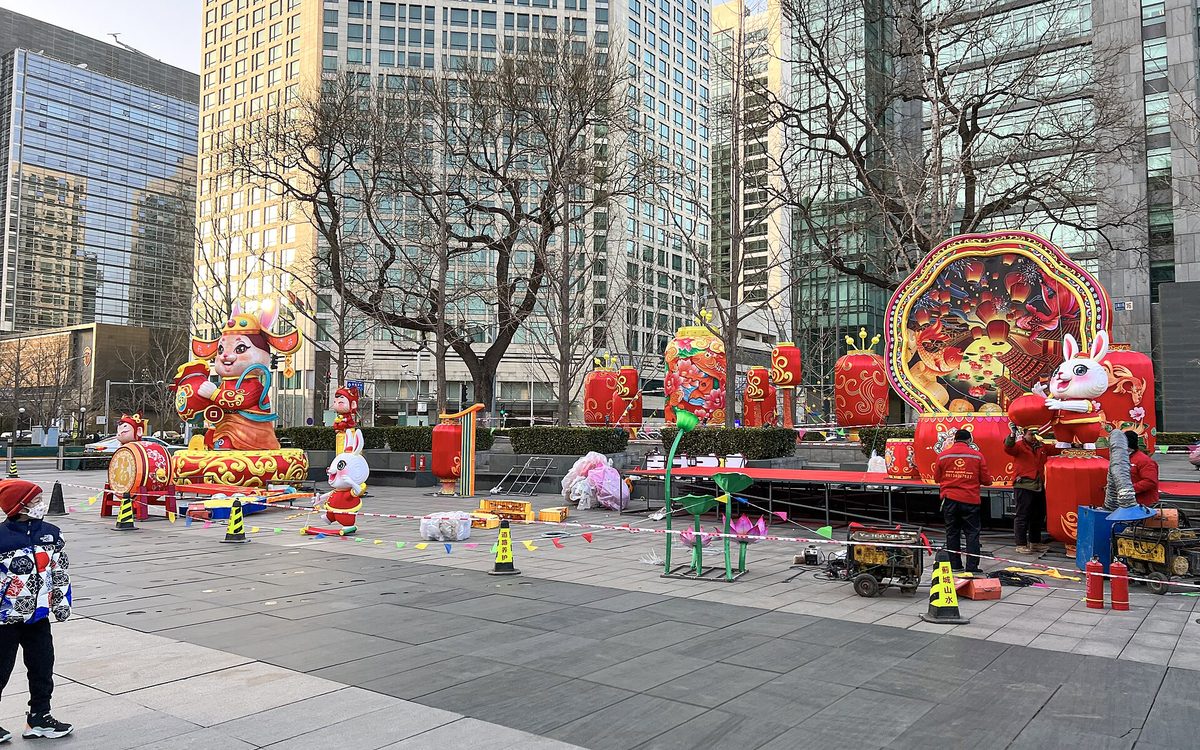
The weeks to avoid. The week either side of the lunar new year (春节), late January or February and the opening week of October. Trains sell out the minute sales open, hotel prices rise steeply, and the well-known sights run at their yearly peak. The new year week is a trade rather than a loss: shops and small restaurants shut, cities empty, and in exchange the temple fairs (庙会), lantern nights and the Guangzhou (广州) flower street happen at that time alone. The October week has no such consolation. The May break is shorter and busier than it looks.
The weeks to aim for. The fortnight after the October holiday ends, from about the eighth to the twenty-fifth, is a clear travel window in the country: the crowd has gone home, the weather is at its clearest from Beijing to Yunnan (云南), and the autumn colour is on. The second half of September is nearly as good. In the south, late March and April; in the west, June and early September.
The trap. A make-up working day is a Saturday or Sunday on which offices and schools open to pay for a long holiday. The 2026 list has six. On those days the museums are open and the parks are quiet, but a "weekend" visit to a market, a wet-market breakfast or a village will find the residents at work. The table under this block has the year's dates; this site's month pages carry them too.
The week. Museums close on Monday, and so do a number of memorial halls and some gardens. Parks fill on Saturday and Sunday and are nearly empty on a working morning. Country markets open on dates, not days, and the number is the thing to ask for.
The day. Breakfast is served from about six and the good stalls have sold out by nine. Lunch is at half past eleven and kitchens rest after one; dinner starts at half past five in the north and six in the south, and in many cities the last orders come earlier than a European expects, except in the night-market towns of the south-west, where the night is a second day. Hotels usually offer check-in at two in the afternoon and check-out by noon. Parks open at six for the morning shift of exercisers and dancers.
Dates that move. Every lunar festival lands on a different Gregorian date each year, so this site prints the festival's name and its usual month and leaves the date to the year's table. Check the year of travel, not the year the article was written.
The solar terms as hooks. Tea picked before Qingming (清明) is the year's dearest; dumplings appear everywhere at the winter solstice; many parks switch to their summer timetable and their higher price in April and back in October, and the page on parks explains what the switch buys.
Weather and luggage. North of the heating line, winter indoors is warm and dry and the cold is outside; south of it, in Shanghai, Chengdu (成都) and Guangzhou, the cold is inside and a coat is worn at dinner. The plum rains (梅雨) of June need a folding umbrella more than a raincoat. Typhoons cancel flights and trains along the south-east coast between July and September, usually with a day's notice.
Other calendars run too. The Tibetan new year, Losar (藏历新年), February or March, falls in February or March and sometimes not on the same day as the Chinese one; the Dai (傣族) new year is the water-splashing festival (泼水节), 13 to 15 April in mid-April; the Hui (回族) and the other Muslim peoples keep the Islamic calendar's two festivals, and Ningxia (宁夏) and Xinjiang (新疆) give days off for them. The peoples page has the map.
05Where It Is Met
Where on PreeChina are the seasons, market days and festivals?
This page is the year. Each month opens a door on another page.
The parks page has the two blocks that this page leans on: the one on how the season changes the visit, and the one on what the month decides, where Changbai's crater lake is visible about one day in three and Harbin (哈尔滨)'s ice park is not a park with a season but a season with a park.
The markets page explains the market that runs on a number, the two clocks inside one market twelve hours apart, and the markets that exist for part of a year, from the four-day flower street of Guangzhou (广州) to the winter fishing on the frozen lakes of the north-east.
The museums page has the Monday rule and its exceptions, with the count.
The breakfast page is about the meal that visitors sleep through and the hours that make it so; the leisure page has square dancing (广场舞), the one event on this calendar that happens every day at dusk and can be joined from the back of the line.
The tea page is organised around the picking calendar, and its solar terms, Qingming (清明) and Guyu (谷雨), are the two useful dates on this page for anyone who drinks tea.
The transport page has chunyun (春运) and the rhythm of rail travel; the peoples page has the festivals of the edges, the water-splashing, the Naadam (那达慕), July or August and the torch festival (火把节), late July or August, and the other calendars that run beside the two on this page.
A festivals page is being built for the events that belong to no other page: the temple fairs (庙会), the lantern nights, the dragon boats (龙舟), the ice festivals and the flower fairs (花市).
The how-it-works page explains how advance planning works for trains and museums, which is why the dates on this page matter.
06What It's Not
What do visitors often get wrong about the Chinese calendar?
- Not in January. The lunar new year (春节), late January or February falls between 21 January and 20 February, and more often in February than not. The start of January brings a one-day holiday and nothing more.
- Not one holiday. There are three long breaks, and the October one is the heaviest for travel. Avoiding the new year and arriving on 1 October is the commonest mistake on this page.
- Not all lunar. The twenty-four solar terms are solar and fall on nearly fixed dates; the October and May holidays are Gregorian. The family festivals alone move with the moon.
- Not a real weekend. Several weekend days each year are working days, moved to pay for the long holidays. A Sunday in the list is a Monday in the office.
- Not shut on Sunday. Museums keep a weekly rest day; shops, restaurants and parks run seven days and are busiest on the weekend.
- Not spring and autumn everywhere. Harbin (哈尔滨) is a January destination, Yunnan (云南) is at its clearest from November to April, Xinjiang (新疆) and Tibet (西藏) from June to September, Hainan (海南) in winter. The national rule of thumb is a northern one.
- Not a date on this site. This site prints a festival's name and its usual month; the exact date belongs to the year's table, because it changes every year and articles do not.
- Not one calendar for everyone. Tibetan, Dai (傣族) and Islamic calendars run alongside the two on this page, with their own new years and their own days off in the regions where those peoples live.