
01An Industry Side Door
What counts as a craft lesson in China, and what surprises new visitors?
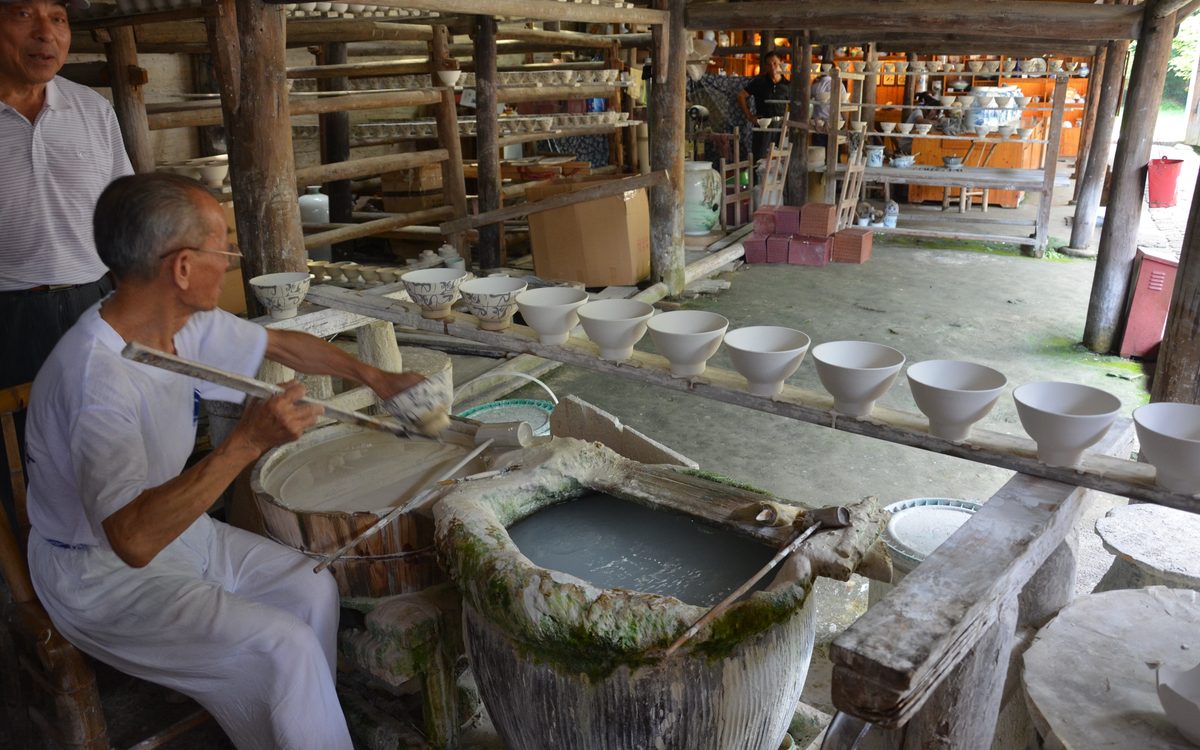
In China a craft lesson is not an experience designed for tourists; it is a side door into an industry that is still working. The kilns of Jingdezhen (景德镇) are still firing commercial porcelain today, and the looms in a Li village are still weaving cloth the family will wear. What the fee buys is a working person stopping work for two hours to teach. Three things follow: the class runs on the master's calendar, not on the visitor's itinerary; the finished object makes the learner wait; and the good classes are usually not the ones with the word experience on the sign.
This page covers lessons where the learner's hands are moving, a teacher is present, and a fee is charged. Buying a finished object belongs to the shopping page. Watching someone else make something belongs to the towns page. Free observation or casual play belongs to the leisure page. Watching Shaolin (少林寺) monks drill from the gate belongs to the temples page. If all three conditions are met, a teacher, a fee and the learner's own hands moving, it is here.
Three things that surprise new visitors.
One: not everything can be taken home the same day. Ceramics require drying, bisque firing (素烧), glazing (施釉), and glaze firing (釉烧). In Jingdezhen, the normal cycle from making to finished piece is one to two weeks; in peak season (旺季) it can stretch longer. Many studios offer domestic shipping within China. International shipping is less commonly arranged directly by studios: ask before arranging a class, or plan to use a courier service. Without asking this question before paying, the result may be a photograph instead of a pot.
Two: not every class requires Chinese, but it helps to know which kind is on offer. Some studios in tourist-heavy areas (Jingdezhen, Dali (大理), Yangshuo (阳朔)) employ English-speaking teachers. Many studios elsewhere operate on a "demonstrate and follow" model: the master shows the motion, the learner copies it, and language is barely needed. A few require an interpreter. The threshold varies by craft, not by city.
Three: the actual hands-on time in a "one-day experience" is often one or two hours. The rest is explanation, waiting for the kiln, photography, and cleanup. This is not a scam: it is the rhythm of the craft itself. But it is worth knowing before arranging a class: the hands-on time is separate from the total course duration.
02Ceramics
How long does a ceramics course in Jingdezhen take, and how does the pot get home?
Ceramics is a large and heavily industrialized category on this page. The core question for a visitor is not whether a pot can be made, since almost anyone can shape clay for an hour, but what happens after the shaping is finished. The answer determines whether a finished object is taken home, weeks of waiting for shipping follow, or a photo is all that remains.
The firing cycle. A freshly thrown pot contains significant water. It must air-dry for one to three days, then undergo bisque firing at approximately 800°C, then glazing, then glaze firing at approximately 1300°C, then cooling before it can be packed. The total cycle is normally seven to fifteen days. During peak season (旺季) (summer holidays, Spring Festival (春节), late January or February), kiln capacity is tight and the wait can extend to two to four weeks. Some studios offer expedited kiln slots for an additional fee, but this is not universal.
Shipping. Many studios in Jingdezhen (景德镇) and other pottery centers offer domestic shipping within China, typically at a modest fee per piece. International shipping is a different matter: many small studios do not have the paperwork or volume to ship directly overseas. For international delivery, ask specifically before arranging. Some larger studios and cultural centers can arrange it; others will advise a third-party courier.
Where to learn. Jingdezhen in Jiangxi (江西) is the center of gravity: it has the densest concentration of studios, kilns, and materials suppliers in China, and it is where the industry still operates at scale. Yixing (宜兴) in Jiangsu (江苏) is the center for zisha (紫砂) (purple clay) teapots, a distinct tradition with its own tools and firing. Dehua (德化) in Fujian (福建) specializes in white porcelain and figure sculpture. Other notable locations include Cizhou in Hebei (河北), Longquan (龙泉) in Zhejiang (celadon), and various smaller studio clusters in Dali (大理) (Yunnan (云南)) and Jingdezhen's Sanbao (三宝村) Village.
What is actually done. A typical two-hour beginner class covers wedging (preparing the clay), centering on the wheel, pulling a basic cylinder, and trimming (修坯). Painting or underglaze decoration may be included or offered as a separate session. The actual hands-on time is usually 60-90 minutes within a two-hour slot. Longer courses (one to five days) add glazing, decoration techniques, and sometimes participation in loading or unloading the kiln.
Intangible cultural heritage status. Jingdezhen hand-made porcelain techniques are listed as national-level intangible cultural heritage (非物质文化遗产) (opening batch, 2006). Longquan celadon firing techniques are also national-level (second batch, 2008). Yixing zisha teapot making techniques are national-level (opening batch, 2006).
| Stage | How long | What happens |
|---|---|---|
| Shaping | 1 to 2 hours | Wedging, centring, throwing, trimming: the part the visitor came for |
| Air drying | 1 to 3 days | The piece loses its water before it can be fired |
| Bisque firing | about 800 degrees | The opening firing, which hardens the body |
| Glazing | hours to a day | Glaze applied, then dried again |
| Glaze firing | about 1,300 degrees | The second firing, which melts the glaze |
| Cooling and packing | 1 to 2 days | Then collection or postage |
| Whole cycle | 7 to 15 days, 2 to 4 weeks in peak season | The visitor will almost certainly have left |
03Textiles and Dyeing
Where can weaving, indigo dyeing or embroidery be learned in China?
Textiles and dyeing cover three distinct traditions: weaving (notably Li brocade (黎锦) in Hainan (海南)), indigo dyeing (found across southern and southwestern China), and embroidery (notably Su embroidery (苏绣) in Jiangsu (江苏)). The common question for a visitor is how long a finished piece takes, and whether a half-finished object can be taken home to complete later.
Weaving. Li brocade (from the Li people of Hainan) is a backstrap-loom tradition. A beginner can learn the basic motions in a few hours, but a completed piece, even a small coaster or pouch, typically takes several sessions. Some workshops allow an unfinished piece to go home on its loom, but this is less common than in dyeing.
Indigo dyeing. This is a very accessible textile category for short visits. A typical half-day class covers preparing the indigo vat, folding or binding the fabric (for shibori patterns), dipping, oxidizing, rinsing, and setting. The fabric can usually be taken home the same day: it is dry enough to carry, though full color development takes a few days. Indigo dyeing workshops exist in many parts of China: Dali (大理) and Xizhou (喜洲) in Yunnan (云南) (Bai (白族) tie-dye (扎染), national-level ICH, 2006), Guizhou (贵州) (Miao (苗族) batik (蜡染) and dyeing), Zhejiang, and Fujian (福建).
Embroidery. Su embroidery (Suzhou (苏州), Jiangsu) is a leading one of China's four major embroidery traditions. It is also a poor fit for a short visit: a single small piece can take tens of hours. Beginner classes usually focus on a few basic stitches on a pre-drawn pattern, and the piece may be completed in a day or taken home to finish. Other embroidery traditions include Xiang embroidery (Hunan (湖南)), Shu embroidery (Sichuan (四川)), and Yue embroidery (Guangdong (广东)).
Language and access. Many weaving and dyeing workshops in areas of local peoples operate on a demonstrate-and-follow model: the motions are visual, and language is less of a barrier than in ceramics. Some workshops in Dali and Yangshuo (阳朔) have English-speaking staff. Embroidery classes in Suzhou may require an interpreter unless the studio specifically caters to international visitors.
A note on "half-finished." Unlike ceramics, where an unfinished piece is fragile and must stay at the studio, textiles are portable. To continue working after leaving, ask whether the workshop provides a take-home kit with the frame, thread, and instructions. Some do; others prefer that the piece is completed on site.
04Martial Arts and Body
Can a foreigner train at Shaolin or Wudang, and what does a week involve?
Martial arts training is a category often misunderstood by visitors. It is not a tourist activity: it is training. A one-week Shaolin program typically involves four to six hours of physical training per day, morning to evening, with shared dormitory accommodation and simple meals. For a photo opportunity or a single demonstration, this is the wrong page: that belongs to the temples or leisure page.
Shaolin. The Shaolin Temple area in Dengfeng (登封), Henan (河南), has multiple international training centers that accept foreign students for short-term programs ranging from one week to three months. A typical one-week program includes daily basic training (stances, kicks, punches, conditioning), one traditional form or routine, an introduction to Shaolin qigong and meditation, and observation of actual monk training. Fees are typically charged per day and include accommodation, meals, and training, with a separate application fee. Accommodation is usually shared dormitory-style; some centers offer private rooms for a supplement. English instruction is available at the international-oriented centers.
Wudang. Wudang Mountain (武当山) in Hubei (湖北) is the center for Taoist internal martial arts (taiji, bagua, xingyi). Short-term programs are available at several schools on and near the mountain. The training style differs from Shaolin: slower, more internal, with a strong emphasis on breathing and meditation. Programs range from a few days to several weeks. Accommodation is typically on the mountain or in nearby towns.
Fitness and age. This is the category with heavy physical demands. A one-week program at either location requires a baseline level of fitness: the day is spent standing, squatting, kicking, and running for hours. Many centers accept adults of any fitness level but will adjust the intensity; participants with joint issues or cardiovascular conditions should consult the center before enrolling. Minimum age varies: some centers accept children from age 6 or 8 in family programs, but intensive adult programs are typically 16+.
Certificates. Many programs issue a certificate of completion (结业证明) at the end. This is a certificate of attendance, not a martial arts rank or professional qualification. It does not certify the holder as an instructor or grant any formal standing. It should not be described as a "Shaolin certification" or imply rank.
What is taken home. There is no physical object. Training is taken home, not a product.
05Paper, Food and Drink
Where can calligraphy, woodblock printing or a cooking class be tried in China?
This block covers two categories that share a trait: they are very accessible for short visits, and many produce a same-day takeaway.
Paper and calligraphy. This is the lowest-threshold category on the page. A calligraphy class can be as short as one hour: the teacher demonstrates basic strokes, the learner practices on practice paper, and may produce one finished piece on rice paper to take home. Materials are cheap, the risk is minimal, and no physical strength is required. Xuan paper making (in Jingxian (泾县), Anhui) is a separate tradition: a workshop visit may include a short hands-on session in paper formation, but the full process involves over 100 steps and is not something a beginner completes. Woodblock New Year prints (in Yangliuqing (杨柳青), Tianjin; Zhuxianzhen, Henan; and elsewhere) offer a hands-on printing session where a print is pulled and taken home the same day.
Food and drink. This category must be distinguished from the cuisine, tea, and baijiu pages: those pages discuss the food and drink themselves. This page covers the visitor making it. A noodle-making class (lanzhou beef noodles, Shanxi (山西) knife-cut noodles, Shanghai soup dumplings) typically lasts two to three hours and the maker eats the result. A tea class may cover brewing techniques and tea appreciation, but it is closer to a tasting than a making session: if no hands-on production is involved, it may belong to the tea page rather than here. Baijiu distilleries offer tours and tasting, but they do not typically let visitors distill: the `takeaway` is `none` and the activity is closer to a factory visit than a lesson. These entries are included with a clear note that the hands-on element is limited.
The research-studies link. A teacher leading a school group that needs programmes aligned to a school curriculum will find those designed and described on the research-studies pages, not here. This page serves individual travelers and small groups.
Language. Calligraphy and food classes are the easiest to take without Chinese: the motions are visual and imitation-based. Many studios in Beijing, Shanghai, Chengdu (成都), and Xi'an (西安) have English-speaking teachers or regularly host international visitors.
06How to Choose
Which Chinese craft class suits the time available?
With five categories and dozens of locations, the decision comes down to four questions.
How much time is there? With half a day, choose paper/calligraphy, indigo dyeing, or a food class: all produce a same-day takeaway and require no prior experience. With one to two days, ceramics is feasible (the piece is shaped, then the studio fires and ships it later). With one week or more, martial arts training or a multi-day ceramics intensive becomes realistic.
Does something need to be taken home? If a physical souvenir matters, avoid ceramics (it will be shipped weeks later) and martial arts (no object). Indigo dyeing, calligraphy, woodblock printing, and food classes all produce same-day takeaways. Textile weaving may or may not.
Is Chinese spoken? If not, prioritize studios with English-taught classes, or choose categories where demonstrate-and-follow is standard (indigo dyeing, calligraphy, food). Avoid classes needing an interpreter unless one has been arranged.
What is the fitness level? Martial arts requires high fitness and is not suitable for everyone. Ceramics involves sitting or standing at a wheel for extended periods. Textiles and paper/calligraphy are low-intensity.
A practical ranking for new visitors. For a half-day in a major city: calligraphy or a food class. For a day trip: indigo dyeing in Dali (大理) or woodblock printing in Yangliuqing (杨柳青). For a dedicated multi-day trip: ceramics in Jingdezhen (景德镇) or martial arts at Shaolin.
| Kind | Shortest class | Hands-on time | Comes home | Language | Fitness |
|---|---|---|---|---|---|
| Ceramics | 2 hours | 1 to 2 hours of a 2-hour class | Usually fired and posted | Some studios teach in English | low |
| Textiles and dyeing | 3 hours | 2 to 3 hours of a 4-hour class | Mostly same day | Demonstrate and follow | low |
| Martial arts | 1 week | 4 to 6 hours a day | No object | English at the international centres | high |
| Paper and calligraphy | 1 hour | 45 to 90 minutes of a 2-hour class | Same day | Demonstrate and follow | low |
| Food and drink | 2 hours | 1.5 to 3 hours of a 3-hour class | Eaten, or nothing | Demonstrate and follow | low |
07Time and Duration
How much of a one-day craft class in China is actually hands-on?
A useful number on this page is not the course length: it is the hands-on time. A "three-hour ceramics experience" may include thirty minutes of introduction, ninety minutes of actual wheel work, thirty minutes of cleanup, and thirty minutes of waiting. The hands-on figure is the actual time the hands are on the material.
Typical durations by category.
- Calligraphy / paper: 1-3 hours total, 45-90 minutes hands-on. Same-day takeaway.
- Indigo dyeing: 3-4 hours total, 2-3 hours hands-on (including waiting for oxidation). Same-day takeaway.
- Food class: 2-4 hours total, 1.5-3 hours hands-on. The result is eaten.
- Ceramics (beginner): 2-4 hours total, 1-2 hours hands-on. Finished piece shipped 7-15 days later.
- Ceramics (intensive): 3-7 days, 4-6 hours per day hands-on. May include glazing and kiln loading.
- Textile weaving: 4-8 hours total for a small piece, 3-6 hours hands-on. May require multiple sessions.
- Embroidery: 4-8 hours for a beginner piece, 3-6 hours hands-on. Often taken home to finish.
- Martial arts: 1-4 weeks, 4-6 hours per day of training. No physical takeaway.
Seasonality. Ceramics and textile studios operate year-round, though some close during Spring Festival (春节), late January or February (approximately one to two weeks in January, February). Martial arts schools operate year-round but winter training in Henan (河南) and Hubei (湖北) is cold: indoor facilities exist but outdoor training is part of the program. Indigo dyeing works in any season, though drying time is longer in winter.
Lead time. For a two-hour beginner class in a major city, a few days' notice is usually sufficient. For martial arts programs, several weeks' notice is standard, and some centers require an application and deposit. In peak season (旺季), ceramics intensives are worth arranging a few weeks ahead.
08Getting There
How are China's craft towns reached and where does a visitor stay?
Ceramics clusters. Jingdezhen (景德镇) is very accessible: it has a high-speed rail station (approximately 2.5 hours from Nanchang (南昌), 4.5 hours from Shanghai) and an airport. Studios are concentrated in the city center (around the Imperial Kiln area) and in Sanbao (三宝村) Village, a valley about 30 minutes by taxi from the center where many potters live and work. Sanbao has guesthouses and small hotels, so a stay near the studios is possible. Yixing (宜兴) is on the high-speed rail line between Nanjing (南京) and Hangzhou (杭州) (approximately 30 minutes from either). Dehua (德化) is in Fujian (福建), reachable by high-speed rail to Quanzhou (泉州) or Xiamen (厦门), then bus or taxi.
Martial arts locations. Shaolin (Dengfeng (登封), Henan (河南)) is reachable by high-speed rail to Zhengzhou (郑州) (approximately 2.5 hours from Beijing), then bus or taxi (approximately 1.5 hours) to the Shaolin Temple area. Many international training centers provide airport or station pickup for an additional fee. Accommodation is on campus: shared dormitories with basic facilities. Wudang (武当山) (Hubei (湖北)) is reachable by high-speed rail to Shiyan, then bus or taxi to the mountain. Schools on the mountain offer simple accommodation; towns at the base have more options.
Textile locations. Dali (大理) (Yunnan (云南)) has an airport and high-speed rail (approximately 2 hours from Kunming (昆明)). Indigo dyeing studios are concentrated in Xizhou (喜洲) and Zhoucheng (周城) villages, about 30-45 minutes from Dali Old Town. Hainan (海南) Li brocade workshops are primarily in Wuzhishan and Baoting in central Hainan, reachable by bus from Sanya (三亚) (approximately 2 hours). Suzhou (苏州) embroidery studios are in Suzhou city, easily reached by high-speed rail from Shanghai (approximately 30 minutes).
Paper and food. These categories are available in many major cities: calligraphy studios in Beijing, Xi'an (西安), Hangzhou, and Chengdu; food classes in Shanghai, Chengdu (成都), Guangzhou (广州), and Xi'an. No special travel planning is needed.
Staying near the studio. For multi-day ceramics or martial arts programs, on-site or nearby accommodation is standard. For half-day or one-day classes, a stay anywhere in the city works with a commute.
09Cost and Arrangements
What does a craft class in China cost, and how far ahead is it arranged?
Prices change fast, so this page gives no figures. For current prices and mechanics, see the how-it-works page.
Beginner classes (2-4 hours).
Multi-day programs.
What is usually included. Materials (clay, fabric, thread, ink), use of tools and equipment, teacher instruction, and (for ceramics) the opening firing. What is usually extra: shipping of finished pieces, international shipping, private accommodation (in martial arts programs), and meals (unless stated).
Arrangements. Many studios accept requests by phone, WeChat (微信), or through travel platforms. A few require a deposit. For martial arts programs, the application process includes a form, a deposit, and sometimes a health declaration.
10Risks and Boundaries
What are the risks, age limits and certificate rules for craft classes in China?
Ceramics. Kilns operate at temperatures up to 1300°C. The visitor will not be near the kiln during firing, but studios may have hot surfaces, wet floors, and sharp tools (trimming knives, fettling tools). Minimum age is typically 6-8 for supervised beginner classes; children under that age may be allowed with a parent. Ceramic pieces can crack or warp during firing: this is a normal risk of the craft, not a defect in the learner's work. Studios typically do not guarantee the survival of every piece.
Textiles and dyeing. Indigo dye can stain skin and clothing: wear old clothes or the protective gear provided. Scissors and needles are sharp. The risk is low overall. Some dyeing processes use mordants that require ventilation; reputable studios handle this.
Martial arts. This is a high-risk category. Four to six hours of daily training can cause strains, bruises, and fatigue. Participants with knee, ankle, back, or cardiovascular conditions should consult the center before enrolling. Many centers will adjust intensity for beginners, but the training is real: not a demonstration. Minimum age for intensive programs is typically 16+, though family and children's programs exist from age 6-8.
Food. Knives, hot oil, and steam are the main hazards. Many food classes are low-risk and suitable for children (with supervision). Alcohol may be involved in some cooking classes: ask when drinking is not wanted.
Certificates and claims. A course completion certificate is an attendance record, not a qualification. It is not a certification, a rank, or a professional standing. A class should not be described as taught by a specific "master" or "inheritor" unless the studio explicitly confirms it. "Taught by studio instructors" is the safe wording unless verified otherwise.
What this page does not promise. It does not promise that a skill will be learned, that a piece will survive firing, that a specific teacher will be assigned, or that international shipping is available. Each of these depends on the studio and the circumstances.
11Connected Pages
Which other PreeChina pages cover buying, watching and visiting crafts?
Shopping. To buy a finished ceramic, textile, or craft object rather than make one, go to the shopping page. Making a pot is here; buying one is there.
Towns. To visit a craft town and watch artisans at work, Jingdezhen (景德镇)'s porcelain street, a Tibetan thangka (唐卡) village, a paper-making village, go to the towns page. Watching is there; doing is here.
Leisure. For free or low-commitment activities, playing with clay in a park, watching a public demonstration, casual cultural activities, go to the leisure page. This page ends where the lesson begins.
Temples. To visit Shaolin or Wudang (武当山) as a temple tourist, watching monks, visiting halls, taking photos, go to the temples page. Training rather than watching is here.
Industry. The ceramics cluster in Jingdezhen, the tea processing industry, and the baijiu distilleries are described as industries on the industry page. This page covers the lesson side; the industry page covers the production and economics side.
How it works. For arrangement mechanics, payment methods, and how to arrange a class as a foreign visitor, see the how-it-works page.
Research-studies programs. A teacher leading a school group that needs programmes aligned to a school curriculum, with assessment and written reflection, will find those designed on the research-studies programme pages. This page serves individual travelers and small groups; the research-studies pages serve school groups with curriculum requirements.
12What This Page Is Not
What does this page on Chinese craft lessons not cover?
- This page is not a shopping guide. To buy a finished object, go to the shopping page.
- This page is not a craft-town tourism guide. To watch artisans at work, go to the towns page.
- This page is not a leisure activities list. For free or casual activities, go to the leisure page.
- This page is not a temple tourism guide. To visit Shaolin or Wudang (武当山) as a tourist, go to the temples page.
- This page is not a school curriculum catalogue. For programmes aligned to a school curriculum, go to the research-studies pages.
- This page does not promise learning outcomes. What is gained depends on the starting level and the studio's instruction.
- This page does not guarantee that a ceramic piece will survive firing. Cracking and warping are normal risks of the craft.
- This page does not quote current prices. Prices change fast; see the how-it-works page for arrangement mechanics and current details.