
01Definition
What is baijiu, and what makes it different from other spirits?
Baijiu is a Chinese grain spirit, distilled, usually strong, and made by a method that has no close equivalent anywhere else. The name means white spirit, and it covers a category rather than a style: something over a thousand products, twelve recognised aroma types, and a range of flavours wide enough that two baijius can taste less alike than whisky and rum.
Three things define it. The grain is fermented solid rather than as a liquid mash. Sorghum is the usual base, sometimes alone, sometimes with rice, glutinous rice, wheat and maize. The starter is qu, a brick of crushed grain colonised by moulds and yeasts, which does the work that malting does for whisky and that cultured yeast does for vodka. And the fermentation happens inside a vessel that is part of the recipe, which the next section is about.
Strength is what many visitors notice at the outset. Chinese sources describe products at 62, 65 and 67 per cent alcohol as normal at the top of the range, and note that spirits this strong are rare elsewhere. Lower-strength baijiu has been a stated national policy direction since the 1980s, and much of what sells today sits well below those figures.
Baijiu belongs to a set English readers already know. Chinese writing places it among the six great distilled spirits of the world, alongside brandy, whisky, rum, vodka and gin. It is the one of the six that ferments its grain in a solid state, and the one whose production vessel is expected to develop a microbial life of its own.
02Why China
Why does the fermentation vessel matter so much in China?
Everywhere else in the world, a fermentation vessel is designed to be inert. Stainless steel, glass-lined tank, a scrubbed wooden vat: the point of the container is that it contributes nothing. In China the container is expected to contribute almost everything.
A strong-aroma distillery ferments its grain in a pit lined with mud. The mud is not a building material. It is a habitat, and the microbial community living in it has been bred in that one pit over generations, selected by conditions nobody designed. Chinese producers describe the result plainly: liquor drawn from the bottom of the pit, closest to the mud, is the pick of the batch. Liquor from the walls comes second. Liquor from the middle and the top is the weakest. The flavour is coming out of the ground.
That single fact carries several consequences that are hard to find written in English.
Old pits are not a marketing claim, they are an asset that cannot be bought. A community like this takes decades to establish. Where conditions are wrong, the mud hardens and ages and has to be replaced every few years, which means those regions have no old pits at all. The pits at Luzhou (泸州) that have been in continuous use since 1573 are protected as national heritage for that reason, and continuity is the thing being protected.
Aroma types are geography before they are recipes. Each type ferments in a different vessel: mud pit, stone pit, ceramic jar sunk into the ground, cement tank. Changing the vessel changes the population living in it, and a different spirit comes out. This is why the Chinese classification runs on twelve aroma types rather than on grain or strength.
And the industry concentrates where the microbes do well. More than eighty per cent of premium Chinese baijiu comes from a single area of about 56,000 square kilometres spanning Sichuan (四川) and Guizhou (贵州), anchored on the cities of Luzhou, Yibin (宜宾) and Zunyi (遵义). The Chishui (赤水) river runs through it. The reason given is not tradition but climate and water: warm, humid, and clean enough that the microbial populations flourish.
China also spent thirty-seven years arguing over how to rank them. Five national tasting conferences were held between 1952 and 1989, and the official list of named liquors grew from four at the opening conference to seventeen at the last. The results still organise how Chinese drinkers talk about the category.
03History
When did China start distilling, and why is the date disputed?
The question is not when Chinese people began making alcohol. That is settled and it is very early: excavation at Jiahu in Wuyang county, Henan (河南), found evidence of fermented drink made by people living more than seven thousand years before the common era. The question is when they started distilling it, and on that Chinese sources disagree with each other.
Three answers are in circulation, each with its own kind of evidence.
The Eastern Han (东汉), 1st to 3rd century AD answer rests on an object. The Shanghai Museum (上海博物馆) holds a bronze vessel made of a steamer and a kettle, with a sloped internal shelf to collect condensate and a tube to lead it out. In 1981 the archaeologist Ma Chengyuan published a study of it and ran distillation experiments, which produced spirit averaging around twenty per cent alcohol. The piece is dated to the early or middle Eastern Han. Two brick reliefs excavated in Pengzhou and Xindu in Sichuan (四川) show what appears to be a distilling workshop, and the equipment resembles the traditional Sichuan still closely enough to be noticed.
The Tang (唐), 7th to early 10th century answer rests on writing. Li Zhao's Guoshi Bu lists "the burnt spring of Jiannan" among notable drinks, spring being a common Tang word for liquor, and the poet Yong Tao wrote that once he had tasted the burnt liquor of Chengdu (成都) he had no wish to return to Chang'an.
The Yuan (元), 13th to 14th century answer rests on authority. Li Shizhen, writing in the sixteenth century, states that burnt liquor is not an ancient method and began under the Yuan, and describes the process: strong liquor and grain residue into the steamer, vapour driven upward, condensate caught in a vessel. The Chinese names recorded for it, alaji (阿剌吉) and its variants, are transliterations of a foreign word. Chinese sources tend to treat this as the more defensible of the three.
There is also a story about monkeys making wine. Chinese writing on the subject dismisses it as invention and keeps it for amusement, which is a useful signal about how the rest of the tradition handles its own legends.
What is not in dispute is that the region was making fine liquor long before any of this. The Records of the Grand Historian describes Emperor Wu of Han, some time after 130 BC, tasting a liquor called goujiang (枸酱) from Yelang in what is now northern Guizhou (贵州) and pronouncing it excellent. The Chishui (赤水) river runs through that country. It takes its name from its water, which runs red because the soil along its banks is purple-red and washes into it.
Two sites anchor the later history. A distillery site at Shuijingfang was uncovered on the bank of the Jin river in Chengdu in August 1998 and dated to the early Ming (明), 14th to 17th century, and is described as physical evidence of continuous baijiu production in China, running more than six hundred years. Fermentation pits at Luzhou (泸州) have been in continuous use since 1573.
The modern shape of the category was set by committee. Five national tasting conferences were held between 1952 and 1989, in Beijing, Beijing again, Dalian (大连), Taiyuan (太原) and Hefei. The opening conference named four liquors. The third, in 1979, named eight baijiu among eighteen national drinks of all kinds. The fourth, in 1984, named thirteen. The fifth, in 1989, judged baijiu alone and named seventeen. Those seventeen are still the reference list.
04Geography
Where is Chinese baijiu made, and why is it so concentrated?
Baijiu is made across China, and it is not made evenly. More than eighty per cent of premium production comes from one area of about 56,000 square kilometres straddling Sichuan (四川) and Guizhou (贵州), with Luzhou (泸州), Yibin (宜宾) and Zunyi (遵义) at its corners. Chinese industry writing calls it the baijiu golden triangle.
The reason given is not history. It is climate, water and what lives in them. The area is warm and humid, the water is clean and protected, and those conditions suit the microbial populations that turn grain into spirit. The Chishui (赤水) river runs through the middle of it, and Chinese sources describe it as the country's brewing river: it also supports Sichuan's hand-made soy sauce and Guizhou's black vinegar, which are the same kind of process applied to different substrates.
This concentration explains something why the vessel matters. If the flavour of a strong-aroma spirit comes from the mud in the pit, and the community in the mud takes generations to establish, then the map of good baijiu is really a map of places where that community survives. Chinese production manuals note the counter-case directly: where conditions are poor for those microbes, the pit lining hardens and ages and has to be replaced every few years, so those regions have no old pits at all.
The aroma map and the climate map track each other, and the vessel is where they meet. Strong aroma, which needs living mud, is concentrated in the southwest. Light aroma, which ferments in a ceramic jar set into the ground rather than in the ground itself, is the type associated with Shanxi (山西) and the north. The jar seals the grain away from the soil. Whether that is adaptation or coincidence is not something Chinese sources argue explicitly, but the two patterns line up.
Other regions hold their own types. Sauce aroma centres on the Chishui valley. Rice aroma belongs to Guangxi (广西), and Guilin (桂林) Sanhua is its reference. Chixiang (豉香), the type finished with aged pork fat, is made in Guangdong (广东). Feng aroma comes from Shaanxi (陕西), where the spirit is stored in a woven vessel called a jiuhai (酒海). Sesame aroma is Shandong (山东). Bran-starter light aroma, the everyday category that includes much Beijing erguotou (二锅头), is northern and fast.
05Types
What are the twelve aroma types of baijiu?
Twelve aroma types are recognised. The useful way to understand them is not to memorise twelve names but to look at what each one ferments in, because the vessel holds the microbial community and the community makes the aroma.
Strong aroma, nongxiang (浓香), ferments in a mud pit. Sorghum alone or with four other grains, a medium-to-high temperature daqu (大曲) starter, forty-five to ninety days. The mud is the point. Chinese producers judge quality by depth in the pit, and the character in the glass is described as pit aroma: rich, sweet, thick, with a clean finish. This is a leading category in China.
Sauce aroma, jiangxiang (酱香), ferments in a stone-walled pit. Sorghum, a high-temperature starter, and eight rounds of fermentation at a month each, with the grain heaped and left to warm between rounds. The result is faintly yellow, and the recognised test for it costs nothing: finish the glass, leave it, and come back. Sauce-aroma baijiu keeps its scent in an empty cup for a long time. No other type does this as strongly.
The chemistry behind sauce aroma has not been settled. Chinese sources list several competing explanations and decline to choose between them, while agreeing on one measurable point: this type carries more nitrogen compounds than any other. A category this prominent with an unresolved mechanism is unusual, and worth knowing before reading confident accounts elsewhere.
Light aroma, qingxiang (清香), ferments in a ceramic jar sunk into the ground. The jar is the opposite decision to the mud pit: it seals the grain away from the soil rather than opening it to it. Twenty-eight days for the daqu version, and as few as four or five days for the bran starter version, which is what much Beijing erguotou (二锅头) is. The liquor is clear, very clean, and sweet at the end.
Rice aroma, mixiang (米香), ferments as a semi-solid in a ceramic vat or a steel tank, from rice rather than sorghum, for about a week. It is the lightest of the four base types, honeyed rather than pungent, and Guilin (桂林) Sanhua is the reference example.
Those four are the base types. The other eight are combinations, and Chinese classification states the derivations explicitly: strong plus sauce gives jianxiang (兼香), which exists in two distinct versions built by two different methods; strong plus light gives fengxiang (凤香); all three together give texing (特型) and fuyuxiang (馥郁香); sauce as a base gives sesame aroma; rice as a base gives chixiang (豉香); light as a base gives laobaigan (老白干).
Two of the eight are worth singling out. Feng aroma stores its spirit in a jiuhai, a vessel woven from willow or wicker and lined by hand, and the compounds that leach out of that lining are named as part of the aroma. The container is doing the work again, this time after distillation rather than during fermentation. And chixiang, made around Guangdong (广东), steeps its finished spirit with aged pork fat. That is the actual production step, not a garnish.
The system is still growing. Chinese industry writing treats the appearance of new aroma types as a sign of health rather than of confusion, and says plainly that more will be recognised. Contrast that with tea, where the six categories were fixed by an international standard in 2023.
| Vessel | Aroma type | Note |
|---|---|---|
| Mud-lined pit | Strong (nongxiang) | Flavour comes from the mud; leading category |
| Stone-walled pit | Sauce (jiangxiang) | Eight rounds, one month each |
| Ceramic jar sunk in ground | Light (qingxiang) | Seals grain away from the soil |
| Ceramic vat or steel tank | Rice (mixiang) | Semi-solid, from rice, about a week |
| Red sandstone pit | Te (texing) | Made from rice, 45 days |
| Cement tank | Sesame; Jian | Bran-based starters |
| New mud pit, then jiuhai | Feng (fengxiang) | Aroma partly from the storage vessel lining |
06Regional Differences
How does baijiu custom differ across China?
Cross a provincial border and two things change. One is the liquor. The other is what happens around the table. Start with the liquor, because the reason for the difference is in the ground.
The vessel changes with the climate
Fermentation in China happens in a hole, a jar, or a basket, and which one depends on location.
In the Chishui (赤水) valley, on the Guizhou (贵州) and Sichuan (四川) border, the pits are lined with stone. The climate there is hot and wet for much of the year, the starter culture is made at high temperature, and the grain goes through round after round, each one lasting about a month, across a full annual cycle. The calendar is the process. Work that starts with one grain charge in autumn is not finished until the following year.
Move upstream and inland to the Sichuan basin and the lining changes to mud. A mud pit is not a container so much as a resident population: the walls hold the microbes, the pit is used continuously, and a cellar that has been in service for a long time is treated as a prized asset of the distillery. It cannot be moved, and a new one cannot be started with the same result in the same season.
Go north to Shanxi (山西) and the ground stops being an ingredient. There the ferment happens in ceramic jars sunk into the floor, sealed off from the soil rather than open to it, for something closer to a month than a year. The cold dry north wants the earth kept out. The warm wet south wants it let in.
Shaanxi (陕西) splits the difference in a way that has no parallel elsewhere. The ferment runs in a mud pit that is rebuilt rather than inherited, and then the liquor is stored in a large basket woven from willow and lined with layers of paper. Compounds from that lining end up in the glass, so the container is not neutral storage. It is part of the recipe.
South of the Nanling the grain changes and the method changes with it. Guangxi (广西) works with rice rather than sorghum, in tanks or jars, semi-solid rather than solid, and in about a week. Guangdong (广东) also starts from rice, ferments as a liquid, and then does something that has no equivalent anywhere else in the category: the finished liquor is steeped with aged pork fat.
The clock is not the same clock
The spread in fermentation time across the categories runs from a few days to several months. A bran-starter light-aroma ferment finishes in under a week. The medicinal type, made in Guizhou with both large and small starters and two separate ferments, keeps one of them going for the better part of a year before the two are distilled together. These are not variations on a schedule. They are different industries that share a shelf in the shop.
The grain follows the same map as everything else
Sorghum in the north and west. Rice in the south. Five grains together in the multi-grain producers of Sichuan and in the rich-fragrance type of western Hunan (湖南). The line that decides whether a province eats wheat or rice decides what it distils, for the same reason: what grows there.
Then the procedure
The liquor changes with the ground. What happens at the table changes with the province, and none of it is written down anywhere.
Start with how much goes in the cup. A saying used in Fujian (福建) sets it at seven parts tea and eight parts liquor. Tea is poured to about seventy per cent, which leaves room to lift a hot cup and room for the aroma. Liquor goes to about eighty, fuller, because the cup is small and a short pour reads as reluctance. The same hand pouring the same evening uses two different levels depending on what is in the pot.
Then the order of things. In Shanxi the food does not arrive until the drinking is finished, which inverts the sequence a Western visitor expects and means the opening part of the evening has no plates on the table at all. Hebei (河北) ties the pace to the dishes instead: two dishes in, the table is still talking, and four dishes in, it is drinking.
The opening toasts vary in structure, not just in number. In Shandong (山东) three toasts on meeting is the common opening. In Henan (河南) the opening runs three as well, but built differently: the person proposing does not drink for the opening two, and joins on the third. Knowing which of those two patterns is in play shows what is expected before anyone explains it.
Numbers carry meaning in the toast itself. Four is invoked for prosperity through the four seasons, six for things going smoothly, eight for the eight immortals crossing the sea. It is a phrase, and the number is the pun.
Some places have named practices. In Anhui a small glass of baijiu is lowered into a larger glass of beer, the two touch with a sound, and the combination has a name of its own.
And some regions are not baijiu regions at all. Zhejiang is the home of yellow wine, and Shaoxing (绍兴) is its centre. Shanghai leans to beer or grape wine for formal occasions. In Guangdong and Guangxi the register is lighter, and the phrase used elsewhere to press a guest, I empty mine and the guest does as pleased, is not the local habit.
What travels across all of it is the thing described in the previous section: the toast is addressed to someone, it carries a sentence, and the order runs by seniority. The words change by province. The grammar does not.
07Culture
What place does liquor hold in Chinese literature and ritual?
An old surviving Chinese comment on good liquor is a warning about it.
The Zhanguo Ce records that a daughter of the emperor had a man named Yi (彝族) Di make wine, that it came out well, and that she presented it to Yu the Great (大禹). Yu drank it, found it sweet, and then distanced himself from Yi Di and renounced fine liquor, saying that a later age would certainly see a state destroyed by it. That is the founding anecdote of the subject, and it is not a celebration.
The counter-example arrived quickly enough. The Records of the Grand Historian describes the last Shang (商), 16th to 11th century BC king filling a pool with liquor and hanging meat from trees to make a forest, and drinking through the night. The phrase for that scene, a pool of wine and a forest of meat, is still in use as a description of ruinous excess.
Between the warning and the excess sits a body of ritual. Ancient Chinese drinking ceremony ran in four movements: bow, offer, taste, drain. The sequence is doing something specific. It puts a gesture of respect before the drink, an offering to something other than the drinker before the taste, and the emptying of the cup last rather than at the start.
The drinking game is where the class system shows. Chinese sources divide them into two kinds and rank them openly. In the elegant version, one person is appointed to preside, sets a line of verse or half a couplet, and the others must continue it so that it matches in both sense and form. A failure means a drink. In the common version, people throw dice, draw lots, guess numbers or play the finger game. The second kind is described in Chinese writing as lively but coarse, noisy and lacking in composure, which says as much about who was writing as about the games.
Poets are the reason much of this survived. Li Bai (李白) called himself an immortal among drinkers and was credited with a hundred poems to a gallon. Ouyang Xiu took the name Old Drunkard and wrote an essay under it that carries the mood the whole way through. Su Dongpo raised a cup to the moon and asked it when it had appeared. Bai Juyi (白居易) drank heavily and also studied brewing seriously enough to be known for it while holding office.
And liquor does political work in the literature. A widely quoted scene has Cao Cao (曹操) inviting Liu Bei to warm wine in a pavilion and discuss who counts as a hero, in order to find out whether his guest has ambitions. Liu Bei, who does, spends the scene pretending to be frightened of thunder.
08Industry
How big is the baijiu industry, and why is volume falling?
Two numbers describe the Chinese baijiu industry, and they point in opposite directions.
Output volume has fallen sharply from its peak in the middle of the last decade. That is not a collapse in the business. Over the same period the sector's output value has risen, which makes baijiu a very large single-category distilled spirits market in the world by value.
China is drinking a great deal less baijiu and paying a great deal more for it. Chinese industry writing calls the pattern volume down, price up, and treats it as deliberate premiumisation rather than as a shock.
Concentration follows the same line. The listed producers account for a little over half of industry revenue. At the premium end, the three leading producers hold well over half of the segment between them. This is an industry with an enormous tail of small producers and a very short head that takes much of the money.
The structural facts behind that are where baijiu is made. More than eighty per cent of premium output comes from one region of about 56,000 square kilometres in Sichuan (四川) and Guizhou (贵州). The pits that make strong-aroma liquor take generations to establish and cannot be built quickly, which puts a hard limit on how fast capacity at the top can grow. A producer who wants more premium spirit next year cannot simply build another plant.
One more constraint is worth naming because it is unusual. Sauce-aroma production runs on a one-year cycle with eight fermentation rounds, so a decision made this autumn produces saleable spirit years later once ageing is added. Few consumer industries have a feedback loop that long.
| Measure | Figure | Year |
|---|---|---|
| Output volume | about 4.15 million kilolitres | 2024 |
| Output volume | 13.58 million kilolitres (peak) | 2016 |
| Sector output value | Rising over the period | 2024 |
| Share of revenue, 19 listed producers | about 56 per cent | 2024 |
| Top three at the premium end | over 70 per cent | 2024 |
09People & Lifestyle
What are the rules of a Chinese drinking table?
There is a story about how the character for liquor got its shape. Du Kang, who could not work out how to make the drink he had been ordered to produce, was told in a dream to add three drops of blood from three men he would meet under a banyan tree. One was a scholar, another a warrior, and the third, because nobody else came, a fool asleep under the tree. The character was then written as the sign for the hour plus three drops of water, and the drink was called after the nine days he had waited.
The etymology is folk invention. The point of the story is not the character. It is the sequence: people drink refined at the start, bold second, and foolish third, and everyone at the table knows it.
What actually governs a Chinese drinking table is rank, and the rules are physical. When glasses meet, the glass is held in the right hand with its base steadied by the left, and its rim is kept below the rim of the person being honoured. A senior guest should not lower the glass too far, because that creates its own problem. Seniority sets the order: senior people toast each other before anyone junior begins. Several people may toast one person. One person toasting several is done by the person of senior rank at the table alone. When glasses are touched in sequence, the round goes in order rather than by favourites.
A toast requires a reason. Standing up with a full glass and no sentence attached is a mistake foreigners often make. The sentence does not need to be elaborate, but there has to be one, because the toast is an address rather than a signal to drink.
And the business is not discussed at the table. Chinese accounts of banquet custom state this plainly: if the meal goes well the deal is mostly settled, and raising it directly during the meal breaks the form. The dinner is the negotiation, conducted in a register that has nothing to do with terms.
None of this is written down anywhere official. It is learned by watching, which is why a visitor who has been told the shape of it in advance is at much less of a disadvantage than one who has not.
10Well-Known Examples
Which baijiu are worth knowing by name?
Seventeen baijiu carry the title of national liquor of distinction, awarded at the fifth national tasting conference in 1989. The list is worth knowing because Chinese drinkers still use it, and because it is a list of places as much as of products: many of these names are the name of the town or the county they come from.
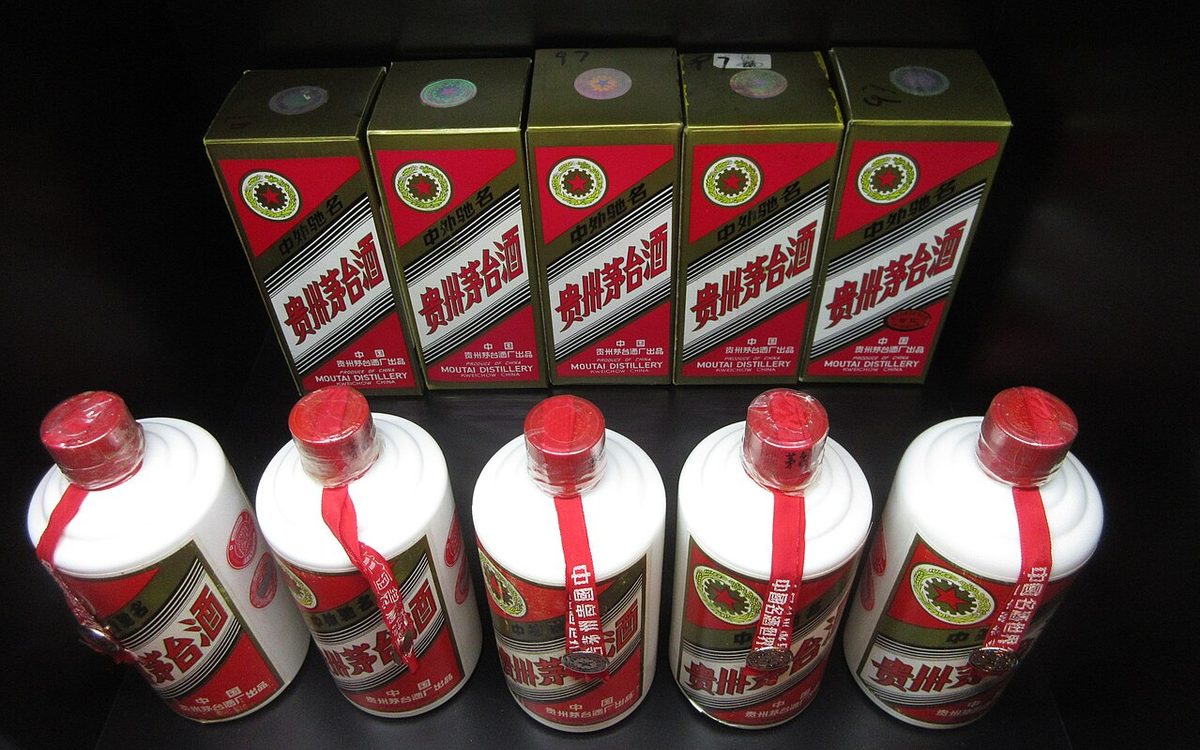
Moutai is the reference for sauce aroma and widely exported. Chinese writing places it alongside Scotch whisky and Cognac as one of the world's three great distilled spirits, which is the comparison a foreign reader needs. It is made in Maotai (茅台), in Renhuai (仁怀), in northern Guizhou (贵州), on the Chishui (赤水) river. It is clear, heavily aromatic, soft on entry, and long in the finish, and the particular smell is named after the town. It took a gold medal at the Panama-Pacific exposition in 1915, and was named at the opening national tasting conference in 1952. Exports began through Hong Kong and Macau in 1953.
Wuliangye (五粮液) is the reference for strong aroma. The name means five grain liquid and dates from 1929; before that it was simply called mixed grain liquor. It is made at Yibin (宜宾) in Sichuan (四川), where the Min river meets the Yangtze, and it also took a gold medal at Panama in 1915. It won the second and third national conferences outright.
The others divide by type. Luzhou (泸州) Laojiao and Jiannanchun are Sichuan strong aroma. Fenjiu (汾酒), from Xinghuacun (杏花村) in Shanxi (山西), is the reference for light aroma, and Xifeng (西凤) from Fengxiang in Shaanxi (陕西) is the reference for feng aroma. Dong (侗族) is the medicinal type from Guizhou. Gujing Gongjiu comes from Bozhou (亳州) in Anhui, Yanghe and Shuanggou from Suqian in Jiangsu (江苏), and Lang from Erlang (二郎镇) on the Sichuan side of the Chishui.
Two notes on names. To begin, these are protected origin products rather than ordinary brands, in the way Champagne and Cognac are, which is why the town name and the liquor name are usually the same word. Second, a bottle labelled with one of these names at a price that seems too low is usually a different product from the same company rather than a bargain.
11Destinations
Where can baijiu be seen being made?
The places worth going to divide into three kinds, and they are not interchangeable.
Liquor towns. These are settlements whose entire economy is one spirit, and the interest is that the town and the product carry the same name. Maotai (茅台), in Renhuai (仁怀) in northern Guizhou (贵州), sits on the Chishui (赤水) river and was named as a village under the Yuan (元), 13th to 14th century before becoming a town in 1930. Xinghuacun (杏花村) in Fenyang, Shanxi (山西), is described in Chinese writing as a village central to the history of Chinese liquor. Erlang (二郎镇), on the Sichuan (四川) bank of the Chishui and separated from the Guizhou side by the river alone, grew around a different distillery. Liulin in Fengxiang, Shaanxi (陕西), and Yanghe in Suqian, Jiangsu (江苏), are the same kind of place.
Working plants. Seventeen distilleries hold national industrial tourism designation from four rounds between 2004 and 2007, which means they were equipped to receive visitors rather than merely willing to. What is seen is set out in what a distillery visit shows.
Archaeology. Two sites carry the physical history rather than the current industry. The Shuijingfang site on the bank of the Jin river in Chengdu (成都) was uncovered in August 1998, dates to the early Ming (明), 14th to 17th century, and is presented as evidence of continuously running baijiu production in China. Jiahu, in Wuyang county in Henan (河南), is older by a different order of magnitude and belongs to a different story: it is where fermented drink has been dated to more than seven thousand years before the common era, long before anyone in China was distilling anything.
One route ties several of these together. The Chishui river valley holds Maotai on one bank and Erlang on the other, with Luzhou (泸州) downstream and Yibin (宜宾) beyond it on the Yangtze. That stretch contains the towns behind a large share of China's widely known spirits, and it is also, by the account Chinese sources give, the reason they exist: the water and the climate.
12Timing
When is baijiu made, and does the season matter?
Many Chinese distilleries run all year. One type does not, and it is the one visitors often want to see.
Sauce aroma follows an annual calendar, and the calendar is fixed to the Chinese lunar calendar rather than to the Gregorian one. Starter production begins at Duanwu (端午节), May or June, the Dragon Boat Festival (端午节), May or June, which falls in the hottest and dampest part of the year. That timing is deliberate and the reason given is biological: environmental microbes are very active then, and the starter made in that period is judged superior. Chinese producers call it fuqu (麸曲), the starter of the hot season, and many large distilleries insist on it.
The grain does not go in until Chongyang (重阳节), October, the Double Ninth (重阳节), October Festival, in autumn. Chinese production writing states the rule flatly: sauce-aroma production does not begin before Chongyang. That opening charge is called xiasha (下沙), laying down the sand, and it is followed a month later by a second charge called caosha (糙沙). After that the batch goes through eight rounds of fermentation and distillation, one month each, which carries the cycle round to the following autumn.
Because both anchors are lunar, their Gregorian dates move. Duanwu falls somewhere in June, and Chongyang somewhere in October, and neither is fixed in the way a solar term would be. A visit timed to see the opening grain going in has to be planned against the lunar calendar for that particular year.
Two consequences follow. A sauce-aroma distillery is doing something different in every month of its cycle, so the same plant gives a different visit in March and in October. And the other eleven aroma types are largely indifferent to season, which makes them the reliable option when the dates cannot be moved.
The starter itself is seasonal beyond sauce aroma. Chinese sources note that traditional named liquors have always specified the season for treading starter, because starter made at different points in the year behaves differently.
| Marker | Roughly | What happens |
|---|---|---|
| Duanwu, Dragon Boat Festival | June | Starter production begins in the hottest season (fuqu) |
| Chongyang, Double Ninth | October | Opening grain charge, xiasha. Production may not begin before this |
| One month later | November | Second charge, caosha |
| Eight rounds, one month each | through to next autumn | Fermentation and distillation cycle |
13How to Experience
What can a visitor actually see at a distillery?
Baijiu is one of the few Chinese industries that opened its factories deliberately. Between 2004 and 2007 the state designated seventeen distilleries as national industrial tourism sites, in four rounds, and those sites were built to receive visitors rather than adapted to it.
What there is to see is production, not a tasting bar. The fermentation pits are the point and they are usually shown at the start: rectangular, sunk into the floor of a long shed, lined with mud or stone depending on the type being made. Steaming is the loudest and a physical stage, with grain lifted in and spirit condensing out. Storage halls hold ceramic jars or, in Shaanxi (陕西), the woven jiuhai (酒海). Blending rooms are where the finished product is actually decided, and they are the least photogenic and among the more interesting parts of the process.
Some sites have specific things worth naming. The pits at Luzhou (泸州) have been running since 1573 and are protected as heritage, which makes them the clearest illustration of why continuity matters. A distillery site at Chengdu (成都), uncovered in 1998, preserves the archaeology rather than a working plant. In Shanxi (山西) the plant at Xinghuacun (杏花村) keeps a museum and the remains of its old workshop alongside the modern operation. In Hebei (河北) one designated site shows the full sequence from fermentation through storage, quality control and packaging in a single visit, which is unusual: many plants show fermentation and distillation and stop there.
Timing matters less than it does for tea, because distilleries run year round, but it is not irrelevant. Sauce aroma works on an annual cycle of eight fermentation rounds beginning in autumn, so what is happening on the floor depends on the time of arrival.
Beyond the designated sites, small private workshops operate across much of the country. They are not set up for drop-in visitors and they are not listed anywhere, so seeing one is a matter of arranging it in advance.
14Practical
How are the aroma types told apart, and how is baijiu stored?
Telling the types apart
Twelve aroma types sound like a memory problem. In practice a few of them are separable by things anyone can notice.
- The empty cup is a useful test, and it costs nothing. Finish a glass of sauce-aroma baijiu, put it down, and come back to it later. The scent stays in the empty cup for a long time. No other type holds like that, and Chinese tasting guides list it as the defining characteristic.
The others have their own markers. Strong aroma is described by the smell of the pit itself: thick, sweet on entry, clean at the end. Light aroma is the clear one, with the cleanest finish and a sweet aftertaste. Rice aroma reads as honey, soft and light. Feng aroma sits between strong and light. Medicinal aroma is exactly what the name says and runs noticeably higher in acidity. Sesame aroma is a Shandong (山东) type and smells of what it is named after. Sauce aroma is faintly yellow in the glass where many types are colourless.
Chinese sellers describe a spirit by aroma type before producer, which is the reverse of how Western spirits are usually sold. Asking which type something is will get a faster answer than asking about the brand.
Storing it
Baijiu carries no expiry date, and this is regularly misread as a promise that age improves it. The mechanism is worth understanding because it explains both halves of the truth.
Alcohols and organic acids in the spirit react with each other over time to form esters, and esters carry aroma. The reaction is slow, which is why Chinese sources put the useful window for a good spirit at three or four years and sometimes longer. But the reaction reaches equilibrium and stops. Past that point, keeping the bottle has a cost: strength falls, flavour thins, and evaporation losses grow.
It also depends on the type. Ordinary aroma types are described as thinning after about five years. Sauce aroma is the one that genuinely rewards long keeping. And mid-market products blended with added aroma compounds are the worst candidates for storage of any length, because what has been added does not age the way the spirit does.
Buying
Names on the shelf are place names. Many of the seventeen national liquors of distinction are called after the town or county they come from, and those origins are protected in the way Champagne and Cognac are. A bottle carrying one of those names at an unexpectedly low price is usually a different product from the same producer rather than a find.
15PreeChina Experiences
What does PreeChina arrange around baijiu?
Everything above this section is public. The designated distilleries run organised visits, and the liquor towns are towns.
What we arrange is the part that is neither listed nor scheduled. Small private workshops operate across much of the country, they are not set up for visitors arriving unannounced, and they do not appear in any directory. Seeing one is a matter of arranging it beforehand, and that is what we do.
The other part is timing. A sauce-aroma plant is running a different stage of its cycle in every month of the year, and the two dates that matter, the start of starter production and the opening grain charge, move with the Chinese lunar calendar. We work out which week those fall in for the year of travel, and build the route around them rather than around a fixed itinerary.
We have been arranging travel in China since well before this page existed, across leisure, study travel and industry visits. Access arrangements, fees and opening conditions change from season to season, so we confirm the current situation when we build a trip rather than publishing one that will be out of date.
16What It's Not
What do people often get wrong about baijiu?
- Baijiu is not one drink. It is a category with twelve recognised aroma types, and the distance between them is large. A light-aroma spirit from a ceramic jar and a sauce-aroma spirit from a stone pit have different grain handling, different starters, different vessels and different fermentation lengths. Ordering "a baijiu" is like ordering "a spirit".
- Older is not automatically better. Storage does improve baijiu, and the mechanism is understood: alcohols and organic acids in the spirit react slowly to form esters, and esters carry aroma. Chinese sources put the useful window for a good spirit at three or four years and sometimes longer. But the reaction reaches equilibrium and stops. Keep going past that and strength falls, flavour thins, and evaporation losses grow. It also depends on type: ordinary aroma types are described as fading after about five years, while sauce aroma is the one that genuinely rewards long keeping. Mid-market and cheap products, which are blended with added aroma compounds, are the worst candidates for long storage.
- The vintage on a bottle is not the same claim as the vintage on a wine. Baijiu has no expiry date, which is often read as an invitation to hoard it. The two are unrelated.
- Qu is not yeast. It is a solid brick of crushed grain that has been colonised by a mixed population of moulds, yeasts and bacteria, and it performs saccharification and fermentation at once. High-temperature, medium-temperature, low-temperature, wheat bran and small qu are different starters that produce different categories of spirit.
- The origin story is not settled, and Chinese sources say so. Distilled spirit in China has been dated to the Eastern Han (东汉), 1st to 3rd century AD on the evidence of a bronze still in the Shanghai Museum (上海博物馆), to the Tang (唐), 7th to early 10th century on literary references, and to the Yuan (元), 13th to 14th century on the authority of Li Shizhen, who wrote in the sixteenth century that the method was not ancient and began under the Yuan. The one story Chinese writing dismisses outright is the tale of monkeys making wine, which is labelled a fabrication kept for amusement.
- A distillery visit is not a tasting room. The Chinese industrial-tourism designation covers working plants, and what is on show is production: the pits, the steaming, the storage halls, the blending. Seventeen distilleries were designated national industrial tourism sites in four rounds between 2004 and 2007.