
Information as of October 2026. Procedures change; check the official source linked in each entry.
01The Page Likely to Date Fastest
How current is this page on paying in China?
Everything on this page was checked on 14 September 2026, and the parts that move fastest are the parts a traveler needs to know. Fee percentages, spending caps and which apps accept a foreign phone number have all changed at least once in the past two years. The numbers below are the state on that date, with the source that published each one.
What this means for a trip: read this page for the shape of the system, and read the app screen for the number. The Add Card screen inside Alipay (支付宝) or Weixin Pay is always current in a way this page cannot be. Where a figure here comes from secondary reporting instead of an official page, it says so, because the difference matters when deciding how much to carry.
The short version, for a quick read. A foreign visitor in 2026 pays by QR code with a home Visa or Mastercard linked directly to Alipay or Weixin Pay, after a passport check. No Chinese bank account is involved. Set this up before the flight, carry a few hundred RMB in cash for the stalls that have no till, and test one small payment in each app on the opening day instead of on the night it is needed.
02No Bank Account Required
Can a foreigner use Alipay or WeChat Pay without a Chinese bank account?
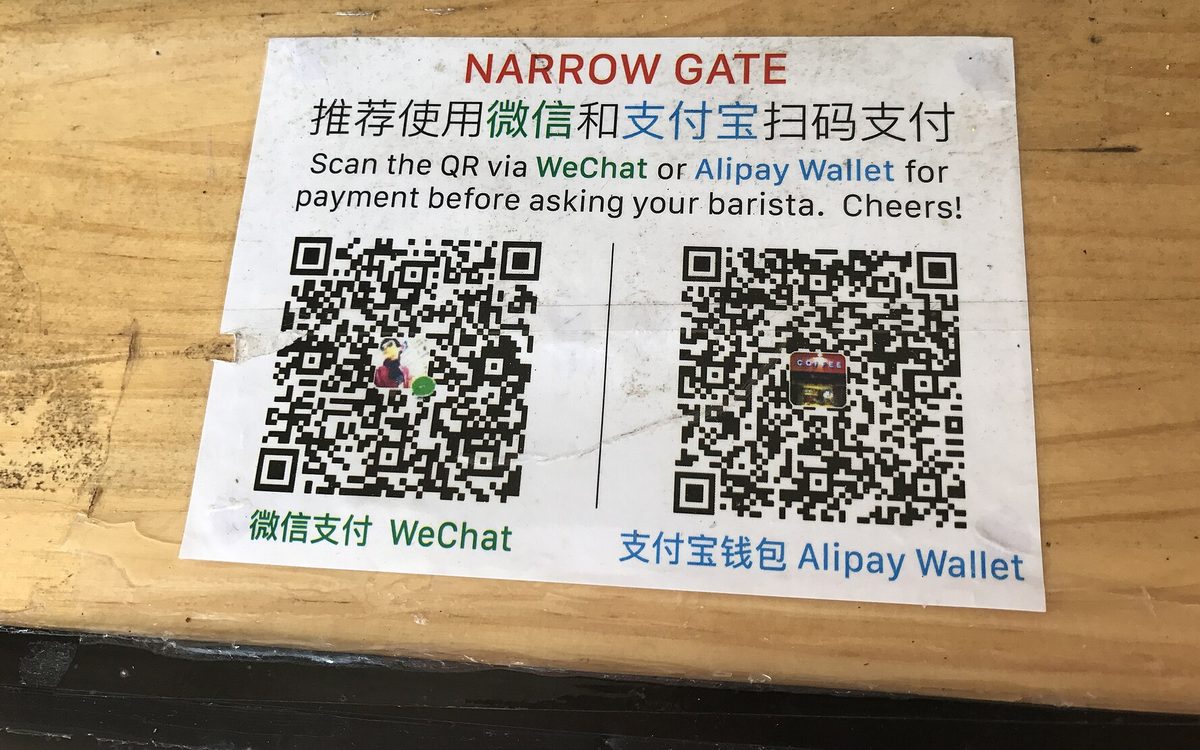
The step that used to stop visitors is gone. The main Alipay (支付宝) or Weixin Pay app is downloaded on the traveler's own phone, a passport real-name check is completed, and a home card is linked. The payment code that follows is the same code local shoppers use at shops, street stalls and metro gates, and the merchant cannot tell the difference.
Seven card networks, on both wallets. The WeChat (微信) help centre lists Visa, Mastercard, American Express, Discover, JCB, Diners Club and UnionPay (银联) International. Alipay states the same seven for direct binding, reported by China Daily in April 2025 citing Alipay. One secondary source lists a shorter Alipay set without American Express, so the screen inside the app is the one to trust.
The passport step is real and it takes a few minutes. Alipay asks for the passport data page plus the entry stamp page and a face liveness check. Weixin Pay asks for identity information and a copy of the passport. The name on the card and the name in the passport have to match, hyphens and middle names included, and a mismatch is the usual reason verification fails.
Do all of this at home, before the flight. The binding flow sends verification codes to the phone, and the home number receives them normally while still on the home network. Debugging that flow in front of a queue at a noodle counter is the version of this to avoid.
03What It Costs
What does it cost to pay with a foreign card in China?
There is a threshold at 200 RMB, and it is the number to remember. On any single transaction of 200 RMB or less, the platform fee is zero. Above 200 RMB, the platform charges 3 percent of the whole amount and not of the amount over the threshold, so a 250 RMB purchase carries 7.5 RMB in fee. Refunds return the fee proportionally. This comes from a Tenpay announcement in November 2025 and the WeChat (微信) help centre, and Alipay (支付宝) applies the same structure.
What this means for a trip: splitting a large bill across small payments is not a trick, it is how the fee schedule is written. Two 180 RMB payments cost nothing in platform fees; one 360 RMB payment costs 10.8 RMB. For a two-week trip of ordinary meals and metro rides, many transactions fall under the threshold and the total platform fee is close to zero.
The home bank adds its own fee on top. Cross-border or foreign-transaction charges from the card issuer commonly run 1 to 3 percent and are separate from the wallet fee. That one is between the cardholder and the bank, and it is worth knowing the rate before deciding whether to pay by code or by cash for a large purchase.
New accounts sometimes open with a fee waiver, commonly around 60 days. Treat the 3 percent as the standing rule and the waiver as a bonus that may not be there on arrival.
04The Caps
What are the spending limits on a foreign card in Alipay and Weixin Pay?
Both wallets set their own spending limits for foreign cards, and the two are not the same. Weixin Pay publishes 6,500 RMB per transaction, 50,000 RMB per month and 65,000 RMB per year on its own help page. Alipay (支付宝)'s foreign-card limits are commonly reported at about 3,000 RMB per transaction, 50,000 RMB per month and 60,000 RMB per year after passport verification, and this set comes from secondary Chinese reporting rather than an official Alipay page, so it carries less weight than the Weixin figure.
Above both sits a regulatory ceiling that neither wallet reaches. In March 2024 the People's Bank of China raised the cap on cross-border QR payments to 5,000 USD per transaction and 50,000 USD per year. Both platforms set operational limits below that, which is why the number that constrains a traveler is the wallet's and not the regulator's.
What this means for a trip: the per-transaction cap is the one that will actually bite. A hotel bill, a rug, a piece of furniture or a several-thousand-RMB tour payment can exceed 3,000 RMB in one go. For those, the options are to split across two wallets, to pay the merchant by bank transfer through their own channel, or to use the physical card if the merchant takes one. The annual caps are far above what a two-week visit spends.
| Wallet | Per transaction | Per month | Per year | Source |
|---|---|---|---|---|
| Weixin Pay | RMB 6,500 | RMB 50,000 | RMB 65,000 | Own help page |
| Alipay | about RMB 3,000 | RMB 50,000 | RMB 60,000 | Secondary reporting, not an official page |
| Regulatory ceiling | USD 5,000 | , | USD 50,000 | People's Bank of China, March 2024 |
05Prepaid Cards
Are prepaid tourist cards still worth using in China?
Direct binding is the normal path in 2026, and the older prepaid products still exist for the case where it fails. The usual failure is a home bank that repeatedly blocks the small recurring authorisations that binding creates.
The Alipay (支付宝) Tour Card is a prepaid virtual card issued with Bank of Shanghai. RMB is loaded onto it from a foreign card, commonly in top-ups between 100 and 10,000 RMB, with a service fee commonly around 5 percent per top-up and a balance valid for roughly 180 days, after which anything unused is refunded to the card. Those specific figures come from travel sites; the official Tour Pass agreement states just that the bank may set per-top-up and annual ceilings. The agreement does confirm what the card cannot do: no transfers to another account, no wealth products, no red packets.
Weixin Pay has no prepaid tourist card of its own. Its route for visitors is the direct card binding in block 02, which is worth stating because search results still turn up guides describing a product that was not located in 2026.
A third option sits outside both wallets. The UnionPay (银联) Nihao China wallet and the UnionPay Tour Card inside the UnionPay app let a short-term visitor register with an overseas number, an international email or an Apple ID, top up from a foreign card, and pay by QR code without a Chinese bank account.
What all of them share is the same boundary. Codes can be scanned at shops, restaurants, metro gates and bike shares, and payments work inside mini-programs. Sending a red packet or transferring money to another person from a foreign-card balance is usually not possible, and Weixin Pay states that limit explicitly. Some merchants run on a domestic-wallet basis and will decline the balance, and their screen is where the reason shows up.
06Cash
Does cash still work in China?
The legal position is clear. Article 16 of the People's Bank of China Law makes RMB legal tender and says no unit or individual may refuse it for public or private debts. In December 2025 the central bank, the National Development and Reform Commission and the financial regulator issued joint announcement 2025 No. 29 on preventing the refusal of cash, and the central bank publishes penalty cases each quarter against businesses that turn cash away.
The practical position is narrower. A solo vendor at a market stall or an unmanned shop often has no till and no change, and the QR code is the sole thing that opens the transaction. This is not a business refusing cash so much as a business that never had a cash drawer. For regulated businesses, transport and public services, the legal position holds, and a complaint goes to the local branch of the People's Bank of China.
What this means for a trip: carry a few hundred RMB in small notes and expect to spend them rarely. The cases where cash helps are a failed app verification on the opening day, a rural stall, and a taxi whose driver's code will not scan.
Where to get it. Bank of China branches exchange foreign cash for RMB against a passport with no account needed, confirmed by Bank of China in 2024. Self-service exchange machines sit near international arrivals at major airports, commonly handling around 20 currencies and dispensing notes and coins against a passport. Several airports run a foreign-guest payment service centre that combines exchange, withdrawal and wallet help at one desk, and BOC ATMs in city centres commonly accept international cards around the clock. For RMB brought in from abroad, the per-person limit across the border is 20,000 RMB.
07Which Apps Need a Number
Which Chinese apps can a foreigner register without a Chinese phone number?
In 2026 the answer for the major consumer apps is none of them, and that is recent.
Alipay (支付宝) registers on the traveler's own phone number. The company states that overseas registration supports mainland numbers plus Hong Kong, Macau, Taiwan and 246 other regions, with non-mainland numbers registering inside the app. Real-name verification with the passport and a face check follows. The phone number is the account, and there is no email route.
WeChat (微信) registers on the traveler's own number, or through an Apple ID on iOS, or through Facebook. The help centre notes that an existing WeChat user may be asked to scan a QR code to complete registration, and for a visitor with no contacts in China yet, that step is the one that stalls rather than the number itself. Weixin Pay then needs the passport upload.
12306, the railway platform, registers on the English site with an email address. The account and each passenger have to pass identity verification before booking or changing tickets online. No Chinese number is needed for that registration, though verification can call for a station window visit with the passport.
Maps and cars. AMAP Global accepts one-tap login from numbers in 65 countries and regions, in English, and hails cars nationwide, reported by Xinhua in July 2026. The domestic map app asks for a mainland number on its registration screen, so the international build is the one to download. The international DiDi app signs up on an overseas number, sends an SMS code and binds a Visa or Mastercard; set it up before the flight, because some roaming plans deliver its codes unreliably from inside China.
Meituan (美团) and Dianping (大众点评). Up to mid-2026 the standalone Meituan app commonly required a mainland number, and the workaround was the Meituan mini-program (小程序) inside Alipay or WeChat. On 10 August 2026 Meituan announced support for foreign users registering with an overseas number plus identity information, covering browsing, ordering and delivery, with payment still running through Alipay or Weixin Pay. Dianping can be browsed without an account, and registration works by overseas number or WeChat login; the soft spot is redeeming a group-buy voucher, which sometimes asks for a code sent to a Chinese number. Handing the phone to the staff at the counter usually settles it.
08Four Tiers
Which apps can a foreign visitor actually use in China?
The site sorts apps into four tiers by what they demand of a foreign visitor, and the same four are used on the Now page. The table below places the ones worth setting up.
Tier 1 is the useful one. A passport plus a bound foreign card covers trains, payments, navigation, cars, bikes and power banks. That covers a normal two-week trip end to end.
Tier 2 has moved. Until 2024 much of it sat behind a mainland number. By 2026 the major apps in this tier accept foreign numbers, and what remains is friction rather than a wall: a help step, a voucher redemption, an older standalone app that still texts a mainland number.
Tier 3 is where a resident ID and a face scan are the gate. Standalone robotaxi apps and parts of the one-stop government service portals sit here. The workaround is an aggregator app or asking a local to make the booking.
Tier 4 is the small residue that can be photographed and cannot be used. Unmanned stores that run on an app alone, gate systems that demand a mainland number at entry, and any merchant terminal that does not carry the card network. This is what the cash in the pocket is for.
The rollout is recent and uneven, which is the practical warning. Test one small transaction in each app on the opening day.
| Tier | What it asks for | What sits there |
|---|---|---|
| 1 | Passport plus a bound foreign card | 12306, Alipay, Weixin Pay, the QR payment code, AMAP Global, international DiDi, shared bikes and power banks |
| 2 | A foreign number works; a Chinese one is smoother | Meituan since August 2026, Dianping, WeChat itself, with voucher redemption and the friend-QR step as the friction |
| 3 | A Chinese resident ID and a face scan | Standalone robotaxi apps, parts of the one-stop government portals |
| 4 | Not usable by a visitor | Unmanned stores that run on an app alone, gates demanding a mainland number, terminals without the card network |
09What This Page Is Not
What does this payment page not cover?
- It is not advice on which card to bring. That depends on the issuer's foreign-transaction fee and on whether the bank blocks Chinese merchant authorisations, and both are questions for the bank.
- It is not a guarantee that a given app will accept a given number today. Every registration rule on this page was checked on 14 September 2026, and several of them changed inside the previous twelve months. The direction of travel has been consistently toward accepting foreign numbers, which makes an out-of-date version of this page pessimistic instead of dangerous.
- It is not a substitute for the in-app limit screen. Where this page and the app disagree about a cap or a fee, the app is right.
- It does not cover money being moved rather than spent. Bank transfers, currency export beyond the 20,000 RMB carry limit, and anything involving a Chinese bank account are outside what a visitor needs and outside what this page checked.