
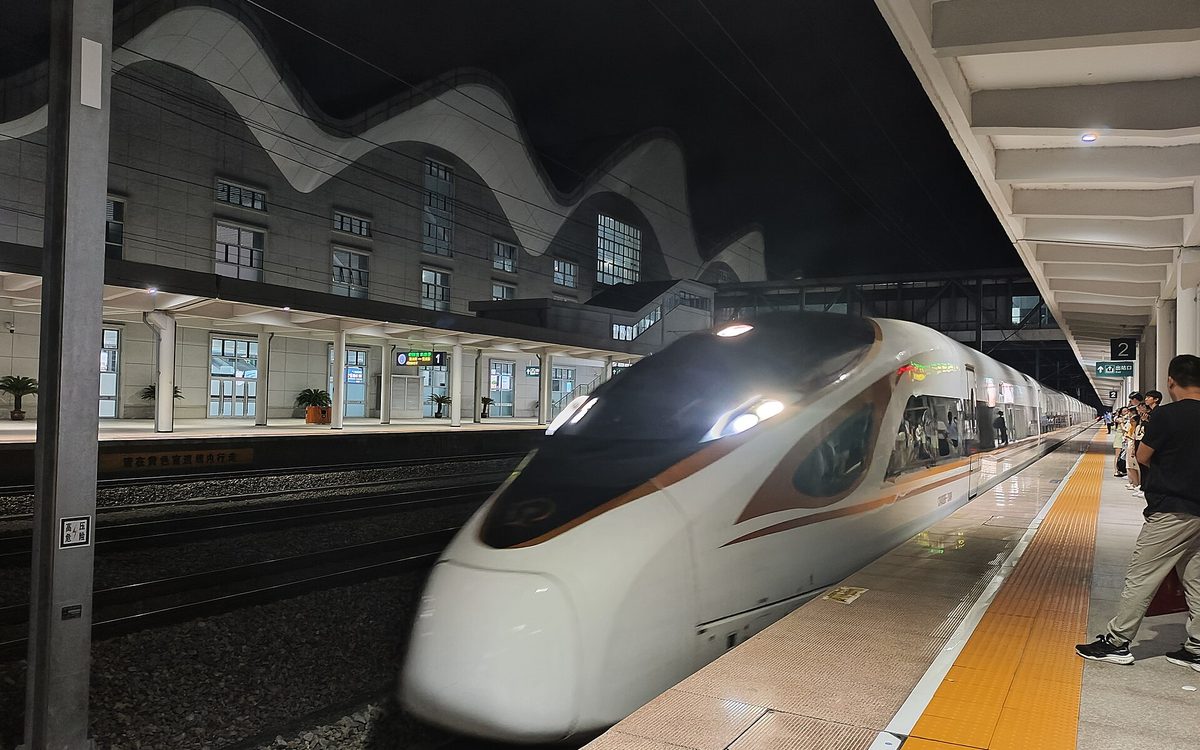
01Distance Is Measured in Hours
How far apart are China's cities in travel time, and where does the high-speed rule stop?
In China a trip is planned in hours, not kilometres. Beijing to Shanghai is 1,318 kilometres and four hours eighteen minutes on the fastest train; Guangzhou (广州) to Shenzhen (深圳) is half an hour; Chengdu (成都) to Chongqing (重庆) is one. The country laid about 50,000 kilometres of high-speed track by the end of 2025, roughly two thirds of all the high-speed rail in the world, and the practical result for a visitor is that the unit of an itinerary is not the city but the five-hour circle around it.
The opening thing to correct is whose hours they are. The hours are the train's, not the traveller's. The people who write up their trips afterwards say the same sentence in different words: a three-hour train is never a three-hour journey. The high-speed station is thirty to sixty minutes outside the centre, there is a security screen at the door and an identity check at the gate, seats on popular routes fill soon after release, and the platform is reached before the doors close, not as they close. Add an hour at each end. This page says so once here and again in block 04, because it is a mistake that new visitors make often.
The second thing is where the hours stop working. East of the line that runs from Heihe (黑河) to Tengchong (腾冲), where the great majority of the people live, the network is dense and the rule holds. West of it the same train takes eleven hours from Lanzhou (兰州) to Urumqi (乌鲁木齐) and there is no high-speed line to Lhasa (拉萨) at all: the train from Xining (西宁) takes a day, and much of Tibet (西藏), Xinjiang (新疆) and the mountains of Yunnan (云南) and Guizhou (贵州) are reached by road, where a hundred kilometres can be three hours. The peoples page explains why the edges are different; this page warns that the clock changes there.
The third thing is the last kilometre. Inside a city, transport is a phone act: the metro gate reads a code, the taxi is called in an app, the bicycle unlocks with a scan. That belongs to the digital page, which is why this page stops at the station door and that one starts at it.
02The Six Layers
What kinds of transport does China run, and how big is each?
Six kinds of transport carry almost every trip, and they stack: expressways and high-speed rail between cities, the metro and the bus inside them, and two kinds of bicycle for the last stretch. Each has a scale and each has a consequence.
Expressways. A vast network that reaches nearly every city of any size. For a visitor the consequence is not driving, which block 04 explains is awkward, but that a car with a driver can reach almost anywhere in a day, and that the long-distance bus still runs where the train does not.
High-speed rail. A network of tens of thousands of kilometres, laid in less than twenty years, on a grid the planners call eight verticals and eight horizontals. Trains run at 300 to 350 kilometres an hour, leave every few minutes on the main corridors, and are the reason a ten-day trip can hold three cities a thousand kilometres apart. The Chinese word is gaotie (高铁), and it is the word to show a driver for the station.
Metro. Dozens of cities on the mainland run urban rail, and Shanghai and Beijing have networks among the very large of the world. A ride costs very little, the gate reads a code from the phone, and there is a security screen at every entrance. The word is ditie (地铁).
Bus. Everywhere, and cheap. Shenzhen (深圳) switched its entire bus fleet to electric in 2017 and its taxis in 2019, and many large cities have followed, which is why a Chinese street is quieter than the number of vehicles on it suggests. Buses are the least English-friendly layer: stops are announced in Chinese, and routes are read on a map app rather than a sign.
Docked public bicycles. A few cities still run the older kind, with stations and a card. Hangzhou (杭州) started its system in 2008 and it is a large system of its type; it survives because the lakeside is built for it.
Shared bicycles and shared electric scooters. Many cities have them, in three or four colours, unlocked by scanning a code and left at the kerb. Around them move hundreds of millions of privately owned electric two-wheelers, which is a major change in a Chinese street in twenty years and the reason the bicycle lane is not a quiet place. Whether a shared bike can be unlocked depends on whether the phone identity has been accepted, which is the digital page's subject.
03By the Numbers
What are the figures behind China's roads, railways and metros, with sources?
The table under this block carries the source and the year beside each figure. The prose says what the figures change.
Trains have replaced planes for anything under about a thousand kilometres. The railway carries billions of passengers a year. On the Beijing, Shanghai corridor the train station is in the city and the airport is not, the train leaves every ten minutes and the flight is delayed, so the train wins on the clock as well as the fare. Above a thousand kilometres, Beijing to Guangzhou (广州) or Shanghai to Chengdu (成都), the aeroplane returns; above two thousand, the sleeper train becomes the alternative rather than the day train.
The shape of the network is the shape of the population. Almost all of the 50,000 kilometres of high-speed track lie east of the Heihe, Tengchong line (胡焕庸线), on the forty-four per cent of the land that holds ninety-four per cent of the people. The map of the railway and the map of where Chinese people live are the same map, and a trip that stays on it moves fast while a trip that leaves it moves at the speed of a bus.
The forty days around the lunar new year (春节), late January or February are the heaviest movement of people on earth. The travel season the Chinese call chunyun (春运) records billions of cross-regional trips, many of them by car and a large share by rail. For a visitor the number means one thing: do not plan to take a train in the week before or after the new year, or in the opening week of October, without a seat arranged the day sales open.
Many new cars are electric. A large share of the cars sold are battery or plug-in vehicles, which is why the taxi that arrives is silent, why the ride-hailing fleet is almost entirely electric, and why a car with a driver stops to charge on a long day.
04What It Changes for a Trip
How should transport shape an opening China itinerary, and what catches visitors out?
Start with the arithmetic, because it decides everything else. A healthy ten-day trip holds three cities inside one five-hour circle, not five cities across the country. Travellers have worked this out for themselves: a common complaint about opening itineraries is not the choice of cities but the time lost checking out, reaching stations, waiting, finding the next hotel and packing again. A travel day between cities is not a day spent seeing either of them; count it as half.
Train seats. Every train seat is tied to a name and a document. There is no paper pass: the passport is scanned at the gate, and foreign passports go through a staffed lane rather than the automatic ones. The national rail system opens sales about two weeks ahead, while the international sites show timetables further out and charge a fee for the convenience. On holiday dates the fast trains sell out within minutes of release. The how-it-works page has the procedure; this page notes that the window is short and the name must match.
Stations. High-speed stations are large, new and usually outside the centre; allow an hour from a downtown hotel in a big city. Everyone and every bag passes a security screen at the entrance, and there is a second identity check at the platform gate. Arrive forty-five minutes before departure. Big stations have several waiting halls and the gate number goes up about fifteen minutes before the train leaves.
In the city. The metro is the fastest way across any large city and the easiest for a foreigner: maps and announcements are bilingual, and a single ride is cheap. The taxi is called through a ride-hailing app that has an English interface and accepts foreign cards; the travellers' notes add that it does not charge automatically at the end of a ride, so payment is made when prompted, and that the fare on the meter runs a little above the estimate. Street taxis exist and take cash or a code; the line at an airport rank is the one place a new visitor meets an unlicensed driver, so use the official rank or the app.
Two wheels. Shared bicycles are the pleasure of a Chinese city and the digital page explains what is needed to unlock one. The electric scooters nearby are the country's real traffic risk for a pedestrian, more than cars; they use the bicycle lane, the pavement and the wrong side of the road, and they are silent. Look both ways on a one-way street. The safety page has the rest.
Driving. A foreign licence is not valid on its own; a temporary permit can be issued at some airports for a short stay, and the procedure changes, so the how-it-works page keeps it. In practice visitors do not drive. A car with a driver for a day is the ordinary way to reach anywhere the train does not, and the cost is within reach because the driver's day is priced in local terms.
When. Avoid the railway in the week either side of the lunar new year (春节), late January or February and in the opening week of October; the calendar page has the dates, which move. The same weeks empty the office towers and fill every scenic road in the country.
At the airport. Domestic security is strict about power banks: power banks must bear the national safety mark to be allowed on board, and the rest are taken at the checkpoint. Buy one in China or check the mark on the one carried.
05Where It Is Met
Where on PreeChina are the train journeys, cruises and drives?
This page is the network. The rides are elsewhere.
Riding it. The page on new China is where the train becomes an experience rather than a line on a map: the overnight sleeper, the old green lüpiche (绿皮车) that still crosses the country at eighty kilometres an hour for a tenth of the fare, the driverless taxis now carrying passengers in Wuhan (武汉) and Beijing, the Shanghai maglev, and the bridges and tunnels that turned islands into suburbs.
Four railways worth riding for their own sake. The line from Guizhou (贵州) to Guangzhou (广州) runs through karst for five hours; the Lanzhou (兰州) to Urumqi (乌鲁木齐) line crosses the Gobi and the Qilian snow; the metre-gauge railway from Kunming (昆明) towards Vietnam is an old scenic line in the south-west; and the 1909 line from Beijing to Zhangjiakou (张家口), a railway the Chinese built themselves, now has a high-speed twin that reaches the ski slopes in an hour. The travel magazines this site reads have been writing these up for a decade; the English internet has barely started.
Water. The Yangtze cruise from Chongqing (重庆) to Yichang (宜昌) through the Three Gorges is three nights and the one journey on this page that is a holiday in itself. The ferry from Xiamen (厦门) to Gulangyu (鼓浪屿) is ten minutes and the island has no cars at all.
The road. The outdoors pages begin where the train ends: the drive into western Sichuan (四川) from Chengdu (成都), the road north from Lijiang (丽江), the loop around the Ili valley. Each one is a car-with-driver itinerary and each is written with the hours, not the kilometres.
The phone. The digital page has the apps that run all of the above, and what a foreign passport can and cannot do in them.
The calendar page has the two weeks a year to avoid the railway, and the peoples page explains why the map of the trains and the map of the peoples are almost mirror images.
06What It's Not
What do visitors often get wrong about getting around China?
- Not the whole country. The hours rule holds in the east, where the people and the track are. Tibet (西藏) has no high-speed line, Xinjiang (新疆)'s is one line, and the mountain provinces of the south-west are reached by road once the train stops.
- Not a three-hour trip. A three-hour train is a five-hour journey once the station on each side, the security screen and the buffer the forums insist on are added. Plan the travel day as half a day.
- Not just the fast train. The ordinary trains, the sleepers and the old green lüpiche (绿皮车) still run, cost a fraction, take all night and are the part of the railway that travellers remember. The page on new China covers them.
- Not the London Underground. Every metro entrance has a security screen, many lines stop in the late evening, eating is discouraged and the platforms have doors. Otherwise it is the easiest thing in the country to use.
- Not hailed by hand. In the big cities taxis are called through an app; the ones that stop for a raised arm at an airport or a station are the ones to avoid. The app has an English interface and takes foreign cards.
- Not an empty bicycle lane. The lane is shared with several hundred million electric scooters that are silent and do not stop. Look both ways, including on one-way streets.
- Not faster by air under a thousand kilometres. The airport is far, the security is slow, domestic flights are often late and the train leaves from the city every few minutes. Fly across the country, not along a corridor.
- Not in the centre. High-speed stations are new towns of their own, twenty to forty kilometres out. The old station in the middle of the city is usually the slow trains' station, which is sometimes the one wanted.