
01One Word, Several Sizes
What does the word park cover in China, from national parks to city parks?
Park is a word with layers, in Chinese as much as in English, and the layers run from a forest the size of a small country down to a lawn with a pond. This page covers all of them, and the opening job is to say which is which.
At the top are the national parks (国家公园) and protected areas (自然保护区). China created a national park system in 2021 with five parks, among them Sanjiangyuan (三江源) on the Tibetan plateau, the Giant Panda (大熊猫) park in Sichuan (四川), and Wuyishan (武夷山) in Fujian (福建). Alongside them are the older protected areas, which is what Shennongjia (神农架), Zhalong (扎龙) and Kekexili (可可西里) are called, and which an English reader would also call a national park. These are large, mostly wild, and mostly reached rather than entered.
Next come the geoparks (地质公园), a UNESCO label for a landform: the sandstone of Zhangye (张掖), the granite of Taining (泰宁), the volcanoes of Wudalianchi (五大连池). Then the mountains and the named scenic spots, which is a large layer on this page and the one many visitors mean. Many of these are fenced and charged, with a grade on the gate and a shuttle (观光车) inside it. Not all are. West Lake (西湖) in Hangzhou (杭州) has no gate and no fee, and neither does the East Lake (东湖) in Wuhan (武汉), which is larger. Whether a well-known view is fenced depends on the place, not on the fame.
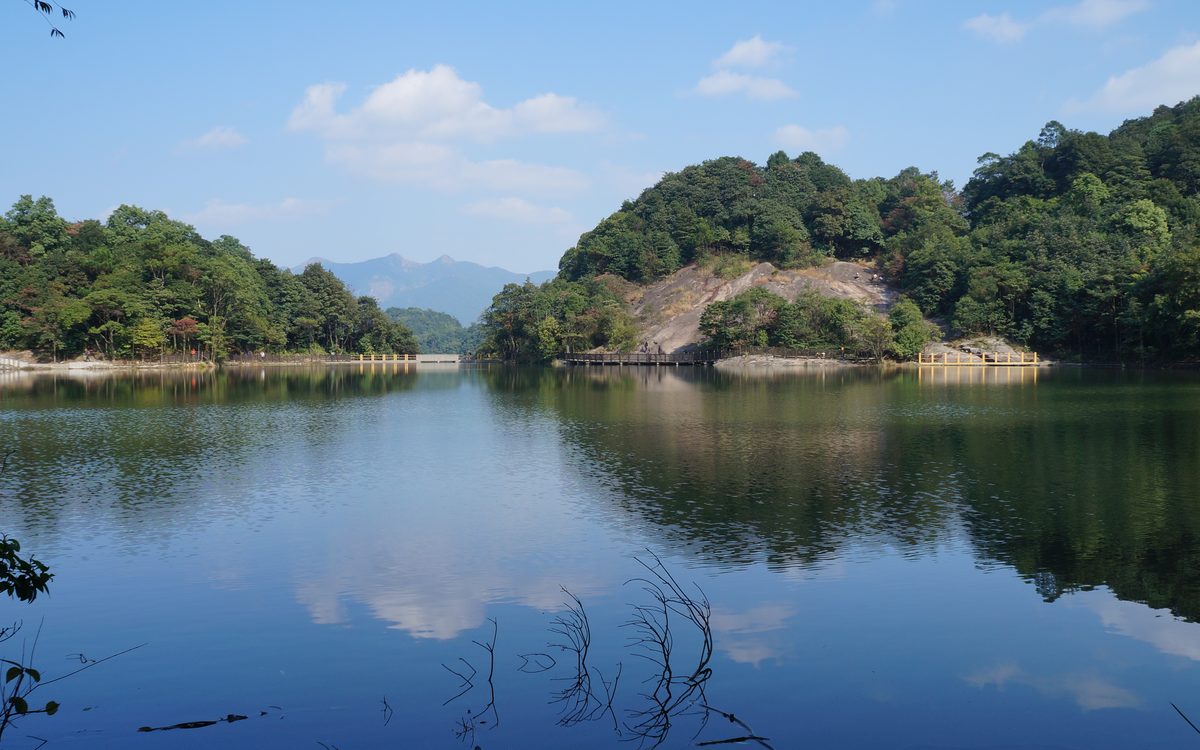
Below that are the wetland parks (湿地公园), the lakes and the gardens, which look like parks to anyone: a path around water, a pavilion, a place to sit. Some charge, many of the city ones do not. And at the bottom are the specialist parks and the city parks, the botanical garden, the zoo, the neighbourhood park that serves the people who live around it.
We surveyed 256 places across every province and kept 233 that fit these layers. The fenced layers share a set of parts that repeat across the country: a grade, an entry sold in pieces, a shuttle, a boardwalk (栈道), a cable car (索道), and a timetable that changes with the season. The next four blocks take those parts one at a time, because they are what a visitor has to deal with. The open layers, the lakes and the city parks, come at the end, and they are where the exceptions live.
02What the Grade Means
What does a 5A rating mean for a Chinese scenic area?
Chinese scenic areas (景区) carry a grade from one A to five, and the grade is on the gate, on the pass, and in every sentence written about the place.
The grading is a national standard. The current standard replaced an older one and keeps the five grades. To hold 5A a place must have at least one resource of significance at world level, and the standard says its area should be no less than three square kilometres. The lower grades step down: national significance for 4A, provincial for 3A, and so on. The country has hundreds of 5A areas, a number that grows by a batch in many years.
In our survey, a large share of the parks are 5A. That is what would be expected from a list built for visitors, and it shows something useful: the grade separates the well-run from the rest, but it does not separate the remarkable from the merely large. A city hill park and a world heritage karst can both be 5A. The standard measures management, services, safety and facilities as much as it measures the view.
What the grade predicts is the machine. A 5A area will have the gate, the shuttle (观光车), the signage in two languages, the toilets and the ticketing app. It will also, very often, have the crowd. What the grade does not predict is whether the place is worth a day of a trip, which is why this site does not sort by grade and why the rest of this page sorts by something else.
03The Entry Is Layered
What does entry to a Chinese scenic area actually include?
A Chinese park sells its entry in layers, and the number on the gate is usually the smallest of them.
The entry pass opens the gate. The shuttle (观光车) goes from the gate to the scenery, and in a large area the walk is not an option. The cable car (索道) goes up. The boat or the raft goes across the water where there is water. Each is priced separately, each is bought separately, and the sum is the real price.
Wudang Mountain (武当山) in Hubei (湖北) is the plain example. The entry, the shuttle and the cable car are each priced separately, so a visitor who wants to reach the top without a day's climb pays for all three. Laojun Mountain (老君山) in Henan (河南) sells two cable cars (索道), one for each stage. Longhu Mountain (龙虎山) in Jiangxi (江西) bundles entry, shuttle and bamboo raft into one figure. Jiuzhaigou (九寨沟) sells entry and shuttle as two lines on one screen. Yandang Mountain (雁荡山) in Zhejiang does it the other way round, with no charge at the gate and a separate charge at each of its scenic spots.
Some passes buy time. Hongcun (宏村), in Anhui, offers a multi-day pass. Zhangjiajie (张家界)'s covers several days. Some buy a second visit: Slender West Lake (瘦西湖) in Yangzhou (扬州) offers the day and, at a higher price, the lit night show. And some now buy a slot: the Humble Administrator's Garden (拙政园) in Suzhou (苏州), in Jiangsu (江苏), asks for timed entry (分时段预约), and the big mountains cap daily numbers in season.
Two things to do with this. One, add up the layers before deciding, because the shuttle and the cable are where the money is. Two, read the free line: the parks in this survey that charge nothing are almost all city parks, and the city park is a different institution, which block ten covers.
04The Season
How do peak and off-peak seasons change Chinese park prices and hours?
Many large Chinese parks run two timetables a year, and the second one is not just shorter. It is cheaper.
The split is called peak and off-peak (淡季), and where it applies it changes both the timetable and the fee. Large Beijing parks such as the Temple of Heaven (天坛) and the Summer Palace (颐和园) follow this pattern. Huangshan (黄山)'s entry price is lower in winter. Tiger Hill (虎丘) in Suzhou (苏州) and Yu Garden (豫园) in Shanghai both drop their price in the off season.
The dates are set by each park and they are not the same everywhere. In Beijing the peak season (旺季) runs roughly April to October. In the south the split may follow the rains or the holidays rather than the temperature. The park's own notice is the reliable source, and the price on a third-party site is often last season's.
What off-peak actually buys is the park with fewer people in it. For the sacred mountains and the karst areas this is the trade to think about, because the view does not change with the price and the crowd does. Two exceptions run the other way. A few parks exist in one season alone, which is the subject of block nine, and a few mountains close their higher paths in winter for ice.
The rule for planning is short: check which timetable applies on arrival, and expect the winter one to be shorter, cheaper, and emptier.
05How Visitors Move Inside
How does one get around inside a Chinese scenic area?
Inside the gate, a Chinese park decides how visitors move, and the decision is made of three things: the shuttle (观光车), the boardwalk (栈道), and the cable car (索道).
The shuttle is the one visitors do not expect. In a large scenic area (景区) the road from the gate to the opening viewpoint can run for many kilometres, and it is closed to private cars. A fleet of park buses runs it on a loop, and the shuttle fare is separate. Jiuzhaigou (九寨沟), Huangguoshu (黄果树), Wuyishan (武夷山), Shennongjia (神农架) and the Dujiangyan (都江堰) area all work this way, and a visitor who walks past the shuttle stop to save the fare is usually walking back to it an hour later.
The boardwalk is the Chinese way of walking a mountain. Plank paths, stone steps, railings and viewing platforms are built along the route, and the route is the walk. At Taishan (泰山) the classic ascent is a stair of some six thousand six hundred steps; at Enshi (恩施) in Hubei (湖北) the path is a walkway bolted to a cliff. Off the boardwalk there is usually nowhere to go, and where there is, the park does not want visitors there. This is the point at which the word wilderness stops applying, and block twelve returns to it.
The cable car is where the mountain becomes a day trip. Taishan runs two lines to the South Heaven Gate (南天门). Laojun Mountain (老君山) runs two in sequence. Emei (峨眉山), Wudang (武当山), Fanjing (梵净山) and Sanqing (三清山) all move many of their visitors by cable. A newer generation adds glass: glass walkways at Yuntai (云台山) and Baishi (白石山), a glass viewing shelf over Yalong Bay (亚龙湾), and at Shenxianju (神仙居) in Zhejiang a double-helix glass bridge. Zhangjiajie (张家界)'s Bailong Lift (百龙天梯), a lift built on the outside of a cliff, is described in Chinese sources as a very tall outdoor elevator, and it moves people the height of a hundred-storey building in under two minutes.
The practical consequence is that a Chinese mountain is mostly experienced from a sequence of built platforms, and the sequence is designed. Knowing that in advance is the difference between finding it convenient and finding it strange.
06The Pilgrimage Underneath
Why are so many Chinese scenic mountains also sacred mountains?
Before many of these mountains were parks they were places of worship, and the park was built on top of the pilgrimage without removing it.
China has three lists of sacred mountains, and they overlap with the parks on this page almost completely. The Five Great Mountains (五岳) are Taishan (泰山) in the east, Huashan (华山) in the west, Hengshan in Hunan (衡山) to the south, Hengshan in Shanxi (恒山) to the north, and Songshan (嵩山) in the centre, the two Hengshans (衡山 · 恒山) sharing a name in English and not in Chinese. The four Buddhist mountains are Wutai (五台山), Putuo (普陀山), Emei (峨眉山) and Jiuhua (九华山), each held to be the seat of a bodhisattva. The four Daoist mountains are Wudang (武当山), Qingcheng (青城山), Longhu (龙虎山) and Qiyun (齐云山). Our survey has cards for all five of the Great Mountains and all four of the Daoist ones, and three of the four Buddhist ones, with Putuo still to be added.
The pilgrimage shows in how the park is laid out. The path up Taishan is a stair because it was a route for emperors and pilgrims long before it was a route for visitors, and the stair ends at a gate called the South Heaven Gate (南天门) for the same reason. Wudang's cable car (索道) lands near the temple complex, not near a viewpoint. At the northern Hengshan (恒山), in Shanxi, the well-known building is a temple hung on a cliff, and the park's whole structure is built around reaching it. At Emei the summit is a temple platform, and the thing people go up for at dawn is a light effect that Buddhist tradition has a name for.
Time runs deep here, and this site keeps the dates honest. Taishan's imperial ceremonies reach back before the Han, more than two thousand years. The Daoist site at Longhu Mountain (龙虎山) claims a lineage from the Eastern Han. The main temples on Wudang date from the Ming, when an emperor rebuilt the mountain as a state project. Where a mountain's story is about the temple, that story belongs to this site's pages on the past. What belongs here is the fact that the pilgrimage set the route, and the route became the park.
One practical thing follows. On a sacred mountain the busiest days are not weekends. They are festival days on the lunar calendar, and the opening day of the lunar year on Emei or Wutai is not a quiet climb.
| List | Mountains | In our survey |
|---|---|---|
| Five Great Mountains | Taishan (east), Huashan (west), Hengshan (south), Hengshan (north), Songshan (centre) | All five |
| Four Buddhist mountains | Wutai, Putuo, Emei, Jiuhua | Three of four; Putuo to be added |
| Four Daoist mountains | Wudang, Qingcheng, Longhu, Qiyun | All four |
07Gardens
How is a Chinese classical garden different from a scenic area?
The classical garden is the other Chinese park, and it works the opposite way from the mountain.
The mountain is large, and the park moves visitors through it by bus and cable. The garden is small, walled, and built to be walked slowly, and the walls are the point: the garden is a landscape made inside a city, by a family or an emperor, for their own use. Much of what a visitor sees is between three and five centuries old. The Humble Administrator's Garden (拙政园) in Suzhou (苏州) dates from the early sixteenth century, the Lingering Garden (留园) from the end of it, and Yu Garden (豫园) in Shanghai from the middle. All three are Ming (明), 14th to 17th century.
The imperial gardens are the same idea at a different scale. The Summer Palace (颐和园) in Beijing was laid out on a lake and a hill and modelled, by its own account, on West Lake (西湖) in Hangzhou (杭州). The mountain resort at Chengde (承德) was the Qing (清), 17th to early 20th century court's summer seat, and its outer temples are a separate subject on this site. Beihai (北海) in central Beijing is older than either, with a lake that has been an imperial garden since the twelfth century. In Lhasa (拉萨), Norbulingka (罗布林卡) was the Dalai Lama's summer garden from the eighteenth century, and it is the one place on this page where the word park and the word palace mean the same building.
The garden park has its own machine, and it is about entry rather than movement. Suzhou's main garden asks for timed entry. The Summer Palace and the Temple of Heaven (天坛) charge a gate fee and a separate combined fee for the buildings inside, and the combined one is often the better value. Tiger Hill (虎丘) and Yu Garden drop their price in the off season like a mountain does.
What a visitor gets wrong here is pace. A garden that can be crossed in ten minutes was designed to take an afternoon, with a view arranged from each window and each turn of the path. The mountain park hurries visitors along a route. The garden park is the route, and the way to see it is to stop.
08A Name That Is a Set
What are China Danxia and South China Karst, and where are they?
Several of the well-known natural sites in China are listed as world heritage not one at a time but as a set, and a visitor who knows the name of the set knows where else to go.
China Danxia (中国丹霞) is six places under one listing. Danxia is the red sandstone landform, cliffs and pillars in a colour that reads as rust, and the 2010 listing groups Chishui (赤水) in Guizhou (贵州), Taining (泰宁) in Fujian (福建), Langshan (崀山) in Hunan (湖南), Danxia Mountain (丹霞山) in Guangdong (广东), Longhu Mountain (龙虎山) in Jiangxi (江西), and Jianglang Mountain (江郎山) in Zhejiang. Our survey has cards for all six, and they are spread across five provinces, which is the point: the name on the certificate at any one of them is the name of all of them.
South China Karst (中国南方喀斯特) is seven. The 2007 listing covered Shilin (石林) in Yunnan (云南), Libo (荔波) in Guizhou, and Wulong (武隆) in Chongqing; the 2014 extension added Guilin (桂林) and Huanjiang (环江) in Guangxi (广西), Shibing (施秉) in Guizhou, and Jinfo Mountain (金佛山) in Chongqing (重庆). Five of the seven are in our survey, and between them they cover much of what a visitor means by Chinese karst: the stone forest, the sinkholes and natural bridges, and the river between the peaks at Guilin.
Other sets are smaller. The Sichuan (四川) giant panda sanctuaries are a listing of several protected areas, of which Siguniang Mountain (四姑娘山) is the one built as a park. The Honghe Hani rice terraces at Yuanyang (元阳) are a cultural listing for a farmed landscape. The classical gardens of Suzhou (苏州), in Jiangsu (江苏), are a set too, nine gardens under one name, of which two are on this page and the rest are still to be added.
Why it matters when planning. A visitor who has seen one Danxia site has seen the landform and can decide whether to see another. A visitor who thinks Zhangjiajie (张家界) is karst, which it is not, will be surprised by Guilin. And a visitor who reads the plaque will find that the heritage site and the ticketed park are not always the same boundary: the listing covers the geology, the park covers the part with a gate.
| Set | Members | In our survey |
|---|---|---|
| China Danxia (2010) | Chishui, Taining, Langshan, Danxia Mountain, Longhu Mountain, Jianglang Mountain | All six |
| South China Karst (2007, 2014) | Shilin, Libo, Wulong; Guilin, Huanjiang, Shibing, Jinfo Mountain | Five of seven |
| Classical Gardens of Suzhou (1997, 2000) | Nine gardens | Two; the rest to be added |
| Sichuan Giant Panda Sanctuaries | Several protected areas | Siguniang Mountain |
| Honghe Hani Rice Terraces | Yuanyang | Yes |
09What the Month Decides
Which month should a visitor choose for a Chinese park?
For some parks on this page, the month of arrival decides not how good the view is but whether there is one.
The mountains sell a sky. Huangshan (黄山)'s own list of its five attractions ends with winter snow, and its cloud sea is a morning event that a hotel on the summit exists to serve. Emei (峨眉山)'s summit is climbed for dawn. At Langshan (崀山) and at Wugong Mountain (武功山) the thing to see is the cloud sea from the top at dawn, and Shenxianju (神仙居) in Zhejiang states its odds plainly: cloud after rain, much of the time. At Changbai Mountain (长白山) the crater lake is visible about one day in three, by the park's own estimate, and on the other two days the climb ends in fog.
The forests sell a colour. Beijing's Fragrant Hills (香山) has a red-leaf season from mid-October to early November and a crowd to match. Guangwu Mountain (光雾山) in Sichuan (四川) describes itself as a red-leaf mountain and runs a festival through October and November. Saihanba (塞罕坝) on the Hebei (河北) grassland turns to birch gold in autumn. In spring the colour is blossom: cherry along the East Lake (东湖) in Wuhan (武汉) through March and April, rhododendron on Cangshan (苍山) above Dali (大理) from April to June, tulips in Beijing's Chaoyang Park (朝阳公园).
The lakes and the rice sell a light. At Yuanyang (元阳) the terraces are photographed at dawn from one viewpoint and at dusk from another, and the village names are the times of day. At Feilai Temple (飞来寺) above the Mekong the thing to see is the moment the sun hits Meili Snow Mountain (梅里雪山), and the viewing terrace is free. On the Erhai (洱海) lakeshore the east side is for sunrise and the west for sunset.
And a few parks exist for one season alone. Harbin (哈尔滨)'s Ice and Snow World (冰雪大世界) is built each winter out of ice and taken down in spring. Songhua Lake (松花湖) and Yaoshan (尧山) sell rime ice in the coldest weeks. These are not parks with a good season. They are parks with a season, and outside it there is a field.
The rule for this page is the same as for the markets on this site: the place is the easy part. The month is the plan.
10City Park and Theme Park
What are Chinese city parks and theme parks like?
Two kinds of park on this page have no gate to speak of and no landscape to sell, and they are the two a visitor is likely to walk into by accident.
The city park
The city park is free, or nearly, and it is where the city is. Many of the city parks in our survey charge nothing, and the rest charge a small fee at the gate and a little more for a temple or a tower inside. Chengdu (成都)'s People's Park (人民公园) is the one we can describe by the hour, because our record for it was collected that way.
It opened in 1911 as a public park for the city. From six to nine in the morning it belongs to locals, who come to exercise and to drink tea. The teahouse, which dates from 1923, sells a lidded bowl (盖碗) of tea for the price of a bus ride and allows a seat for the day. Through the afternoon the marriage corner (相亲角) fills, where parents post and read their children's particulars on behalf of children who are elsewhere, and the ear-cleaners (采耳) work the tea tables. In the evening the square dancing (广场舞) starts. The morning is the local hour and the afternoon is the visiting one.
Other city parks in the survey each have one thing that is theirs. Yuexiu (越秀公园) in Guangzhou (广州) has its Cantonese opera (粤剧) circles in the mornings. Qianling (黔灵山) in Guiyang has wild macaques and a modest fee. Beishan (北山公园) in Jilin (吉林) holds a temple fair (庙会) on the twenty-eighth of the fourth lunar month that Chinese sources call a major one in the northeast. Beijing's Zhongshan Park (中山公园) was a public park of the capital, opened in 1914 on an imperial altar to the soil and grain.
The theme park
The theme park is the newest kind on this page and the one that resembles the visitor's own country. Shanghai Disneyland opened in 2016 and Universal Beijing in 2021. The Chinese-built ones are older: Window of the World (世界之窗) in Shenzhen (深圳) has shown the world's landmarks in miniature since 1994, the Overseas Chinese Town (华侨城) group that built it went on to build the resort park at the east of the city in 2007, and Chimelong (长隆)'s ocean park at Zhuhai opened in 2014 and describes its whale shark tank as a very large aquarium. Harbin (哈尔滨)'s Ice and Snow World (冰雪大世界), running since 1999, is a theme park made of ice, which places it in both this block and the previous one.
We list these because they have park attributes and visitors use them. What they do not have is anything on the rest of this page: no grade to read, no sacred mountain underneath, no season to catch except the ice.
11PreeChina Experiences
What does PreeChina arrange around parks and scenic areas?
- The barrier at a Chinese park is not the gate. It is the timetable and the machine, and both are easier with someone who has read them before.
- A mountain at the hour it is built for. The summit at dawn, which means the night before on the mountain and the cable car (索道) timed to the dawn light. We will say which mountains are worth the night and which are worth the cable car and a lunch.
- The off-peak (淡季) version. The same park, in the cheaper timetable, with the crowd gone. For the karst areas and the sacred mountains this is usually the better trip, and we will say when it is not.
- A garden at the pace it was designed for. The timed slot booked, and the afternoon left open.
- A set, not a site. Two Danxia parks or two karst parks a day apart, so that the name on the certificate means something.
- A city park in the local hour. Chengdu (成都) at seven in the morning, tea and the marriage corner (相亲角), before the visiting hour begins.
- A theme park as a family day, priced and timed, with nothing else on the schedule.
- What we do not do. We do not rank parks by grade. We do not publish fees as current, because they change by season and by year. We do not describe what a temple on a mountain means; that is a different page.
- One thing we will say plainly. If a walk into a landscape with freedom to go where one likes is wanted, much of this page is not for the reader, and block twelve says why. Tell us, and we will build the day around the parts of China that still work that way.
12What It Is Not
What is a Chinese scenic area not?
- Not wilderness. Inside the gate there is a route, and the route is built. A day on a Chinese mountain can pass without leaving a paved surface. The parts of China where walking is free are covered on this site's pages about the land, and they are not the parts with a gate fee.
- Not one institution. China has five national parks (国家公园), created in 2021, and a set of protected areas (自然保护区) that an English reader would give the same name; it also has a few hundred graded scenic areas (景区) with a gate and a shuttle (观光车), and it has lakes and city parks with neither. The word park covers all of them, and the fee, the grade and the shuttle belong to the middle layer alone. Block one sorts them.
- Not a museum, and not a temple visit. The mountain is here. The temple on it, and the emperor who climbed it, belong to the pages on the past. This page says the pilgrimage set the route. It does not say what the pilgrims believed.
- Not a town. Lijiang (丽江), Hongcun (宏村), Fenghuang and the other old towns that appear in Chinese lists of scenic areas are held for a separate page, because a town that people live in is not a park.
- Not sorted by grade. More than half of these parks carry the top grade, which makes the grade useless for choosing between them. We sort by the month and by the machine.
- Not the same price twice. The figures on this page are from one survey in one year. The park's own notice is the current one, and the layered fee means the number on the gate is a floor.
- Not one thing. A stair up a sacred mountain, a shuttle loop through a karst gorge, a walled garden with a timed slot, a lakeshore with a sunrise side, a free city park with a marriage corner (相亲角), and a theme park made of ice share a word in English. What they share in China is the machine, and the machine is what this page is about.