
01Four Walls, Four Enemies
What kinds of walls are there in China besides the Great Wall?
China has walls at four scales: the empire's, the city's, the coast's and the family's. Each was built against one particular threat, and the threat shows how to read the wall. The empire's wall was built against horsemen and traded height for time. The coast's wall was built against steamships and lost. The family's wall was built against bandits and is still lived in.
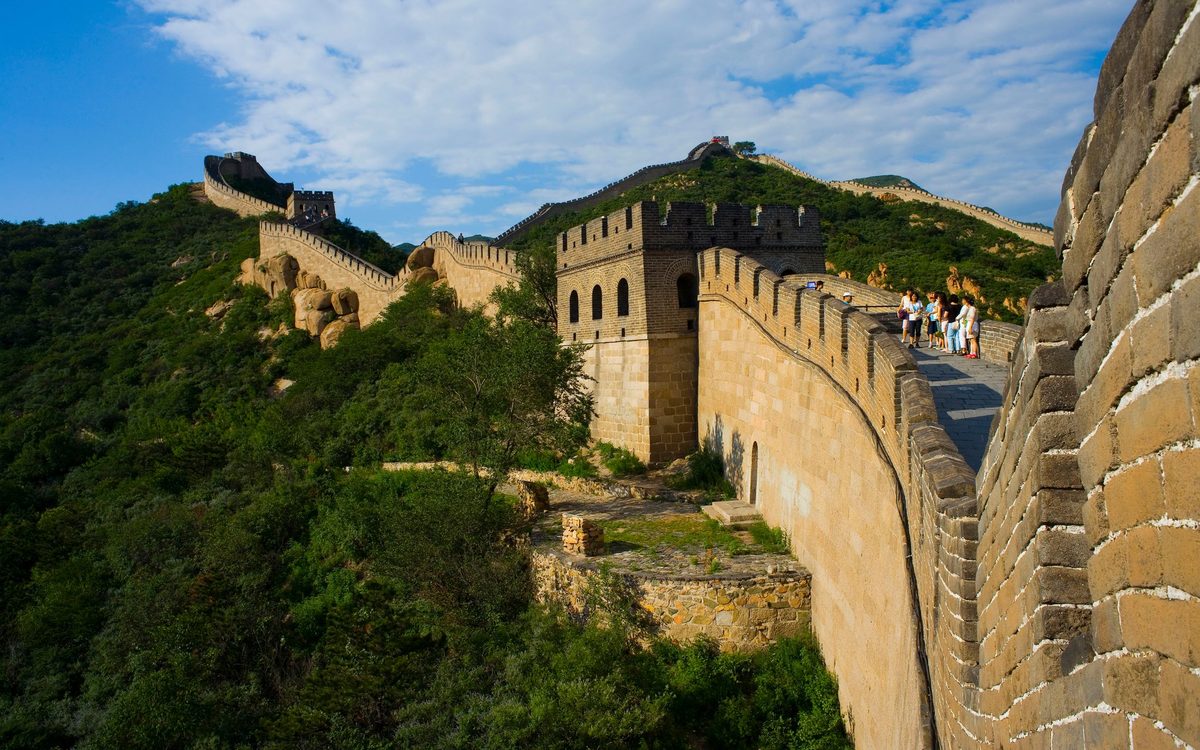
The empire's wall is the Great Wall (长城), and it is a system of four levels. Wall, tower, pass and garrison town, four levels, from the sea at Shanhaiguan (山海关) to the desert at Jiayuguan (嘉峪关), with an older earth wall running on past Dunhuang (敦煌) into the Gobi. Fourteen of the forty places on this page belong to it, and they come in three states a visitor must know apart: restored, where the brick is new and the steps are safe; original, where the Ming (明), 14th to 17th century brick is still in place with the maker's marks on it; and wild, where the wall has fallen in and no entry gate stands.
The city's wall is the one that can be ridden on a bicycle. Eight walled cities on this page still have their circuit, from Xi'an (西安)'s fourteen kilometres to a Song (宋), 10th to 13th century wall at Ganzhou (赣州) where every brick carries a date. Two mountain fortresses belong here too, because they were built for the same purpose as the Great Wall and, unlike it, they held.
The coast's wall is the newest and the saddest. Four forts and a naval base, from a Ming harbour for the fleet that fought the pirates to the Qing (清), 17th to early 20th century gun batteries that met the Royal Navy in 1841 and the Japanese in 1895. The guns are still there. The wall did not work, and the survey is honest that this is where modern China begins.
The family's wall is the one foreigners have seen in photographs. The round earth buildings (土楼) of Fujian (福建), the tower-houses of Kaiping (开平碉楼) built by emigrants home from California, and the stone village of the Qiang (羌族) in the mountains above Chengdu (成都) are all fortifications, against bandits, against clan feuds, against the next valley, and all three still have people in them, which is why they belong to this page for their walls and to the old-town page for their life.
How to use the page. Decide which threat is of interest. New visitors want the empire's wall near Beijing and one of its two ends; people who have done that want the passes of the north and the walls that turned into markets; walkers want the wild sections and the mountain fortresses; anyone in the south wants a city wall and a family's wall. The survey's forty are sorted that way below, with the honest note on every one of what is Ming and what was rebuilt last century.
02What the Great Wall Is
How long is the Great Wall, who built it, and what is it made of?
The Great Wall (长城) is not one wall and was never finished. It is two thousand years of walls built by different states against different horsemen, and the brick one in the photographs is the last hundred years of it.
The count and the material. The state heritage survey of 2012 measured every wall it could find and put the total at just over twenty-one thousand kilometres, by the survey's citation. Much of that is earth: rammed earth (夯土), or in the desert sand packed between layers of reed and tamarisk that the salt has kept for two millennia. The Ming (明), 14th to 17th century wall, the one visitors mean, is under nine thousand kilometres of it by the survey's figure, and just the stretches near Beijing were faced in brick and stone.
Who built which. An early wall on the page is not the First Emperor (秦始皇)'s: the state of Qi (齐国) in Shandong (山东) began one around 685 BC, four centuries before him, and a stretch of it can still be walked. The Qin (秦), 3rd century BC joined the northern walls into one after 221 BC; the Han (汉), 2nd century BC to 3rd century AD pushed an earth wall west past Dunhuang (敦煌) with a chain of beacon towers to carry news to the capital in hours; the Ming, after 1368, rebuilt the whole northern line and organised it as nine frontier commands with garrison towns behind it. Everything a visitor climbs near Beijing dates from the Ming's last century.
The idea was to trade height for time. A wall does not stop a mounted raiding party; it slows one. Riders who have to dismount, find a breach and pass through in file give the towers time to light their fires and the garrison towns time to send reinforcements. That is why the wall runs along ridges where a horse cannot climb anyway: the ridge is the wall, and the brick on top is the signal line.
The towers came from the coast. In the 1550s a general named Qi Jiguang (戚继光), working on the Zhejiang coast, built two-storey hollow towers into the city wall of Linhai (临海) so that a garrison could live, store grain and keep watch from inside them. In 1567 he was sent north to command the Beijing frontier and spent sixteen years turning its earth wall into a chain of those towers; the ones at Jinshanling (金山岭) and Badaling (八达岭) are his design, and the survey calls Linhai the blueprint for the wall foreigners know.
And then it became a customs post. After a peace with the Mongols in 1571 the passes opened markets; after the Qing (清), 17th to early 20th century united both sides of the wall in 1644 a new gate was cut at Zhangjiakou (张家口) for the caravan road to Mongolia and Russia, named a gate, not a pass. The wall spent its last two centuries collecting tax. The page keeps that story for its own section, because it is the one thing about the wall that is rarely told.
03Beijing's Wall: Restored, Original, Wild
Which section of the Great Wall near Beijing should a visitor choose: Badaling, Mutianyu, Jinshanling, Simatai or Jiankou?
Six sections of the wall lie within two hours of Beijing, and they are three different experiences: rebuilt for crowds, left as the Ming (明), 14th to 17th century built it, or fallen in and free. Choose by which of the three appeals, and by how far the walk should be.
Restored: Badaling (八达岭) and Mutianyu (慕田峪). Badaling, sixty kilometres out at the north mouth of the Juyong gorge (关沟), is the section that many tour buses go to; it is rebuilt to the last brick, safe, and busy. Mutianyu, seventy kilometres out, is the same age and the same restoration with more trees, a cable car (索道) and fewer people, and the survey's pick for an opening visit. Three to four hours each.
Original: Jinshanling (金山岭) and Simatai (司马台). Jinshanling, a hundred and thirty kilometres north-east, is the survey's well-preserved Ming wall: sixty-seven towers of Qi Jiguang (戚继光)'s design, bricks stamped with the year and the battalion that fired them, and by the survey's estimate eight parts in ten of what is touched is Ming. It was braced in the nineteen-eighties, never rebuilt, and gets a tenth of Badaling's visitors. Simatai, five kilometres east and a hundred and twenty from the city, was never braced at all: the survey calls it a section left in its Ming condition, a tower every hundred and fifty metres, one stretch with a parapet on one side and a cliff on the other. Cable car up; the lookout tower on the summit is nearly a thousand metres.
Wild: Jiankou (箭扣). Eight kilometres of collapsed wall on a ridge shaped like a drawn bow, thirty kilometres beyond Huairou (怀柔), no rail, no stairs, and slopes the survey puts at eighty degrees on the stretch called the Eagle Flying Upside Down (鹰飞倒仰). It is a much photographed wall in China and a hazardous one; go with a guide, in daylight, in dry weather, and give it four to six hours. Restoration has been creeping along it since 2005 on a principle of doing as little as possible.
And the gate the wall was built to guard. Juyongguan (居庸关), fifty kilometres out in the gorge below Badaling, has a rebuilt Ming fort from the nineteen-nineties around one genuine treasure: a stone arch of 1345 that once carried a Buddhist tower, carved inside with scripture in six scripts, two of them extinct. Beside it run the Ming wall, the railway of 1909 built without foreign engineers, and the motorway. Two to three hours.
The honest order is Mutianyu for an opening day, Jinshanling for a second, Simatai for those staying out there, and Jiankou for those who walk mountains at home.
04The Two Ends: Sea and Desert
Where does the Great Wall begin and end, and what is the Han wall at Dunhuang?
The Ming (明), 14th to 17th century wall begins in the sea and ends in the Gobi, and beyond the Gobi an older wall goes on. The two ends are a day each, and the far end is a good place in China to see what the wall was before it was brick.
Shanhaiguan (山海关), where the wall walks into the water. Fifteen kilometres from Qinhuangdao (秦皇岛) and on the high-speed line from Beijing, the pass was founded in 1381 by a Ming general where the mountains come down to the Bohai Gulf (渤海) and leave eight kilometres of flat ground. Three things make the visit: the gate tower with the inscription (天下第一关), the leading pass under heaven, rebuilt in the nineteen-fifties to its Ming pattern; the Old Dragon's Head (老龙头), where the wall runs out into the sea on a stone platform built by Qi Jiguang (戚继光) in 1579 and rebuilt in the nineteen-eighties; and the section climbing Jiao Mountain (角山) behind, which is Ming and quiet. In 1644 the gate marked the turn from the Ming to the Qing, and the survey tells that story at the gate. Three to four hours with the sea; arranged ahead on holidays. The walled town inside is on the old-town page.
Jiayuguan (嘉峪关), where the wall gives up. Six kilometres from the city of the same name, at the point where the Hexi corridor (河西走廊) narrows to fifteen kilometres between two ranges, a fortress founded in 1372 and finished in 1539 stands alone on the gravel with its inner and outer walls and gate towers complete, a very well preserved fortress on the Ming line by the survey's judgement. It was as much a customs house as a fort: caravans showed their papers and paid duty here, and envoys from the west waited for permission to go on to Beijing. Stand on the west wall at dusk and the next thing is the desert. Two to three hours.
Dunhuang (敦煌), where the older wall goes on. Ninety kilometres west of Dunhuang, reached by car, the Han dynasty's Jade Gate (玉门关) is a rammed-earth fort ten metres high, put there around 110 BC to control the northern road to Central Asia and never rebuilt; it was inscribed with the Silk Road in 2014. Beside it runs the Han wall (汉长城) itself: sand packed between layers of reed and red willow, beacon towers still standing, and stacks of signal fuel two thousand years old lying where the sentries left them, very old signalling equipment by the survey's claim. Seventy kilometres south, the southern gate at Yangguan (阳关) is a single Han beacon on a hill above dunes littered with old potsherds, a museum built in 2003, and a poem every Chinese schoolchild knows about leaving friends behind. Half a day for the two with the wall between.
The lesson of the ends is the material: brick at the sea, stone in the corridor, sand and reed in the desert. The wall was always built from whatever was underfoot.
05The Passes of the North
Which Great Wall passes in Shanxi and Hebei are worth visiting?
Between the two ends the wall crosses the mountains of Shanxi (山西) and Hebei (河北) through passes that each carry a story, and it touches the Yellow River exactly once. Six places, none of them crowded, tell the wall's northern story.
Yanmen (雁门关), a pass with a long record. Twenty kilometres above Daixian (代县) and a hundred and fifty from Taiyuan (太原), the gap in the Goujian range has, by the survey's count, a long record of events: a Zhao general's ambush of the nomads in 265 BC, Han (汉), 2nd century BC to 3rd century AD marches against the Xiongnu (匈奴), the Song (宋), 10th to 13th century general Yang Ye (杨业)'s victory of 980 that made his family a legend, and the palace woman Wang Zhaojun (王昭君) riding through in 33 BC to marry a chieftain. The fort is Ming (明), 14th to 17th century, of 1374, on a dramatic saddle. Two to three hours.
Niangzi (娘子关), the pass with a woman's name. In a gorge of the Taihang mountains forty kilometres from Yangquan (阳泉), the fort of 1541 is named for a Tang (唐), 7th to early 10th century princess, Pingyang (平阳公主), who held the pass in 617 and who was buried six years later with honours. Waterfalls below the walls; under two hours.
Pingxingguan (平型关), a Ming pass. A hundred and thirty kilometres from Datong (大同) in Shanxi, the pass of 1511 on the inner wall is visited today for the gorge below it. The Ming wall is original.
Laoniuwan (老牛湾), where the wall meets the river. Forty kilometres from Pianguan (偏关) in the far north-west of Shanxi, a fort of 1467 and a hollow watchtower of 1636 stand on a cliff a hundred metres above the Yellow River's opening bend into the province, the one point on the whole line where the Great Wall (长城) touches the river. The wall here is dry-laid limestone, no mortar, nothing like Beijing's brick. A boat trip is part of the visit.
Suoyang (锁阳城), a Tang city in the Gobi. Seventy kilometres from Guazhou (瓜州) and a hundred and seventy from Dunhuang (敦煌), a whole frontier city of the seventh century stands in rammed earth (夯土): inner wall, outer wall, a third wall for the horses, a temple ruin and the irrigation canals that fed the garrison's own fields. It was inscribed with the Silk Road in 2014 and the survey calls it a very complete Tang city defence in China. Reached by car; two to three hours.
And a much older wall. Seventy kilometres from Jinan (济南), at Jinyang Pass (锦阳关), seven hundred and fifty metres of the wall the state of Qi (齐国) began around 685 BC still stand five metres high with their arrow slits, four centuries older than the First Emperor (秦始皇)'s, open to walk. The legend of the widow who wept a wall down began here, the survey notes, before it moved north.
06The Wall as a Customs Post
Was the Great Wall used for trade?
For its last three hundred years the Great Wall (长城) collected tax. Four places on the northern line show the change from battlefield to market, and they are the part of the wall's story that never reaches a guidebook.
Zhenbeitai (镇北台), a great tower and the market beside it. Five kilometres north of Yulin (榆林), a very large watchtower by the survey's measure, thirty metres and four storeys, was built in fifteen months in 1607 to guard a walled market next door, an official trading ground between Ming China and the Mongols after the peace of 1571. Tower and market sit side by side, trade in one frame, and almost nobody visits. An hour.
Dajingmen (大境门), the gate that is not a pass. At Zhangjiakou (张家口), eleven kilometres from the high-speed station, the Qing (清), 17th to early 20th century cut a new opening in the Ming (明), 14th to 17th century wall in 1644 and called it a gate, a gate on the wall named that way, because its purpose was to let the caravans out. From here the tea road ran to Ulaanbaatar and on to Russia, and the survey records the silver that passed through in the hundreds of millions of taels. Above the arch a governor of 1927 painted four characters, "great rivers and mountains (大好河山)," that are still there. Free below.
Shahukou (杀虎口), the gate the migrants walked through. Thirty kilometres from Youyu (右玉) on the Shanxi (山西) side, the Ming called this pass Kill-the-Barbarians; in 1696 the Kangxi (康熙) emperor, having just fought the Mongols as allies, changed one character so that it read Kill-the-Tiger, and the name records a change of policy. Through it in the eighteenth and nineteenth centuries walked the Shanxi merchants and the millions of migrants of the movement called Going West (走西口), whose cart ruts are still cut in the old road. The gate tower is modern; the earth wall and the road are old. Free, two hours, with a free museum in Youyu.
And a pass that moved. The Han pass of Hangu (汉函谷关), thirty kilometres from Luoyang (洛阳), stands off the Great Wall and belongs with these: in 114 BC a general asked the emperor to shift the old Qin frontier gate three hundred li east so that his home would lie inside the pass, and paid for it himself. What stands is the Han earth platform with a brick tower of 1923 on top, two eras in one building, inscribed with the Silk Road in 2014 as an early pass west out of Luoyang. An hour.
What the four say together is that the wall's enemy changed. Once the horsemen were customers, the towers watched the caravans and the gates counted the silver, and the wall went on standing because it was still useful, as a border.
07The Passes Without Walls
What are Jianmen Pass and Tongguan, and why are they well known without a wall?
Two of China's well-known passes have almost no wall at all. They are places where the ground did the work, and the phrase every Chinese knows, one man at the pass and ten thousand cannot force it, was written about one of them.
Jianmen (剑门关), the gate of Sichuan (四川). Fifty kilometres from Guangyuan (广元) and fifteen from Jiange (剑阁), the road from the north into Sichuan squeezes through a gorge under cliffs of conglomerate three hundred metres high. In 229 the chancellor Zhuge Liang (诸葛亮) had a plank road built along the cliff face and a gate set in the gap; the holes his engineers cut for the beams are still in the rock, thirty centimetres across, and are the old part of the site by a long way. The poet Li Bai (李白) wrote of the gorge that one man could hold the pass. The gate tower itself has been destroyed three times in a lifetime, taken down for a road in 1935, rebuilt in 1992, burned in 2006 and shaken down in the 2008 earthquake, and the one standing is a design of 2009. Go for the gorge, the holes and the cliff path, and read the tower as the fourth attempt. Three to four hours, with the cypress-lined road beyond.
Tongguan (潼关), the gate of the Wei valley, largely under water. Where the Yellow River turns east and the Hua mountains come down to meet it, five kilometres from the modern county town, a pass founded by Cao Cao (曹操) in 196 replaced the old Qin gate as the eastern door of the capital region and was contested for eighteen centuries. In 1960 the old town was moved wholesale for the Sanmenxia (三门峡) reservoir and much of the pass went under the lake or under the bulldozer. What remains are fragments of Ming (明), 14th to 17th century and Qing (清), 17th to early 20th century wall on the hill and the shape of the river bend, free and unvisited, which the survey rates as worth an hour and a half precisely because it shows how many well-known passes no longer exist.
Why they belong on a wall page. The Great Wall (长城) is the same idea at a bigger scale: put the barrier where the land already narrows and the threat has to come to the barrier. Jianmen and Tongguan are the idea with the wall left out, and after seeing them the brick near Beijing looks less like a monument and more like an argument about geography.
08The City Walls
Which Chinese cities still have complete city walls that can be walked or cycled?
Eight Chinese cities still have their wall all the way round, and the fine ones are a better afternoon than many palaces: visitors walk or ride the circuit, look down into the city, and read the bricks.
Xi'an (西安) is the one to ride. Fourteen kilometres around, twelve metres high, built between 1370 and 1378 on the foundations of the Tang (唐), 7th to early 10th century imperial city and faced with brick in 1568, it is a very large intact city wall in China by the survey's account and wide enough on top for a rented bicycle to do the loop in two to three hours. The ring park below it dates from 1983, when the city cleared the shanties from its foot. Lit at night.
Nanjing (南京) is the one to read. The Ming (明), 14th to 17th century founder's capital wall of 1369 to 1393 followed the hills and the river instead of a square, ran thirty-five kilometres, and lost ten of them to demolition in the nineteen-fifties and sixties; twenty-five survive, a very long city wall by the survey's claim. Every brick was stamped with the names of the kiln, the foreman and the county that made it, so that a bad brick could be traced, and they can be read by hand. The Gate of China (中华门) on the south side is a barbican of three courts inside one another, a vast one. Parts are free.
Pingyao (平遥) is the one that comes with a town. Six kilometres of Ming brick from 1370 around a county seat that never outgrew it, seventy-two towers and three thousand crenellations arranged, the survey says, for the disciples and students of Confucius (孔子), six gates with their barbicans intact, and a walled town inside that is on the old-town page as one of the eleven towns chosen in the country. The town pass covers the wall; the high-speed station is eight kilometres out.
The other five, for people who collect walls. Jingzhou (荆州) in Hubei (湖北) has eleven kilometres of Qing brick of 1646 on a Ming base, with five hidden chambers inside the wall itself. Xingcheng (兴城) in Liaoning (辽宁) is a complete Ming garrison town, a three-kilometre square of 1428. Linhai (临海), the old prefecture city of Taizhou in Zhejiang, has five kilometres of wall founded in 402 where Qi Jiguang (戚继光) built hollow towers in the 1550s, and rounded barbicans that double as flood defences against the river. Xiangyang (襄阳) has a very wide moat at two hundred and fifty metres by the survey's measure, a stretch built by women in 378, and a long history as a frontier city of the Song. Ganzhou (赣州) in Jiangxi (江西) has a Song brick wall, laid between 1056 and 1063 above the meeting of two rivers, with five hundred and twenty-one kinds of dated brick inscription from the Song to the republic, and a drainage system of the same age still working under the town.
What to do on any of them is the same: go up at five, walk or ride until the light goes, and look at the roofs inside and the city outside. The wall is the one place in a Chinese city where both can be seen at once.
09The Walls That Won
Where did the Mongols lose in China, and what are the tusi fortresses?
The Great Wall (长城) is known for failing. Three fortresses in the south-west are the walls that held, one of them against a mighty force, and they are among the quiet world heritage sites in China.
Diaoyucheng (钓鱼城), a fortress on a hill. On a flat-topped hill above the meeting of three rivers at Hechuan (合川), an hour from central Chongqing (重庆) by bus, the Song (宋), 10th to 13th century built a fortress in 1243 on the advice of two brothers from Guizhou (贵州): hold the points, not the line, and put the garrison on a hill with its own fields and wells. The fortress held for decades against a very large force and ended with an agreement in 1279. The Song walls, gates, cliff walkways and the pits of the gunpowder works are still there. Three to four hours.
Hailongtun (海龙屯), the tusi's castle. Twenty kilometres north-west of Zunyi (遵义), on a cliff top reached by a stair of thirty-six giant steps cut into a forty-degree slope, stand nine gate-passes and the ruins of two palaces of the Yang family, who governed this corner of Guizhou as hereditary native chiefs (土司) for seven centuries from 876 and began the fortress in 1257 against the same Mongols. In 1600 the fortress was burned in a campaign by the Ming (明), 14th to 17th century. It was inscribed in 2015 with the other native-chief sites and is, the survey says, one of the quietest world heritage sites in the country; the shuttle (观光车) to the foot of the stair is worth the fee.
Laosicheng (老司城), the tusi's capital. Nineteen kilometres from Yongshun (永顺) in the mountains of western Hunan (湖南), the Peng family ruled the Tujia (土家族) people for eight hundred years and thirty-five generations from 910, and their capital, in use from 1135 until the court ended the chieftainship in 1724, survives as streets, wall and palace platforms in the forest: the left street for commoners and the right lanes for the chief's household, a plan the survey calls rare. Inscribed in 2015; two to three hours with the museum.
Why they won and the Great Wall did not is in the founding advice of the earlier fortress. A line can be crossed anywhere; a hill with water, fields and cliffs on three sides cannot be starved or stormed, and the enemy has to sit down in front of it and wait. The fortress shows the idea at work.
10The Walls That Faced the Sea
Where can the coastal forts of Qing China be seen?
The last walls China built faced the sea, and they lost. A Ming (明), 14th to 17th century harbour and three Qing (清), 17th to early 20th century gun batteries mark the century in which steamships made every wall on this page obsolete, and the survey is right that the modern country starts on these shores.
Penglai (蓬莱), the harbour that worked. On the tip of the Shandong (山东) peninsula, beside the well-known pavilion on the cliff above, a small artificial harbour with its sea gate, breakwater and walls has been a naval base since a Song (宋), 10th to 13th century squadron anchored there in 1042 and was walled by the Ming in 1376 against the pirates. Qi Jiguang (戚继光) trained his fleet here in 1553 before the coastal campaigns that made his name. It is, the survey says, an ancient naval base in China still whole. An hour and a half.
Humen (虎门), the river-mouth forts. At the mouth of the Pearl River below Guangzhou (广州), reached by high-speed train and bus, forts on the headlands hold gun pits, tunnels and magazines of the Qing, and two pits of fifty metres a side remember an event of June 1839. The museum explains the period. Two to three hours.
Hulishan (胡里山炮台), the big gun. On the shore of Xiamen (厦门), a fort finished in 1894 keeps in its original emplacement a German coastal gun of two hundred and eighty millimetres, eighty-seven tonnes, a very large one of its age by the survey's citation. The semi-underground gun positions and tunnels can be walked. Ninety minutes, ten minutes from Gulangyu (鼓浪屿)'s ferry.
Liugong Island (刘公岛), the fleet base. Fifteen minutes by ferry from Weihai (威海), the island that closes the bay was the base of the Beiyang fleet (北洋海军) from 1888, with its headquarters, dry dock, forts and an iron pier of 1891 that ships still use. The museum is free. Three to four hours.
What the four teach is the argument of the whole page in reverse. The Great Wall (长城) worked because horsemen could not climb; the coastal wall failed because a ship with an engine could choose where to land, and no wall is long enough for that.
11The Family's Wall
What are the Fujian tulou, the Kaiping diaolou and the Qiang villages?
The smallest walls on the page are the ones people still live behind. Three kinds of fortified home, in Fujian (福建), Guangdong (广东) and the mountains above Chengdu (成都), were built against bandits and neighbours, and they are fortifications in China where the visit is about the people inside.
The earth buildings (土楼) of Fujian. In the hills between Longyan (龙岩) and Zhangzhou (漳州), clans of Hakka (客家) and Minnan settlers from the seventeenth century onward built round and square houses of rammed earth (夯土) with walls a metre or two thick, one door, no windows on the ground floor, and the whole clan inside by rank around an ancestral hall in the middle. Forty-six of them were inscribed in 2008. The King of the Round Houses at Chengqi (承启楼), of 1709, is seventy-three metres across with four concentric rings and two hundred and eighty-eight rooms that once held eight hundred people, by the survey's count; the cluster at Tianluokeng (田螺坑), one square house and four round ones on a slope, is the photograph everyone has seen; a house of 1732 at Hegui (和贵楼) stands on a marsh on a raft of pine. Each cluster is visited separately, public transport is poor, and the survey allows one to two days by car from Xiamen (厦门). Families still live in many of them.
The tower-houses of Kaiping (开平碉楼). In the rice fields of the Pearl River delta west of Guangzhou (广州) stand, by the survey's count, one thousand eight hundred and thirty-three fortified towers of four to nine storeys, built between the eighteen-sixties and the nineteen-thirties by emigrants who had made money in California, Canada and Australia and sent it home to a district plagued by bandits and floods. The towers carry Greek columns, Roman arches and Islamic domes on Chinese roofs, copied from postcards, and the survey calls the district a museum of the world's architecture in one county. Inscribed in 2007 as an overseas-Chinese site. The four villages can be visited together; the tower at Zili (自力村) built in 1925 is the one from the film about a bandit and a governor. Three to four hours by car.
The stone village of the Qiang (羌族). A hundred and eighty kilometres north-west of Chengdu, two and a half hours by road, the village of Taoping (桃坪羌寨) is a labyrinth of stone houses joined by thirty-one tunnels and roof passages, with a channel of mountain water running under every house for drinking, fire and escape, and two watchtowers of ten storeys. The Qiang have farmed here since a county was founded in 111 BC, by the survey's account, and the old towers came through the 2008 earthquake standing when much around them fell. Two to three hours.
The wall and the life are two subjects. This page says why the walls were built and what they are made of; the old-town page, which lists the same three places, says who lives there now and how to visit without being a nuisance. Read both before going.
12PreeChina, and What It Is Not
What does PreeChina arrange on the Great Wall and China's other walls?
- The wall is easy to reach and hard to choose. Choosing the section, the car and the guide for the wild parts is what we do.
- Beijing, by the kind of day wanted. Mutianyu (慕田峪) for an opening morning with a driver and an early start; Jinshanling (金山岭) with a picnic for people who want the Ming (明), 14th to 17th century brick under their hands; Simatai (司马台) after dark from the resort town for a night on the wall; Jiankou (箭扣) with our mountain guide alone, in dry weather, for people who walk ridges at home. We do not send anyone to Jiankou alone and we do not arrange Badaling (八达岭) unless asked.
- The two ends. Shanhaiguan (山海关) as a day from Beijing by high-speed train, with the Old Dragon's Head (老龙头) at low tide and the walled town on the old-town page for lunch. Jiayuguan (嘉峪关) folded into a Hexi corridor (河西走廊) trip with Dunhuang (敦煌), and from Dunhuang a car for the day to the Jade Gate (玉门关), the Han wall (汉长城) and Yangguan (阳关), which have no other way in.
- The passes of the north. A Shanxi (山西) week that takes Yanmen (雁门关), Laoniuwan (老牛湾) and Pingyao (平遥)'s wall in one loop, with Datong (大同)'s caves from the grottoes page and the wooden buildings from the page on old architecture; Zhenbeitai (镇北台) and Shahukou (杀虎口) for anyone who wants the trade story.
- City walls and family walls. A bicycle on Xi'an (西安)'s wall at five in the afternoon, arranged with a tandem on request; two days in the Fujian (福建) earth buildings (土楼) by car from Xiamen (厦门) with a night inside one; Kaiping (开平碉楼) as a day from Guangzhou (广州). The coastal forts we fit into Xiamen, Weihai (威海) and Guangzhou days rather than build trips around them.
- What this page is not. It is not the old-town page, which has the towns inside the walls, Pingyao, Shanhaiguan, Jingzhou (荆州), Xingcheng (兴城), Linhai (临海) and the family walls, and the life in them. It is not the parks page, which has Badaling, Jiayuguan, Jianmen (剑门关) and Liugong Island (刘公岛) as places to spend a day. It is not the tombs page, though the tombs page's emperors built much of this. It is not a page of military judgement: where a wall lost, at Humen (虎门) or on Liugong Island or at Shanhaiguan in 1644, we tell what the survey records and leave the verdicts to the reader.
- The practical rules. Wild wall means a guide, boots, water, daylight and a weather check. Entry is worth arranging ahead for Badaling and Mutianyu and on holidays at Shanhaiguan, and for Jianmen and the Humen forts; the desert sites near Dunhuang need a car and have no shade. We check every rule the week of travel.