
01Reading the Cliff
What are the cave temples of China, and in what order should they be seen?
The cave temples (石窟) of China are the footprints Buddhism left as it walked in along the Silk Road, and they can be read like a book, west to east and early to late. At Kizil (克孜尔石窟) the Buddha has a Greek face; at Yungang (云冈石窟) he has an emperor's; at Longmen (龙门石窟) he puts on a Chinese robe; at Maijishan (麦积山石窟) he learns to smile; at Dazu (大足石刻) he starts telling stories. Stand in front of any cliff and ask one question at the start: which century is this?
The book has an order. The early caves are in the far west, at Kucha (龟兹) in Xinjiang (新疆), cut from the third century by a kingdom that had Buddhism before China did. The road runs east through the Gansu (甘肃) corridor, where a small kingdom at Wuwei (武威) set the pattern in the early fifth century, where an early dated inscription in a Chinese cave, of 420, is at Bingling (炳灵寺石窟) above the Yellow River, and where Dunhuang (敦煌) kept painting for a thousand years. It reaches the northern capitals at Yungang in 460 and Longmen in 493, the two imperial sites, and runs on into the sixth century at Xiangtangshan (响堂山石窟) and the Tang at Tianlongshan (天龙山石窟). Then the north stops and the south begins: the giant at Leshan (乐山) in the eighth century, the kings of Yunnan (云南) at Shizhongshan (石钟山石窟) in the ninth, and the last flowering at Anyue (安岳石刻) and Dazu in Sichuan (四川) between the ninth century and the thirteenth, where the Buddha shares a cliff with Confucius (孔子) and Laozi (老子) and the carvings tell stories about hell and parents.
Three kinds of looking. Some caves are looked up at: the seventy-one-metre Buddha at Leshan (乐山大佛), the twenty-seven-metre one at Bingling, the twenty-metre one at Xumishan (须弥山石窟). Some are entered with a guide and a torch, because the art is painted on the walls and the caves are kept dark: Mogao (莫高窟), Yulin Caves (榆林窟), Kizil. And some are climbed, on wooden walkways bolted to a cliff eighty metres high at Maijishan or through tunnels cut inside the rock at Mati (马蹄寺石窟). Know which kind is planned, because it changes the shoes, the time and the arrangements.
Some pages are missing. Between 1902 and the nineteen-twenties, expeditions from Germany, Japan, Britain and the United States cut murals from the walls at Kizil and Bezeklik (柏孜克里克石窟) and sawed heads from the statues at Xiangtangshan and Tianlongshan. They are in Berlin, Tokyo, New York and Washington, and half the Berlin murals were later lost. The page says at each site what is gone, and records the head that came home in 2021.
The eighteen on this page are the survey's choice: five great sites inscribed on their own, two more inscribed with the Silk Road in 2014, and eleven that hardly any foreigner has heard of, seven of them in Gansu alone. Photography is forbidden inside almost every cave on the page; the torch is the guide's, and the visit is slower and quieter than anything else in Chinese heritage.
| Century | Site | Where | What is seen | Look |
|---|---|---|---|---|
| 3rd to 8th | Kizil | Kuqa, Xinjiang | diamond-lattice murals, Persian and Greek east | walk in, torch |
| 5th | Tiantishan | Wuwei, Gansu | the Liangzhou model; a Buddha behind a dam | look up |
| 420 onward | Bingling | Lanzhou, Gansu | Early dated inscription; 27 m Buddha | boat, look up |
| 4th to 14th | Mogao and Yulin | Dunhuang and Guazhou | a thousand years of murals | walk in, torch |
| 5th to Ming | Maijishan | Tianshui, Gansu | 7,800 clay figures, the eastern smile | climb |
| 460 to 524 | Yungang | Datong, Shanxi | the emperor as Buddha, Gandharan faces | look up |
| 493 to Tang | Longmen | Luoyang, Henan | the Chinese robe; the Tang Vairocana | walk the river |
| 550 to Tang | Xiangtangshan · Tianlongshan | Hebei, Shanxi | transition and Tang peak; missing heads | walk in |
| 5th to Tang | Xumishan · Beishikusi · Mati | Ningxia, east Gansu, Zhangye | the forgotten corridor | look up, climb inside |
| 713 to 803 | Leshan | Sichuan | the 71 m giant | cliff stair or boat |
| 850 to 12th | Shizhongshan | Dali, Yunnan | the kings of Nanzhao | walk |
| 892 to 1252 | Anyue · Dazu | Sichuan, Chongqing | stories in stone; three teachings | walk |
02The Road In
What are the Kizil, Bezeklik and Tiantishan caves, and why do they matter?
Three sites in Xinjiang (新疆) and the Gansu (甘肃) corridor are the opening chapters, and the survey is honest that they are hard to reach and badly damaged. They are where the style that filled Dunhuang (敦煌) and Yungang (云冈石窟) was worked out.
Kizil (克孜尔石窟), the beginning. Seventy kilometres from Kuqa (库车), in a valley of the Tianshan foothills, the kingdom of Kucha (龟兹) cut caves from the third century, a hundred years before Dunhuang by the survey's count, and painted them in a manner found nowhere else: ceilings divided into diamond lattices, each cell holding a scene from the Buddha's earlier lives, in blues from lapis and a style that mixes India, Persia and the Greek east. The cave of musicians has twenty-eight groups of players. Between 1906 and 1914 a German expedition removed five hundred square metres of these walls by the survey's figure, and the survey notes the site is better known in the West, where the pieces are, than in China. Two hours, and a long drive.
Bezeklik (柏孜克里克石窟), the Uyghur (维吾尔族) court. Forty-five kilometres from Turpan (吐鲁番), in the red gorge of the Flaming Mountains (火焰山) that every Chinese child knows from the story of the Monkey King (孙悟空), the Uyghur kingdom of Gaochang (高昌), Buddhist between the ninth century and the thirteenth, kept its royal temple in a row of caves above a river. The murals showed the kingdom's nobles as donors in their own dress, a notable body of Uyghur Buddhist painting by the survey's account, and between 1902 and 1914 German teams took four hundred square metres of them to Berlin, where half were destroyed in 1945. What remains is fragmentary and the setting is magnificent. An hour and a half.
Tiantishan (天梯山石窟), the ancestor. Fifty kilometres from Wuwei (武威), an hour by car with no bus, the kings of the short-lived Northern Liang (北凉) cut caves between 412 and 439 that the survey calls the ancestor of Chinese grottoes: it was here that the Central Asian manner was married to Chinese hands into what scholars call the Liangzhou model (凉州模式), and when the Northern Wei (北魏) took over the kingdom in 439 its craftsmen moved east to build Yungang. A fifteen-metre Tang Buddha sits in the main cave with six attendants. In 1959 a reservoir was built across the valley, the murals and statues of the smaller caves were moved to museums, and the big Buddha was left behind a dam, a major relocation in the history of Chinese cave conservation by the survey's account. An hour.
Why start here. Everything at Yungang and Dunhuang that looks foreign, the faces, the lattices, the blue, arrived by this road. Seeing the three at the start makes the well-known sites legible; seeing them after makes them look like drafts, which they were.
03Dunhuang: Mogao and the Quiet Sister
How are the Mogao Caves at Dunhuang visited, and what are the Yulin Caves?
Mogao (莫高窟) is the one everyone knows and it deserves it: a thousand years of painting on forty-five thousand square metres of wall, in a cliff at the edge of the desert. The visit is strictly managed and must be booked a month ahead. Its sister site at Yulin Caves (榆林窟) has the same keepers, murals the survey rates higher for one period, and a twentieth of the visitors.
What Mogao is. Twenty-five kilometres from Dunhuang (敦煌), a monk named Lezun (乐僔) cut a cave in 366, by tradition, having seen the cliff shine with a thousand Buddhas, and for a thousand years after him, through ten dynasties by the survey's count, monks, merchants and governors paid to have caves cut and painted: some seven hundred survive, four hundred and ninety-two with murals and statues. The painting runs without a break from the fourth century to the fourteenth, so that walking from one cave to the next is walking through the history of Chinese art, from Central Asian figures in thin robes to Tang (唐), 7th to early 10th century courts in full colour to the last Mongol-era work. In 1900 a Taoist caretaker found a sealed cave holding tens of thousands of manuscripts and paintings from before the eleventh century; many went to London, Paris and elsewhere over the next decade, and the story is told on site without softening. In the nineteen-forties the painter Zhang Daqian (张大千) lived here for two years copying two hundred and seventy-six murals by the survey's count, and made the place known in China.
How the visit works. The caves are dark, sealed with doors, and opened by a guide with a torch for a small group; about eight are seen, chosen by the academy that day, with special caves costing extra. Nothing may be photographed inside. Entry is arranged online well ahead in season, and the day begins with two films in the visitor centre before the buses to the cliff. Three to four hours.
Yulin Caves, the sister. A hundred and fifty kilometres east near Guazhou (瓜州), in a canyon on a river, forty-odd caves under the same academy hold work of the same periods with, the survey says, far fewer visitors than at Mogao. Its treasure is the painting of the Western Xia (西夏), the Tangut kingdom of the eleventh and twelfth centuries, and in particular the Water-Moon Guanyin (水月观音) of cave two, a figure on a rock over water under a moon that the survey calls a beautiful painting in Chinese art, and a thousand-armed Guanyin in cave three. The special caves are opened by the guide for a small group. An hour and a half to two, a car from Dunhuang.
Do both where possible: Mogao for the thousand years and Yulin Caves for the single hour of looking at one wall in silence that Mogao's crowds no longer allow.
04The River and the Clay Cliff
What are the Bingling and Maijishan grottoes?
Two sites in Gansu (甘肃), both inscribed with the Silk Road in 2014, are the ones to see after Dunhuang (敦煌): one reached by boat up a gorge of the Yellow River, the other climbed on walkways up a cliff of clay figures with notable smiles in Chinese sculpture.
Bingling (炳灵寺石窟), by boat. Seventy-five kilometres from Lanzhou (兰州), the road ends at a reservoir and a boat takes visitors up the river between red cliffs to a bend where, from the year 420, monks and pilgrims cut caves into the rock. The inscription of that year in cave one hundred and sixty-nine is an early date written in a cave in China, the survey says, and the measure against which every other early site is dated; the monk Faxian (法显) passed on his way to India in 405. Above the river sits a seated Tang Buddha of twenty-seven metres, and the caves around it run from the fifth century to the Ming (明), 14th to 17th century. Three hours with the boat, and the water level decides the season.
Maijishan (麦积山石窟), on the walkways. Forty-five kilometres from Tianshui (天水), a single hill shaped like a haystack rises from the forest with its whole face honeycombed with caves, reached by stairs and galleries bolted to the rock eighty metres up. The art here is clay: seven thousand eight hundred figures by the survey's count, modelled over twelve dynasties from the fifth century, and the survey calls the hill China's sculpture gallery. The faces of the sixth century, in caves like forty-four, wear what the literature calls the Eastern smile (东方微笑), a serene half-smile that the survey rates unmatched elsewhere. One cave is a tomb: the story goes that an empress of the Western Wei, who passed away in 540, was buried here by her son. The upper galleries are exposed and the drop is real; go in dry weather. Two to three hours.
What the two teach. The road did not run through the desert alone. Buddhism came up the Yellow River as well as along the corridor, and the clay at Maijishan shows what happened when a Central Asian art met a region with no good stone: it modelled instead of carving, and the modelling is softer, and the smile is the result.
05The Emperor as Buddha: Yungang
What is special about the Yungang Grottoes at Datong?
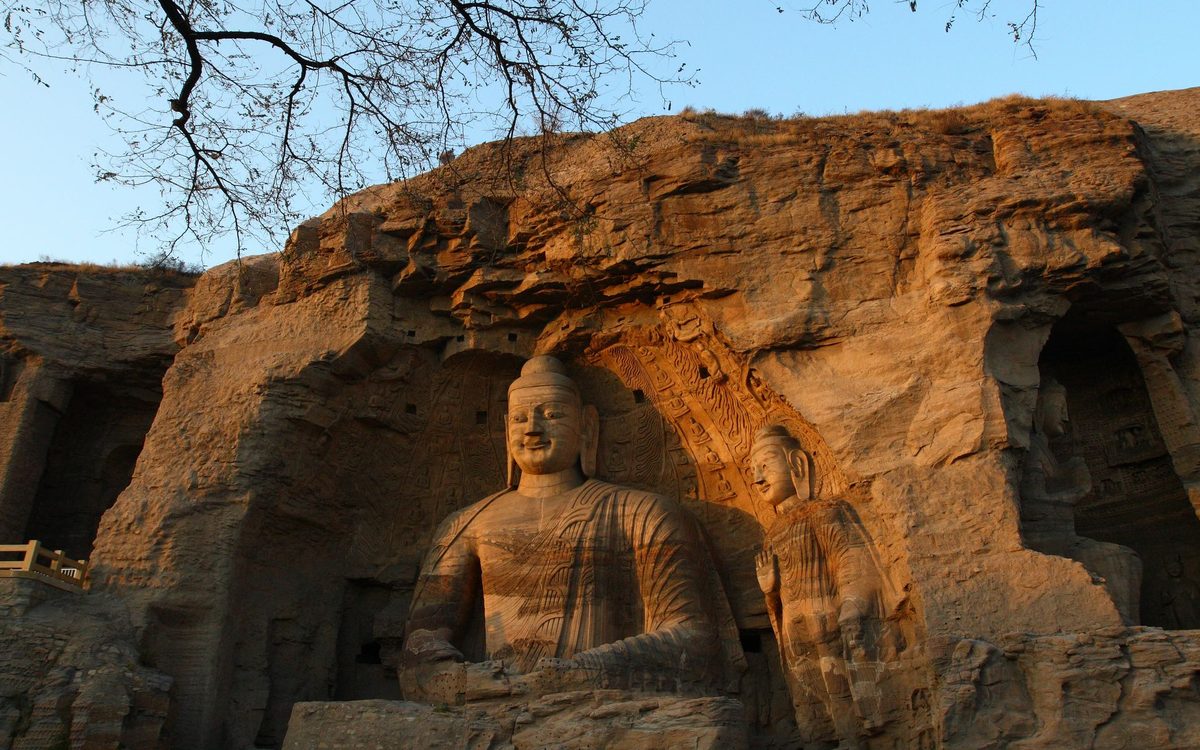
The opening great imperial caves in China were cut by a dynasty of nomads, and the Buddhas have the faces of its emperors. Yungang (云冈石窟), outside Datong (大同) in Shanxi (山西), is where the art that came down the corridor was taken over by the state.
Who and when. The Northern Wei (北魏), a people from the steppe who ruled north China from Datong, had destroyed Buddhism in 446 and restored it in 452; the monk in charge of the restoration, Tanyao (昙曜), persuaded the emperor in 460 to cut five great caves in a sandstone cliff sixteen kilometres west of the capital, one for each of the dynasty's emperors, with a Buddha in each to be understood as the emperor himself. The survey calls the idea the emperor as Buddha, and it ran through Chinese imperial cave-cutting for the next three centuries. Work went on until 524; by the survey's count the cliff holds fifty-nine thousand figures in forty-five major caves.
What is seen. The five caves of Tanyao are the ones to stand in front of: colossal seated and standing Buddhas, the main ones seventeen metres, with the broad shoulders, straight noses and heavy-lidded eyes of the Gandharan (犍陀罗) art of the Indian north-west, which had come down the road through Kucha (龟兹). This is the Buddha before he became Chinese, and the survey calls the faces raw and powerful. Later caves, six above all, are different: a central pillar carved into a tower, walls covered in thirty-three relief scenes of the Buddha's life, and figures in Chinese court dress, cut after the court had ordered its nobles to dress as Chinese. The change from cave twenty to cave six is the change from the steppe to China in one walk.
How to visit. Three hours, sixteen kilometres from the city by bus or taxi; a museum at the entrance, and the caves themselves open to the air behind wooden galleries, so that unlike Dunhuang (敦煌) they are seen in daylight and the exteriors may be photographed. It was inscribed in 2001. The geographer who wrote the classic description of China's rivers in the sixth century described these caves, the survey notes, and they have not moved.
The pairing that makes sense of the page is Yungang with Longmen (龙门石窟): the same dynasty, the same idea, thirty-three years apart, before and after it moved its capital south and decided to become Chinese.
06The Chinese Robe: Longmen
How are the Longmen Grottoes visited, and who is the great Buddha?
When the Northern Wei (北魏) moved their capital to Luoyang (洛阳) in 493 they began a new cliff on the river south of the city, and over the next three centuries the Buddha there put on Chinese clothes and, under the Tang (唐), 7th to early 10th century, a Chinese smile. Longmen (龙门石窟) is a very walkable one among the great sites and the one where the change is easiest to see.
Two banks, four centuries. The Yi River (伊河) runs between two limestone hills six kilometres south of Luoyang, and the caves are cut into both banks, a hundred thousand figures by the survey's count and more inscriptions than any site in China, some two thousand eight hundred, which is why calligraphers come here as much as Buddhists. The west bank is the early work: the Guyang (古阳洞) cave begun after 493, with the twenty inscriptions that every student of Chinese writing learns, and the Binyang (宾阳洞) caves of the early sixth century, where the figures have lost their steppe faces and wear the loose robes and broad sashes of a Chinese scholar. The survey calls it the central plains model, and it is the second step of the book.
The great Buddha. Halfway along the west bank, in an open cliff called the Fengxian (奉先寺) temple, sits the Vairocana (卢舍那) Buddha of the Tang, seventeen metres high, carved in the six seventies with a full face, half-closed eyes and a faint smile that the survey reports the Chinese call the eastern Mona Lisa. The story goes that the empress Wu Zetian (武则天) paid for it with her cosmetics allowance and that the face is hers; what is certain is the date and the quality, which the survey rates the summit of Tang sculpture. The attendants and guardians on either side, muscles and armour, are the same period.
The walk. Cross the bridge to the east bank for the later Tang caves and the view back across the water at the whole west cliff, then return through the garden of the poet Bai Juyi (白居易), who is buried at the far end. Three to four hours; the site is a park and a museum as well as a cliff, and both are on their own pages. It was inscribed in 2000.
The order that matters is west bank at the start, north to south, so that the sixth century is met before the seventh; that way the Fengxian Buddha arrives as the end of a sentence rather than a monument on its own.
07The Missing Heads
Where are the missing heads of the Xiangtangshan and Tianlongshan grottoes?
Two royal cave sites of the sixth and seventh centuries, one in Hebei (河北) and one in Shanxi (山西), hold fine sculpture of their periods and almost none of its heads. They are the pages of the book that were torn out, and the survey keeps them for that reason as much as for what is left.
Xiangtangshan (响堂山石窟), the twenty-seven years. Forty kilometres from Handan (邯郸), on two hills called north and south, the Northern Qi (北齐), a dynasty that lasted from 550 to 577, cut its great caves, and the survey calls them the surviving body of art of that short reign. The importance is in the transition: the figures have moved on from the thin, elongated scholars of the Wei and have not reached the full-bodied Tang (唐), 7th to early 10th century: a rounder, calmer style in between, with drapery that clings and a stillness the survey singles out. The main cave on the northern hill may have been intended as the tomb chamber of the dynasty's founder. In the early twentieth century dealers sawed the heads and reliefs from the walls, and the survey lists the Metropolitan Museum and the Freer in Washington as the places where whole galleries of them now stand. Two hours, and empty.
Tianlongshan (天龙山石窟), the return. Thirty-six kilometres from Taiyuan (太原) in a wooded valley, caves cut from 534 by the same founder and continued under the Qi and the Tang hold Tang figures that the survey and much of the literature rate as outstanding Tang cave sculpture in China, bodies turned and relaxed under thin cloth in a manner scholars named the Tianlongshan style. In the nineteen-twenties more than a hundred heads and figures were cut away and sold, and the survey lists Tokyo and New York among their homes. In 2021 the head of a Buddha from cave eight came back from Japan and was shown on the national New Year broadcast, and the site has become the emblem of the country's campaign to recover what was taken. Two hours, with an eight-metre Maitreya (弥勒) in cave nine, and a cool walk.
How to look at them. Bring the photographs. Both sites publish, and the survey reproduces, images of the caves as they were, and the guides will show on a phone where each missing head belongs. The bodies that remain are enough to see the style, and the empty necks are their own lesson in what a century of trade in antiquities did to a cliff.
08The Forgotten Corridor
Which cave temples in Gansu and Ningxia do tourists never see?
Between Dunhuang (敦煌) and the imperial sites lies a belt of caves that almost nobody visits, in the hills of Ningxia (宁夏) and eastern Gansu (甘肃) and in the Qilian mountains above Zhangye (张掖). Three of them hold a twenty-metre Buddha, a fifteen-metre hall and a cliff climbed from the inside.
Xumishan (须弥山石窟), the northern road. Fifty-five kilometres from Guyuan (固原), a town the survey notes many foreign travellers have never heard of, the northern branch of the Silk Road passed a gate in the hills, and from the late fifth century monks cut a hundred and sixty-two caves into the red sandstone by the survey's count. The prize is a Tang Buddha of the seventh century, twenty metres high, seated in the open in cave five and visible across the valley; the scholars' prize is a group of caves of the Northern Zhou (北周), a dynasty of the five seventies, which the survey calls a systematic body of that period's carving. Two hours, in a quiet valley.
Beishikusi (北石窟寺), the seven Buddhas. Twenty-five kilometres from Qingyang (庆阳) in the loess hills of eastern Gansu, a provincial governor of the Northern Wei (北魏) cut in 509 one of the great caves of his dynasty, a hall fifteen metres high holding the seven Buddhas of the past, each larger than a man, in a cliff that the survey calls a cathedral in the wilderness. He cut a sister cave at Jingchuan (泾川) the same year. Tang (唐), 7th to early 10th century figures fill the smaller caves. An hour and a half, and the survey records virtually no visitors.
Mati (马蹄寺石窟), the cliff climbed inside. Sixty-five kilometres south of Zhangye, in the Qilian mountains among the herding villages of the Yugur (裕固族), a people of the region, a row of temples and caves has been cut since the Northern Liang (北凉) of the fifth century, Chinese Buddhist at the start and Tibetan Buddhist since the Yuan. The site to see is the Thirty-three Heavens (三十三天): twenty-one caves in seven tiers inside a vertical cliff, joined by stairs and tunnels cut through the rock, so that the cliff is climbed from within and come out at the top, a hanging honeycomb by the survey's description. Two hours away by car, a separate cave at Jinta (金塔寺), opened by telephone arrangement days ahead, holds high-relief clay flying figures that the survey dates three centuries before Dunhuang's. Three to four hours for the main site, a car from the city.
Why bother. Because the three between them show what the great sites leave out: the Northern Zhou, the loess country, the Tibetan overlay, and the ordinary provincial patronage that cut many of the caves in China. And because in all three one's own footsteps are heard.
09The Giant: Leshan
How big is the Leshan Giant Buddha, and how should it be seen?
One cave site on the page is a single figure, and it is a very large stone Buddha. Leshan (乐山) is the eighth-century chapter, the Tang (唐), 7th to early 10th century idea of a Buddha as engineering, and a much visited place in this section (龙门石窟).
What it is. Where three rivers meet below the city of Leshan in Sichuan (四川), a monk named Haitong (海通) began in 713 to cut a seated Maitreya (弥勒) out of the red cliff, the story goes to calm the water that was drowning boatmen at the confluence; the work was unfinished at his passing and a provincial governor completed it in 803, ninety years after the opening cut. The figure is seventy-one metres from head to foot, a very large one by the survey's account, with ears seven metres long and a foot a hundred people can stand on. The genius is invisible: a system of drains cut into the hair, the shoulders and the folds of the robe carries rainwater away inside the rock, and it is the reason the survey gives for the figure's survival through twelve centuries of Sichuan rain.
How to see it. There are two ways and the survey recommends both if there is time. One is the cliff path: down a stair cut into the rock beside the Buddha from the head to the feet, slow, crowded at weekends, with the face above throughout. The other is the boat: from the river the whole figure and the two guardian carvings beside it appear at once, which is how its makers meant it to be seen. Two to three hours for the path; the boat is extra and short. The mountain behind, with its temples and paths, is on the parks page, and the cliff tombs of the Han (汉), 2nd century BC to 3rd century AD beside the south gate, with what the survey calls an early Buddha image in China, are on the tombs page.
What it is not. The Buddha at Bamiyan is gone; the survey lists a reclining Buddha of twenty-three metres at Anyue (安岳石刻) and a seated one at Rongxian (荣县大佛) as the nearest Chinese cousins, and sends anyone who wants the giant idea without the crowd to Rongxian. Leshan itself is calm at opening time on a weekday, and crowded on a Chinese public holiday, when the cliff stair becomes a long line.
Read it as a page and it is the moment when the Chinese Buddha stopped being a figure in a cave and became a landmark, part of a river and a city, which is what the southern chapters that follow are about.
10The Last Peak: Dazu and Anyue
What are the Dazu Rock Carvings, and what is Anyue?
When the north stopped cutting caves at the end of the Tang (唐), 7th to early 10th century, Sichuan (四川) carried on for four more centuries, and the last great chapter of the book is the one where the Buddha learns to tell stories, shares his cliff with Confucius (孔子) and Laozi (老子), and looks like a neighbour.
Dazu (大足石刻), the summit. A hundred kilometres west of Chongqing (重庆), on a ring of hills, carving began in 892 and went on into the twelve fifties, three hundred and sixty years, and the survey calls the result the last peak of Chinese cave art. The two sites to see are Baoding (宝顶山) and Beishan (北山). Baoding is the work of one monk, Zhao Zhifeng (赵智凤), who spent seventy years from the twelve hundreds laying out a single continuous sermon in stone around a horseshoe valley: the wheel of rebirth (六道轮回图), nearly eight metres across, held in the teeth of a demon; a reclining Buddha thirty-one metres long; scenes of parents raising children and of what happens to the unfilial in hell, with a drunkard, a cattle herd, a woman feeding a baby. It is carving read like a comic strip, and the survey notes it was meant to be. On a third hill three niches hold Buddha, Laozi and Confucius side by side, a cave site in China to do so by the survey's account. Four to five hours for both hills. It was inscribed in 1999.
Anyue (安岳石刻), the source. A hundred and fifty kilometres from Chengdu (成都), the county of Anyue has a huge number of carvings by the survey's count, a hundred thousand figures at more than two hundred sites, many of them in fields and on farm tracks, and Zhao Zhifeng learned his trade here before he went to Dazu. Three are worth the drive: a seated Guanyin (观音) of the Northern Song (宋), 10th to 13th century, three metres high, one knee raised, so graceful that the survey reports the Chinese call her the Eastern Venus; a reclining Buddha of the Tang, twenty-three metres, carved lying on his left side across a hill; and a cave of twelve bodhisattvas of the eleventh century. The sites are scattered, and the survey allows four to six hours by car and reports one visitor for every hundred at Dazu.
What changed. The northern caves were cut for emperors and monks and show the Buddha as a lord; the Sichuan cliffs were cut for farmers and townspeople and show him as a teacher with a story to tell about their own lives. That is the end of the book, and it is the friendliest chapter for anyone who has never opened it.
11The Kings of Yunnan
What are the Shizhongshan grottoes near Dali?
One cave site on the page belongs to no Chinese dynasty. In the hills of Dali (大理), a kingdom that stood beside the Tang (唐), 7th to early 10th century and the Song (宋), 10th to 13th century for five hundred years carved its own kings, and they are portraits of them.
Shizhongshan (石钟山石窟). Twenty-five kilometres from Jianchuan (剑川) and a hundred and twenty from Dali, on a mountain of red sandstone called Shibao (石宝山), the kingdom of Nanzhao (南诏) and its successor Dali cut sixteen caves between 850 and the twelfth century. Two of them are courts: the king Yimouxun (异牟寻) seated in council with his ministers, and the king Geluofeng (阁逻凤) on procession with a retinue of sixteen, in the dress of their own court and not of China's, surviving likenesses of the rulers of a state that the Chinese histories mention in a few lines. The survey calls them the royal portrait gallery of a lost empire. The other caves hold Buddhas and guardians in a style with Indian and Tibetan as well as Chinese hands, cut by the Bai people (白族), who still live in the villages below and whose temple fairs (庙会) on the mountain are on the page on shows.
The carving people talk about. Cave eight holds a carving of the female organ, venerated for fertility by the Bai for centuries and still, the survey records, the object of offerings by women hoping for children; it is rare in a Chinese Buddhist cave, and the site presents it without embarrassment. Visitors should treat it as the local people do, which is to say respectfully and without cameras.
How to visit. Two to three hours; the mountain is a scenic area (景区) with a temple and a colony of monkeys, the road from Dali runs through Jianchuan's old town, which is on the old-town page, and the survey reports almost no tourists. Go in the late afternoon when the sandstone turns red.
Why it is here. Because the book of the cliffs is not just a Chinese book. Nanzhao took Buddhism from India and Tibet (西藏) as much as from the Tang, and its kings had themselves carved in their own likeness beside the Buddha, which no Chinese emperor before the Northern Wei (北魏) had dared and none after them did. It is the one chapter written in another language.
12PreeChina, and What It Is Not
What does PreeChina arrange at China's cave temples, and what are the rules?
- Caves are booked, guided and driven to, and the three are what we do. The reading is the reader's.
- The Silk Road book, in order. Kizil (克孜尔石窟) and Bezeklik (柏孜克里克石窟) from Kuqa (库车) and Turpan; Mogao (莫高窟) arranged a month ahead and Yulin Caves (榆林窟) the next day by car; Mati (马蹄寺石窟) and its telephone cave from Zhangye; Tiantishan (天梯山石窟) from Wuwei; Bingling (炳灵寺石窟) by boat from Lanzhou (兰州) and Maijishan (麦积山石窟) from Tianshui; then Xumishan (须弥山石窟) and Beishikusi (北石窟寺) for the completists, and the two imperial sites, Yungang (云冈石窟) and Longmen (龙门石窟), as the end of the road. Three weeks for all of it, a week for the Gansu (甘肃) heart, and the survey's Silk Road itinerary is the spine.
- The Sichuan (四川) book. Leshan (乐山) by cliff path and by boat, Anyue (安岳石刻) by car through the fields, Dazu (大足石刻)'s two hills in a day, and Shizhongshan (石钟山石窟) from Dali (大理) as a detour; five days.
- Two days from a city. Longmen from Luoyang (洛阳) with the White Horse Temple (白马寺) from the temples page; Yungang from Datong (大同) in Shanxi (山西) with the wooden buildings of the architecture page; Xiangtangshan (响堂山石窟) and Tianlongshan (天龙山石窟) as a pair for anyone chasing the missing heads.
- The rules that hold everywhere. No photographs inside a cave unless a sign says otherwise, and the sign almost never does. The guide carries the torch and opens the doors; stay with the group. Special caves cost extra and are worth it at Mogao, Yulin Caves and Mati. Walkways at Maijishan and the cliff stair at Leshan close in rain and ice. Mogao must be arranged about a month ahead in season and turns away walk-ins; Mati's Jinta (金塔寺) cave is arranged by telephone days ahead; Longmen, Yungang, Dazu, Leshan and Maijishan are worth arranging ahead and can be walked into on a quiet weekday. We check every rule the week of travel.
- What this page is not. It is not the temples page, which has the living monasteries and the faith; here the caves are art and history, and nobody prays in many of them. It is not the museums page, which has the site museums at Longmen, Yungang and Dazu and the Dunhuang (敦煌) academy's exhibitions in the cities. It is not the parks page, where Longmen, Leshan and Maijishan appear as places to spend a day outdoors. It is not the tombs page, which has the Han cliff tombs beside the Leshan Buddha. And it takes no view on any of the images: we say which century cut them, who paid, what was taken and where it is, and leave the rest to the wall.