
Qingyang is in Gansu, in Northwest China.
Home › Destinations › Gansu › Qingyang
Gansu · City Guide
Qingyang, Where the Loess Lies Deep in the World.
Overview
Why Go
The Dongzhi tableland covers roughly 900 square kilometres of flat farmland with loess up to two hundred metres deep beneath it, generally described as a large and thickest loess plateau surface on earth. It is wheat to the horizon with gullies cut into the edges.
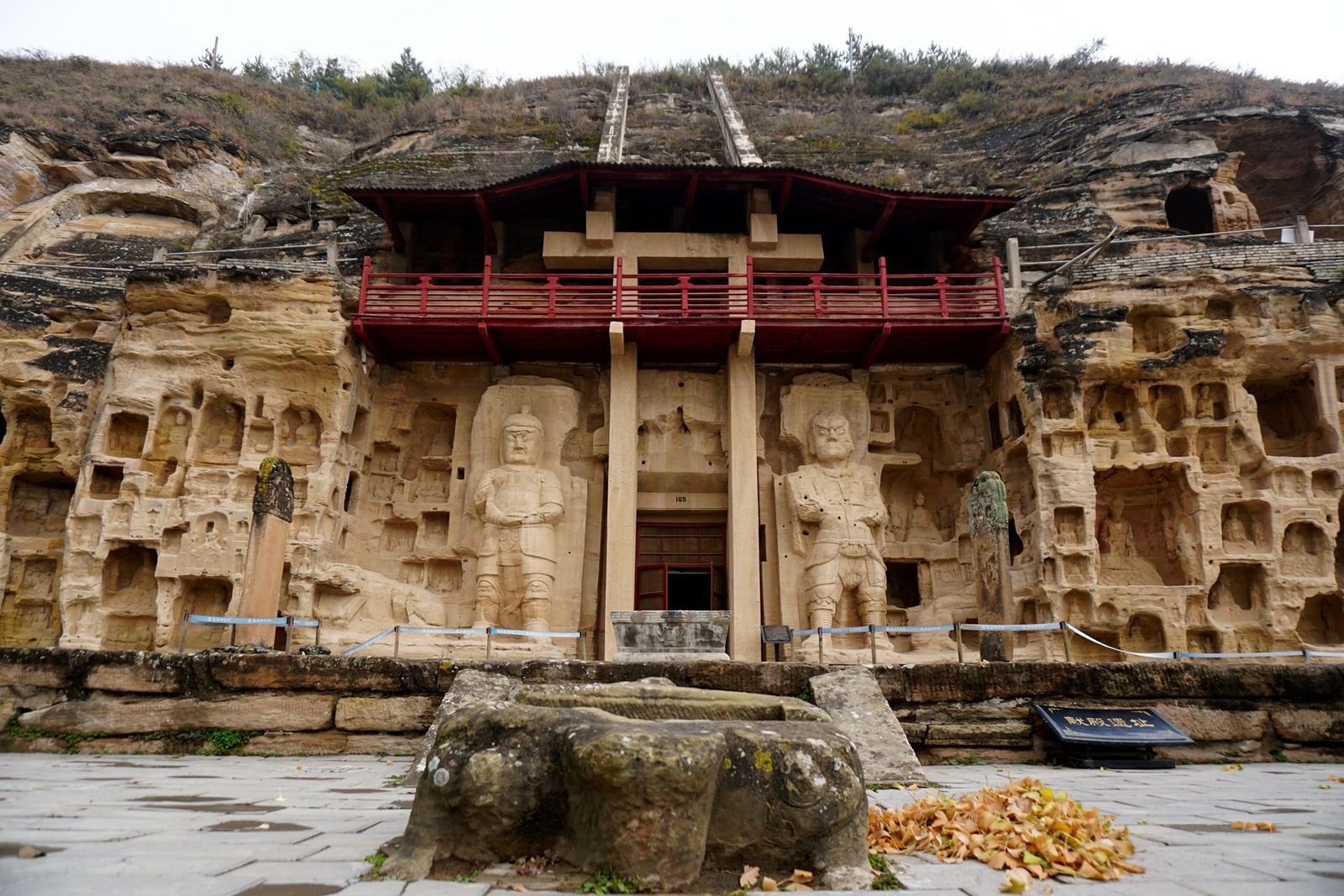
The North Grottoes Temple was cut in 509 and its main cave holds seven standing Buddhas about eight metres high in a hall fifteen metres tall, one of the larger Northern Wei caves anywhere. Almost nobody visits it.
Huanxian Daoqing shadow puppetry combines carved donkey-hide figures with a Taoist-derived singing style. It was part of the Chinese shadow puppetry inscription by UNESCO in 2011, and village troupes still tour with it.
Qingyang's embroidered sachets are stitched at home across the prefecture and sold in enormous numbers at the annual fair around the Dragon Boat festival. The craft is on the national intangible heritage list and the designs are pre-modern.
A near-complete skeleton of a Yellow River stegodon, about four metres at the shoulder, was dug out of a gully at Heshui in 1973. It is a particularly complete example of the species found. The skeleton itself is in the Beijing Museum of Natural History.
See
A flat farmed plateau with near-vertical gullies eating into its edges, and cave houses cut into the gully walls. The ideal way to see it is to stand on the rim: the flatness above and the depth below are the same landscape.
A cliff site of 509 above the Pu river with the seven-Buddha cave as its centrepiece and several hundred smaller niches around it. It pairs with the South Grottoes in Pingliang, cut by the same patron in the same year.
Troupes in Huanxian county perform with carved and coloured hide figures behind a lit screen, with a distinctive singing style and a small band. There is a museum in the county town and performances are scheduled rather than daily.
Stuffed embroidered figures and pouches, stitched at home and sold at the fair held around the Dragon Boat festival. The animal forms and colour combinations are old and are not designed for the market; the market followed them.
A late Neolithic site on the tableland with the foundations of an unusually large building and a ringed enclosure, excavated since 2021. It is changing how the scale of settlement in this region around five thousand years ago is understood.
A terraced hilltop complex above Qingcheng town associated with Buzhu, an ancestor of the Zhou house, who is recorded as having settled this country. The buildings are modern; the association is what the site is for.
On the Map
Approximate locations of the attractions above, across Qingyang.
Eat
Lamb from sheep grazed on the dry grassland of Huanxian, braised dark with chilli or boiled plain. The county carries a geographical indication and the meat is young enough that it is cooked fast rather than long.
Daylily buds picked in summer and dried gold, then soaked and cooked into soups and stir fries. The prefecture is one of the main producing areas and the drying mats cover the tableland in July.
A clay chimney pot layered with pork, meatballs, tofu and cabbage over broth and simmered through. Eastern Gansu makes it with pork where the west uses mutton. It is the winter meal and it is ordered for the table.
Maize or wheat flour stirred into a stiff paste over heat and served in a sour broth with pickle and chilli oil. Stirring it properly takes a long time and one direction alone, which every household will tell visitors about.
Do
Drive out of Xifeng to any point where the flat farmland stops and look down. The gully walls are near vertical and the drop is often over a hundred metres. Cave houses are cut into those walls and some are still lived in.
The cave is tall and the figures stand around visitors rather than facing them, which is unusual. Bring a torch; the lighting is minimal by design. There is rarely anyone else on the site.
Ask at the Huanxian museum which troupes are performing. Watching from behind the screen for part of it is usually allowed and shows how many hands the figures take. A full episode runs an hour or more.
Held around the Dragon Boat festival in Xifeng, with makers from across the prefecture. Buy from the stitchers rather than the resale stalls; the difference in the work is visible once visitors have handled a few.
When
Wheat green on the tableland and the sachet fair at Dragon Boat. The ideal window, and comfortable temperatures.
Hot, with daylily drying across the plateau and the harvest coming in. Dusty and bright; the grottoes are cool.
Clear air, harvest finished and the gullies at their sharpest in low light. The other good window.
Cold and dry, with the tableland bare. Cave houses are at their especially obviously sensible, and the warm pot is what everyone is eating.
Explore More
Qingyang is in Gansu, in Northwest China.
Related
Share the travel dates and interests, and PreeChina's local team will design a route that fits.
Plan My Trip to QingyangSee Private Tour Prices