
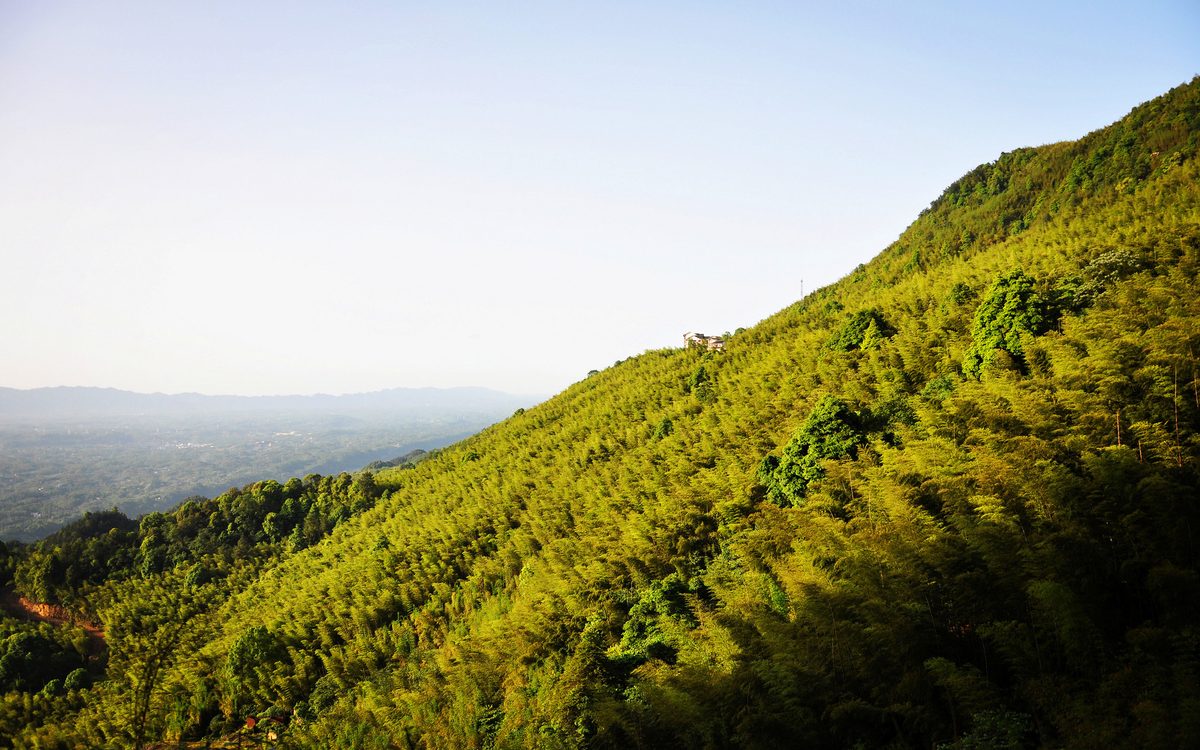
01Definition
What counts as Chinese tea, and what does not?
Chinese tea means the leaf of one plant, Camellia sinensis, grown in China and processed by one of six methods. That definition is narrower than the English word suggests and narrower than the Chinese word does, and both gaps cause confusion.
In English, "tea" has stretched to cover anything steeped in hot water. The international standard disagrees. ISO 20715:2023, which classifies tea into six types by processing method, applies solely to Camellia sinensis and states plainly that infusions of other herbs and fruits are outside its scope. Chamomile is not tea. Rooibos is not tea.
Chinese has the same problem in its own way. The character cha (茶) attaches to plenty of drinks with no tea leaf in them: chrysanthemum cha, bitter-vine cha, the laoying cha drunk in Chongqing (重庆) and Guizhou (贵州), the forsythia cha made in the Funiu mountains of Henan (河南). Some of these sit on the menu beside real tea and are ordered the same way. A visitor who wants the leaf has to know which is which, and this page covers the leaf alone.
The rest of the domain follows from that. Six categories, made by six sequences of the same handful of operations. Twenty provinces that grow it, from a tropical island to the thirty-seventh parallel. One plant, and roughly two thousand years of arguing about what to do with it.
02Why China
Why does Chinese tea matter more than other origins?
Every tea in the world comes from one plant, Camellia sinensis. What separates a green tea from a black one is not the bush but what someone does to the leaf in the hours after picking it. China worked out six different answers to that question, and a Chinese scientist put names to them.
Green, white, yellow, oolong, black and dark: the system now seen on tea packaging worldwide came from Chen Chuan, who in 1979 sorted roughly a thousand Chinese teas by how they are processed and how far the leaf is allowed to oxidise. India, Sri Lanka and Kenya together supply much of the tea sold in Britain and North America, and nearly all of it sits in one of those six branches. China works all six, and has a named place for each.
The knowledge did not stay put. In 1848 the East India Company sent a Scottish botanist, Robert Fortune, into the tea districts of Wuyi and Huangshan (黄山), both then closed to Europeans. He travelled in Chinese dress, shipped plants and seed out in sealed glass cases, and took Chinese tea makers with them. What grew from those consignments became the tea industry of Assam and Darjeeling. Anyone drinking Indian tea in London today is drinking the outcome of that journey, and it began in the hills this page describes.
China gave away a second thing and then stopped doing it itself. Whisked powdered tea, diancha, was how the Song (宋), 10th to 13th century dynasty drank; Japanese monks carried the method home in the twelfth century. In 1391 the Hongwu emperor ended compressed tea cakes as court tribute, and China moved to loose leaves steeped in hot water, which is still how the country drinks. Matcha is Song China, kept going in Japan after China itself moved on.
03History
How did tea go from food to the drink it is now?
Tea began as food. The early Chinese descriptions of it read like recipes. The Guangya, a third-century dictionary, records what people did with it around Jingzhou (荆州) and Bazhou: press the leaves into a cake, roast the cake until it reddens, crush it to powder, pour on hot water, then stir in spring onion and ginger. Older texts point the same way. The Yanzi Chunqiu lists mingcai, tea leaves, among the plain dishes on a frugal minister's table, alongside the unhusked rice. For centuries tea was a vegetable and a medicine before anyone thought of it as a drink.
The trail starts in the southwest. The Huayang Guozhi names tea among the goods that Ba communities in what is now Sichuan (四川) and Chongqing (重庆) sent north as tribute, and lists tea-producing districts that fall inside modern Leshan (乐山), Pengshan and Pengshui. A tomb at Mawangdui (马王堆) in Changsha (长沙), sealed in the second century BC, held a bamboo-wrapped box labelled yi si, one box, whose contents have been identified as tea. A century or so later a servant contract, the Tongyue, instructs the household to buy tea at Wuyang and to have the vessels ready. Tea was already something bought at market.
The man who turned all this into a subject was an orphan. Lu Yu was abandoned as an infant around 733 and raised in a monastery. He asked to study the Confucian classics instead of Buddhist doctrine, was set to menial work as punishment, and walked out. He spent his twenties in the tea districts of Jiangxi (江西) and Jiangsu (江苏), talking to growers and taking notes, and in 765 he finished a manuscript drawn from fieldwork across thirty-two prefectures. The Cha Jing, printed in 780, runs to about seven thousand characters in ten chapters, covering the plant, the tools, the making, the vessels, the boiling, the drinking, the earlier literature, the growing regions, what may be left out, and how to display the text on silk beside the seat. Lu Yu also wrote a short account of himself. He says he was plain-looking and stammered, and that he would keep an appointment through a thousand li of ice and snow with tigers on the road.
Tang (唐), 7th to early 10th century court demand turned tea into policy. Around 770 the court set up tribute estates at Yixing (宜兴) and at Guzhu Mountain (顾渚山) in Changxing, where growers carried their buds to a single site to be pressed with water from the Jinsha (金沙) spring. The prefects who ran those estates went down to the spring each year to make offerings, worried on two counts: that the quality or the quantity would fall short, and that the spring would dry up. One of them wrote a poem about what the quota cost the growers and sent it to the throne along with the season's three thousand six hundred cakes. A Qing (清), 17th to early 20th century commentator credited that poem with an early easing of the tea tribute.
Song China stopped boiling tea and started whisking it. Powdered tea beaten to a froth in the bowl produced competitions judged on two points: whose froth was whitest, and whose left a water mark on the bowl last. It also produced chabaixi, patterns drawn in the foam with water and a spoon, described in period sources as landscapes, birds and characters. The technique lapsed and was reconstructed in 2009 by Zhang Zhifeng, who had gone to Japan to study the tea ceremony there in 1997 and again in 2004. Japan had kept the Song whisking method going after China let it lapse, so part of what the reconstruction needed had been preserved abroad. The images hold for about fifteen minutes.
One decree ended all of it. The Hongwu emperor, who had grown up poor, judged that pressing tribute cakes cost the growers too much labour, and in 1391 he abolished them in favour of loose buds. The Ming Shilu records what prompted him: officials had been sending men to hurry the tea households, and the households had been paying them off. Whisking went out with the cakes. Steeping loose leaves in hot water, the way much of China still drinks, dates from that decision. By the end of the dynasty one catalogue could list ninety-seven named teas.
The last change was commercial rather than technical. Under the Qing, tea drinking moved out of the household and into premises, and the teahouse became an institution with several distinct forms. That part of the story belongs to tea in Chinese daily life.
04Geography
Where in China does tea grow?
Tea grows in twenty Chinese provinces, over a range that runs from a tropical island to the thirty-seventh parallel and from sea level to Himalayan river valleys. That range is why China can work all six categories at once, and this section is the map of where each of them comes from.
China divides its own tea land into four regions, and the division is agronomic rather than administrative. The Southwest covers Yunnan (云南), Sichuan (四川), Chongqing (重庆), Guizhou (贵州) and Tibet (西藏), and is where the plant is native. South China covers Guangdong (广东), Guangxi (广西), Fujian (福建), Hainan (海南) and Taiwan, and is tropical or close to it. Jiangnan, south of the lower Yangtze, holds Hunan (湖南), Hubei (湖北), Jiangxi (江西), Zhejiang and Jiangsu (江苏) and produces much of the country's green tea. Jiangbei lies north of the Yangtze and takes in Anhui, Henan (河南), Shandong (山东), Shaanxi (陕西) and Gansu (甘肃), where the swing between day and night temperature does the work that latitude does elsewhere.
The Southwest is the old country. Yunnan grows tea in Lincang (临沧), Baoshan (保山), Pu'er (普洱) and Xishuangbanna (西双版纳), and Chinese sources treat it as one of the centres where the plant originated. Along the Lancang river in Lincang the surviving old trees are numerous and varied enough that growers describe the valley as a gene bank. Baoshan works high ground in the province. Xishuangbanna carries a set of named tea mountains, Nannuo, Banzhang, Yiwu (易武), Jingmai, Manzhuan and Gedeng, though Jingmai sits over the border in Pu'er rather than in Xishuangbanna itself. Sichuan splits its own growing land four ways, east, west, south and north, and the southern part around Junlian and Gao counties is where Chuanhong, the province's gongfu black tea, comes from. Guizhou calls itself the tea homeland of the Yunnan-Guizhou plateau, and works low latitude at high altitude with few hours of direct sun. Tibet grows tea, which surprises many people who read that sentence. The plantations sit in the Yarlung Tsangpo (雅鲁藏布江) valley in Linzhi, in Bomi (波密), Motuo (墨脱) and Zayu counties.
South China is where the awkward categories live. Fujian describes itself as the home of both Chinese oolong and white tea, and the claim holds: Da Hong Pao, Tieguanyin (铁观音) and Fuding white all belong to the province. Fuding's white tea comes out of townships like Bailin, and Fuzhou (福州)'s Jin'an district is the core area for jasmine tea (茉莉花茶), a Qing invention. Guangdong runs from Chaozhou (潮州), where Phoenix Dancong grows on Phoenix Mountain and supplies the Chaoshan (潮汕) gongfu tradition, west through Jiangmen (江门), Maoming and Zhaoqing to Yingde, whose red tea is the province's other leading name. Guangxi has four, one to a city: Liubao (六堡茶) from Wuzhou, Guilin (桂林) Maojian from Guilin, Lingyun Baihao from Baise and Zhaoping black from Hezhou. Hainan is the southern end of the whole system, growing tea in Wuzhishan, Baisha and Wanning, where a green tea grows beside a meteorite crater and Wanning makes an infusion from a wild-growing leaf called zhegu. Taiwan sits in the same tea region and works the same categories: Wenshan Baozhong from the hills at the edge of Taipei, green tea from Pinglin and Sanxia in New Taipei, black tea from Yuchi beside Sun Moon Lake, and Dongding oolong, which is picked four times a year and rated spring above autumn.
Jiangnan supplies the names many people already know. Jiangsu has Nanjing (南京)'s Yuhua, Suzhou (苏州)'s Biluochun (碧螺春) and Yixing (宜兴)'s Yangxian Xueya, Yixing being the same town that makes the clay pots. Zhejiang has West Lake (西湖) and Kaihua. Jiangxi spreads across the province, Lushan Yunwu from Jiujiang, Wuyuan (婺源) green from Shangrao, Gougunao from Suichuan county in Ji'an (吉安), and Fuyao Xianzhi from Jingdezhen (景德镇), which is better known abroad for porcelain. Hubei's Enshi (恩施) prefecture makes both green and red tea, and Huanggang has been growing tea since the Tang. Hunan is described in Chinese sources by compass point rather than by city: red and green tea in the east, green in the south, the province's main growing area in the centre between two mountains, Guzhang Maojian in the west along two rivers, and yellow, green and red tea around Dongting lake in the north.
Jiangbei is where the constraint is visible. Anhui's tea belongs to historic Huizhou, six counties including Qimen (祁门), which English spells Keemun (祁门红茶), plus a western group around Lu'an, Jinzhai, Huoshan and Tongcheng. Henan grows in Xinyang, on the upper Huai river below the Dabie mountains. Shaanxi has three prefectures and no more, Hanzhong (汉中), Ankang and Shangluo, with Ankang trading on selenium in its soil. Gansu has one, Longnan, and that is the whole province.
Shandong is the interesting case, because its tea is not old. Tea was moved north into the province under a state programme begun in 1954 and counted as successful during the 1960s, which pushed the northern edge of Chinese tea growing to Rongcheng at 37 degrees north. Rizhao and Laoshan, the two Shandong names now sold abroad, are products of that decision rather than of tradition. One fact shows how far the six categories have been stretched: the northern limit of Chinese tea is younger than the People's Republic.
One consequence matters for anyone planning a trip. The six categories are not distributed evenly. White tea and oolong are Fujian, dark tea is Yunnan, Hunan, Guangxi and Shaanxi, yellow tea is scattered thinly, and green tea is nearly everywhere. Nor do they share a picking season: the harvest opens on the Fujian coast and is still running in Jiangxi ten weeks later, which when Chinese tea is picked sets out. No route reaches all six categories, and the calendar decides which province is worth the flight.
05Types
What are the six types of Chinese tea, and how are they made?
The six categories are not six plants and not six flavours. They are six answers to a single question: when does the maker stop the leaf's own enzymes, and what is allowed to act on the leaf before and after that moment. Read them that way and the differences stop being arbitrary. The scheme is the international standard as well, and the six names below are the ones it uses.
- Green. The enzymes go at the start. Within hours of picking, the leaf meets heat, either steam or a hot dry pan, in a step the Chinese call shaqing (杀青), kill-green. Nothing oxidises after that. Rolling then shapes the leaf and presses juice to the surface, and the drying method that follows leaves a signature that can be tasted: Longjing (龙井) is finished in a pan, Huangshan Maofeng (黄山毛峰) is baked, and the coarse sun-dried greens of Yunnan (云南) become raw Pu'er (普洱). Chinese green tea is a major family of the six, and eleven of the forty widely known Chinese teas are green.
- White. The least is done to it. No kill-green, no rolling. The leaf is withered, often for a long time, and then dried, and that is the whole process. Because nothing crushes the bud, the silver down survives on it, which is where Silver Needle (白毫银针) gets both its look and its name. Light oxidation happens during the withering rather than in a dedicated step, and the withering itself has several forms, which the six categories covers. White tea is also kept: stored leaf darkens from pale yellow towards amber over years, and aged white tea trades as a category of its own.
- Yellow. Green tea plus one more step, and the extra step is the entire point. After kill-green and rolling, the leaf goes into a damp pile, packed down and covered with padded cloth, or wrapped tight in paper, and left to turn yellow. This is menhuang (闷黄), sealed yellowing. The enzymes are already dead, so what changes the leaf is heat and moisture working on the polyphenols directly. Some makers seal it once, some twice. For the tenderest bud teas, Junshan Yinzhen (君山银针) and Mengding Huangya (蒙顶黄芽), the rolling is skipped. There is no fixed schedule for any of it: the maker judges by the moisture in the leaf and the temperature of the pile, and can watch one batch at a time. That is why yellow tea is the hardest of the six to find, in China as much as anywhere else.
- Oolong. The maker damages the leaf on purpose, and just at the edges. After withering, which in Fujian (福建) and Taiwan often means late-afternoon sun rather than midday, the leaves are shaken in bamboo trays or a rotating drum and then left to rest, four or five times over. Each shake bruises the rims. The bruised rims oxidise while the centre of the leaf stays green, which is the description Chinese makers use: green leaf, red edges. Kill-green then stops the process, and the leaf is rolled hot and baked. Aroma in an oolong has three separate sources, and good ones carry all three at once. Manufacture supplies one, the cultivar supplies another (Shuixian reads as orchid, Tieguanyin (铁观音) as orchid and osmanthus together, Huangjingui as ripe peach), and the site supplies the third. Da Hong Pao, Rougui, Tieguanyin, Dongding and Oriental Beauty all sit here, and they do not taste like one another.
- Black. In Chinese this is hongcha (红茶), red tea. Here the enzymes are left alive through the whole of oxidation. The leaf is withered, then rolled hard enough to rupture the cells so that the polyphenols meet their own oxidase, then held in a warm humid room to oxidise, then dried. The drying is what finally kills the enzymes, which makes it the one category where the killing step comes last. Theaflavins and thearubigins form during the oxidation, and their ratio sets the colour in the cup. Chinese black tea splits three ways. Souchong is fired over pine, which is where Lapsang comes from. Gongfu black is whole leaf twisted tight and sorted carefully, and covers Keemun (祁门红茶), Dianhong, Ninghong and Chuanhong. Broken and CTC leaf is cut rather than rolled, which gets the colour and strength out fast and flattens the detail.
- Dark. Heicha. The enzymes die early, as in green tea, and then something else takes over. After kill-green and rolling, the leaf is piled deep, covered to hold heat and moisture, turned once part-way through, and left. Microbes do the work, breaking down and recombining the proteins and sugars in the leaf. This is wodui (渥堆), wet piling, and it is the reason dark tea keeps changing in storage while the other five settle. Much of it is then steamed soft and pressed into bricks, cakes or tubes. One dark tea goes further: in Fu brick, made at Jingyang in Shaanxi (陕西) and Anhua in Hunan (湖南), the maker encourages a fungus to bloom inside the pressed brick, and the gold specks that appear are called jinhua, golden flowers, from Eurotium cristatum. A brick without them is considered a failure.
What the six share is a decision point rather than a scale. The shape of the leaf, the smoke, the storage, the fungus and the price all follow from where the maker chose to put it.
The operations behind those six sequences
Everything above is a decision about order. What follows is what the individual operations involve, and where the difficulty actually sits.
- Withering removes water and softens the leaf so it can be worked without tearing. White tea lives almost entirely inside this step, which is why makers have three ways of doing it: indoors in still air, under gentle heat when the weather is wet, and a combination of morning sun and shade used for the spring crop of certain cultivars.
- Kill-green has two traditions. Steaming keeps the leaf greener and the aroma fresher. Pan-firing drives the water off fast in a hot dry wok, and there the risk runs both ways: too much heat scorches the leaf, too little leaves it yellowing and dull. Either way the leaf cannot stop moving.
- Rolling shapes the leaf and presses juice onto its surface. Chinese makers describe the pressure as something to be measured out: too heavy and the leaf tears, too light and it never takes shape.
- Drying is where a green tea acquires much of its character. Pan-drying gives a roasted note and the flat pressed shapes. Baking is gentler and keeps tender leaf whole. Sun-drying is an old method and a coarse one.
Those four are shared across the categories. Four more belong to one category each, and they are the difficult ones: shaking for oolong, sealed yellowing for yellow tea, oxidation for black, wet piling for dark.
What the difficult four have in common is worth understanding about Chinese tea. None of them runs to a fixed schedule. The oolong maker decides how long the next rest lasts by smelling the leaf. The yellow tea maker reads the moisture in the pile and its temperature, and can watch one batch at a time, which is the practical reason yellow tea stays scarce. The black tea maker calls the end of oxidation by colour and smell. The dark tea maker judges by the water beading on the surface of the heap. A recipe will not reach that point, and that is why the same cultivar in the same village yields tea of several grades in the same week.
| Category | Kill-green | Acts on the leaf before | Acts on it after |
|---|---|---|---|
| Green | Early | Nothing | Nothing |
| Yellow | Early | Nothing | Heat and moisture, not enzymes |
| White | Never | Light oxidation while withering | Nothing |
| Oolong | Part way | Enzymes, at the leaf rims alone | Nothing |
| Black | Last, as it dries | Enzymes, fully | Nothing |
| Dark | Early | Nothing | Microbes |
06Regional Differences
Why is tea drunk so differently across China?
Chinese tea drinking divides into two traditions that disagree about a basic question: whether anything else belongs in the cup.
The plain tradition holds the east and the southeast. In Jiangsu (江苏), Zhejiang and Fujian (福建) the leaf goes in and hot water goes in and nothing else does. The Chaoshan (潮汕) style in eastern Guangdong (广东) takes this furthest, using a pot the size of a fist and cups the size of thimbles, brewing the same leaves over and over in short infusions and pouring for others before oneself. The point of the small vessel is that the tea never sits and goes flat.
The mixed tradition holds the southwest and the mountains. In Dali (大理), the Bai people (白族) serve three courses in sequence: a bitter one, roasted in a clay pot over the fire until the leaf turns yellow and smells scorched; a sweet one, with walnut, sesame, brown sugar and a local dried milk sheet; and a third called the aftertaste, with cinnamon, ginger, Sichuan (四川) pepper and honey. The three are meant to stand for three stages of a life. Among the Yi (彝族) in Sichuan, tea is roasted in a hot clay jar, salt is added and roasted with it, then hot water, then puffed rice, walnut powder and sesame. Guests are handed a jar and a cup each and roast their own.
Some of it stops being a drink at all. The Jino, on a mountain in Xishuangbanna (西双版纳), rub fresh tea leaves fine and dress them with oil, salt, chilli, star anise, lemongrass, coriander, garlic and ginger, then add dried meat, mountain crab, bamboo grubs, sweet bamboo shoot and sour ant eggs, and pour spring water over the lot. It is a salad. It is also the older practice: for centuries before anyone brewed tea, people ate it.
The Naxi (纳西族) in the Lijiang (丽江) highlands make something they call the dragon and tiger fight. Pu'er (普洱) is roasted in a clay pot until it scorches, boiling water is poured in to make a thick liquor, and that liquor is poured into a cup that already holds grain spirit. The tea and the alcohol meet with an audible crack, and the louder the crack the better the omen.
Then there is the question of where it is drunk. Sichuan drinks in teahouses, from a lidded bowl (盖碗), with cards and chess and sometimes a storyteller. Chongqing (重庆) puts the same thing on the pavement, bamboo chairs and a wooden table, and calls it babacha (坝坝茶). Guangdong drinks in the morning with food, and has evolved a signal for a refill that requires no speech: lift the pot lid and rest it beside the pot. Hainan (海南) runs the same morning habit under the name laobacha (老爸茶). Among the Dong (侗族) in Guangxi (广西), oil tea comes in four courses with an order to them, and nobody drinks until everybody has been served, the opening bowl going to the senior person present.
The generalisation that survives all this is a rough one, and it is geographic rather than cultural. The closer to the gardens, the less goes into the cup. The further from them, the more the tea has to do, and the more it is asked to carry.
07Culture
What did Chinese people drink tea out of, and why did it change?
Chinese teaware has been rebuilt from scratch twice, and both times the drinking method moved ahead of the vessels. The vessels are downstream of the method, which makes them easy to read once the rule is known.
Tang (唐), 7th to early 10th century, boiling. Lu Yu gave equipment a chapter of its own and specified twenty-four items, from the brazier he designed himself to the basket that carried the lot. His reasons are functional. The iron cauldron is smooth inside and rough outside, so it takes heat. The water filter has a frame cast in raw bronze, because bronze leaves no deposit to taint the taste, and a bag woven from green bamboo silk. The tongs that hold the cake over the fire are green bamboo, because the bamboo scents the cake as it toasts. He ranked water as well: mountain water at the top, river water next, well water last, with spring-fed pools preferred and waterfalls rejected. And he timed the boil by sight. At the initial boil the bubbles are the size of fish eyes, and that is when the salt goes in. At the second they run round the edge like a string of pearls, and that is when a ladle is scooped out, stir a vortex with bamboo tongs and drop the powder into the middle. At the third the water rolls, and it is finished.
A complete Tang service survives. In 1987 a collapsed pagoda at Famen Temple (法门寺) in Fufeng, Shaanxi (陕西), opened a sealed crypt that had been closed in 874. Inside was a gilt silver tea set made for the young emperor Xizong: a grinder dated 869, a sieve box, a basket, a spoon, and a salt stand. The grinder's roller carries the characters wu ge, the emperor's childhood name. Museums describe it as a complete ninth-century tea service. The salt stand settles an argument on its own, since it shows the seasoning was standard rather than eccentric.
Song (宋), 10th to 13th century, whisking. When the thing being judged is a white froth, the bowl has to be dark. Kilns at Shuiji in Jianyang, Fujian (福建), supplied black-glazed bowls whose iron-rich glaze crystallised in the firing into streaks called hare's fur, spots called partridge feather, and the iridescent yaobian that Japan later classed as a national treasure. Cai Xiang recommended the hare's-fur bowl by name in his Cha Lu, written in the 1050s, which also set out the whisking sequence: soften and scrape the cake, dry it, crush it, grind it, sieve it repeatedly, because the powder must be fine enough to froth white. Jizhou (蓟州) in Jiangxi (江西) made black wares too, and did something no one else did, firing real leaves and cut paper onto the glaze. Around 1269 an author writing as Shen'an Laoren published the Chaju Tuzan, which draws twelve implements and gives each a rank in the civil service. The brazier is an officer of the Court of State Ceremonial, the stone mill a Transport Commissioner, the whisk a Vice Commander.
Ming (明), 14th to 17th century, steeping. Loose leaves in hot water needed a pot, and the pot arrived. The cups turned white and blue-and-white, which is the Song rule running backwards: what is now judged is the colour of the liquor, so the cup has to be pale. Yixing (宜兴) stoneware rose with the method. Wen Zhenheng argued in the Zhang Wu Zhi that clay makes the ideal pot because it neither robs the tea of its scent nor leaves a stewed smell. Feng Kebin added that small is better, one pot per guest, each person pouring for themselves, because a small pot holds the aroma and the tea does not sit around going flat.
Qing (清), 17th to early 20th century, the lidded bowl (盖碗). The gaiwan (盖碗) is a lid, a bowl and a saucer, descended from the Song cup and its stand. It took over because the colour of the liquor is visible, the leaves can be held back with the lid, and the vessel washes easily.
The rule is worth keeping. The colour of a Chinese tea vessel usually shows which method it was built for, and a black bowl in a modern shop is a Song reference whether or not the shop says so.
08Industry
How big is the Chinese tea industry, and where does its tea go?
Many people outside China assume two things about the Chinese tea industry, and both are wrong.
One is that China is a tea exporter in the way that Kenya or Sri Lanka is. It is not. China grows roughly half of the world's tea, and exports about a tenth of what it makes. The other nine tenths are drunk at home. China grows far more tea than it sells abroad.
The second assumption is that the Chinese tea arriving in Western cups is black. It is not that either. Green tea makes up the great majority of China's export volume. Black tea is a small share. The leading destination by volume is Africa, not Europe or North America. The black tea in a British or American blend is far more likely to have come from Kenya, India or Sri Lanka, for reasons this page sets out in the history of Chinese tea: the plant and the method were taken out of China in the nineteenth century and the industries built from them undercut the original.
Put those together and the shape of the industry becomes clear. China is a producer whose main market is itself. Export prices reflect it. The average export price is a commodity price, while the teas this page spends much of its time on are sold domestically at prices that have nothing to do with that figure. Two markets sit inside one industry, and they barely touch.
This is not new. The Ming (明), 14th to 17th century and Qing (清), 17th to early 20th century tea trade ran on the same split. Huizhou merchants had been trading tea since the Tang (唐), 7th to early 10th century and reached their peak under the Ming and Qing, working the domestic market from a base of six counties. The export trade meanwhile was a state and company affair, run through Guangzhou (广州) and later through the treaty ports, and by the Qing tea had become a leading export commodity. The tribute system was a third market again, and a small one: at its height the imperial tea gardens at Beiyuan in Fujian (福建) numbered forty-six.
Scale at the production end has always been local rather than corporate. Anhua in Hunan (湖南) at its height had eight tea market towns, several hundred tea firms and a workforce in the tens of thousands, and that was one county. The structure survives. What a visitor sees in a Chinese tea region is not one large company but a dense layer of small ones, many of them working a single category, many of them working a single mountain.
One recent change is worth noting because it runs the other way. In March 2023 the six-category classification that Chinese tea science has used since 1979 became an international standard, ISO 20715:2023, drafted by a Chinese university team. China spent two centuries losing control of the tea trade. It has just gained control of the vocabulary.
09People & Lifestyle
What place does tea hold in ordinary Chinese life?
There is a Chinese phrase that lists the seven things a household cannot open its door without: firewood, rice, oil, salt, soy sauce, vinegar and tea. The phrase came into common use in the Song (宋), 10th to 13th century dynasty, and its structure shows where tea sits. It is not in the category of wine or incense. It is in the category of salt.
That ordinariness creates a problem for the historical record. Song writers left a great deal about competitive tea, court tea and the tea of literary gatherings, and very little about how an ordinary family drank at home, because nobody writes down what everybody already does. What survives instead is painted on tomb walls. A tomb at Baisha in Yuzhou, Henan (河南), shows a couple seated opposite each other at a table holding a covered ewer and tea bowls, with attendants behind them carrying fruit plates. The occupants were ordinary landowners with no rank worth recording. The mural is evidence precisely because it was not meant to be.
The teahouse arrived later as a word than as a thing. Zhang Dai (张岱)'s Tao'an Mengyi records someone opening one in 1633, and that is an early recorded use of the term. Before that there were tea stalls, a table and a few stools at a street corner, tea sold in coarse porcelain bowls.
What happened next is the part worth knowing. Through the Qing (清), 17th to early 20th century the teahouse did not just multiply, it specialised, and it split along lines of what people wanted to do rather than what they wanted to drink. There were quiet houses where merchants settled business. There were houses with a storyteller or a ballad singer working the room. There were houses out in the hills, next to water, where writers held gatherings and travellers stopped for the view. And there were houses where the point was the chessboard. Four different businesses, one word, and the descendants of all four are still trading.
Price is part of why. A character in the eighteenth-century novel The Scholars is not a wealthy man, carries a few coins, and still drinks his way around several teahouses in an afternoon. Cheapness is not incidental to the institution. It is the institution.
Tea also does formal work in Chinese life, and the vocabulary shows it. In parts of Guizhou (贵州) an engagement involves three separate teas: one when the match is proposed, one when it is settled, and one drunk by the couple together on the wedding night. Among the Jurchen, the ceremony where the groom's family called on the bride's was simply called xiacha, laying down the tea. In Taiwan, a Hakka (客家) bride serves sweet tea to her husband's guests, and when she comes back for the tray the groom puts a red envelope on it. None of these are metaphors. The tea is the transaction.
10Well-Known Examples
Which Chinese teas are worth knowing by name?
China names something over a thousand teas. Around forty are known widely enough that many Chinese drinkers would recognise the name, and those forty split unevenly across the six categories: roughly eleven greens, six blacks, nine oolongs, three whites, four yellows and five darks.
Chinese sellers describe a named tea by seven fixed properties, and knowing the list is more useful than memorising any particular tea. They are: where it comes from, what leaf goes into it, the colour of the dry leaf, the colour of the liquor, the aroma, the taste, and the appearance of the spent leaf at the bottom. That last one is not decorative. Opening the pot and looking at the used leaf shows how the tea was picked and how far it was oxidised, and it is the hardest of the seven to fake.
Among greens, Longjing (龙井) from West Lake (西湖) is the one outsiders have heard of, pan-fired flat and finished in the wok. Biluochun (碧螺春) from the hills in Lake Tai (太湖) is picked before Qingming (清明) and rolled into a spiral. Taiping Houkui has a short picking window, opening after Guyu (谷雨) and closing before Lixia (立夏). Huangshan Maofeng (黄山毛峰) is oven-finished rather than pan-fired, which is why it stays whole.
Among blacks, Keemun (祁门红茶) from the historic Huizhou counties is the one that went into English breakfast blends. Lapsang Souchong (正山小种) from Tongmu is generally credited as the origin of black tea. Jinjunmei, from the same place, takes single buds from old bushes, and it was created in 2005, which makes it younger than many people assume.
Among oolongs, Tieguanyin (铁观音) from Anxi (安溪) and Da Hong Pao from the Wuyi cliffs sit at opposite ends of the same category, one floral and lightly oxidised, the other roasted. Huangjingui is picked earlier than its neighbours and reaches the market early. Baijiguan is a Wuyi cultivar with a long history as court tribute and a very small crop, and almost nobody outside China has heard of it.
Among whites, Silver Needle (白毫银针) is all bud, picked before Qingming in Fuding and after it in Zhenghe, which is a genuine and checkable difference in the same tea. Shoumei is the coarse end of the same category and the cheap one.
The yellows are the ones to notice, because all four are hard to find even in China. Junshan Yinzhen (君山银针) comes from an island in Dongting Lake and is picked in the days before Qingming. Mengding Huangya (蒙顶黄芽) skips rolling entirely. Pingyang (平阳公主) Huangtang was once used to make milk tea for the Qing court. The category is scarce for a production reason rather than a marketing one, which the six categories explains.
Among darks, Pu'er (普洱) is the name that travels. Anhua dark tea from Hunan (湖南) carries six different names depending on the week it was picked. Liubao (六堡茶) from Wuzhou has been shipping to Southeast Asia for long enough to have its own following there. Fu brick is the one with the fungus in it.
These forty are a starting list rather than a ranking. What decides whether any tea is worth its price is the four-step assessment set out in how to buy Chinese tea, and that works just as well on a tea nobody has heard of.
| Property | What it shows |
|---|---|
| Origin | The place, and often the legal definition attached to it |
| Leaf picked | Bud alone, bud and one leaf, or coarser |
| Dry leaf colour | For oolong, a direct record of how far it was oxidised |
| Liquor colour | Oxidation and, in black tea, the theaflavin ratio |
| Aroma | Manufacture, cultivar and site, in an oolong all three at once |
| Taste | , |
| Spent leaf | How it was picked and how far oxidised. The hardest of the seven to fake |
11Destinations
Which Chinese mountains and gardens are worth visiting for tea?
China has four World Heritage (世界遗产) sites listed as mixed, meaning UNESCO judged them outstanding for both their nature and their culture. There are Mount Taishan (泰山), inscribed in 1987, Mount Huangshan (黄山) in 1990, Mount Emei (峨眉山) with the Leshan Giant Buddha (乐山大佛) in 1996, and Mount Wuyi in 1999. All four grow tea.
That is not a coincidence, and the reason is worth following. A tea bush of any quality wants cloud, mist, a wide gap between day and night temperature, diffuse rather than direct light, and a slope that drains. The landforms that produce those conditions are mountains, lakes, gorges and the cloud that sits in them. The map of good tea and the map of good scenery are largely the same map, which is why so many Chinese tea names are place names that may already be familiar for another reason.
Huangshan gives Maofeng and Taiping Houkui, and the historic prefecture around it gives Keemun (祁门红茶). Emei gives Zhuyeqing, grown around the temples on its slopes. Wuyi gives the rock oolongs and the black tea that began the category. Taishan is the odd one out and the interesting one: tea grows there because the state moved it north in the 1950s, not because it always had.
Others follow the same pattern. West Lake (西湖) in Hangzhou (杭州) was inscribed in 2011 as a cultural landscape, and it gives Longjing (龙井). Lushan, inscribed in 1996, gives Yunwu, picked between Guyu (谷雨) and Lixia (立夏) and on clear days. Mount Qingcheng (青城山) and the Dujiangyan (都江堰) irrigation system, inscribed in 2000, give Qingcheng Xueya. The Wudang (武当山) Mountains, inscribed in 1994 for their building complex, give a Daoist tea. Fanjingshan, a natural site inscribed in 2018, gives Cuifeng. Each of these is a place a visitor might already have on a list for reasons that have nothing to do with tea.
One site inverts the relationship. In 2023 the Cultural Landscape of Old Tea Forests of the Jingmai Mountain (景迈山) in Pu'er (普洱) became China's 57th World Heritage site and a site listed for tea itself. It is not a mountain that happens to grow tea. It is five old tea forests covering 1,180 hectares, nine villages of about 5,000 people, and three belts of protective forest, worked by the Blang and the Dai (傣族) since the tenth century. What UNESCO recognised was the method and the community that maintains it: the tea grows under the forest canopy rather than in cleared rows, which is a response to the mountain's own ecology.
The practical version of all this is short. At a Chinese mountain known for something else, it is worth asking what it grows.
12Timing
When is Chinese tea picked, and when is the time to go?
Picking is not a season. It is a ladder that climbs north and uphill over about ten weeks, and the position on it decides what can be seen.
Chinese growers date the whole thing by the Chinese lunar calendar rather than by month, and its two kinds of marker behave differently. Solar terms are set by the sun and hold to the Gregorian date: Qingming (清明) falls on 4 or 5 April every year, Guyu (谷雨) on 19 or 20 April, Lixia (立夏) on 5 or 6 May. Lunar dates move: the Lantern Festival (元宵节), fifteen days after the new year can land anywhere from early February to early March.
- The ladder opens on the Fujian (福建) coast. At Xiapu the leaf is ready before the Lantern Festival, ahead of the rest of the country. Yunnan (云南) starts soon after.
- The single densest week is the one before Qingming. Tea picked before that date is called mingqian, and the word functions as a price bracket (斗拱). Biluochun (碧螺春), Fuding Silver Needle (白毫银针), Junshan Yinzhen (君山银针), Pingyang (平阳公主) Huangtang and the yellow bud teas all come in during those few days, across five provinces. No trip catches more than one or two of them.
There is a growers' saying in Suzhou (苏州), in Jiangsu (江苏), about how narrow the window is: three days early and the buds are too small, three days right and it is treasure, three days late and it is grass.
- Then the openings come in a run. Fuding picks before Qingming and Zhenghe after it. Jinjunmei starts after Qingming. Around Guyu, Taiping Houkui opens and Liu'an Guapian starts. The ten or so days between Guyu and Lixia are what Wuyi rock tea makers call the golden window, and the category worth watching being made is oolong, because the shaking happens then.
- One scheduling fact is worth more than the rest. Leaf picked between nine and eleven in the morning and between two and five in the afternoon is the pick of the day, and the afternoon pick is then worked in the evening. What that means for a day's plan is set out in how to see tea being made.
- After Lixia the spring is over. A Suzhou saying puts it as: tea after Lixia ages by the night, and after Xiaoman it turns to grass.
- Autumn is not empty. Tieguanyin (铁观音) picked in September and October is the aromatic crop of its own year. Anhua picks through the summer and into autumn under a different name for each stage. Taiwan takes a winter crop from the middle of October.
- Two dates on the calendar are not about picking at all. At Jingzhe (惊蛰), the solar term in early March, growers around Wuyishan (武夷山) climb to the top of the plantation, make offerings, and end by calling out that the tea is budding, three times, everyone together. Before Qingming, in Guizhou (贵州), unmarried Buyi women go up the mountain to pick the tips for a tea they fold into a cone and dry, which is given as a token when a couple becomes engaged.
Actual opening dates move by a week or two with the weather in any given year. The solar terms do not.
| Marker | Gregorian date | What happens |
|---|---|---|
| Lantern Festival | Moves: early Feb to early Mar | Opening leaf at Xiapu on the Fujian coast |
| Jingzhe | 5 or 6 March | Mountain-calling ceremony at Wuyishan |
| Qingming | 4 or 5 April | Tea picked before this date is mingqian, the top price bracket |
| Guyu | 19 or 20 April | Taiping Houkui opens; Liu'an Guapian starts |
| Lixia | 5 or 6 May | Spring ends; Wuyi rock tea's golden window closes |
| Sept to Oct | , | Tieguanyin autumn crop, the aromatic crop of its year |
| From mid-Oct | , | Taiwan winter crop |
13How to Experience
How can a visitor see Chinese tea being made?
There are three ways to meet Chinese tea where it is made: watch someone work, take a class, or do one of the steps by hand. They are not the same commitment, and the season governs all three.
Watch
A highly watchable stage of Chinese tea happens in the evening. Oolong makers shake the leaves and rest them four or five times over an afternoon and a night, each round bruising the rims a little further, and the maker decides how long the next rest runs by smelling the batch. The afternoon pick reaches the workshop late, so the work runs late. An itinerary that sees sights in the morning and travels in the afternoon misses it completely.
Other things are worth watching for different reasons. Kill-green is a person over a pan hot enough to hurt, moving leaf without pause. Wet piling for dark tea is a covered heap that gets turned once, judged by water beading on its surface. None of these are demonstrations. They are what the building is for, which is why the season matters more than the venue. Timing is set out in when Chinese tea is picked.
Two fixed dates are open to onlookers rather than participants. At Jingzhe (惊蛰), a solar term of the Chinese lunar calendar in early March, growers around Wuyishan (武夷山) climb to the top of the plantation, make offerings, and finish by calling out that the tea is budding, three times, all together. Wuyishan also holds competitive judging in season, which descends directly from the Song (宋), 10th to 13th century tea contests described earlier on this page.
Learn
A cheap and useful thing to learn is how to read a tea rather than how to make one. The seven properties Chinese sellers use are listed in the named Chinese teas, and the one that repays practice is the last, the spent leaf. It survives in the pot after everything else is gone.
Formal classes exist. Several provinces run intangible heritage courses through their own cultural programmes, and these tend to be stable in content even when the teacher and the fee change. Chabaixi, the Song technique of drawing pictures in tea foam, is taught this way at an institute in Wuyishan by a recognised holder of the technique or by someone trained under one. A session runs from grinding the leaf, through whisking it to a froth stiff enough to hold a line, to drawing on that froth with nothing but water. The image lasts about fifteen minutes.
Do
Picking is the obvious one and a seasonal one. It is also the least interesting on its own, because picking is repetitive and the skill is in knowing which two leaves to take.
Better is to take a turn at a process step. Some production sites hold national or provincial status as heritage demonstration workshops, and those are set up for visitors to handle the leaf: shaking a tray, turning leaf in a pan, rolling by hand. Doing one round of shaking teaches more about oolong than reading about it twice.
At Jingmai Mountain (景迈山) in Yunnan (云南), the World Heritage (世界遗产) site where the tea forests themselves are the listed property, picking and processing sessions run alongside roasted tea prepared the Blang way. The mountain is a graded scenic area (景区) with shuttle (观光车) buses between its old villages, so this is a matter of arriving rather than of arranging.
One caution. A number of the striking tea customs in China, the sealed tea ceremony of the Li in Hainan (海南), the cone-shaped tea folded by unmarried Buyi women before Qingming (清明), belong to communities' own festivals rather than to any venue. They are not services, and we do not present them as bookable.
14Practical
How is Chinese tea bought, kept and brewed?
Buying
Chinese buyers assess a tea in four steps, always the same four, and a visitor can learn them in one shop visit: look at the dry leaf, smell it, taste the liquor, then look at the spent leaf. The last step is the one outsiders skip and the one that matters, because the used leaf shows how the tea was picked and how far it was oxidised.
Three specific tells are worth carrying:
- Squeeze the dry leaf. If it crumbles it is dry. If it bends without breaking it has taken up moisture, and damp tea moulds. This test appears in the green, black and dark tea sections of Chinese guides alike, which is a fair sign it is the general one.
- Do not treat white down as a mark of quality across the board. It is a real standard for the downy types, the Maofeng, Maojian and Silver Needle (白毫银针) group, and it says nothing useful about a tea outside that group. English-language tea writing repeats the fuzz-equals-quality idea far more widely than Chinese practice supports.
- For oolong, read the colour of the dry leaf as a record of oxidation. The greener it looks the lighter the oxidation and the paler the liquor will be. Brown-green, brown-red and finally a dark oily black mark progressively deeper oxidation and roasting. One category, an enormous range, and the leaf shows where in that range the tea sits before it is bought.
Two things that look like grades are actually dates. Mingqian means picked before Qingming (清明) and yuqian means picked before Guyu (谷雨). They are price brackets (斗拱) driven by scarcity and tenderness, not quality certificates, and a well-made later-picked tea can beat a badly made early one.
A few names carry legal definitions rather than marketing ones. Pu'er (普洱) is the strictest: it has to come from specified townships within Yunnan (云南) and be made from an approved large-leaf cultivar. Outside those limits the same processing produces something that cannot use the name.
For a purchase for personal use rather than as a gift, the useful move is not to hunt for the single top tea in the shop. It is to buy small quantities of three teas from three different categories. The distance between categories is far greater than the distance within one, and the four-step assessment is much easier to run as a comparison.
Keeping and brewing
Tea keeps badly in three conditions: damp, warm and near anything with a smell. Of the six, dark tea and aged white are the ones meant to change in storage; the other four are at their peak young and should be sealed and used.
On brewing, the Chinese habit differs from the Western one in a way that costs nothing to adopt. Rather than one long steep, the same leaves are infused several times for short periods, and the tea changes across those infusions. Delicate green and yellow teas want water that has come off the boil. Roasted oolongs, black and dark teas take it boiling. Beyond that, the leaf-to-water ratio and the timing are matters of preference, and the fastest way to find the preferred balance is to pour early and taste often.
15PreeChina Experiences
What does PreeChina arrange around tea?
Everything above this section is public. Anyone can walk into a Chengdu (成都) teahouse or visit Jingmai Mountain (景迈山) without us.
What we do is the part that depends on timing and access. The picking ladder moves north over about ten weeks, so the season decides the province and the province decides the route. Factory visits are arranged privately rather than as scheduled tours, which means the site is chosen for what it is actually making that week, and evening work is scheduled as evening work. Fujian (福建) is the province worth knowing about at the outset, because oolong, white, black and green tea are all made inside it, which is four of the six without a domestic flight.
We have been arranging travel in China since well before this page existed, across leisure, study travel and industry visits. Teachers, fees and dates shift from season to season, so we confirm the current arrangement when we build a trip rather than publishing one that will be wrong by the time of reading.
Tell us which of the six is wanted for watching, and the calendar does much of the planning.
16What It's Not
What do people often get wrong about Chinese tea?
- "Black tea" means two different things. What English calls black tea, Chinese calls hongcha (红茶), red tea, after the colour in the cup. Chinese heicha, literally black tea, is a separate category that ferments microbially after the leaf is already dry. Pu'er (普洱) belongs to it. Asking for black tea in a Chinese teahouse can produce either one, depending on how the staff read the request.
- Lapsang Souchong (正山小种) is not a flavoured tea. The pine smoke is a production step rather than an additive: the leaves sit on slatted bamboo floors in a multi-storey smokehouse while smoke from a pine fire rises through them. By many accounts it is also an early black tea. One more thing surprises regular drinkers: since the early 2000s Tongmu has been producing an unsmoked version, and that is what much of the Chinese market now buys.
- Chinese tea and the Japanese tea ceremony are not one tradition. They share an ancestor, and the history of Chinese tea explains where they parted. A Chinese tea session today uses whole leaves, repeated short infusions, and no whisk.
- Oolong is not a midpoint between green and black. Lining the six categories up on a single scale from low to high oxidation is a handy shortcut that gets oolong wrong. Makers bruise the leaf edges and shake the leaves over several hours, so oxidation runs unevenly through one leaf rather than evenly across the batch. That is why one oolong tastes floral and the next tastes roasted.
- Age alone does not improve Pu'er. Starting material and storage decide it. Leaf that was poor to begin with, kept badly for thirty years, is thirty-year-old poor leaf, and the aged cake market has a well-documented problem with fakes.
- Gongfu tea has nothing to do with fighting. The Chaoshan (潮汕) style of brewing in a small pot and thimble cups uses the same word as kung fu (功夫), and in both cases it means skill and patience put into a task over time.