
01Five Religions, and the Parts Open
What religions does China have, and which parts are open to visitors?
China is a country where all three schools of Buddhism are established at scale, and each occupies a distinct piece of geography. The religious China a visitor sees is a map, not a slogan. Han Buddhism covers the central plains and the south, Tibetan Buddhism covers the plateau and its eastern rim, Theravada Buddhism covers the south-western border with Myanmar and Laos. Entering the wrong region while expecting the wrong school brings surprises in the architecture, the robes, the rituals and the rules.
The opening correction is that Buddhism is not the sole religion here. The state recognises five: Buddhism, Daoism, Islam, Catholicism and Protestant Christianity. Daoism is the one indigenous to China, and the temples a visitor often walks into on a mountain trip, Qingcheng (青城山), Wudang (武当山), are Daoist, not Buddhist. The mosques in Xi'an (西安) and Kashgar (喀什) are also active religious sites, not museums. A visitor who plans around Buddhist temples alone will miss half the religious landscape.
The second correction is that a very large category on the map has no official colour. Folk religion, Mazu, City God, Earth God, Guan Yu (关羽), the God of Wealth, is not counted among the five, yet it is a highly visible form of devotion along the coast and in the countryside. Mazu belief was inscribed on the UNESCO Intangible Cultural Heritage list in 2009. The incense a visitor sees in Quanzhou (泉州), Putian (莆田) and many small towns is more likely to be folk religion than any of the five organised faiths. "Religious China" is not coextensive with "registered religious venues."
The third correction is that Confucianism is not a religion, but Confucius (孔子) temples are temples. The Temple and Cemetery of Confucius in Qufu (曲阜) is a UNESCO site, the Dacheng Hall looks like an imperial hall, and sacrifices to Confucius follow a ritual code. Scholars have long debated whether Confucianism counts as a religion; this page states that the debate exists and takes no side. For a visitor, the practical point is that Qufu behaves like a pilgrimage site even though the faith system it represents does not fit the five-religion frame.
How to use this page. Read the map in block 02 before choosing the region. If Tibetan Buddhist culture is the draw, the eastern rim, Qinghai (青海), southern Gansu (甘肃), western Sichuan (四川), north-western Yunnan (云南), offers the same monasteries, prayer wheels and butter (酥油) lamps as the Tibet (西藏) Autonomous Region, outside it. If Theravada temples are the appeal, Xishuangbanna (西双版纳) and Dehong (德宏) in Yunnan are where the golden spires and orange robes are. The map shows which part of the country matches the interest.
02The Map of It
Where is each religion in China, and what does it look like from the street?
Start from the centre and move outward. Each faith has a region, a reason it is there, and a look a visitor can recognise from the street.
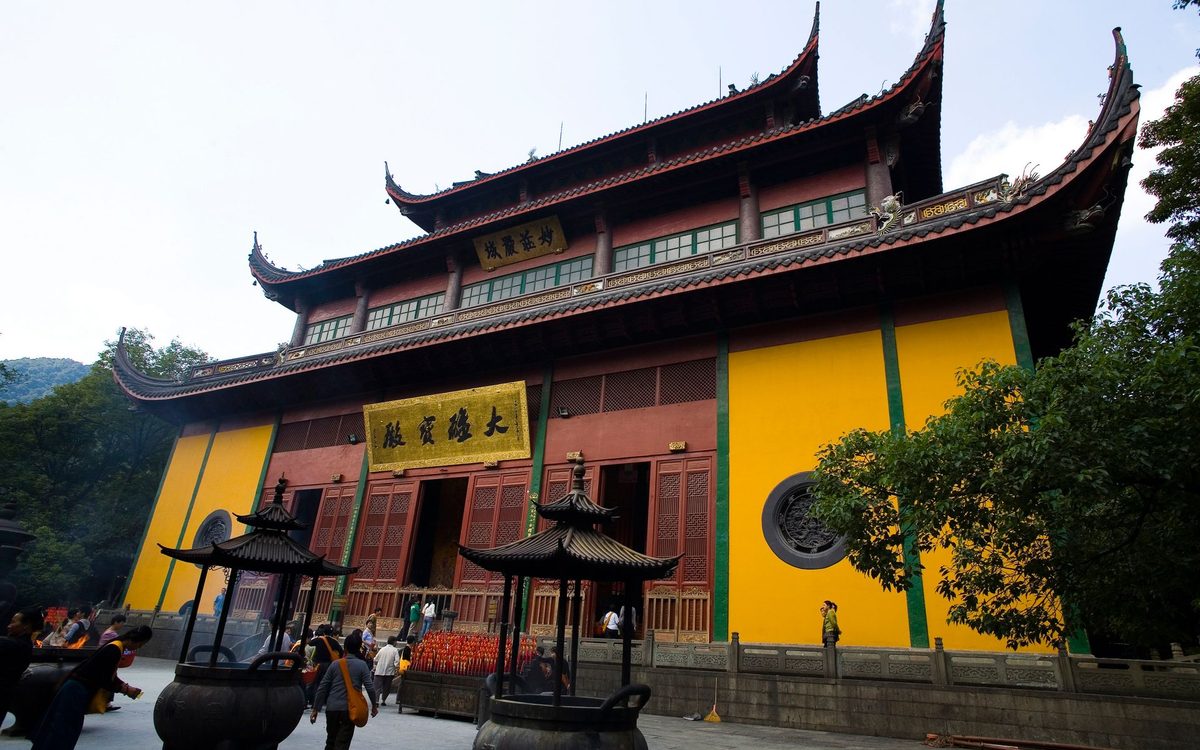
Han Buddhism, the central plains, the Yangtze south, and the four pilgrimage mountains. The ancestral halls cluster in Henan (河南) (Shaolin (少林寺), White Horse) and Zhejiang (Guoqing (国清寺) on Tiantai (天台山)), where Indian Buddhism was translated into Chinese schools. The four pilgrimage mountains, Wutai (五台山), Emei (峨眉山), Putuo (普陀山), Jiuhua (九华山), each belongs to a bodhisattva and remains an active monastic centre. A visitor sees timber halls, tiled roofs, grey or red walls, and monks in grey or brown robes.
Tibetan Buddhism, the plateau and its eastern rim. Lhasa (拉萨) is the heart, but the geography that matters for a visitor is the eastern rim: Kumbum (塔尔寺) in Qinghai (青海), Labrang (拉卜楞寺) in southern Gansu (甘肃), the monasteries around Kangding (康定) and Derge (德格) in western Sichuan (四川), and Songzanlin (松赞林寺) in Shangri-La (香格里拉), Yunnan (云南). This rim line is a useful fact: Tibetan Buddhist culture is fully present there, outside the Tibet (西藏) Autonomous Region. The look is white walls, golden roofs, prayer wheels, and monks in maroon and yellow.
Theravada Buddhism, the south-western border. Xishuangbanna (西双版纳), Dehong (德宏) (Mangshi (芒市), Ruili (瑞丽)), Lincang (临沧) and Pu'er (普洱) in Yunnan share a Buddhist tradition with Thailand, Myanmar and Laos. The temples have golden spires, the monks wear orange or saffron robes, and the Water-Splashing Festival (泼水节), 13 to 15 April in mid-April is the new year. A visitor could mistake the street for Chiang Mai or Mandalay.
Daoism, the mountains. Wudang (武当山) in Hubei (湖北), Qingcheng (青城山) in Sichuan, Longhu (龙虎山) in Jiangxi (江西) and Qiyun (齐云山) in Anhui are the four mountains held sacred by Daoists. Daoist temples also appear in cities as City God temples and Lüzu temples. The look is darker timber, black or grey tiles, and a layout that follows the landscape rather than imposing an axis. Daoism is the organised faith native to China.
Islam, two lines and scattered inland points. The north-western line runs through Ningxia (宁夏) (Yinchuan (银川), Wuzhong (吴忠)), Gansu (Lanzhou (兰州), Linxia (临夏)) and Qinghai. The Xinjiang (新疆) line runs through Kashgar (喀什), Hotan (和田) and Turpan (吐鲁番). Inland, the Great Mosque (清真大寺) in Xi'an (西安), Niujie (牛街) in Beijing, Qingjing (清净寺) in Quanzhou (泉州) and Huaisheng (怀圣寺) in Guangzhou (广州) are historic points. The distinctive feature: Chinese-style mosques are courtyard complexes with a prayer hall, not domes and minarets, visible from the gate.
Catholicism and Protestant Christianity, the treaty ports and the north-east. Xujiahui (徐家汇) in Shanghai, the Sacred Heart (石室圣心大教堂) Cathedral in Guangzhou, Saint Sophia (圣索菲亚教堂) in Harbin (哈尔滨) and Macau's churches are the historic landmarks. In the countryside, Protestant churches cluster in parts of Zhejiang, particularly around Wenzhou (温州). The look is Gothic or Byzantine, usually brick or stone.
Folk religion, the coast and the villages. Mazu, the sea goddess, has her ancestral temple (祖庙) on Meizhou Island (湄洲岛) in Putian (莆田), and Tianhou temples up and down the coast. City God temples, Earth God shrines and Guan Yu (关羽) temples are in almost every old town. Incense is thickest here, official status is lowest. A visitor who follows the smoke will end up here more often than at any registered Buddhist or Daoist site.
| Faith | Region | Places | What it looks like |
|---|---|---|---|
| Han Buddhism | central plains, the Yangtze south, four pilgrimage mountains | Wutai · Emei · Putuo · Jiuhua · Shaolin · White Horse · Guoqing | timber halls, tiled roofs, grey or brown robes |
| Tibetan Buddhism | the plateau and its eastern rim | Lhasa · Kumbum · Labrang · Kangding · Derge · Songzanlin | white walls, golden roofs, prayer wheels, maroon robes |
| Theravada Buddhism | the south-western border | Xishuangbanna · Dehong (Mangshi, Ruili) · Lincang · Pu'er | golden spires, orange robes, the water-splashing new year |
| Daoism | the mountains | Wudang · Qingcheng · Longhu · Qiyun · City God temples | darker timber, black or grey tiles, layout follows the land |
| Islam | two lines, plus inland points | Yinchuan · Linxia · Kashgar · Xi'an · Niujie · Quanzhou · Guangzhou | courtyard complexes with a prayer hall; Chinese-style mosques have no dome |
| Catholic and Protestant | treaty ports and the north-east | Xujiahui · Guangzhou · Harbin · Macau · rural Zhejiang | Gothic or Byzantine, brick or stone |
| Folk religion | the coast and the villages | Meizhou Mazu · Quanzhou Tianhou · City God · Earth God · Guan Yu | the thickest incense, the lowest official status |
03By the Numbers
How many believers, temples, mosques and churches does China have?
The table under this block carries the source and the year beside each figure. The prose says what the figures change for a visitor.
Nearly 200 million believers, 1.4 billion people. The 2018 white paper counts religious citizens at nearly 200 million. Against a population of roughly 1.4 billion, that means many Chinese people do not belong to any registered religion. This does not mean temples are empty: the incense at Buddhist and Daoist sites, and at folk religion shrines, is dense on festival days. The two facts sit side by side, registered affiliation is one thing, customary practice is another, and the page does not reconcile them. For a visitor, the practical consequence is that a temple can be crowded with people who are not "religious" in the organisational sense.
144,000 venues, unevenly distributed. The white paper counts approximately 144,000 registered religious activity sites: 33,500 Buddhist temples, 9,000 Daoist temples, 35,000 mosques, 6,000 Catholic sites and 60,000 Protestant sites. The ratio of Protestant to Catholic sites is ten to one. So when a visitor sees a cross in a Chinese village or small town, it is overwhelmingly likely to be a Protestant church, not a Catholic one. The 35,000 mosques mean that in any county town in the north-west, a halal meal is within walking distance, look for the green sign.
380,000 clergy, and the schools that train them. The white paper counts over 380,000 religious personnel. The number matters for a visitor because it determines whether a site is active or merely historic: a temple with resident monks has morning chanting, a meditation hall and a vegetarian kitchen; a temple without them is a museum with a roof. The white paper does not break down Buddhist temple numbers by school (Han, Tibetan, Theravada), so this page does not estimate them. Mazu belief was inscribed on the UNESCO list in 2009, a Chinese folk belief to be listed; for a visitor, that means the rituals in Putian (莆田) and Quanzhou (泉州) are protected as living heritage, not tourist shows.
| Figure | Value | Source | Year |
|---|---|---|---|
| Religious citizens | nearly 200 million | State Council Information Office white paper on religious belief | 2018 |
| Registered religious activity sites | about 144,000 | same white paper | 2018 |
| Buddhist temples | 33,500 | same white paper | 2018 |
| Daoist temples | over 9,000 | same white paper | 2018 |
| Mosques | over 35,000 | same white paper | 2018 |
| Catholic sites | over 6,000 | same white paper | 2018 |
| Protestant sites | over 60,000 | same white paper | 2018 |
| Religious personnel | over 380,000 | same white paper | 2018 |
| Muslims | over 20 million, across 10 communities | same white paper | 2018 |
| Catholics · Protestants | about 6 million · about 38 million | same white paper | 2018 |
| Buddhist temples by school (Han, Tibetan, Theravada) | the white paper does not break this down; this page does not estimate it | same white paper | 2018 |
| Protestant to Catholic sites | about 10 to 1 | calculated from the white paper | 2018 |
| Total population | about 1.41 billion | National Bureau of Statistics | 2024 |
| Mazu belief inscribed by UNESCO | 2009 | UNESCO Intangible Cultural Heritage list | 2009 |
04What It Changes for a Trip
Which Tibetan areas need a permit, and how should a visitor behave in a temple or mosque?
Plan by region, not by religion list. A common mistake is to add "a temple" to an itinerary without noticing which school it belongs to and what rules apply. A Tibetan monastery, a Theravada temple and a Chinese mosque each require a different kind of preparation.
Planning. Tibetan Buddhist culture is not confined to the Tibet (西藏) Autonomous Region. Kumbum (塔尔寺) in Qinghai (青海), Labrang (拉卜楞寺) in Gansu (甘肃), the monasteries of western Sichuan (四川) and Songzanlin (松赞林寺) in Yunnan (云南) carry the same prayer wheels, the same butter (酥油) lamps and the same maroon robes. Some monasteries limit visitors during major religious festivals; the rule exists, and the specific dates move.
Arriving. Each tradition has its own entry etiquette, and the cost of getting it wrong is embarrassment, not danger. At mosques, prayer times, especially Friday congregational prayer, usually mean no sightseeing; women may have a separate entrance or may not be admitted at all; shoes come off; shoulders and knees are covered. At Tibetan Buddhist monasteries, walk clockwise around halls and stupas, do not step on thresholds, do not point at statues with a finger, turn prayer wheels clockwise, and photography is usually forbidden or charged inside halls. At Han Buddhist temples, incense is bought at the entrance, the main hall is usually off-limits for photography, and a hall is not used as a shortcut. At churches, Mass is always open to attend but silence is expected. Three general rules, from the old-towns page: do not stage photos, do not interrupt someone praying, and ask before photographing a person.
Walking through. Access splits into two categories. Many registered religious sites charge nothing or a nominal fee; the same site, when also classified as a scenic area (景区), charges a scenic-area fee. A religious site and a scenic area can be the same physical place with two different pricing logics. Incense, donation boxes and the purchase of incense for offering are customary; this page describes what they are and how they work, and takes no position on whether a visitor should participate. Vegetarian meals are available at many Han Buddhist and some Daoist temples; the cuisine page covers what to expect. At high-altitude monasteries, above 3,000 metres, the advice is to ascend slowly; this page recommends no medication.
| Area | Tibet permit | Note |
|---|---|---|
| Tibet Autonomous Region: Lhasa, Shigatse, Shannan, Nyingchi | required, with a guide and an organised itinerary | rules change; the how-it-works page has the current procedure |
| Qinghai: Kumbum and the Amdo monasteries | not required | same tradition, same rituals |
| Southern Gansu: Labrang and Xiahe | not required | a major Gelug monastery outside Tibet |
| Western Sichuan: Kangding, Derge, the Garze area | not required | some monastic academies are restricted; see the restricted-sites note |
| North-west Yunnan: Shangri-La, Songzanlin | not required | the easiest Tibetan Buddhist monastery to reach |
| Buddhist academies at Seda and Yarchen | reported restricted for foreign visitors | status checked 2026-09-11; verify before planning around them |
| Border-managed counties on the Yunnan and Xinjiang frontier | a border-area permit may be needed | applies to some Theravada temples and mosques near the line |
05Where It Is Met
Where on PreeChina are the temples, the Muslim quarters and the festival dates?
This page is the map. The buildings and the streets are elsewhere.
The temples page is where the 22 specific temples live, Jokhang (大昭寺), Shaolin (少林寺), Labrang (拉卜楞寺), Kumbum (塔尔寺), the White Horse Temple (白马寺), the mosques in Xi'an (西安) and Kashgar (喀什). This page names them as regional examples; the temples page gives the founding of each.
The old-towns page covers the living religious quarters: the Barkhor (八廓街) in Lhasa (拉萨), the Muslim Quarter (回民街) in Xi'an, the eight mosque districts of Linxia (临夏), Niujie (牛街) in Beijing. These are neighbourhoods, not buildings, and their religious character is in the street life as much as the architecture.
The museums page is where the religious objects go when they leave the temple: Buddhist sculpture, Daoist paintings, Islamic calligraphy. A museum visit is the fastest way to compare three schools of Buddhism in an afternoon.
The peoples page covers the border regions. Tibet (西藏), Xinjiang (新疆) and the other border areas are covered there.
The calendar page has the festival dates, the Water-Splashing Festival (泼水节), 13 to 15 April, Mazu's birthday, the major Buddhist and Islamic observances. These determine when a religious site is at its liveliest and busiest.
The outdoors pages begin where the lowland temples end: the mountains held sacred by Buddhists and Daoists that are also hiking destinations, the plateau monasteries reachable by road. Several of the four Buddhist pilgrimage mountains and the Daoist mountains appear there as walkable routes.
The parks page covers the scenic-area framing that determines pricing: when a religious site is inside a national park (国家公园) or a 5A scenic area (景区), the entry rules come from the park side, not the temple side.
The how-it-works page has the current procedure for the Tibet permit and any restricted-site entry, the rules that move, and that this page deliberately does not pin to a date.
06What It's Not
What do visitors often get wrong about religion in China?
- Not an atheist country in one sentence. The state is secular, but the landscape is full of temples, mosques, churches and folk shrines, and the incense is real. "Atheist" describes the government's position, not the street.
- Not just Buddhism. Five religions are officially recognised, and Daoism, Islam and Christianity are all visible to a visitor. Many mountain-top temples are Daoist; distinctive courtyard architecture is often Islamic; many rural crosses are Protestant.
- Not "Chinese Buddhism = Japanese Zen (禅)." Zen is one school of Han Buddhism, and a Japanese development at that. China has Han, Tibetan and Theravada schools, and within Han Buddhism there are a dozen traditions. A visitor expecting Zen everywhere will be confused by the chanting, the statues and the layout.
- Not all temples charge a fee. Registered religious sites are usually free or nominal; the fee appears when the site is also a scenic area (景区). A temple inside a 5A park and the same temple as a religious venue can have two price logics.
- Not all Tibetan Buddhist culture sits in the Tibet (西藏) Autonomous Region. Qinghai (青海), southern Gansu (甘肃), western Sichuan (四川) and the Tibetan parts of Yunnan (云南) hold major monasteries too. The regional line is administrative, not cultural.
- Not every mosque has a dome. Chinese-style mosques are courtyard complexes with a prayer hall, tiled roofs and wooden gates, they look like Buddhist temples from outside until the prayer direction and the ablution area are seen. The dome-and-minaret style is a later import, common in Xinjiang (新疆) but not universal.
- Not Confucianism as a religion, but Confucius (孔子) temples as temples. The debate over whether Confucianism counts as a religion is long-running and unresolved. This page takes no side. For a visitor, Qufu (曲阜) functions as a pilgrimage site regardless of classification.
- Not just elderly people burning incense. Temple visitors span all ages, and young people at a Buddhist hall or a Mazu procession are there for the same reasons as their grandparents, customary practice, family obligation, a wish, a visit. Age is not a reliable predictor of who is inside.