
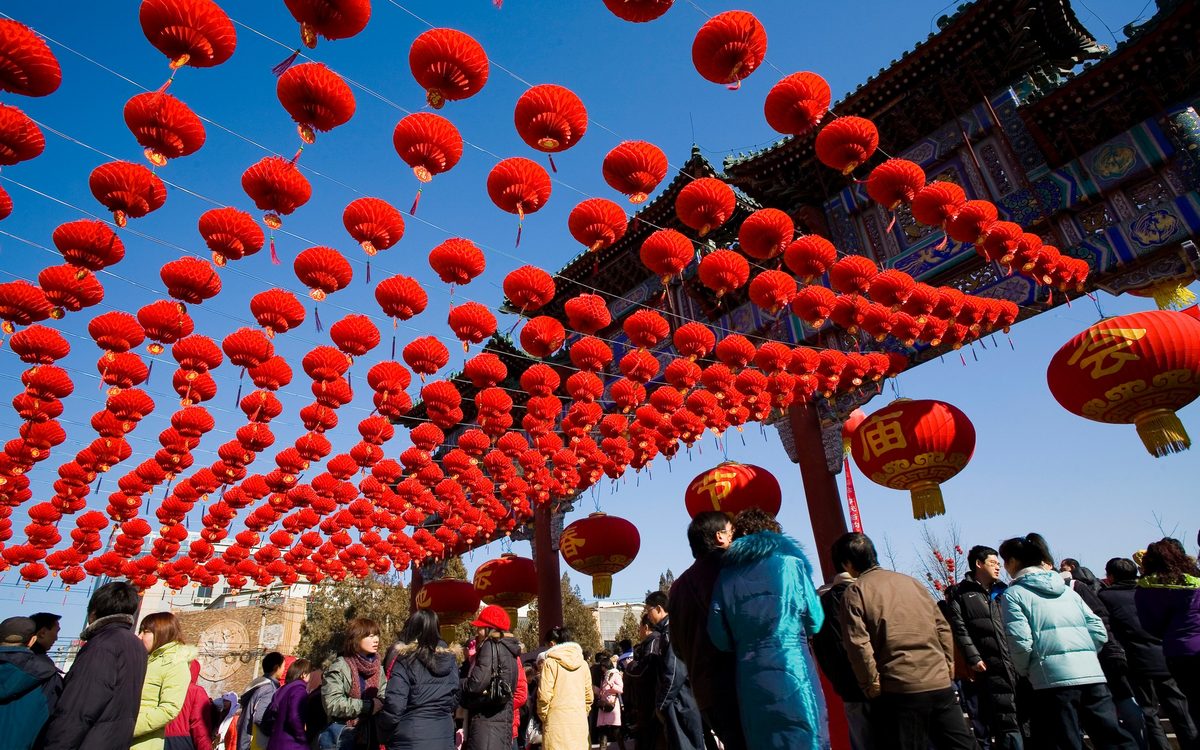
01Two Kinds of Festival
Which Chinese festivals can a visitor simply turn up to, and which are community events?
Chinese festivals fall into two categories, and the line between them determines whether an event is open to anyone or whether an outsider arrives as a guest. Lantern festivals, ice and snow festivals (冰雪节), and flower fairs (花市) are staged for the public: a city or company funds them, entry is open to all, and the event exists partly for an audience. Temple fairs and dragon boat races are community events: a village or temple organizes them for its own calendar, and while outsiders can usually watch from the perimeter, the inner parts (the altar ritual, the dragon boat feast (龙船饭)) are not open to join without an invitation.
English-language festival listings for China almost never draw this distinction. Listings note that the Dragon Boat Festival (端午节), May or June falls in early summer, but not whether the race in that village is open to any passer-by or something that happens between clans who have invited each other. This page is built around the distinction. Each event is marked `public` for events staged for outsiders, `community` for events run for the community itself, and `mixed` for events that have both a public viewing area and a core kept for the community.
Three corrections before reading further.
Correction one: not every festival welcomes onlookers. Some are organized with viewing stands and managed entry; others are village affairs where an onlooker stands on the bridge and watches from a distance. Knowing which kind of event it is separates a planned afternoon from an awkward arrival.
The second correction: a date is not a time window. A lantern festival (灯会) may run for a month across the Lantern Festival (元宵节), fifteen days after the new year period. A dragon boat race (龙舟赛) happens on one day: usually the day of the festival itself, or the weekend nearest it. A temple fair (庙会) follows the temple's own calendar, which may not align with the public holiday. "Going for the Dragon Boat Festival" and "going on the day of the dragon boat race" are two different plans.
Correction three: the fullest versions are not in the big cities. The temple fairs with the fullest ritual sequence and the dragon boat races with many villages participating are often in county towns and riverside villages, places where transport and accommodation are tight during the festival. Reaching the full version calls for journey planning as careful as the event itself. The transport page covers how to reach smaller towns; the how-it-works page covers rail travel with a foreign passport.
| Value | What it means | What an outsider can do | Typical of |
|---|---|---|---|
| public | Staged for anyone who comes | Open entry; no local connection needed | Lantern festivals, ice festivals, city flower fairs |
| community | Run by a village or temple for itself | Watch from where others watch; the inner parts are by invitation | Village dragon boat races, village temple fairs |
| mixed | Both at once | A public viewing area, with a core kept for the community | County temple fairs, some official races |
02Temple Fairs
What is a Chinese temple fair, when does it happen, and can outsiders go in?
A temple fair is the combination of a temple's ritual calendar with a market that gathers around it. The temple holds its festival on a date set by its own religious calendar, often the birthday of the deity enshrined there, and vendors, performers, and pilgrims converge for anywhere from one day to two weeks. It is not a permanent market (those belong to the markets layer); it is a time-bound event tied to a specific temple's schedule.
What it looks like. At the center is the temple itself, with incense, ritual processions, and sometimes opera performances on a temporary stage. Around it spreads a market of snacks, crafts, fortune-tellers, and children's rides. The ratio of ritual to commerce varies: some fairs are primarily religious gatherings with a market attached; others are primarily fairs with a temple at the center.
Where they happen. Temple fairs occur wherever there is a temple with an active festival calendar. Well-known ones in major cities (Beijing's Ditan Temple Fair during Spring Festival (春节), late January or February, Shanghai's City God Temple area) are heavily commercialized during peak periods. The fuller ritual versions are in county towns and villages, where the temple's community still organizes the procession and the feast.
Timing. Many temple fairs follow the lunar calendar. Common anchors include the opening month of the lunar year (Spring Festival period), the second day of the second lunar month (the dragon raising its head), the birthday of Guanyin (观音) (nineteenth day of the second, sixth, and ninth lunar months), and the mid-autumn period. Each temple sets its own dates; the lunar anchor is the stable reference.
Can outsiders enter? This varies sharply. City temple fairs during Spring Festival are public events with open entry. Village temple fairs on a deity's birthday are community events: the temple grounds are usually open to pilgrims and onlookers, but the ritual procession and the community feast may be restricted to temple members and invited guests. Each community entry here is marked `public`, `community`, or `mixed`. For `community` entries, a visitor can typically watch from the perimeter, offer incense if the temple allows it, and stay out of restricted ritual areas unless invited.
The beliefs page explains the religious calendar and why temples close or restrict access on certain days; this page covers the fairs themselves and how open each one is to outsiders.
03Lantern Festivals
What is a Chinese lantern festival, how long does it run and what does it cost?
A lantern festival is a city- or company-produced event where large-scale illuminated installations are displayed in a park, along a river, or in a historic district. Unlike a temple fair, it is not tied to a temple's ritual calendar. It is a public exhibition, usually ticketed, and it runs for weeks rather than days.
What it looks like. The core is the lanterns themselves: traditional silk-and-bamboo lanterns in some venues, massive steel-frame LED structures in others. Many events combine lantern displays with food stalls, performances, and amusement rides. The peak attendance is around the Lantern Festival (the fifteenth day of the opening lunar month), but many events open weeks earlier and close weeks later.
Where they happen. Lantern festivals occur in many major cities during the opening lunar month. The large-scale industrial version is in Zigong (自贡), Sichuan (四川): the Zigong Lantern Festival is a large-scale commercial production that runs for approximately two months, uses hundreds of artisans, and has become an export industry (Zigong lantern crews design and build events overseas as well). Other notable events include the Qinhuai Lantern Festival in Nanjing (南京), the Yuyuan (豫园) Lantern Festival in Shanghai, and various city-level events in Xi'an (西安), Chengdu (成都), and Guangzhou (广州).
Timing. Many lantern festivals run from roughly the third week of the opening lunar month through the Lantern Festival and beyond: typically late January to late February or early March in the Gregorian calendar, depending on when Chinese New Year falls. Some events, particularly in warmer southern cities, run longer.
Can outsiders enter? Lantern festivals are `public` events, with entry open to all and designed for an audience. Some historic-district events can be walked through freely, with specific installations or activities set apart. Peak nights, especially the Lantern Festival itself, draw very large crowds and may use timed entry (分时段预约). The how-it-works page covers how entry to popular attractions is organized.
The calendar page explains why the Lantern Festival falls on a different Gregorian date each year; this page covers the events themselves and how entry works.
04Dragon Boat Races
Where can a visitor watch a dragon boat race in China, and what happens after it?
A dragon boat (龙舟) race happens on the water, on one day, and it is the part of the Dragon Boat Festival (the fifth day of the fifth lunar month) that belongs to this page. The weeks of practice, the village visits, and the social obligations before race day belong to the leisure page. This page covers the day itself: where the races are, what kind of race it is, and how close a visitor can get.
Two formats. There are two distinct things called dragon boat racing. Competitive racing is what many people picture: standardized boats, twenty or more paddlers, a drummer, a steerer, races over a set distance, often with a referee and a finishing line. These can be government-organized sporting events with spectator stands, or village-level competitions between neighboring clans. Processional or leisure boating is less a race and more a parade: decorated boats moving slowly along a river, sometimes with performers on board, for viewing rather than competition. The card library distinguishes between the two.
Village races versus official races. This is a key distinction for a visitor. Official or government-organized races are typically held in urban rivers or lakes, have designated spectator areas, may have grandstand seating, and are run as public events. Village races are held on local rivers and canals, organized by the villages themselves. The audience stands on bridges, riverbanks, and rooftops. There is no infrastructure: no grandstands, no signage, and good viewing spots are claimed early. The race itself is part of a larger inter-village system of visits and feasts (known as zhaojing and yingjing in the Cantonese (广府) delta), where villages issue formal invitations to each other.
How close can a visitor get? At official races, follow the spectator signage. At village races, a visitor can watch from the riverbank, but the race course itself is cordoned off by local authorities or volunteers, and getting too close to the launching area or the boats is discouraged. The post-race dragon boat feast is, traditionally, a village meal, and walking into a village feast uninvited is not appropriate. Some villages open the meal to visitors by arrangement, but many do not. Each community entry here notes whether the feast is open to outsiders, open by arrangement, or by invitation.
The leisure page covers the weeks of practice and visiting before race day; this page covers the race itself and what a visitor can see.
05Ice, Snow and Flowers
When are China's ice festivals and Cantonese flower fairs, and are they ticketed?
This block covers two categories that share a trait: they are seasonal, geographically concentrated, and primarily `public` events. They are grouped here because both are city-produced rather than community-organized, but they occupy opposite ends of the calendar and the country.
Ice and snow festivals
Ice and snow festivals are winter events, concentrated in Northeast China, where the climate allows large-scale ice and snow sculpture to persist for months. A very large one is the Harbin (哈尔滨) Ice and Snow World (冰雪大世界) in Heilongjiang (黑龙江). The site covers approximately 1.2 million square meters and uses roughly 400,000 cubic meters of ice and snow. Other notable ice and snow events include the Changbai Mountain (长白山) ice and snow festival in Jilin (吉林), the Shenyang (沈阳) ice and snow festival, and various smaller events in Heilongjiang and Inner Mongolia (内蒙古).
These are `public` events: enter and walk through the sculpture park. Peak dates are the Spring Festival holiday period and the Lantern Festival. The land and climate page explains why Northeast China has the winter conditions for these events.
Flower fairs
The flower fair that belongs on this page is the Cantonese spring flower street, a multi-day event held in the days before Chinese New Year in Guangzhou (广州) and surrounding cities in the Pearl River Delta. The markets are spread across several districts, and stalls sell cut flowers, potted plants, artificial flowers, and small New Year goods. The tradition of "walking the flower street (行花街)" is listed as national-level intangible cultural heritage (非物质文化遗产).
This is distinct from the Dounan (斗南) flower market in Kunming (昆明), Yunnan (云南), which is a year-round wholesale and retail flower auction market: it belongs to the markets layer, not this page. The Cantonese flower fair is a time-bound festival event; Dounan is a permanent commercial market. This page covers the seasonal festival flower fairs, not permanent markets.
Flower fairs are `public` or `mixed` events: the street itself is open to all, but the busiest hours (the final evening before New Year) are extremely crowded and some areas may have one-way pedestrian flow controls.
06How to Choose
Which Chinese festival suits a given set of dates and travel style?
With five categories and over a hundred entries in the card library, the question is which one fits the trip. This block offers a decision framework rather than a ranking: each festival suits a different travel style, set of dates, and comfort level with being an outsider at a community event.
For a self-contained, organized experience. Choose a lantern festival or an ice and snow festival. These are `public` events: entry is open, and the event is designed for an audience. No local knowledge is required, and English-language information is increasingly available at major venues. The tradeoff is that these are heavily commercialized and crowded during peak periods.
For a living community tradition. Choose a village dragon boat race or a county-town temple fair. These are `community` or `mixed` events: an outsider can watch, and the atmosphere is different from anything staged for tourists, but a visitor is a guest, not a participant. The tradeoff is that transport and accommodation in the host town may be limited, and the schedule is tied to the lunar calendar rather than to a trip itinerary.
For the days before Chinese New Year in Guangzhou (广州). The flower fairs are the obvious choice: centrally located, and a genuine local tradition rather than a performance. The tradeoff is crowds on the final night.
For dates fixed in the Gregorian calendar. Lantern festivals and ice festivals fall in roughly predictable Gregorian windows (January to March for lanterns, December to February for ice). Temple fairs and dragon boat races are tied to lunar dates, so their Gregorian dates shift by up to three weeks from year to year. The calendar page explains the lunar-to-Gregorian shift.
For a group. The audience label matters. `public` events can absorb a group of any size. `community` events may not have facilities for organized groups, and arriving with a busload of visitors at a village race changes the character of the event.
To avoid the Golden Week crush. Where possible, plan a festival trip outside the week-long Spring Festival and National Day (国庆节), 1 to 7 October holidays. Transport and accommodation prices rise sharply, and popular events draw very large crowds. The calendar page covers Golden Week dates.
07When to Go
When do Chinese festivals fall, and how do the lunar dates move each year?
The timing of Chinese festivals is a common surprise for visitors used to fixed-date holidays. Many of the events on this page are tied to the lunar calendar, which means their Gregorian dates shift by up to three weeks from year to year. The calendar page explains how the two calendars work; this block covers what that means for planning a trip.
The lunar anchor. Every event is tied to a lunar anchor in its original form: for example, "the fifteenth day of the opening lunar month," "the twenty-third day of the twelfth lunar month through New Year's Eve," or "the fifth day of the fifth lunar month." This is the date the event is tied to, not the Gregorian date. A lunar calendar converter or the calendar page gives the Gregorian date for a given year.
Seasonal windows by category.
- Temple fairs: clustered in the opening lunar month (Spring Festival period, roughly late January to mid-February), with additional fairs on specific deity birthdays throughout the year.
- Lantern festivals: run from roughly the third week of the opening lunar month through the Lantern Festival and beyond, typically late January to early March.
- Dragon boat races: the fifth day of the fifth lunar month (the Dragon Boat Festival), usually falling in late May or June. Some villages hold races on the days immediately before or after.
- Ice and snow festivals: December through February, with the main season running from late December to late February.
- Cantonese flower fairs: the final three to six days of the twelfth lunar month, ending on New Year's Eve or the early hours of New Year's Day (元旦), 1 January.
The Golden Week problem. Two week-long public holidays, Spring Festival (usually late January or February) and National Day (国庆节), 1 to 7 October, are when domestic travel peaks. If a festival falls within or near a Golden Week, transport and accommodation are significantly more expensive and harder to secure. The Spring Festival period is complex: many temple fairs and flower fairs happen during it, but trains and flights are at their fullest. The calendar page covers Golden Week.
Off-peak alternatives. With flexible dates, consider the days immediately before or after a festival rather than the festival day itself. Lantern festivals are open for weeks and are less crowded before the Lantern Festival weekend. Temple fairs often have quieter days mid-run. Dragon boat races are the exception: the race is on the day, and there is no off-peak (淡季) version.
| Lunar anchor | What it is | Gregorian window | Which kind |
|---|---|---|---|
| Days one to five of the opening month | Spring Festival | Late January to mid-February | Temple fairs, flower fairs |
| Fifteenth day of the opening month | Lantern Festival | February to early March | Lantern festivals, temple fairs |
| Second day of the second month | Dragon Raising its Head | February to March | Temple fairs |
| Fifth day of the fifth month | Dragon Boat Festival | Late May to June | Dragon boat races |
| Twenty-third of the twelfth month to New Year's Eve | Little New Year to New Year's Eve | January to February | Flower fairs |
| Fixed to the Gregorian winter | No lunar anchor | Late December to February | Ice and snow festivals |
08Getting There
How can a Chinese festival in a county town be reached, and where do visitors stay?
The fullest versions of these festivals are often in places that are not built for large numbers of visitors. This block covers what that means for transport and accommodation, without repeating the transport page's general guidance.
The city events are easy. Lantern festivals in Nanjing (南京), Shanghai, Xi'an (西安), and Chengdu; ice festivals in Harbin (哈尔滨) and Changchun; flower fairs in Guangzhou (广州). All of them are cities with airports, high-speed rail stations, and plenty of hotels. For these, the main planning issue is arranging accommodation before the peak nights fill, not whether the place can be reached at all.
The county and village events are the challenge. A village dragon boat race in the Guangdong (广东) delta, a temple fair in a county town in Shanxi (山西) or Henan (河南), a smaller ice festival in a Heilongjiang (黑龙江) county: these are places where the nearest high-speed rail station may be an hour away by bus, where the local hotels fill up with returning family members during the festival, and where a good viewing spot is a bridge reached on foot. For these events:
- Arrange accommodation early. During a festival, every room in a small town may be taken by relatives returning home. If no room is available in the host town, the nearest county seat or city, which may be thirty to sixty minutes away, is the fallback.
- Allow extra travel time. Roads into a festival town are congested on the day. Buses may be rerouted or overcrowded. A journey that takes forty minutes on a normal day may take two hours during the festival.
- Have a backup viewing spot. For river races, the bridge nearest the starting line may be full an hour before the race. Scouting the riverbank the day before, or asking at the accommodation where locals watch from, helps.
- Cash is useful. Small-town vendors and some local transport may not accept international payment cards. The digital page covers mobile payment acceptance patterns.
The transport page covers intercity transport options in general; the how-it-works page covers how a foreign passport works with the rail system. This block adds the festival-specific layer: the same transport system is under more strain, and the last mile to a village venue is the difficult part.
09How Access Works
What do Chinese festivals cost to attend, and which ones are free?
Festival events differ in how they are organized, and that shapes what a visit involves. This block summarizes the structure, with the caveat that arrangements change from season to season.
Open events. Cantonese flower fairs are open to walk through. Many temple fairs in smaller towns are open to visitors, who pay for what they buy or eat. Village dragon boat races can be watched from the riverbank. Some city temple fairs are open outside peak periods but organized differently during the Spring Festival holiday.
Organized events. Lantern festivals are typically organized venues with managed entry, with the scale depending on the city and the event. The Zigong (自贡) Lantern Festival is at the larger end. Ice and snow festivals are organized on a bigger scale again: the Harbin (哈尔滨) Ice and Snow World (冰雪大世界) is a managed park. Official dragon boat races in urban venues may have grandstand seating, while riverbank viewing is usually open.
What entry covers. For lantern and ice festivals, entry typically covers the installations and many of the performances. Some events set apart specific rides, activities, or guided tours. For temple fairs with managed entry, the fairground is covered, while individual food stalls, game booths, and temple incense are separate.
Arrangements change. Arrangements change each season, so this page does not describe current terms. For any trip, the event's official channel is the place to check before going. The how-it-works page explains why this page does not guarantee current details and where to check.
Hidden costs. The unbudgeted cost at festival events is often not the event itself but the transport and accommodation surge during peak periods. A hotel room can sit well above its normal rate during the Lantern Festival weekend.
10Etiquette and Boundaries
What are the etiquette rules at a Chinese temple fair or village dragon boat race?
This block is the practical side of the proposition in block 01. At a `community` or `mixed` event, a visitor is a guest, and there are things to do and things to avoid. These are not rules posted on a sign: they are the boundaries that make the difference between a visitor who is tolerated and one who is not.
Photography. At public events (lantern festivals, ice festivals), photography is generally permitted everywhere except where signs prohibit it (inside certain temple halls, near specific ritual objects). At community events such as a village temple fair or a dragon boat race, the general principle is that photographing the event from the public viewing area is fine, but photographing people up close without asking, especially during ritual moments, is not. If a ceremony is happening inside a temple or an enclosed area and it is unclear whether outsiders are allowed there, the answer is usually that they are not.
Ritual areas. At temple fairs, the inner sanctuary of the temple, the procession route, and any area marked off for ritual are for participants. Standing at the edge and watching is acceptable; stepping inside to get a better photograph is not. The beliefs page covers the religious context; this page adds the visitor boundary.
Dragon boat feasts. The post-race dragon boat feast is the clearest example of a community activity. Traditionally, it is a meal for the rowers, their families, and invited guests from neighboring villages. Some villages open the meal to visitors by arrangement, and many do not. If a village does not publicly open the feast, it is by invitation, and walking in uninvited and expecting a seat is not appropriate. When it is unclear, asking at the village committee office or at a nearby shop shows whether visitors are welcome in a given year.
Offering incense. At temples during fairs, offering incense is generally open to anyone who buys incense (usually a small fee). Follow the local practice: three sticks is standard, hold them with both hands, bow, and place them in the burner. Do not take incense meant for ritual use without paying.
General principle. The rule for `community` events is simple: watch from where others are watching, do not go where others are not going, and if it is unclear whether something is open to outsiders, it probably is not. Each entry here states the specific boundaries for that event.
11Connected Pages
Which other PreeChina pages cover Chinese festival dates, the festivals of China's many peoples, and rituals?
This page does not exist in isolation. Every category connects to a page that explains something this page deliberately does not. Use these links to get the full picture.
The calendar page explains the two calendars, why festival dates move, and when Golden Weeks fall. It also covers the dates and meanings of the four major traditional festivals (Spring Festival, Qingming (清明), Dragon Boat, Mid-Autumn (中秋节), September or October): this page covers where those festivals are visible, not what they mean.
The peoples page covers the festivals of China's many peoples: the Water Splashing Festival, Naadam (那达慕), July or August, the Torch Festival (火把节), late July or August, the Tibetan New Year, and the Miao (苗族) New Year. Those are not on this page; they are on the peoples page because they are tied to specific communities rather than to the five categories covered here.
The beliefs page covers the religious calendar, why temples close or restrict access on certain days, and the meaning of ritual practices. This page covers whether a temple fair is open to visitors; the beliefs page covers what is happening inside.
The leisure page covers the weeks before a dragon boat race: the practice sessions, the inter-village visits, the social side of the event. This page covers the race day itself.
The society page explains why real-name entry and timed entry (分时段预约) became standard across Chinese attractions, which shapes how the larger events on this page are organized.
The transport page covers how to reach the cities and towns where these events happen, and the how-it-works page covers how a foreign passport works with the rail system.
The markets layer covers permanent markets, including the Dounan (斗南) flower market in Kunming (昆明). That is not a festival and is not on this page; this page covers the seasonal Cantonese flower fairs.
12What This Page Is Not
What does this page on Chinese festivals not cover?
Eight corrections to the common misunderstandings about festivals in China.
- This page does not list every festival. It covers the five categories that other pages explicitly assigned here: temple fairs, lantern festivals, dragon boat races, ice and snow festivals, and Cantonese flower fairs. Festivals of China's many peoples are on the peoples page; the dates and meanings of the four major traditional festivals are on the calendar page.
- This page does not guarantee that a community event will welcome outsiders. Each event is marked as public, community, or mixed. For community events, the page states what a visitor can typically do: it does not promise that any specific village will welcome outsiders in any given year.
- This page does not give the Gregorian date. It gives the lunar anchor. The Gregorian date shifts each year; the calendar page or a lunar calendar converter gives the date for a given travel year.
- This page does not give current terms of entry. It describes how each kind of event is organized. Current details are on the event's official channel; the how-it-works page explains how to check.
- This page does not explain the religious meaning. Temple fairs are listed as events with access information; the beliefs page covers the theology and ritual. For what is happening inside the temple, start there.
- This page does not cover the weeks before a dragon boat race. The practice, the visiting, and the social structure are on the leisure page. This page covers the race day and what a visitor can see.
- This page does not rank festivals by authenticity. No temple fair or dragon boat race is the "authentic" one. There are events with different levels of commercialization, different community participation, and different access levels. The audience and access labels describe what each one is; they do not rank them.
- This page will need updating. Festival dates shift each year, prices change, and villages may open or close their events to outsiders. The card library records the source and year for each entry. If a card's year is more than two years old, verify the current status before planning a trip around it.