
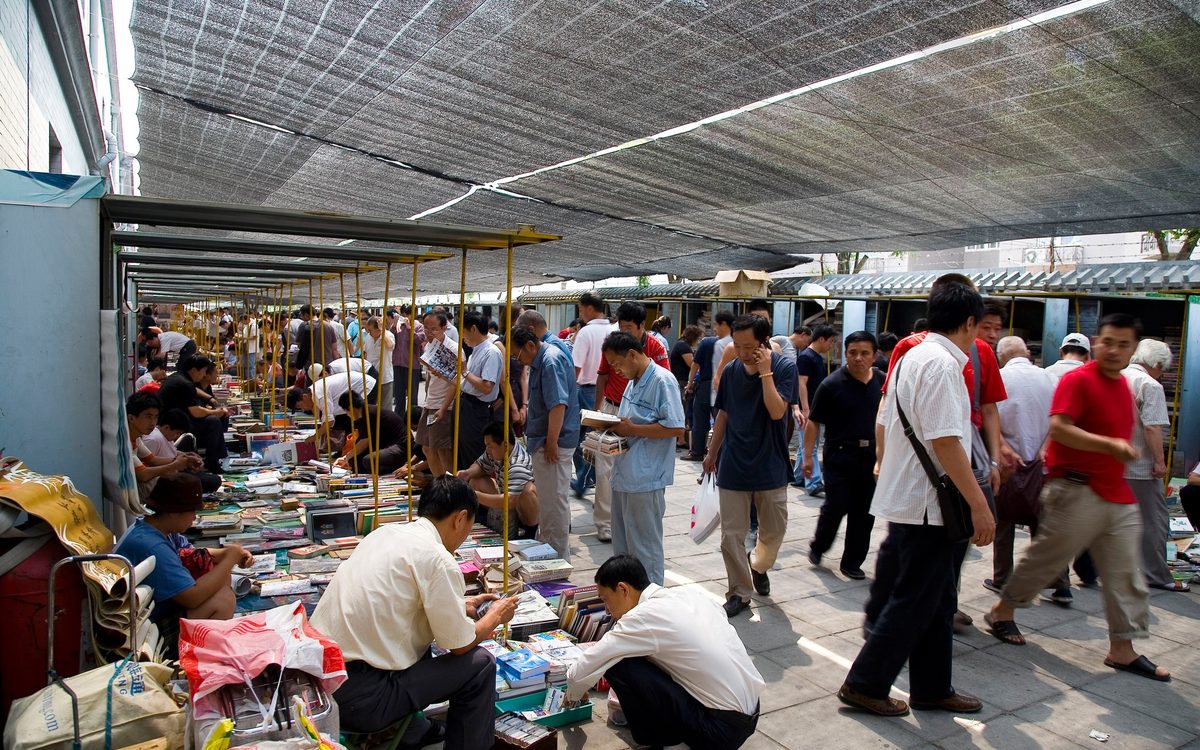
01A Time, Not a Place
What is the difference between a caishichang, a zaoshi and a ji?
Chinese has several words here and they describe different hours, not different buildings.
Caishichang (菜市场) is the everyday market, open through the day, where the neighbourhood buys vegetables and meat. Zaoshi (早市) is the morning market, which exists between roughly dawn and mid-morning and then stops. Ji (集) is the country market, which is not open today unless today is its day.
We counted the markets in a ten-batch survey of 518 across the country. The three leading kinds are the country market, the morning market and the night market, and with the seasonal markets they come to about three fifths of everything recorded. All of those are defined by when they happen. The kinds defined by what they sell, vegetables and fish and flowers, come to about a third, and much of that third is the everyday food market.
This is the fact to carry into the rest of the page. A Chinese market is a scheduled event that happens in a place, and the place is often doing something else the rest of the time. A street that sells clothes at noon sells food at nine. A hall that wholesales at two in the morning sells to the public at four in the afternoon. A field that is empty on the third of the month is a market on the fifth.
The hour says when to go. The next block says why.
02What Each Kind Sells
What does each kind of Chinese market sell?
Every kind of market on this page has its own inventory, and the inventory is the reason to go. We took the goods listed on 273 market records and sorted them by kind. This is what came out.
The night market sells food, and it is the cheapest map of Chinese regional taste there is. Nearly everything recorded at night markets is something to eat on the spot, and the list changes with the province in exactly the way the food does. In the northeast it is skewers (撸串), sweet and sour pork and Korean rice sausage. In the northwest it is hand-pulled lamb, lamb grilled over tamarisk wood and fermented sweet grain. In the southwest it is chilled jelly, hot and sour glass noodles and pounded chicken feet. In Guangxi (广西) it is river snail noodles (螺蛳粉) and pickled fruit. In Guangdong (广东) and Hainan (海南) it is sweet soup. In Jiangxi (江西) it is clay pot soup and mixed rice noodles. Stinky tofu (臭豆腐) turns up everywhere. Alongside the food, the larger night markets sell clothes, phone cases and small goods, and some are as much a bazaar as a food street.
The morning market sells breakfast and the day's produce. Fried dough sticks, tofu pudding, fried cakes, meat pastries, lamb soup, and then the vegetables, fruit and eggs the neighbourhood came for. In the northeast in winter the fruit is frozen: frozen pears, frozen persimmons, frozen strawberries, sold hard as stones. In Yanbian (延边) it is kimchi and dried pollock.
The country market sells what a farming district has. Live poultry and pigs, sometimes slaughtered on the spot. Mountain goods: walnuts, pine nuts, wild greens in spring. Frozen goods in winter. Songbirds, goldfish and crickets in the section Chinese calls flowers, birds, fish and insects. And the local specialty that made the market: the Hejian (河间) markets in Hebei (河北) are described in Chinese sources as the birthplace of the donkey meat sandwich (驴肉火烧), and they still sell it by the thousand.
The everyday market sells the staples, and in regions with distinct local peoples the staples are different. In Yanji (延吉) it is pickled cabbage, dried fish and rice sausage. In Lhasa (拉萨) an old market sells butter (酥油), tea, dried yak, incense, amber and turquoise.
The fishing port sells whatever the coast has. Yellow clams (黄蚬子) at Dandong (丹东), swimming crab down the Zhejiang coast, sea urchin and oysters in Shandong (山东), salmon and sturgeon on the Heilongjiang (黑龙江) river at Fuyuan (抚远).
The border market sells the other country. On the Russian border that means chocolate, purple sweets, vodka, black bread, honey, flour, cooking oil, nesting dolls and Russian cosmetics, with king crab (帝王蟹) landed through the same crossings. At Ruili (瑞丽) on the Myanmar border it is Burmese snacks. At Pingxiang (凭祥), in Guangxi on the Vietnamese border, it is durian, dried mango and Vietnamese coffee. A border market is a duty-free shop for a country not yet entered.
The Xinjiang (新疆) bazaar sells everything, and it is the one market on this page where the half that is not food matters as much as the half that is. Food leads: naan (馕) in a dozen forms, including rounds half a metre across, baked meat pies (烤包子), pilaf (手抓饭), skewers, lamb roasted on a rack (架子肉), grilled fish, cold noodles, yoghurt with rice, and pomegranate juice pressed while the buyer waits. Then dried fruit and nuts, sold loose from wide trays and tasted before buying: raisins of several kinds, almonds, dried figs and apricots, red dates, walnuts, goji. Then the handmade goods: Uyghur embroidery (维吾尔族刺绣), Hetian jade (和田玉) and coloured-stone jewellery, hand-worked copper in Pakistani and Indian styles, woodcarving, gourds burned with designs, and the instruments, the dutar (都塔尔), the rawap (热瓦普) and the frame drum (手鼓). Then clothes: dresses in atlas silk (艾德莱斯绸), embroidered wool caps (朵帕), shawls, gold and silver. And a corner of local medicinal plants and safflower (红花). The price on a handmade piece is an opening bid. The people who run our trips reckon a sale at somewhere between half and sixty per cent of the opening number is ordinary.
The flower market sells flowers at two scales. Cut flowers by the bunch and the auction lot at Dounan (斗南). Potted kumquat, peach blossom, orchids and narcissus at the new year fairs.
And some seasonal markets are built around a single product and sell little else. Ginseng at Wanliang (万良) in six grades from fresh root to wild root, with deer antler (鹿茸) and lingzhi beside it. Fish on the ice at Chagan Lake (查干湖).
| Kind | Mainly | Examples from the survey |
|---|---|---|
| Night market | Street food, by province; clothes and small goods | Skewers in the northeast, lamb in the northwest, river snail noodles in Guangxi, sweet soup in Guangdong |
| Morning market | Breakfast and the day's produce | Fried dough sticks, tofu pudding; frozen pears in a northeastern winter |
| Country market | Farm produce, live animals, mountain goods | Walnuts and pine nuts; songbirds and crickets; donkey meat sandwiches at Hejian |
| Everyday market | Staples of the neighbourhood | Kimchi and dried fish in Yanji; butter, yak and incense in Lhasa |
| Fishing port | The coast's own species | Yellow clams at Dandong, swimming crab in Zhejiang, sturgeon at Fuyuan |
| Border market | The other country's goods | Russian chocolate and vodka; Burmese snacks at Ruili; Vietnamese coffee at Pingxiang |
| Bazaar | Food, dried fruit and nuts, handmade goods, clothing, herbs | Naan and pilaf; raisins and almonds by the tray; embroidery, jade, copper, dutars; atlas silk dresses; safflower |
| Flower market | Cut flowers; new-year pot plants | Auction lots at Dounan; kumquat and peach blossom at the fairs |
| Seasonal market | Often a single product, in its season | Six grades of ginseng at Wanliang; fish on the ice at Chagan Lake |
03Before Buying
What should be thought about before buying at a Chinese market?
- Some of what a Chinese market sells will be unfamiliar, some of it is regulated, and some of it cannot legally go home with the buyer. This block is a notice, not a recommendation.
- Live animals. Country markets sell live poultry and livestock, and some slaughter on the spot. The livestock bazaar outside Kashgar (喀什) trades cattle, sheep, horses, donkeys and camels by the thousand, and buyers settle the price by touching fingers inside a sleeve so nobody else can see the number. The flowers, birds, fish and insects section of a market sells songbirds, fish and fighting crickets as pets. None of this is hidden and none of it is staged.
- Animal parts and medicine. Deer antler is sold at the ginseng market and at the Russian border. One Russian goods street in Heihe (黑河) lists antelope horn (羚羊角) among its wares. Several markets have a medicinal herb street, and Lhasa (拉萨)'s old market sells Tibetan medicine and incense. Animal and plant products of this kind are restricted or prohibited from crossing many borders, and some species involved are protected under international agreements. We do not list which items are legal where, because the answer changes and depends on the home country's rules. The practical advice is short: look, and do not buy to take home.
- Fur. Russian goods streets sell fur coats. The same border rules apply.
- Unusual food. Chinese markets sell things many visitors have not eaten: offal, blood, donkey, insects in some regions, fermented and strong-smelling foods. We treat these the way this site treats all food: we say where they are, and we do not urge anyone to eat them. Our market survey has not yet recorded edible insects at a specific market, so we do not name one.
- One word that misleads. A market nicknamed the dog market, as one in Xiangyang (襄阳) is, is a pet and flower market. The name is about what is sold as pets, not as meat.
04Runs on a Number
Why is a major kind of Chinese market shut on many days?
A major single kind of market in the country is the one that is shut on many days.
Ganji (赶集) means going to the market, and the market in question opens on fixed dates that repeat. Not weekends, and not daily. Dates. The Hongqi market (红旗大集) in Yingkou (营口), on the Liaoning (辽宁) coast, opens on days whose date ends in two, five, eight or zero, and again at weekends. The Wanliang (万良) ginseng market in Jilin (吉林) holds its trading days on the fifth and the tenth of each month.
So the market has a number, and the number is the thing needed. A visitor who asks where the market is has asked the wrong question. The question is when it is.
Why this is worth knowing rather than just worth arranging
The number shows which calendar the place is still counting by. Shenyang (沈阳) has three big country markets and they run on the Gregorian date: one on dates ending two, five and eight, one on one, four and seven, one on three, six and nine, so that between them the city has a market on every day of the month. The markets around Hejian (河间) in Hebei (河北) run on the lunar calendar instead, in pairs of days, one and six, two and seven, three and eight, four and nine. Two systems, sometimes an hour apart, that never line up. We are recording which one each market uses, market by market, and we would rather say that than publish a timetable we cannot stand behind.
The same institution goes by different names across the country. In the northeast and in Shandong (山东) it is a daji (大集), a big market. In the Xinjiang (新疆) countryside the periodic market is a bazaar. Our survey files them as one kind, because they behave the same way: a fixed cycle, a village or town rather than a city, and a crowd that arrives from a radius.
Some of them are old. The Hongqi market is described in Chinese sources as having several centuries behind it, and Liaoning province lists it as intangible heritage. The Shaling market (沙岭大集) in Panjin (盘锦) is reported to have run since the late Qing (清), 17th to early 20th century. We have not yet checked either claim against a local gazetteer.
05Morning and Everyday
When do Chinese morning markets open and close?
The morning market is the one a visitor is likely to walk past without registering that it was a thing, because it is gone by eleven.
It opens somewhere between four and six, depending on the city and the season, and it thins out through the morning. In the northeast it opens in the dark. The Xiaoheyan (小河沿) market in Shenyang (沈阳) starts in the dark before dawn. The Hongzhuan Street (红专街) market in Harbin (哈尔滨) runs through the early morning, a few minutes from the city's main tourist street, and many people walking that street never see it.
This is the block where markets and breakfast are the same subject. Much of what a morning market sells is breakfast, eaten standing up, and the hours are the hours of the breakfast domain. Anyone who has read that page has already read half of this one.
The everyday market, and what its name remembers
The all-day neighbourhood market is the least exotic kind and the one with a long memory. The Daoli market (道里菜市场) in Harbin has been on its site since 1902, which makes it older than much of the city around it. Its old name was Bazashi (八杂市), and Chinese sources say that name transliterates the Russian word for a bazaar, from the decades when the city was built along a Russian railway. Hongzhuan Street traces back to a lane of Russian bakeries from 1903.
Two markets, two Russian ghosts, and today they sell steamed buns (包子) and fried dough sticks.
Chinese media describe both with superlatives, one as the country's leading food market and one as a very large morning market in Asia. We record who said it and when. We do not repeat a ranking as though it were a measurement.
06Night Markets
Why are Chinese night markets often on a pedestrian street?
Chinese night markets are frequently set up on a pedestrian street or in a busy commercial block, which means the market and the street are the same address at different hours.
A new visitor can look at the daytime version, see shops and shoppers, and conclude there is no market. The stalls arrive in the evening. The Jiankang Road (健康路) market in Zhengzhou (郑州) puts its stalls out around six in summer and seven in winter, runs its busiest stretch until about ten, and then follows a fixed closing sequence: the lights go off at a set minute and the street is cleared by eleven. A market with a lights-out time is still a market.
What arrives with the stalls is food, and this is a very good way into Chinese street eating. Three hundred stalls on one street in Zhengzhou, eighty of them cooking. The visitor walks, points, pays a small sum, and moves to the next one, and the next one is a different dish from a different province. The list in block two is what to expect; the rule for choosing is the one this site gives for any street food: go where the line is.
The form covers a lot of ground. In Guangzhou (广州) and Shenzhen (深圳) and Haikou (海口) the evening trade happens along arcaded streets built for walking. In Nanning (南宁) and Liuzhou (柳州) it fills a named pedestrian block. In Hefei and Nanchang (南昌) it occupies a district built or rebuilt for the purpose. In Linxia (临夏), in Gansu (甘肃), the same lanes carry a morning market and a night market at the two ends of the day.
How we decide whether it counts
Our test is whether stalls go out in the evening, not what the venue is called the rest of the time. We treat a video record of the stalls as sufficient evidence that the market exists. That evidence settles existence and nothing else. It does not confirm any claim of rank, and we handle those separately.
07Two Clocks
Why does a Chinese market look empty in the middle of the day?
Many Chinese markets run two separate sessions for two different sets of customers, and the gap between them is a very useful thing on this page.
One session is the trade. Buyers with vans arrive, the volume moves, and the hour is set by whatever the market depends on: when the boats land, when the flowers are cut, when the distributors need to be on the road. The other session is the retail, which is when everybody else is allowed to be there and when there is anything to look at.
They are often twelve hours apart.
The flower market at Dounan (斗南), outside Kunming (昆明), runs its wholesale session at night, from about half past eight until two in the morning, and sells to the public through the day. It also has an auction floor, which is unusual for a market of any kind in China and which we are still verifying before we describe how it works.
The Shipu (石浦) seafood market in Ningbo (宁波) does its wholesale trade as a night market, when the boats sell in bulk to dealers. Its retail crowd comes in the late afternoon. The Cangnan (苍南) market further down the coast opens for wholesale in the afternoon. On Nanao Island (南澳岛) in Guangdong (广东) the harbour buys the day's fishing in the mid afternoon, while the market up the hill opens in the morning and has largely broken up by late morning.
A visitor who arrives between the two sessions sees an empty shed and concludes the market is finished. It is not finished. It is between shifts.
| Market | Trade session | Public session |
|---|---|---|
| Dounan flower market, Kunming | About 8.30 pm to 2 am | Through the day |
| Shipu seafood market, Ningbo | About 9 pm to 4 am | Late afternoon |
| Cangnan seafood market | From 5 pm | Daytime |
| Nanao Island, Guangdong | Harbour, mid afternoon | Hill market, 7 am to about 11 |
08Part of the Year
Which Chinese markets exist for part of the year alone?
Some Chinese markets exist for a few weeks a year, and one of the important ones exists for about four days.
The Guangzhou (广州) flower fair (花市) runs in the week before the lunar new year (春节), late January or February, from around the twenty-third of the twelfth lunar month to the eve itself. Eleven districts of the city each set up their own, at the same time, and then all of them come down. The custom has its own name in Cantonese (广东) usage, walking the flower street (行花街), and the Guangzhou city government and national news outlets report it as a listed item of national intangible cultural heritage (非物质文化遗产). Local writing puts the point more plainly: if the flower street has not been walked, the new year has not been had.
Northern and eastern cities keep the same festival in a different building. Shanghai holds its new year flower trade as an indoor exhibition. The open-air street version belongs to the south.
Other seasonal markets follow a harvest rather than a festival. The Wanliang (万良) ginseng market in Jilin (吉林) trades dried root all year, but its fresh-root season runs from September to November, about a hundred days, and the market changes character completely for it. The Chagan Lake (查干湖) fish market in Jilin exists on the ice, for a stretch either side of the new year, around the winter netting that the state lists as intangible heritage. In the Hulunbuir (呼伦贝尔) grassland, an Ewenki (鄂温克) banner holds a winter meat market for the cold storage season.
These are the markets where being there in the wrong month is not a matter of missing the good stalls. There is nothing there at all.
09Fishing Ports
When should a visitor go to a Chinese fishing port market?
A fishing port market keeps a timetable on this page that nobody set.
The boats come in when they come in, the market happens then, and everything else in the building works backwards from it. At Dongang (东港), on the Liaoning (辽宁) coast facing North Korea (朝鲜), the boats land at about five in the morning and the market is the hour after that. At the Qiaogang (侨港) harbour market in Beihai (北海), on the Guangxi (广西) coast, the trading runs from around five to nine, with a hundred metres of quay covered in what came off the boats that night.
China has a lot of these and they are not evenly written about. Our survey records around thirty, and until recently every one of them was in the north. The southern ports came into the record last, which says more about who has been writing than about where the fish is.
Shenjiamen (沈家门) on the Zhoushan (舟山) islands is the one usually put at the top. Chinese sources call it one of the world's great fishing harbours and a very large one in the country, and we pass that on as their description rather than ours. The port itself is open at any hour and the market beside it is not, which returns to the block on two clocks.
What a visitor sees depends on which of the two markets they walk into. The wholesale hall is a trade floor with a floor manager's hours. The retail rows are for the town. They are usually in the same compound and they are usually not open at the same time.
10Border Markets
Why do China's border markets exist?
On several of China's land borders there is a market that exists because of a specific customs rule, and the rule is the reason the goods are cheap.
Residents registered on the border can carry a set daily value of goods across duty free. Chinese official and media sources describe that allowance, and the trade that has grown around it is what fills these markets. The market is not there because the border is nearby. It is there because of the allowance.
Each crossing faces a different country, and the market changes with it. At Hunchun (珲春) in Jilin (吉林), where China meets both Russia and North Korea (朝鲜), the halls sell Russian confectionery and chocolate alongside crab. At Heihe (黑河) the Russian city is on the far bank of the river, and the traders speak Russian. At Dongxing (东兴) in Guangxi (广西) the crossing is a pontoon bridge over the Beilun River (北仑河), and the morning the gate opens is the part worth seeing. At Pingxiang (凭祥), also in Guangxi and further along the Vietnamese border, the shops price in both currencies. At Horgos (霍尔果斯) the market is a duty-free zone shared between China and Kazakhstan, built so that a visitor can stand with a foot in each.
Ten land borders, and our survey covers seven. The Laos, Kyrgyz, Tajik (塔吉克族), Afghan and Pakistani crossings are not in it yet. The Pakistani one is seasonal in any case, because the pass closes.
Entry rules are the part we will not summarise. Several border zones have special conditions, the requirement differs by crossing, it changes, and the rules for foreign visitors are not the same as the rules for Chinese ones. Check with the crossing itself before planning around any of this, and treat anything read elsewhere, including here, as possibly out of date.
11PreeChina Experiences
What does PreeChina arrange around markets?
- The barrier at a Chinese market is not access. It is the timetable.
- A night market as a food route. One street, one evening, a dozen dishes from as many provinces, with someone who can say what each one is and which stall the locals are lining up at. For many visitors this is a standout evening of eating in China, and it costs little.
- A market day in the country. The country market is a major kind in China and the hardest for a visitor to reach on their own, because it is not open unless it is its day. We are building the schedule market by market and we will not sell a day we have not confirmed.
- A landing. A fishing port at the hour the boats come in, which in many places means before sunrise, and the walk through the wholesale hall before the retail rows open.
- A flower street before the new year. Four days a year, in one city, and the rest of the year it does not exist.
- A border crossing market, with the permit position checked in advance for the traveller's nationality and confirmed with the crossing rather than with us.
- Language, where it matters. Much of a market is conducted by pointing and by calculator. The words worth having are the ones for quantity.
- A market inside a business programme. The specialised wholesale market at the end of an industrial belt, where ten suppliers can be compared in a morning, can be a day in a business group's programme, next to the factory visits. See industry clusters and factory visits.
- What we do not publish. We do not name stalls or traders. Traders move, stalls change hands, and a name we print today misleads somebody next year. The market is the institution and the market is what we write about.
12What It Is Not
What is a Chinese market not?
- Not a wet market (菜市场). The English term arrived in many readers' vocabulary in 2020 attached to a question about disease, and it does not translate anything. The Chinese word means the place where vegetables are bought. It is where a neighbourhood shops, it is regulated, and it is the ordinary back half of Chinese food shopping. We use the plain translation and we would rather address the word than write around it.
- Not just a food street. The night market is a food route and a fine one in the country. The morning market, the country market and the fishing port are where a town buys, and the eating there is a by-product.
- Not a tourist attraction. There is no gate, no route and nothing staged. Several of the markets on this page have become busy because of short video, which changes the crowd and not the institution.
- Not a souvenir shop. The border markets are the closest thing to retail on this page and they exist for a customs rule, not for visitors. And some of what they sell cannot go home with the buyer, which block three covers.
- Not open today, necessarily. A major kind of market in China is shut on many days. This is the sentence to leave with.
- Not one thing. A dawn market, a night street, a country market on a fixed date, a harbour at the landing hour, a flower fair (花市) that lasts four days and a duty-free hall on a river border are six different institutions. They share a word in English and very little else.