
Yingkou is in Liaoning, in Northeast China.
Home › Destinations › Liaoning › Yingkou
Liaoning · City Guide
Yingkou, the Port Old Maps Call Newchwang.
Overview
Why Go
Yingkou was opened to foreign trade in 1861, the opening port in the northeast, and nineteenth-century English sources call it Newchwang. The customs house, foreign banks and trading offices still line the old river street.
A cave at Jinniushan produced one of the more complete archaic human skeletons found in East Asia, dated to roughly 260,000 years ago. The fossil is held elsewhere; the site is a hill with a cave and an exhibition.
Much of the country's edible jellyfish passes through Yingkou to be salted, alum-cured and graded. It carries a protected-origin mark here and the processing yards along the coast are a real industry, not a display.
The Hongqi fair at Bayuquan has run since the Qianlong reign and now covers 130,000 square metres with some 3,700 stalls. It is listed as provincial intangible heritage, which is unusual for a market rather than a craft.
The tree garden at Xiongyue was planted in 1915 and is one of the older in China, holding around two thousand species. A Liao pagoda stands a short walk from the gate, which is an odd and pleasant pairing.
See
The treaty-port quarter along the Liao, with customs, bank and trading-house buildings from the late Qing and Republic in brick and stone. Restored as a walking street with cafes. Ninety minutes.
A limestone hill at Dashiqiao with the excavated cave and a small exhibition explaining the find. The skeleton itself is not here. Worth it if visitors care about human origins, thin if they do not. An hour.
A steep rock knob with a Ming pagoda on top, above the orchards at Xiongyue, attached to a legend about a mother watching for a son who never came back. A festival for mothers is held here each May.
A Liao brick pagoda in the middle of Xiongyue town, with the 1915 arboretum a few minutes away, laid out in plots by species. Both are free or nearly so. Half a day for the pair.
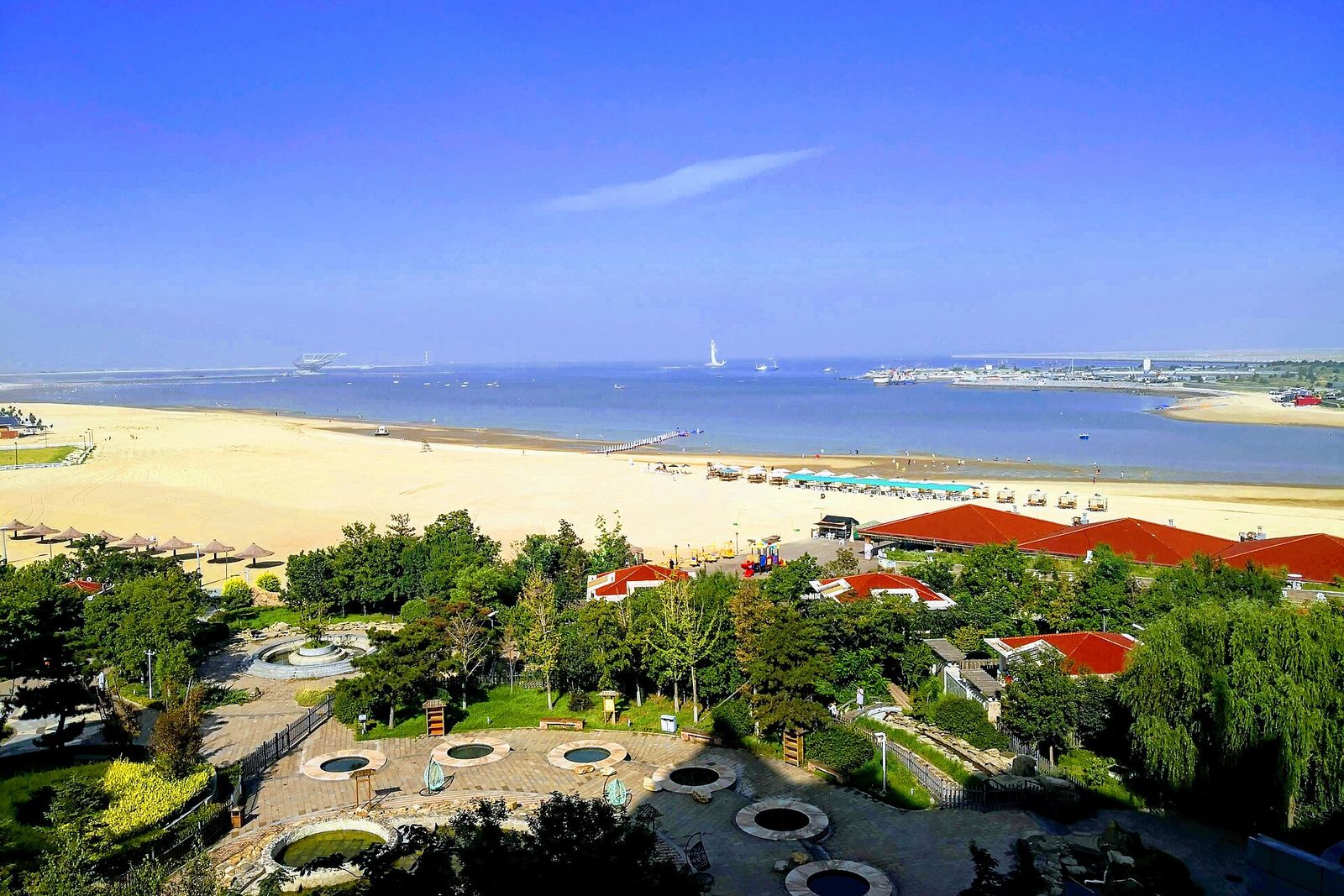
A sand beach backed by pine forest south of Bayuquan, with the Xianrendao headland and its coastal woods beyond it. Shallow, calm and busy in July; empty and good for walking the rest of the year.
A resort district built around springs in the hills at Gaizhou, with outdoor pools, hotels and a ski hill working the same valley in winter. Busy at the lunar new year, quiet otherwise.
On the Map
Approximate locations of the attractions above, across Yingkou.
Eat
Cured jellyfish shredded and dressed with vinegar, sesame oil and cucumber, eaten cold. The texture is crisp and slightly springy with almost no flavour of its own, which is why the dressing does the work.
Spanish mackerel minced to a paste with chives and water until it is smooth, then wrapped and boiled. The district of Bayuquan is named after the fish. Spring, when the mackerel run, is the season.
Apples from the hills at Gaizhou with a protected-origin mark, picked from late September. The cold nights and long autumn are what growers credit for the sugar. Sold by the crate at the orchard gate.
Short-grain rice grown on the coastal plain in slightly saline soil, harvested once a year, with a protected-origin mark. It is eaten plain rather than fried, and the difference is in the texture rather than the aroma.
Do
The Hongqi fair opens on fixed days of the lunar month rather than every day, and the other village fairs run their own cycles. Ask locally for the next date; turning up on the wrong day means an empty lot.
The buildings on Liaohe Old Street carry the names and dates of the firms that put them up, in several scripts. Walking it slowly is how visitors read the port's foreign period off the wall.
The Bohai tide pulls back a long way and people go out with buckets and short rakes for clams and razor shells. Check the tide table, watch when the locals turn back, and do not be the last one out.
Gaizhou shadow theatre is listed intangible heritage and the remaining troupes play at temple fairs and on commission. The culture centre in Gaizhou knows who is working and when.
When
Mild, dry and clear, with apple blossom at Gaizhou and the mothers' festival at Wang'ershan in May. The strongest window.
Beach season and peak jellyfish processing, hot and busy along the coast. Book Bayuquan rooms well ahead or stay inland.
Apple harvest, cool clear air and empty beaches. The ideal walking weather and the cheapest rooms of the good months.
Cold and windy with the Bohai partly frozen. Hot springs and the country fairs carry on, and the lunar new year fair is the main one of the year.
Explore More
Yingkou is in Liaoning, in Northeast China.
Related
Share the travel dates and interests, and PreeChina's local team will design a route that fits.
Plan My Trip to YingkouSee Private Tour Prices