
01Five Floors
Why does the same thing cost five different prices in China?
In China the price of a thing depends less on the thing than on where the buyer is standing when asking.
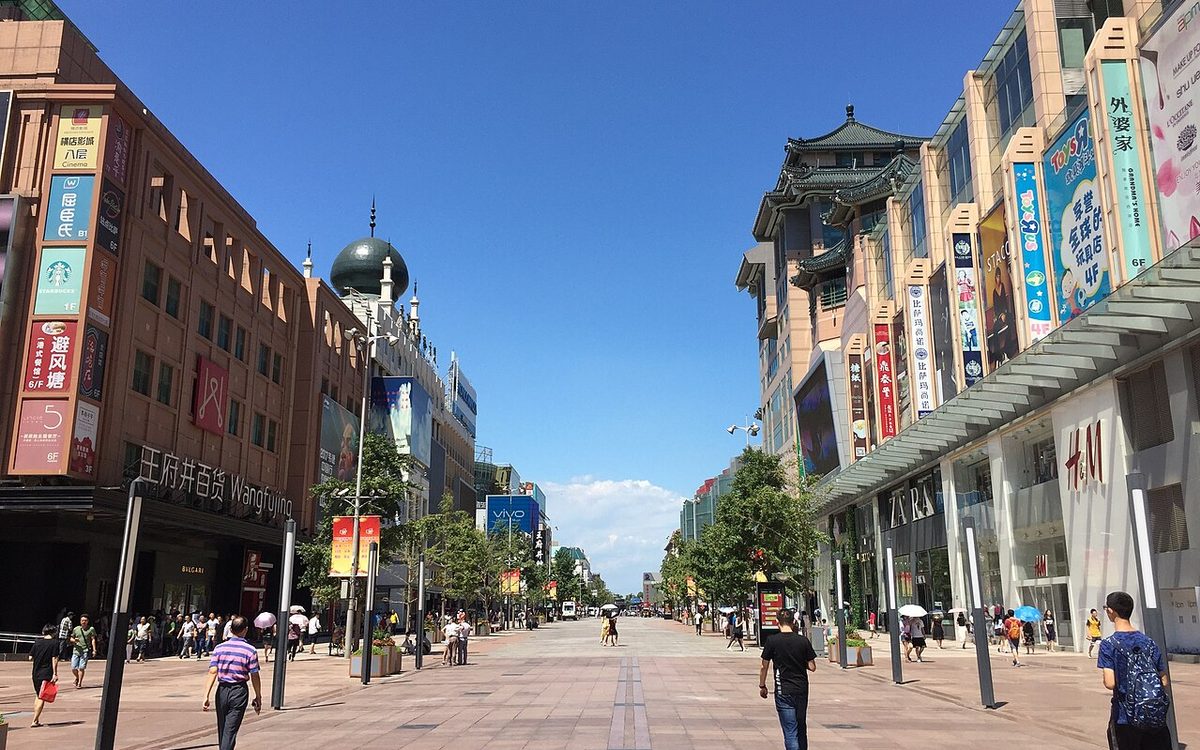
Our survey of shopping places sorts into five floors, and they run in one direction. At the top is the mall: printed prices, no bargaining, English on the signs, and the floor where a foreign bank card is likely to work at the till. Below it is the old commercial street, the Wangfujing (王府井) or Nanjing Road (南京路) kind, where the big shops price like a mall and the small ones will knock a little off. Below that is the wholesale market (批发市场), where the unit is a stall a few metres square, the price is a conversation, and the opening question is not "how much" but "how do I take it (怎么拿)", meaning by the dozen. At the bottom is the factory town, where the market is built next to the plant and the price is whatever the plant will take.
The cards say this plainly. Of the mall districts we hold, nearly all list bargaining as no. Of the wholesale markets, many list it as yes, and the industrial clusters all do. English goes the other way, from "complete" at the top to "almost none" at the bottom, and the foreign card disappears by the second floor. The report we draw on gives one T-shirt five prices on the way down: the brand counter, the mall promotion, the flagship online, the subsidised app, and the wholesale stall in Guangzhou (广州) at a fifth of the top price.
One floor sits off the line, and this page keeps returning to it. The tourist street and the museum shop charge more than the wholesale floor for objects that are often simpler, and they bargain little or not at all. What is paid for there is the story: the museum's authority, the street's name, the assurance that the thing came from here. Nobody is being cheated on that floor; it is a different purchase, and we say so where it applies.
So this page is not a list of shops. It is a description of the line, floor by floor, with the prices, the timetable and the language met on each, and then the three places where a visitor can walk the whole line in a day.
02What Foreigners Buy
What do foreign visitors actually buy in China, and where should they buy it?
The things visitors take home from China are mostly small, light and printed with a story, and the one rule about them is not to buy them at the gate.
The list, from the evidence we have. The report's own top twenty souvenirs and the Reddit threads we read agree on the core: museum products, above all the Palace Museum (故宫博物院)'s; tea, with Longjing (龙井), Tieguanyin (铁观音) and the black tea of Qimen (祁门) the ones a foreign palate takes to; porcelain from Jingdezhen; embroidery from Suzhou; dried fruit from the Urumqi (乌鲁木齐) bazaar; hotpot base (火锅底料) from Chongqing (重庆) in vacuum packs; the old Shanghai biscuits and milk sweets; a small thangka; an ikat (艾德莱斯) scarf from Xinjiang; cloisonné; a Yixing (宜兴) teapot; the Dunhuang (敦煌) flying-apsara scarf; Cantonese (广东) cured meat; Bai (白族) tie-dye (扎染) from Dali (大理). The Reddit threads add three things the report does not: running shoes (跑鞋), because Chinese brands now make good ones cheaply; a power bank with the CCC mark (3C 认证), because the airport checks for it; and the fact that hanfu (汉服) is rented for photographs, not bought. Nobody on those threads reports carrying snacks or spirits home, which does not mean nobody does.
Where each of these is bought decides what it costs and whether it is real. The report gives a six-line test that a visitor can run in a shop doorway: is the material local, is the design tied to this place or to any place, is the price explained by handwork, is the shop a workshop or a stall at the gate, is there a maker's or museum's mark, and would the person receiving it know where it came from. A panda magnet fails all six in every city; a Suzhou (苏州) double-sided embroidery passes all six in one.
The map that follows from this is short. Museum products in the museum shop. Crafts at the place they are made, which is the subject of a later block. Food from the old-name brands on the old street. Clothes and shoes in the mall, or from an app to the hotel. Small commodities from a wholesale floor when a hundred are wanted, from a night market when one is wanted. And nothing at the mouth of a scenic area (景区), where the report's own phrase is that the shops get cheaper the further in the walk goes.
| Thing | Buy it at |
|---|---|
| Palace Museum products · phoenix-crown magnet · Sanxingdui masks | the museum shop |
| Longjing · Tieguanyin · Qimen black tea · Wuyi rock tea · Pu'er · jasmine | the tea market at origin, or an old-name shop |
| Jingdezhen porcelain · Yixing teapot · Dehua white ware | the factory town |
| Suzhou embroidery · cloisonné · Fuzhou lacquer · Bai tie-dye · thangka · ikat scarf | a workshop, or a tourist street that passes the six-line test |
| Hotpot base · cured meat · Shanghai biscuits · Xinjiang dried fruit · cherry-blossom cakes | old-name brands on the old street; the bazaar for fruit |
| Running shoes · a CCC power bank | the mall, the brand outlet, the convenience chain |
03The Phone Is the Wallet
How does a foreigner pay in China without a Chinese bank account?
China pays by phone. A visitor who lands without Alipay (支付宝) or WeChat Pay (微信支付) registered and a bank card bound to it may spend the opening day unable to buy a bottle of water. That is an exaggeration, and a fair one: the shops do take cash, but almost nobody in the line is using it.
The setup is now done from abroad. WeChat Pay accepts a foreign card from the major card schemes, registered with a foreign mobile number and a passport, and it works at the same QR code the locals scan. Small purchases have carried no fee, and new users have had a fee-free allowance in the opening months; above that a fee applies. Alipay's international version does the same and adds a prepaid tour card. UnionPay (银联)'s own app for visitors opens some Chinese services, from train seats to food delivery, without binding a card to each. Keep some cash for the stall that takes cash alone, and expect the taxi not to.
The card in the pocket is a mall instrument. Of the shopping places we hold, a handful say a foreign card works directly at the till, and nearly all of them are malls. The electronics market's own card says it plainly: no foreign card at the counter, but bind it to the phone and pay that way. The Chinese government reported that foreign-card payments through WeChat have risen sharply, which is the direction of travel.
The second half of the wallet is the hotel room. Chinese shopping apps deliver to any address, and the report describes the practice of ordering before landing and finding the parcel at the desk. The address is the hotel's full name, then "front desk to hold for guest" and the guest's name in pinyin; same-city orders arrive next day. A visitor in Kunming (昆明) without a warm coat once had one delivered to the hotel within the hour. The registration hurdle is real, and JD (京东) is the platform our cards call the friendliest, with an English interface and foreign cards accepted.
The delivery apps (外卖平台) are the other half of that room. Meituan (美团), Taobao (淘宝) and JD all take same-city orders, and the reason it works is that the shops on the street around the hotel have put their shelves on the app, and that the number of people who ride for a living (跑腿) is very large. In cities of the top tier down to the fourth, almost anything a visitor uses day to day can be at the door within the hour. Many people use it for food, and a visitor can too, because the dishes come with photographs and a translation app reads the rest. PreeChina has used these apps more than once to put a phone charger, a medicine or a forgotten personal item in a guest's hand inside an hour. One caution, from the same experience: do not order the cheapest meal on the list. At that price the oil and the ingredients are unlikely to be good.
The convenience store (便利店) is the floor that needs no page. Across China there are chains of the 7-Eleven kind, in business districts and residential ones, many open very long hours and some around the clock in the busy centres, selling the usual snacks, drinks, cigarettes, liquor and household goods, cheaply, many of them run by a couple. Some sell breakfast and hot meals. That is the whole description, because it is the one place in this country where a visitor needs no help.
| Method | Works where | Set up |
|---|---|---|
| WeChat Pay with a foreign card | every QR code in the country | foreign number and passport, before landing |
| Alipay international | the same, and the Alibaba shops | prepaid tour card available |
| UnionPay's visitor app | some three hundred Chinese apps | one card, no per-app binding |
| Foreign card at the till | malls, some brand stores | nothing; rare below the top floor |
| Cash | stalls, older shops | some cash; taxis may refuse it |
04The Mall
What is a Chinese mall like, and do foreign cards work there?
The Chinese mall is the top floor of the line, and for a visitor it is also the toilet, the lunch and the place that takes the card.
Everything about it is fixed. Prices are printed and nobody expects to move them; of the mall districts in our survey nearly all say bargaining is no, and the few that say "partly" mean a promotion, not a conversation. English is strongest here, and the flagship stores of the international brands are inside. The Reddit threads describe the mall as infrastructure rather than shopping: a clean toilet, a food court, air conditioning, and the shop already known.
The luxury floor is a short list of cities. The report counts the country's top luxury malls at no more than thirty, in about ten cities, and the cards show what that looks like on the ground. In Shanghai one metro station at Jing'an Temple (静安寺) opens onto four malls joined by an underground passage, with a department store of over five hundred brands at one end. Beijing's Sanlitun (三里屯) has taken many opening stores (首店), a brand's opening store in the country or the city. Chengdu (成都)'s core has five big malls that open their doors on a weekend at the same minute, and a panda climbing the outside of one of them that is the city's photograph. Luxury prices in China are about the same as the brand's own website, and the airport duty-free may be cheaper; the report does not send a visitor here to save money.
The floor a visitor might not expect is the Chinese designer floor. On Shanghai's Huaihai Road (淮海路) the cards record a bag brand whose customers are more than half foreign and a shoe brand at a third, and the phrase for the traffic is "reverse purchasing (反向代购)": people arriving with a list of Chinese labels. Sanlitun and Chengdu's Taikoo Li (太古里) carry the same brands. This is the one part of the mall where the price is Chinese and the thing is not sold at home.
How long. The cards give two to four hours for a district and an afternoon for the big ones, and the point about the mall is that it is where to go when the rest of the line has worn the visitor out.
05The Street
Are tourist streets in China a rip-off?
Between the mall and the market runs the street, and the street is where a visitor pays for the name of the place.
There are two kinds, and the cards keep them apart. The old commercial street is a city's own: Qianmen (前门) in Beijing with its old-name shops and the magnets of every monument on the central axis (中轴线), Nanjing Road (南京路), Guangzhou (广州)'s Beijing Road (北京路). Prices there are half fixed, half not; the big shops print, the small ones give a little. The tourist street is the other kind, built or rebuilt around a sight: Nanluoguxiang (南锣鼓巷)'s seven hundred years of hutong (胡同), the Yu Garden (豫园) bazaar around a Ming (明), 14th to 17th century garden with a sweet shop from 1855, Tianzifang (田子坊)'s converted lanes where, by the 2025 card, forty per cent of visitors are foreign, Xi'an (西安)'s Tang-themed avenue that is pleasant after dark when the lights come on. On these the report's own reckoning is that prices run a third to double the wholesale floor for similar things, bargaining is "partly", and the scores are high on the page.
That premium is the story tax, and it is worth paying for some things and not others. The six-line test from the second block is the tool. A lacquer (漆器) box from a Fuzhou (福州) workshop stall on a tourist street passes it; the same street's plastic fans do not. The report's advice, which we repeat, is that the shops nearest the gate are the dearest and that walking a hundred metres in changes the price.
The newest thing on the street is the city gift (城市礼物). City governments have been building their own souvenir lines, and the cards record Wuhan (武汉)'s with six shops and a flagship of over five hundred items, Beijing's with a design competition, Fuzhou's with a shop of its own. These are printed-price, museum-shop-style goods on the tourist street, and they are the safe buy there.
What the street becomes at night is not on this page. When the shutters come down and the stalls go up on the same paving, it is a market, and this site's page on markets has it, with its hours.
06The Museum Shop
Are Chinese museum shops worth it?
The museum shop is the one place on this page where the posted price and the good purchase are the same thing.
It is a recent phenomenon and a large one. The Palace Museum (故宫博物院)'s product line, drawn from a collection the museum counts in the high hundreds of thousands of objects, made "museum products" a category in China: palace cats (宫猫), roof-beast (脊兽) bookmarks, a calendar that sells every year. The National Museum (国家博物馆)'s phoenix-crown (凤冠) fridge magnet sold in the millions, with lines to the museum door, and the report treats that single object as the proof that a museum can turn an artefact into a thing people line up for. The Shanghai Museum (上海博物馆)'s Egyptian exhibition drew close to three million visitors and a product line of its own. Ten top museums now sell under one banner on a major shopping platform, and the category has grown steadily, by the platform's count.
Prices are printed, low and honest. The cards give a modest range, from small items to a few larger ones, and the magnet in question is a small purchase. Nobody bargains. The design is tied to a specific object in the building just walked through, which is the whole of the six-line test in one purchase.
The catch is the door, not the price. Every museum's online shop requires a Chinese phone number and a Chinese payment account, so a visitor buys in the building or not at all, and the building asks for advance arrangements: the Suzhou Museum (苏州博物馆), in Jiangsu (江苏), by its card, a week ahead. The museum shop is therefore the one purchase on this page that has to be planned like a visit, because it is one.
Which shops. The Palace Museum's, in the palace and on Qianmen (前门). The National Museum's. The Shanghai Museum's. Shaanxi History Museum (陕西历史博物馆)'s Tang (唐), 7th to early 10th century three-colour ware. Suzhou's, with a coloured-ink series and a brocade series that the card calls the arts-school end of the trade. Sanxingdui (三星堆)'s bronze masks. This site's page on museums has the arrangements and the rest days; this block says that the shop is worth the line.
07The Wholesale Floor
Can a tourist buy at a Chinese wholesale market, and when does it open?
The wholesale market (批发市场) is the floor with no equivalent in the West, and the floor where the price is finally spoken.
The unit is the stall. In the report's description, a stall in Guangzhou (广州)'s Shisanhang (十三行) is three to five square metres with this week's styles on hangers and the owner taking orders for a factory an hour away; in Huaqiangbei (华强北) a stall is a glass counter that is also a company; in Yiwu (义乌) it is nine square metres of samples. Rent is low, turnover is fast, and that, the report says, is the root of the prices. The same market sells wholesale and retail across the same counter, and the day is split accordingly: the morning belongs to the buyers taking stock by the bundle, the afternoon to whoever walks in.
The hours are the opening thing a visitor gets wrong. Wholesale markets run to their own clocks: some open early in the morning and close by early afternoon, with packing and shipping filling the afternoon, and some switch the lights on in the small hours and do their trade before mid-morning. Examples include Shisanhang, Shahe, Hangzhou (杭州)'s Sijiqing (四季青) and Wuhan (武汉)'s Hanzheng Street (汉正街). Arriving at noon can miss the market; arriving mid-morning can get in the way of it. The report's own advice to visitors is to come in the afternoon, when a stallholder has time to sell one piece.
The price is a conversation with a vocabulary. The question is not "how much" but "how do I take it (怎么拿)", which announces that a dozen might be bought, and the answer is a wholesale price that a single piece will not get. Minimum quantities exist and are not always posted. Of the wholesale cards we hold, many list bargaining as yes and English as almost none; the exceptions are the stalls that already sell abroad. A translation app on the phone, and the price typed into a calculator and turned round, is how much of it is done.
At the bottom of this floor is the surplus market. In Guangzhou's Shijing (石井) the cards record clothes sold by the jin, and single pieces for the price of a coffee, from brand overruns and cancelled export orders. It is the last stop of the supply chain, and the report puts it on the one-day route for that reason, not for the shopping.
08Huaqiangbei
How is the Huaqiangbei electronics market in Shenzhen visited?
If a visitor walks one wholesale floor in China, the report and this site agree it should be the electronics street in Shenzhen (深圳).
The scale is the point. By the figures in the report, drawn from Xinhua and the city's own media, Huaqiangbei (华强北) is a square kilometre and a half with a pedestrian street under a kilometre long, over a hundred thousand registered businesses, some thirty-five specialist markets, and more than a million kinds of electronic component on sale. It counts several thousand foreign buyers a day. An early electronics market in the country opened here in 1988 in the building that is still the landmark. The report's phrase is that from a single resistor to a pair of AI glasses, design to export, everything happens within one district, and that nowhere else on earth has that in walking distance.
The half-day route the report designs is the one we would use. Start at Huaqiang Electronics World (华强电子世界) at eleven, when the stalls are open: the ground floor is components and the culture of the one-metre counter; the second floor is the front line, AI glasses, translation earphones, health monitors, much of it not yet on sale abroad. Then SEG (赛格), and the card's instruction is not to linger on the ground floor, which prices for tourists; go to the fourth for laptops, the fifth and sixth for graphics cards and memory, and the high floors to see chips in heaps. Then the accessories market, where phone cases and screen protectors are cheap, and where the report says a visitor is least likely to be overcharged because the goods are standard. Ask "how do I take it (怎么拿)", not "how much", and buy ten. Lunch at a Cantonese (广东) tea restaurant. An optional afternoon at the new-phone wholesale halls, with the warning from the card that a cheap "locked" handset needs a workaround a tourist should not attempt.
Two things the cards add. Tuesday to Friday afternoons are the hours when every stall is open and the crowds are thin; and across the road is Huaqiangnan (华强南), thirty-odd markets of second-hand electronics, which is its own afternoon. Foreign cards do not work at the counters, and the phone does.
This is also the block where our two sources disagree. The report scores Huaqiangbei high for content potential on the page. The Reddit threads we read mention it once or twice. The gap between those is the reason this site writes it.
09Guangzhou Supply Chain
What is the Guangzhou clothing wholesale district like for a visitor?
Guangzhou (广州) is where a Chinese garment is born, and the report lays out a single day that follows one from the design stall to the surplus pile.
The city's figures explain why it is here. By the municipal government's count in our cards, Guangzhou has close to two hundred garment wholesale markets and over thirty thousand garment firms. The fabric district around Zhongda (中大) covers some two and a half square kilometres with more than twenty thousand shops. The Shahe (沙河) cluster puts out over two thousand new styles a day and moves several thousand tonnes of goods, and a sample can be turned round in one to three days. Shiling (狮岭), in the northern suburbs, makes about half the country's bags. The report's reason is the one that runs this whole page: the factories are an hour away, and the market is where they sell.
The day. Shisanhang (十三行) at half past six, the New China Building (新中国大厦), to see the market open, the women's-wear stalls that change their styles every week, and the packing. Shahe by nine, the cheapest women's wear in the country, the supply base for the online shops, and the live-stream studios selling to Vietnam. Lunch where the traders eat. Then the Liuhua (流花) district by the railway station, Baima (白马) and Zhanxi (站西), where the buyers from Russia, the Middle East and Africa come for mid-range brands and the export trade dates from the Canton Fair (广交会). Shijing (石井) by four, where the surplus is sold by weight. An optional second day is the fabric market, which is where a designer goes to find cloth and which the report calls the top of the chain.
Who it is for. The report says buyers, founders, fashion students and people who make content, and it is honest that a general visitor will find the language hardest here of any place on the page. Its own English-gap table puts Shisanhang, Shahe and Shijing at the top of the country, and its advice for Shijing is a local guide. That is what this site arranges, and the last block says so.
Do not drive to Shahe. The card says it in those words.
10The Factory Towns
Where can porcelain, leather, tea and small goods be bought at the source in China?
The bottom floor of the line is a town, not a market: a place where one thing is made and everything in it is for sale.
Jingdezhen (景德镇) is the one a visitor already knows. The porcelain town has a creative district built in old kilns, Taoxichuan (陶溪川), where young makers sell from studios; a former state sculpture factory (雕塑瓷厂) where art-school graduates run stalls and a creative market sets up on Saturday mornings, with student work at modest prices and better pieces for more; and the imperial kiln (御窑厂) site with its museum. It also has a village of antique reproductions (仿古瓷), which the report lists among the places where a visitor needs a guide, for the obvious reason. Making a pot is on this site's page for things made by hand; buying one is here.
Yiwu (义乌) is the one a visitor has heard of without knowing the name. The international trade city (国际商贸城) is, by the figures Xinhua reported in early 2025, over six million square metres of market with seventy-five thousand stalls and two million kinds of goods across twenty-six categories, and it counts several thousand foreign buyers a day and twenty thousand foreign residents. The five districts are mapped by product: toys and jewellery in the opening district, hardware and small appliances in the second, stationery and eyewear in the third, socks and knitwear in the fourth. The opening district has a service desk for foreign buyers, which is where a visitor should start, and the card gives it half a day to a day.
The rest are seasonal, and the report gives the season. Haining (海宁)'s leather city (皮革城), an hour from Hangzhou (杭州) by a railway that stops at its door, is an autumn and winter place, coats and fur at prices below the mall and open to bargaining, with weekend crowds the card puts above twenty thousand. Keqiao (柯桥) sells cloth by the metre to the world. Anxi (安溪) is the home of Tieguanyin (铁观音) and the place to buy it is the tea market in April and May or again in October, with an introduction to a grower for the farm price. Yixing (宜兴)'s Dingshu (丁蜀) town makes the purple-clay (紫砂) teapot; Dehua (德化) makes the white porcelain figures; the factory outlets of Jinjiang (晋江) in Fujian (福建) sell the country's sports brands at printed discounts, with the card's example of four items for a fifth of the price.
The two problems are the same everywhere. These are third-tier towns with almost no English, and the thing bought is often large or breakable. The report's challenge table puts "how do I get it home" beside "how do I speak to them", and this site's answer to both is the last block.
11Bargaining
How is bargaining done in China, and where should it not be tried?
Bargaining in China is a floor-by-floor rule, and the opening half of the rule is where not to try.
Not in the mall, the brand store, the supermarket, the convenience store (便利店) or the restaurant. Prices there are printed, the report says that trying is taken as rude, and the question worth asking is whether there is a promotion. Not in the museum shop. On the tourist street, partly: the small shops will move, the old-name brands will not.
Everywhere below that, yes, and the report gives the arithmetic. On the wholesale floor the opening offer is a third to a half of the asking price and the deal settles at half to two-thirds. In the tourist bazaars built for foreigners, the Silk Street (秀水街) and the Pearl Market (红桥市场) in Beijing, the opening offer is a fifth to a third and the deal settles under half, because, in the report's words, foreign visitors are the target of the high asking price. Around a scenic gate, open at half. At a night market, half. The report's examples: a pearl necklace marked high in the Pearl Market that settles at a fraction; dried fruit at the Urumqi (乌鲁木齐) bazaar that settles at half; an Egyptian visitor in Yiwu (义乌) who took ten minutes to bring a cheap fan down in price and bought five. This site's own note from the bazaar, recorded on the markets page, is that a craft item there settles at about half to six-tenths of the asking price.
The techniques are the obvious ones, and two that are not. Compare three stalls. Decide a ceiling and open at half of it. Walk away, because the call-back is an old move in the market. Buy several. Ask whether cash is cheaper, since some stalls will discount to avoid a payment fee. The two to learn: say "how do I take it (怎么拿)" instead of "how much", and let the stallholder type the price into a calculator and type the buyer's own price back. Do not insult the goods to lower the price; the report is explicit that this closes the conversation.
And the half of this block that is a warning. The Reddit threads we read are heavier on traps than on any kind of shopping: the tour-group stop at a jade shop, the teahouse invitation, the scenic stall that names a price after the thing has been picked up. Of the Pearl Market one poster's advice was to go knowing it is fake or not to go. This site's rule for such places is the same as for the sensitive items on the markets page: we say what they are and where they are, and we do not recommend them.
12PreeChina, and What It Is Not
What does PreeChina arrange for shopping in China?
- Almost everything on the top floors of this page can be done alone. The bottom floors are where we come in.
- A half day in Huaqiangbei (华强北), on the route in the eighth block, with someone who knows which floor of which building, how to say "how do I take it (怎么拿)", and which counter to skip.
- A day on the Guangzhou (广州) supply chain, from the half-past-six opening at Shisanhang (十三行) to the surplus market at four, with a guide, because the report itself says the language here is the hardest on the page.
- A day in Jingdezhen (景德镇), on a Saturday if it can be managed, for the creative market, with the wheel and the kiln on this site's page for things made by hand and the pot itself here.
- A day in Yiwu (义乌), starting at the foreign buyers' desk in the opening district, with a plan of which of the five districts to walk, because the card's own warning is that a day is not enough to see it.
- Anxi (安溪) in tea season, April or October, with an introduction from the tea market to a grower.
- A buying trip for a business group. Wholesale floors and factory towns can be built into a programme for a company, an association or a chamber, with the factory visits and an English-speaking guide. See factory visits and sourcing trips and industry clusters.
- And getting it home. Large or breakable things from the factory towns need a freight forwarder, and that is arranged with the visit.
- What this page is not.
- Not a tax-refund guide. Departure refunds exist in a growing list of cities, with conditions on the purchase and the timing, and not at individual market stalls. Rules change, so the page does not list them.
- Not a luxury guide. The mall block says where the luxury malls are and that the prices are the brand's own.
- Not an online tutorial. The registration hurdles change by the month; the page says which platform is friendliest and how to address a parcel to a hotel, and stops there.
- Not a guide to fakes. The markets that sell them are named once, in the bargaining block, as places to know about.
- Not the whole map. The report covers Hong Kong, Macau and Taiwan in a table each; this page covers the mainland. And it is not a page about massage, spas or anything else that happens to be sold near a mall: this site does not cover them, by decision.