
01A Place's Evening
Why does every Chinese city have a show on tonight?
In China a good show does not come to town. It belongs to the town, and it is on tonight.
That is the whole difference from the way a visitor plans a night out at home. There is no tour to catch and no festival pass to buy. A theatre, a teahouse, a city gate or a lake stages the same show at the same hour, many nights of the year, and has done for years. Our survey holds some two hundred and fifty of them in over a hundred cities, and it was built through four gates in a row: a fixed place, a fixed time, a run that continues, and a door a visitor can walk through, with a seat, by arrangement, or for nothing. Anything that failed one gate is not here: the star concert, the one-off festival, the theatre company that plays a city for a week.
How this came about is a short story the survey tells with dates. In 2004 a director staged a show on the Li River (漓江) at Yangshuo (阳朔) with the karst peaks as the set and several hundred local farmers as the cast, and the nightly landscape spectacle became an industry. From 2018 the scenic areas (景区) were told to run like theme parks, with printed daily timetables. From 2019 the night-economy push and, from 2022, one viral Tang-themed street in Xi'an (西安) led old cities across the country to hire permanent casts for the evening. The result is that the visitor's question is never "what performances exist in China" but "in this city, tonight, at what hour, and will I understand it".
The second half of that question is the axis of this page. Six in ten of the shows we hold need no language at all: acrobatics, face-changing (变脸), lion dance (醒狮), song and dance of local peoples, a lake full of light. A quarter need one paragraph of background. The rest, the full-length operas and the historical dramas, are better with Chinese, and the page says which and how to get round it. The seat is rarely the barrier. The words sometimes are.
So each block below is a kind of show, with its hour, its language and its leading examples, and the last two blocks are the ones that do not run nightly: the annual rites, and what we arrange.
02Are the Words Needed?
Can a foreigner enjoy a Chinese show without understanding Chinese?
Every show in this survey carries a language level, and it predicts the evening better than the price.
Level one needs nothing. Acrobatics, martial-arts drama, face-changing (变脸) and fire-spitting, lion dance (醒狮) on poles, string puppets, song and dance of local peoples, the lakeside spectacles, the street shows in the old cities, the light shows. A hundred and fifty of the shows we hold are here, and the survey's advice for an opening night in China is to pick from this shelf. Acrobatics is the safest of all: no story, no words, and the survey scores it very high among the nine kinds.
Level two needs a paragraph. Traditional instruments, a teahouse variety bill, the Naxi (纳西族) ancient music of Lijiang (丽江), the nanyin (南音) of Quanzhou (泉州), the walking dramas of Dunhuang (敦煌) and Pingyao (平遥). A visitor who reads one paragraph before the lights go down, which is what this site's context cards are for, gets much of it. Sixty-odd shows sit here, and the strong ones score as high as anything on the page.
Level three is opera, and the words matter. A full-length Peking, Kunqu (昆曲) or Sichuan (四川) opera is sung in a form of Chinese that many Chinese need surtitles for. The survey's fix, which we follow in the opera block, is to choose the excerpt (折子戏) programme rather than the full play: a bill of celebrated set-pieces, a martial scene with no singing at all, an English subtitle board at the side of the stage. The opera houses that do this score twenty points above the ones that do not.
Level four is not on this page. Crosstalk, stand-up, modern drama, any show whose jokes are in the language: the survey excluded them and so do we, not because they are poor, but because without Chinese there is nothing to watch.
One rule of thumb from all this. If the poster shows a body doing something, go. If it shows a face singing, read a paragraph beforehand, or find the excerpt night.
| Kind | Language level | Examples |
|---|---|---|
| Acrobatics | none | Beijing kung fu drama · Shanghai ERA · Wuqiao |
| Heritage acts | none | face-changing · lion dance · marionettes · shadow puppets · molten iron |
| Song and dance of local peoples | none, sometimes a paragraph | Xinjiang spectacle · Yunnan dance collection · village timetables |
| Outdoor spectacle | none, sometimes a paragraph | Li River · Huaqing Palace · Wuyi · Lijiang · Lhasa |
| Old-city street shows and parades | none | Xi'an Tang street · Kashgar gate · Qufu gate |
| Teahouse bills | a paragraph | Lao She Teahouse · Chengdu courtyard theatres |
| Historical dramas | a paragraph to some Chinese | walking dramas at Dunhuang and Pingyao · the Zhengzhou drama city |
| Traditional opera | Chinese helps; choose the excerpt night | Liyuan Theatre · Tianchan · Kunqu museum · nanyin |
| Crosstalk, stand-up, modern drama | Chinese required | not on this page |
03The Evening Rhythm
When do shows start in China, and how are they arranged?
The Chinese show starts after dinner, and the timetable is a reliable thing in the survey.
Half past seven is the national hour. Nearly half the shows we hold are tagged for the slot after dinner, and the curtain times cluster between seven and half past eight: the kung fu (功夫) drama in Beijing at half past seven, the Sichuan (四川) opera bill in Chengdu (成都) at eight, the lake spectacle at Huaqing Palace (华清宫) at ten past eight, the Tibetan epic in Lhasa (拉萨) at nine because the sun sets late on the plateau. The big resident shows add afternoon performances and, in the peak months, a second and third evening show. A fifth of the survey is daytime: the lion dance (醒狮) at ten and two, the village welcomes, the mountain spectacle at Lijiang (丽江) at eleven and two because the stage is at three thousand metres.
The season is the second thing to check. The outdoor spectacles mostly run from March to November or December and stop for winter, and their cards say so month by month. The survey pairs several with indoor stand-ins: when the Huaqing Palace lake is closed, Xi'an (西安)'s rotating auditorium show runs all year; when the Li River (漓江) show pauses, the Guilin (桂林) resident theatre does not. Monday is the other trap. The Kashgar (喀什) gate ceremony, the Pingyao (平遥) walking drama, the Wuhan (武汉) river-boat show and, on Monday and Tuesday, the Quanzhou (泉州) puppets are dark.
Arrangements are by phone, and largely Chinese phone. The channels named often on the cards are the two big Chinese travel apps, then the ticketing platform Damai (大麦), then the venue's own WeChat (微信) account; a dozen shows are sold on an international platform with an English page, and those are the well-known ones. Arrive early, the cards say almost without exception, and earlier still for the outdoor spectacles with unreserved seating. What the survey does not answer is whether a foreign passport works on the Chinese ticketing apps, which use real-name registration, and until it does this site treats arrangement as something we do for a guest rather than something we explain.
And some shows happen on a date rather than a night. These are mostly rites, and this page treats them as performances alone: Tibetan opera in Lhasa's parks in summer, free; the masked dance and the unfurling of the giant thangka (唐卡) at Kumbum (塔尔寺) outside Xining (西宁) on fixed lunar dates; Labrang (拉卜楞寺)'s dances in the opening lunar month; the public rite at Tianshui (天水) in midsummer; the float parade at Shawan (沙湾) in spring. The seasonal residencies are the longer list: Hohhot (呼和浩特)'s horse epic (千古马颂) in the warm months, Chengde (承德)'s imperial spectacle in the warm months, Harbin (哈尔滨)'s balcony concert (马迭尔阳台音乐会) on summer evenings and its ice show (哈冰秀) in winter, the Snow Village (雪乡) drama through the winter. Build the month around the show, not the show around the month; the cards carry the dates, and the festivals themselves are another page.
Price bands. The street shows are free. A teahouse bill or a puppet theatre is the price of a meal. A resident theatre show costs more. The lake and mountain spectacles run higher for the good seats, and the cards give the ranges.
04Acrobatics
Where should a new visitor see Chinese acrobatics?
If a visitor sees one show in China, the survey and this site both say: make it acrobatics, and make it the opening night.
The reason is in the scores. Acrobatics is the kind of show in the survey where every entry is language level one, and it has a very high median score among the nine kinds. There is no story to lose. The survey traces the form to the Han (汉), 2nd century BC to 3rd century AD dynasty's "hundred entertainments", which bundled tumbling, martial arts, conjuring and animal acts two thousand years ago, and that is its claim rather than ours; what is ours is that the Beijing shows still bundle exactly those things.
Beijing has three. The kung fu (功夫) drama at the Red Theatre (红剧场) near the Temple of Heaven (天坛), seventy minutes with no dialogue, sold on the international platforms and a safe single choice in the country. The Chaoyang Theatre (朝阳剧场), the China Acrobatic Troupe's home. And the one the survey calls hidden: the Wansheng Theatre (万胜剧场) in the old Tianqiao (天桥) district, a ninety-year-old house run by the Beijing troupe as the keeper of the street acrobatics that were once performed on that ground, with far fewer tourists.
Shanghai has the modern one. The multimedia acrobatic show at the Circus World (上海马戏城) has run in one form or another since 2005, Tuesday to Sunday at half past seven with weekend matinees, with an English ticketing page of its own.
And the birthplace is a county town. Wuqiao (吴桥), in Hebei (河北), calls itself the home of Chinese acrobatics, and its acrobatics park runs troupes in old courtyards through the day, with a seventy-minute gala in the evening in season. The survey puts it second on its hidden list and gives it a full day, and it is two and a half hours from Beijing by road. The sleight-of-hand act called "three immortals return to the cave (三仙归洞)", performed in one courtyard there, is the thing the cards say not to miss.
How to sit. Arrive twenty to thirty minutes early; the cheaper seats in these houses are fine because the acts are large; children are the intended audience as much as anyone.
05The Teahouse Table
Where can Sichuan face-changing and a teahouse show be seen?
The small shows are the ones a visitor remembers, and many of them come with tea.
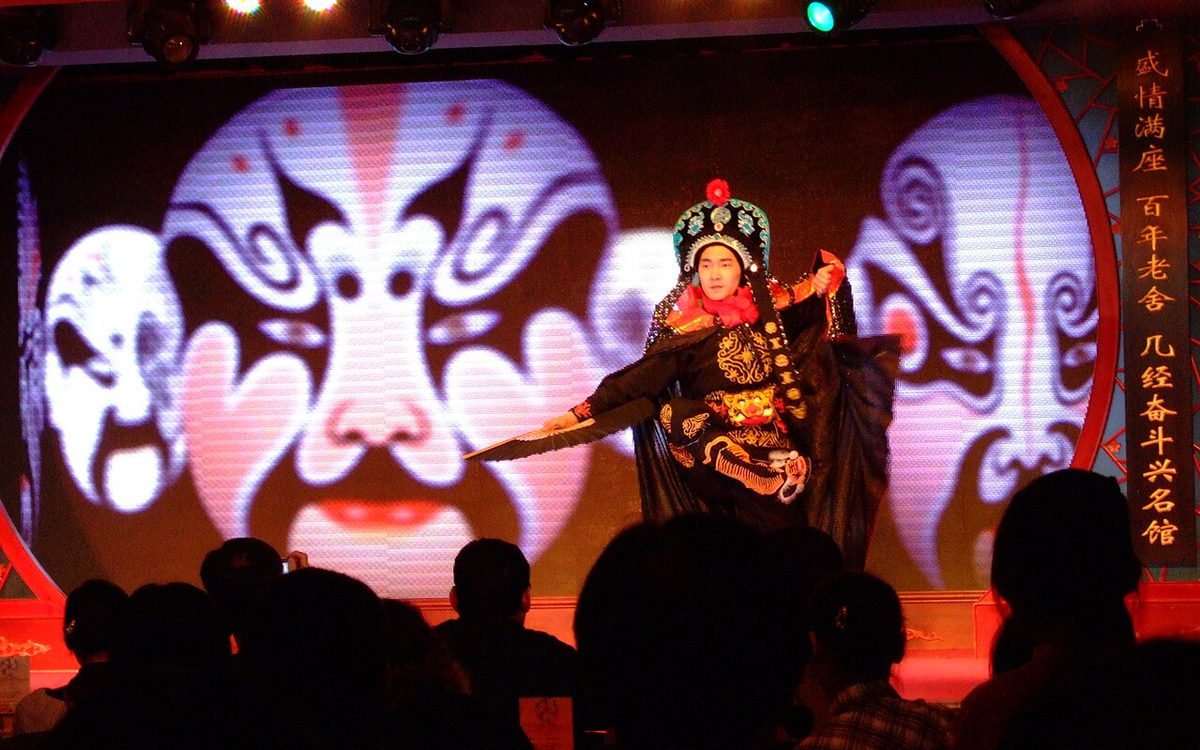
Chengdu (成都)'s Sichuan (四川) opera bill is the model. At the Shufeng Yayun (蜀风雅韵) theatre in the culture park on Qintai Road (琴台路), in the evening for ninety minutes, the programme is a variety bill: the face-changing (变脸) that swaps masks faster than the eye can follow, fire-spitting, the rolling-lamp balancing act, hand-shadow puppetry, long-spout tea pouring, and a short opera excerpt (折子戏), with bilingual announcements and a lidded bowl (盖碗) of tea at the seat. It is a very foreigner-ready opera house in the city by the survey's count. Inside Kuanzhai Alley (宽窄巷子) a courtyard theatre runs the same bill several times a day, for anyone who cannot wait for evening.
Beijing's version is the teahouse. The Lao She Teahouse (老舍茶馆) at Qianmen (前门) stages a Beijing variety show in the evening, with a weekend matinee: opera excerpts, acrobatics, magic, face-changing borrowed from Sichuan, folk dance and tea ceremony, served with tea and Qing-style snacks at square tables. Tianjin (天津)'s teahouse does drum-song nightly at a modest price, and needs Chinese; the survey lists it for the atmosphere.
The heritage acts are shorter and cheaper still. In Xi'an (西安)'s Muslim Quarter (回民街) a four-hundred- year-old courtyard runs shadow puppetry on the hour through the day at a modest price. In Quanzhou (泉州) the marionette (提线木偶) theatre, whose puppets opened the 2008 Olympics, plays several sixty-minute programmes a day on many days, and sells out. In Foshan (佛山) the southern lion dances on poles three times a day in the courtyard of the ancestral temple (祖庙), inside a modest museum entry, rain permitting; the hall that hosts it has been under renovation, so check before going. In Nuanquan (暖泉), a day from Beijing, smiths fling molten iron (打树花) against a fort wall on warm-season evenings, and an indoor version runs all year. In Huayin (华阴), at the foot of Huashan (华山), the old men of the Laoqiang (老腔) slam benches and shout a boatmen's chant in a theatre daily and, in the warm months, on the riverside square for free.
Where this page hands over to the leisure page is the sold seat. The amateur opera club in the park, the free Cantonese opera (粤剧) stage in Guangzhou (广州), the storytelling session for the price of a bus fare: those are leisure. Everything in this block sells a seat.
06Landscape as Stage
What are the Impression shows and the other outdoor spectacles in China?
The show China invented is the one where the mountain is the set, and it runs every night in season.
It began in 2004 on the Li River (漓江). At Yangshuo (阳朔), on the water, with a dozen karst peaks lit as the backdrop and several hundred local fishermen and farmers as the cast, a director staged a sixty-minute poem of light, boats and song about a Zhuang (壮族) folk heroine. It still plays nightly at half past seven, with a second show in season, and the survey calls it the origin of the form. The same team then did the same in a dozen places, and the "Impression (印象)" name on a poster now means: outdoors, hundreds of performers, a real landscape, no dialogue. At Wuyi Mountain (武夷山) the audience sits on a platform that rotates through the tea country. At Lijiang (丽江) the stage is at three thousand one hundred metres under the snow mountain, at eleven and two in the day, with oxygen recommended. On West Lake (西湖), from March to December, the dancers perform on the water at twenty to eight.
The second family is the resident epic. The Songcheng (宋城) theme parks stage a sixty-minute history-of-the-city spectacle on a rotating stage, and have since 1997; the survey counts five of them, from Hangzhou (杭州) to Sanya (三亚), and notes that they are very standardised shows in the country and therefore very certain. The Huaqing Palace (华清宫) show at Xi'an (西安) is staged on the actual lake where the Tang (唐), 7th to early 10th century emperor and his consort lived, nightly in the warm months, with an ice-and-fire winter version. The Lhasa (拉萨) one is performed at three thousand six hundred and fifty metres by eight hundred people with the Potala (布达拉宫) across the river, in the evening through the year, and the card's advice is a thick coat.
The third family walks. At Dunhuang (敦煌) and at Pingyao (平遥) the audience moves through the sets for ninety minutes before sitting for the last act; the Dunhuang one is well seen before the caves, the survey says. In Zhengzhou (郑州) a drama city (戏剧幻城) of twenty-one theatres in a wheat field takes a day or two and, unusually for this block, is better with some Chinese. In Wuhan (武汉) the theatre is a 1930s steamship (知音号) that cruises the Yangtze while a hundred performers play out a night in the old concessions around the audience; costume hire is on the pier.
What to know before arranging a seat. These are the dearest seats on the page. They are outdoors, so the season and the weather rule. And because they are chains and institutions, they are the shows likely to be exactly as described.
07The Evening of Local Peoples
Where can a visitor watch the dance of China's smaller peoples?
China has fifty-five recognised smaller peoples, and the survey's large shelf is the evening where one of them dances.
The grand one is in Xinjiang. A top-scoring show in the country is the Silk Road spectacle at the Xinjiang Grand Theatre (新疆大剧院) outside Urumqi (乌鲁木齐), an indoor production with camels, horses and eagles on stage, a water curtain and holograms, in six chapters that fold in the Uyghur (维吾尔族) muqam (木卡姆) and the meshrep. There is a shorter midday version and a full evening version, every day, all year. In the city itself the Grand Bazaar (国际大巴扎)'s dinner show does the same in an hour with a buffet, with whirling dance, Kazakh (哈萨克族) eagle dance and a highwire act.
Yunnan (云南)'s is the one built from villages. The dance collection staged nightly in Kunming (昆明)'s arts theatre was created by a leading dancer of the province, and by the card three quarters of its performers are farmers from local village communities; seven acts, drums, no words. Zhangjiajie (张家界)'s show, twenty-four years running by the card, puts the Yao courtship climb and the Tujia (土家族) crying bride on stage nightly with a bonfire and stunts outside.
The villages themselves run a timetable now. At the great Miao (苗族) village of Xijiang (西江千户苗寨) the villagers dance on the reed-pipe ground (芦笙场) each afternoon, free within the entry, and pour the "high mountain flowing water (高山流水)" toast later in the afternoon. In the Dong (侗族) village of Zhaoxing (肇兴) the grand chorus (侗族大歌), the many-part singing without instruments or conductor, is sung at the drum towers (鼓楼) for nothing, at times the sources disagree about. At Huzhu (互助) in Qinghai (青海) the Tu people (土族), a group of a few hundred thousand, run several two-hour shows a day with a wheel-swing (轮子秋) act the card calls jaw-dropping, and almost no foreign visitor has heard of it. At Basha (岜沙) in Guizhou (贵州) the welcome is a volley from black-powder muskets. At the foot of Changbai Mountain (长白山) a Manchu (满族) shaman (萨满) parade leaves the square each evening, free, followed by a fire dance on the water stage.
Two honest notes. The weddings, courtships and rituals in these shows are performed, not happening; the cards say so and so do we. And the difference between this block and the leisure page's circle dances is the same line as everywhere else: there the visitor joins the ring; here the visitor watches it, and the survey scores the watching very high.
08Opera Without the Words
How does a foreigner watch Peking opera without the language?
Chinese opera is the hardest thing on this page to watch and the easiest to walk out of, and the survey's fix is to buy the excerpt (折子戏) night.
The problem is stated plainly in the scores. Of the nine kinds of show, traditional opera has the lowest median, and the reason is a single column: much of it is language level three. A full-length Peking, Kunqu (昆曲) or Cantonese opera (粤剧) is sung in a stage Chinese that many Chinese follow by surtitle. The survey counts some three hundred and fifty living regional forms, by a 2015 census it cites, and nearly every one of them is a full evening of words.
The excerpt programme solves it. Beijing's Liyuan Theatre (梨园剧场) at Qianmen (前门) has sold Peking opera (京剧) to foreign visitors since 1990: a sixty-minute bill of celebrated scenes, with an English subtitle board beside the stage and the actors putting on their make-up in the lobby beforehand. Across the road the Tianleyuan (天乐园) house does six classic scenes in ninety minutes with modern staging. The survey's advice is to look for the martial scenes: a fight in the dark between two men who cannot see each other needs no translation.
The serious houses are cheaper and need more of the audience. Shanghai's Tianchan Yifu (天蟾逸夫舞台) stage, a century old, runs full-length Peking and Kunqu on weekend nights and afternoons, and some programmes carry an English synopsis. In Harbin (哈尔滨) the provincial Peking opera company plays a weekly subsidised show. In Suzhou (苏州), in Jiangsu (江苏), the Kunqu museum on Pingjiang Road (平江路) plays excerpts at weekends all year and daily in the peak months, next door to the storytelling museum.
Quanzhou (泉州) is where an old sound is. The nanyin (南音) hall stages seventy-minute concerts of a music the survey traces to the Han (汉), 2nd century BC to 3rd century AD court, on dates published monthly; the Liyuan opera (梨园戏) theatre nearby plays a Song-and-Yuan form that many Chinese cannot follow either, and the card's honest advice is a synopsis beforehand. Neither is nightly, and both are on the survey's hidden list for that reason.
Where the amateurs are is the leisure page. The opera club in the park, the Qin opera (秦腔) shouted in the moat park (环城公园) on weekday nights, the free Cantonese stage in Guangzhou (广州) each afternoon: those have no sold seat, and this page ends at the box office.
09The Street Show Is Free
Which Chinese shows are free?
A third of the shows in this survey cost nothing, and many of those happen in the street of an old city at a fixed hour.
Xi'an (西安) set the pattern. The Tang-themed pedestrian street below the Big Wild Goose Pagoda (大雁塔) runs a rota of short free acts every evening: the "tumbler girl (不倒翁)" swaying on her pivot at half past seven, half past eight and half past nine in summer, two costumed hosts challenging passers-by to complete Tang (唐), 7th to early 10th century poems on the hour, whirling dance, a pipa piece, each eight to fifteen minutes, all year with earlier starts in winter. The survey credits the viral success of one such street in 2022 with sending permanent costumed casts into old cities across the country, and the cards bear that out.
Kashgar (喀什)'s is a gate. At the east gate (东门) of the old city, at half past ten and at six, every day except Monday, dancers, musicians and actors playing a Han (汉), 2nd century BC to 3rd century AD general and a Qing (清), 17th to early 20th century concubine open the city, and the finish is a collective dance that the crowd is pulled into. It is free, twenty to thirty minutes, and the survey's own phrase is that it has become the way to arrive in the city.
Qufu (曲阜)'s is a morning. In the morning the city gate below the Confucius temple (府文庙) opens with ritual dancers in Han dress, free from outside the wall; later the worship ritual is performed in the temple's main hall. Kaifeng (开封)'s martial-arts park (万岁山) runs over a hundred short acts a day through the day for a modest entry, with a cavalry display and molten iron (打树花) thrown into the night sky in the evening. Datong (大同), in Shanxi (山西), runs stilts, lion dance (醒狮), aerial silk and puppetry in its restored southeast quarter from late afternoon into the evening in season. In Huayin (华阴) the bench-slamming chant is played on the riverside square for nothing on warm evenings, and in Jingdezhen (景德镇) an orchestra plays instruments made entirely of porcelain several times a day inside the old kiln museum (古窑民俗博览区)'s entry.
What free costs. A place at the front, which means arriving early at the gate ceremonies. And a check of the day. Otherwise these are the easiest shows in the country to see, and the survey scores the strong ones alongside the sold-seat spectacles.
11The Interactive Park
What are China's interactive NPC parks, and how does a foreigner use one?
The newest kind of Chinese show is not a show at all. It is a park where the cast never leaves, and the entry buys the whole day of them.
The form has a name in Chinese, which is the NPC (NPC 常驻演员). Borrowed from video games, it means the costumed characters who wander a walled town or a themed park all day, on a printed timetable, stopping passers-by, staging fights, weddings and court cases on the hour, and pulling the crowd into the last dance. The survey scattered these across its other categories and later gave them one of their own, because for a visitor they behave differently: a visitor does not arrive for a curtain but for an afternoon, and the language barrier is the lowest on the page.
Kaifeng (开封) has three. The martial-arts town on Wansui Mountain (万岁山) runs over a hundred short acts a day for a modest entry, with a cavalry display and molten iron (打树花) thrown against the night sky in the evening. The reconstructed Song prefecture opens its gates in the morning with drums and guards and holds court cases through the day. The Song garden (清明上河园) on the lake, whose night spectacle is described earlier, runs more than fifty acts by day inside the ordinary entry: a magistrate's welcome, a cavalry duel with fireworks, a river display with charges in the water, and a comedy in which a rich man throws an embroidered ball to choose a son-in-law. A night-show entry also admits a visitor early in the morning at no extra cost.
Xi'an (西安) has the indoor one. The Tang-dynasty street beside the Tang (唐), 7th to early 10th century mall is under one roof, based on a television drama, with fixed performances through the day and a farewell scene at nine before the doors close at ten; hanfu (汉服) is hired at the door. Zhengzhou (郑州) has the film town (建业电影小镇), with a stunt show and a night walk under projections at eight, and fifteen minutes away the drama city (戏剧幻城) in the wheat field, the ambitious end of the form and the one that rewards some Chinese. At the foot of Changbai Mountain (长白山) a Jin-dynasty market runs thirty acts a day with delivery-rider NPCs and a mecha parade.
More entered the survey later. Hengdian (横店), the film-studio town in Zhejiang, where the survey had taken the two night spectacles alone, runs over a hundred acts a day across its palace and street sets, from an enthronement in the Qin palace to gunfights on the Canton street and a night show in which the audience is filmed; a one-day entry covers two sets. The second drama city, at Langfang (廊坊) an hour from Beijing, is built on the Dream of the Red Chamber: four main theatres, dozens of small ones, one main play in the day entry, and, like its sister in Zhengzhou, better with some Chinese. The old town at Linyi (临沂) in Shandong (山东) sells its hour-long indoor epic separately and puts the horse show, the water show and the Han ceremony inside a basic entry good for several days. The Tang-dynasty night street at Tangshan (唐山) throws molten iron from spring to autumn. And the zoo in Changchun (长春) becomes a Journey to the West in the warm months; its star turn is a monkey's stand-up in north-eastern dialect, the one act here that needs Chinese.
How to use one. Enter in the afternoon for the afternoon acts and the night parade, or early for the full day; read the timetable at the gate, which every one of these parks prints; and expect to be spoken to. The reply "no Chinese" is understood everywhere, and the cast will still put the sword in a visitor's hand.
12PreeChina, and What It Is Not
What does PreeChina arrange for shows in China?
- The one thing on this page that is hard for a visitor is the seat, and that is the thing we do.
- A Beijing night. Dinner at Qianmen (前门), the kung fu (功夫) drama at half past seven, and the teahouse bill the next night; or the excerpt (折子戏) opera with the subtitle board and the make-up room.
- A Xi'an (西安) night. Snacks at Yongxingfang (永兴坊), the Qin opera (秦腔) variety bill at the century-old opera society (易俗社) for the price of a coffee at half past seven, the Tang street (大唐不夜城)'s free acts from nine, and the Muslim Quarter (回民街) for a late bowl.
- A Chengdu (成都) night. Qintai Road (琴台路) at seven, the Sichuan (四川) opera bill at eight with the tea and the seeds, and the snack street after.
- A Quanzhou (泉州) night. West Street (西街) for dinner, the marionettes (提线木偶) at half past seven, Zhongshan Road (中山路) for peanut soup after; Wednesday to Sunday.
- A Kashgar (喀什) evening. The gate at six, the night market, the immersive Kashgar show at nine, and the old-city square where the locals dance on summer nights.
- A Lijiang (丽江) day. The snow-mountain spectacle at two, dinner in a Naxi (纳西族) courtyard, and the Naxi ancient music hall after.
- Seven days, ten shows. The survey's own route, Beijing to Xi'an to Chengdu to Yangshuo (阳朔) to Shanghai, is nine tenths language level one and every date on it is verifiable; we use it as the spine and swap the winter stand-ins.
- And the seat itself. Until this site can confirm how a foreign passport works on the Chinese ticketing apps, we arrange the seats, and we do it a week ahead for the lake shows in season.
- What this page is not.
- Not concerts, tours or festivals. Nothing here moves; nothing here happens once.
- Not comedy or drama. Crosstalk, stand-up and the modern stage are in the language; the survey excluded them and this page follows.
- Not the park singers. The amateurs with no sold seat are on this site's page on leisure.
- Not the venue. The lake, the palace, the temple, the museum and the old street have their own pages; this page says what happens on them in the evening.
- Not the meaning of a rite. The calendar block gives dates and what is seen, and stops.
- Not Hong Kong or Macau. The survey covers them; this site does not.