
01The Road, the Room, the Museum, and the Empty Mound
What is actually seen at a Chinese imperial tomb?
At a Chinese tomb the tomb itself is almost never what is seen. The sight is one of four things: the road that leads to it, the room they opened, the museum they built over the pit, or a mound with nobody in it. Ask which of the four before going, and the day makes sense.
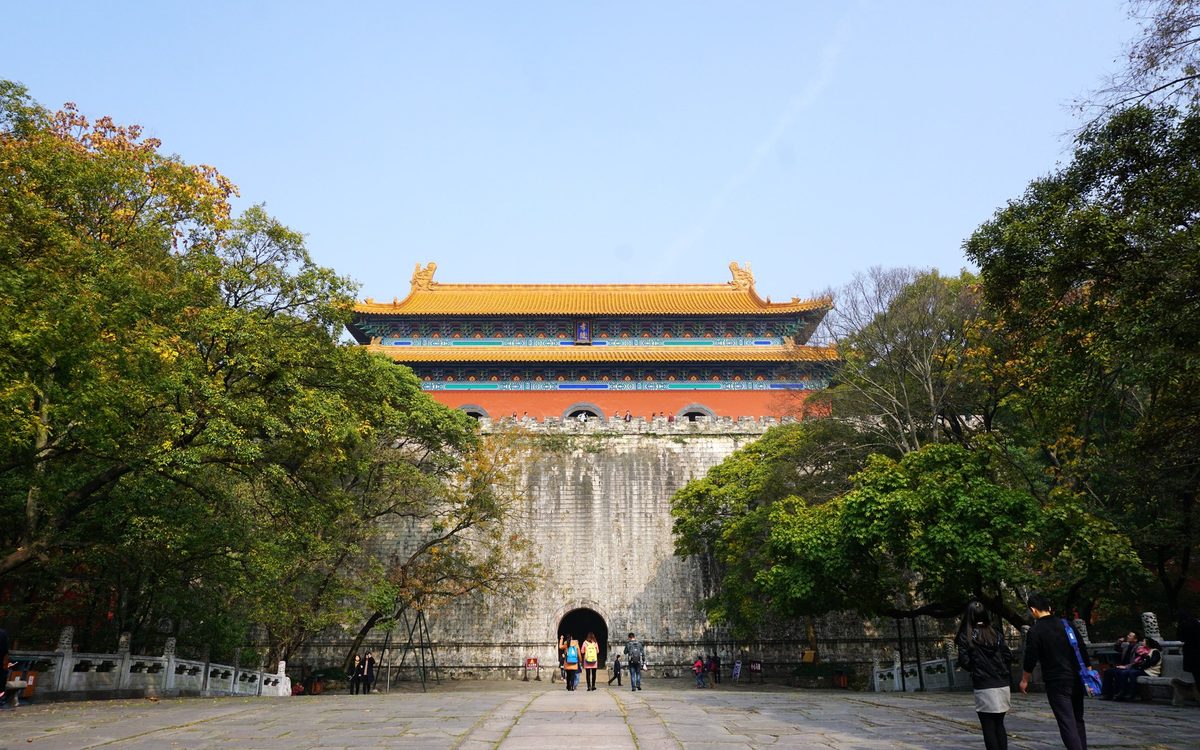
The road is the commonest. An emperor's tomb in China is a hill, natural or heaped, and the hill is sealed. What was built for visitors, then and now, is the approach: a gate, a stone avenue of animals and officials, a hall for offerings, and the mound at the end. The First Emperor (秦始皇)'s mound near Xi'an (西安) has never been opened; the tomb of the founder of the Ming (明), 14th to 17th century in Nanjing (南京) is a stone avenue that bends around another man's grave; the thirteen Ming emperors north of Beijing share one avenue seven kilometres long; the Tang (唐), 7th to early 10th century tombs west of Xi'an are mountains with a line of stone figures walking up to them. At all of these the road is the visit.
The room is rare, and it is almost never an emperor's. Since the Ming tomb Dingling (定陵) was dug out in 1956, no emperor's chamber has been opened on purpose, by the survey's account. The rooms that can be walked into belong to princes and kings whose tombs were found by accident: by workers blasting a hill in 1968 at Mancheng (满城汉墓), by a building crew in downtown Guangzhou (广州) in 1983, by roadworks for the Xi'an airport in 1990, by archaeologists at Xuzhou (徐州) in 1994. The exceptions are the two Qing (清), 17th to early 20th century chambers in the eastern valley, robbed in 1928 and left open, and Dingling itself.
The museum over the pit is the modern Chinese invention. At the Han (汉), 2nd century BC to 3rd century AD emperor Jing (汉景帝)'s tomb visitors walk on glass above the pits while the figurines are still being uncovered; at Suizhou (随州) the tomb of a marquis is a rock pit thirteen metres deep kept as it was found, with its sixty-five bells across the province in Wuhan; the terracotta pits themselves are a roof over a hole. And there is a fourth case, the tomb that has been emptied: at Mawangdui (马王堆) in Changsha (长沙) the pits were filled back in, and the lady, her robe and her manuscripts are in the provincial museum (省博物馆) on the other side of town.
The empty mound is the one foreigners least expect. The Yellow Emperor (黄帝)'s tomb holds a robe, the Yan Emperor (炎帝)'s and Yu the Great (大禹)'s are memorials rebuilt in the nineteen-eighties, Genghis Khan (成吉思汗)'s has no grave at all, just eight hundred years of ritual, and the general Guan Yu (关羽)'s holds, by tradition, his head. These are visited for ceremony and for trees, and a visitor who arrives expecting an excavation leaves puzzled.
This page sorts forty-one tombs the survey chose into those four kinds, then by who is in them: seventeen emperors, six kings and marquises, five ancestors and sages, six named men and women, cliffs full of coffins in the south, one stepped pyramid in the north-east, and three tombs of the twentieth century.
| What is seen | What it means | Examples |
|---|---|---|
| The road | the mound is sealed; the avenue, the stone figures and the halls are the visit | First Emperor · Ming Xiaoling · Ming Tombs · Qianling · Qiaoling · Song tombs at Gongyi · Western Xia |
| The room | a chamber that can be walked into, almost always a prince or a robbed emperor | Dingling · Eastern Qing Tombs · Mancheng · Lion Mountain at Xuzhou · Nanyue king |
| The museum over the pit | a roof built over the excavation, finds shown in place | Han Yangling · Marquis Yi of Zeng · Marquis of Haihun · the terracotta pits |
| The empty mound | a memorial with no body, or none certain; visited for rite, trees and name | Yellow Emperor · Yan Emperor · Yu the Great · Genghis Khan · Wang Zhaojun · Guan Yu |
| The emptied tomb | pits filled back in, everything in a museum across town | Mawangdui, Changsha |
02The State in Miniature
Why were Chinese emperors buried with retinues of figures, officials and foreign envoys?
A Chinese emperor was buried with a copy of his state, because the dead were to be served as the living. The rule has a name, "serve the dead as the living were served (事死如事生)," and it explains why some tombs have more to see above ground than a city, and why the modest ones have almost nothing.
The First Emperor (秦始皇) took a guard of clay. Eight thousand figures by the survey's count, each with a different face, stood in pits east of a mound that the histories say holds rivers of mercury; soil tests around the mound, the survey notes, agree. His successors took the government instead of the guard. At the Han (汉), 2nd century BC to 3rd century AD emperor Jing (汉景帝)'s tomb outside Xi'an (西安) the pits around the mound held the ministries: small pottery officials, servants, animals and stores, the whole household of the state at a third of life size. At the Han emperor Wu (汉武帝)'s tomb the generals were buried around him, and the stone horse standing on a fallen nomad at the tomb of the young general Huo Qubing (霍去病) is, by the survey's reckoning, an early monumental sculpture in China. The Tang (唐), 7th to early 10th century emperor Taizong (唐太宗) took two hundred companions, ministers and princes in a ring of tombs around his mountain, and his six horses in relief. His son and daughter-in-law, the woman who ruled China as emperor, took sixty-one foreign envoys in stone, now headless, lined up at the mountain's foot: the empire's foreign relations, in rows.
The Ming (明), 14th to 17th century and Qing (清), 17th to early 20th century made the road itself the statement. The founder of the Ming laid out the pattern at Nanjing (南京) in the fourteenth century, a square walled court for offerings in front and a round mound behind, and every Ming and Qing emperor after him copied it. The Qing emperor Kangxi (康熙), from the dynasty that had replaced the Ming, knelt at that tomb in 1699 and left a stele praising its occupant as greater than the Tang and Song (宋), 10th to 13th century, a political courtesy in stone that is still standing.
There was always a counter-tradition, and it is worth knowing before driving out to see it. The Han emperor Wen (汉文帝) ordered a plain burial, pottery and no gold, and got one; his real tomb was identified in 2021, seven hundred years after the wrong hill had been named. Cao Cao (曹操), the warlord of the Three Kingdoms, ordered no mound, no trees and no treasure, and his tomb was found in 2009 under a field near Anyang (安阳) with stone tablets naming him. The Qing ancestors' tomb in the north-east has no stone animals, no terrace and no side halls, on the principle that the founders lived plainly and their descendants should not show off in front of them. A modest burial leaves a museum and a story, and little else. For the road with the animals, choose an emperor who wanted one.
03Xi'an: The First Emperor and the Han
Which tombs are worth seeing in Xi'an besides the Terracotta Army?
Xi'an (西安) has four imperial tombs within an hour, and they answer the same question four ways: what does a Han (汉), 2nd century BC to 3rd century AD or Qin (秦), 3rd century BC emperor leave above ground?
The Terracotta Army (兵马俑) is the opening anchor of any China trip, and it needs planning ahead. The pits are forty kilometres east of the city, half an hour by high-speed train or an hour by road, and the survey counts three to four hours as the visit. Everything seen is a pit under a roof: a very large one with its ranks facing east, a smaller one with the command group, and the bronze chariots in a side hall. The mound itself, a kilometre and a half to the west, is a wooded hill with a path around it and nothing to enter; the histories describe rivers of mercury inside, and that is one reason it has stayed shut. Arrange entry days ahead with a passport.
The emperor Jing (汉景帝)'s tomb is the alternative the survey prefers, and few visitors go. Twenty kilometres north of the city, found in 1990 when the airport expressway was cut through, it is a leading site museum (遗址博物馆) in the country by the survey's judgement: visitors walk on glass floors above the pits, and below are the pottery officials and animals of a Han court, a third of life size, some still half in the earth. Two hours, and a fraction of the crowd. Seen after the Terracotta Army it reads as the next chapter, the state that followed.
The emperor Wu (汉武帝)'s tomb is a mound in the fields and a general's grave. Forty-five kilometres west, a very large Han mound was built over fifty-three years by the emperor who sent Zhang Qian (张骞) west and opened the road to Central Asia. The visit is the stone carvings at the tomb of his general Huo Qubing (霍去病) beside it, the horse standing on the fallen nomad among them, and the small museum. An hour and a half.
The emperor Wen (汉文帝)'s tomb is for people who like archaeology in progress. For seven hundred years the wrong hill on the White Deer Plateau (白鹿原) carried his name; in 2021 the state heritage authority confirmed the real tomb at Jiangcun (江村大墓), a few kilometres away, a plain burial of pottery as his decree had ordered. Visits are limited, by the survey, and there is little to see beyond the shape of the land, which is the point.
The day that works is the Terracotta Army in the morning, Jing's tomb in the afternoon, or the reverse; Wu's tomb is a separate half day to the west, well joined to the Tang (唐), 7th to early 10th century mountains in the next section. All four sit on the plateau north and east of the Wei River (渭河), and a car from Xi'an is the honest way to link more than two.
04The Tang Mountains
Which Tang dynasty tombs near Xi'an are worth visiting?
The Tang (唐), 7th to early 10th century emperors stopped heaping earth and took mountains instead. Their tombs are a line of peaks north-west of Xi'an (西安) with stone figures walking up to each, and three of them are worth a day in a car.
The Tang Zhaoling (唐昭陵) near Xi'an began it. The emperor Taizong (唐太宗), founder of the Tang golden age, had a chamber cut into Mount Jiuzong (九嵕山) in the seventh century and forbade a mound; the tomb precinct is, by the survey's measure, very large in area, with two hundred companion tombs of his ministers and family. The six celebrated horses carved in relief for it are not on the mountain: four are in the stone museum in Xi'an and two were sold abroad a century ago and stand in Philadelphia. Seventy kilometres from the city, an hour and a half on site, and a museum of the companions' finds at the foot.
Qianling (乾陵) is the one many visitors choose, and the reason is a blank stone. The emperor Gaozong (唐高宗) and Wu Zetian (武则天), his empress and later emperor in her own name, lie together under Mount Liang (梁山), eighty kilometres from Xi'an. The avenue climbs between winged horses, ostriches, officials and lions to two steles, one carved with Gaozong's virtues and one left blank, which tradition reads as Wu Zetian leaving her reputation to history. Beside them stand sixty-one statues of foreign envoys who attended the funeral, all without heads. The mountain has never been robbed, by the survey's account, so what is inside is anyone's guess; the tombs of a prince and a princess beside it are the ones that can be walked into. Two to three hours.
Qiaoling (桥陵) is the one the survey would pick for a single visit, and it is quiet. The emperor Ruizong (唐睿宗)'s mountain at Pucheng (蒲城), a hundred and ten kilometres from Xi'an, has remarkable stone figures among Tang tombs by the survey's judgement: officials four metres tall, lions nearly three, forty-seven figures along an avenue of six hundred metres, and a lion at the east gate (东门) that turns its head to look back, found nowhere else. It is likely to be walked alone.
Twenty kilometres away, Tailing (泰陵) shows what changing fortunes do to a tomb. The emperor Xuanzong (唐玄宗) chose the site himself in 729 at the height of his reign; he was buried in 763, after the upheavals of the 750s had weakened the dynasty, with figures half the size of his father's at Qiaoling and a single companion grave, the eunuch Gao Lishi (高力士) who had stayed loyal. Seeing the father's tomb and the son's in one afternoon is the clearest lesson in Tang history the survey knows.
05The Ming and Qing Valleys
Which Ming and Qing imperial tombs can be entered, and which valley should be chosen?
The last two dynasties buried their emperors in valleys, in the pattern the founder of the Ming (明), 14th to 17th century set at Nanjing (南京): a square court for offerings in front, a round mound behind, and one stone avenue shared by everyone who came after. Five sites hold them, and one of the five is a place in China where an emperor's chamber can be entered.
Nanjing has the original, Ming Xiaoling (明孝陵). Zhu Yuanzhang (朱元璋), the peasant who founded the Ming, was buried under Purple Mountain (紫金山) in 1398, and his avenue of stone animals, twelve pairs of lions, camels, elephants and the rest, bends around a smaller hill because, the story goes, he refused to move the tomb of a king of the Three Kingdoms and kept him as a gatekeeper. It is an imperial avenue in China that is not straight. The mound has never been opened; the visit is the avenue, fine in late autumn when the ginkgo leaves come down, and it is ten minutes' walk from a metro station.
Beijing has the thirteen. In a valley fifty kilometres north of the city the Ming emperors from Yongle (永乐) onward share one avenue of seven kilometres. Three tombs are open: Changling (长陵) with what the survey calls a very large hall of nanmu (楠木) timber in China, Zhaoling, and Dingling (定陵), the tomb of the Wanli (万历) emperor, dug out in 1956 and a Ming chamber that can be descended into. Three to five hours.
East of Beijing, the Qing valley is the richer and the sadder. At the Eastern Qing Tombs (清东陵), a hundred and twenty-five kilometres from the city, lie five emperors and fifteen empresses, including Qianlong (乾隆) and the empress dowager Cixi (慈禧). Both their chambers are open, because in 1928 both were robbed and left open; what was left is a chamber carved from floor to ceiling with Buddhist figures and scripture, and Cixi's hall clad in gold leaf and dark hardwood. Four to five hours; go by car.
West of Beijing, the other valley is the quiet one. The Western Qing Tombs (清西陵), a hundred and twenty kilometres out, hold four emperors under a forest of old pines, from Yongzheng (雍正), who started the second valley rather than lie near his father, to Guangxu (光绪), whose tomb of 1915 was the last imperial tomb built in China and was robbed in 1938. The dynasty's rule that sons alternate valleys was broken by Daoguang (道光), who moved west on the grounds that his eastern site leaked, and the survey tells that story on site. A fraction of the eastern valley's crowd.
And in Hubei (湖北) there is a tomb for a man who was never emperor. At Zhongxiang (钟祥) the Jiajing (嘉靖) emperor spent three years fighting his own court to have his dead father declared emperor, then built him a Ming tomb with two mounds; it was inscribed as world heritage in 2000. Two hours, in quiet.
07The Princes' Hoards
Which Han dynasty tombs in China can be walked into?
The rooms that can actually be walked into belong to kings and marquises, and they were found by accident. Six of them hold, between them, much of what the world knows about how a Han (汉), 2nd century BC to 3rd century AD noble expected the afterlife to run.
Mancheng (满城汉墓), near Baoding (保定), was found by blasting in 1968. Two chambers cut into a rock hill held a prince of the Han and his wife, each in a suit of jade plates sewn with gold wire, complete ones of great interest, two and a half thousand plates in his by the survey's count, and a bronze lamp shaped as a kneeling maid whose sleeve draws the smoke into her body. Visitors walk through the rock rooms; the suits and the lamp are in the provincial museum (省博物馆) at Shijiazhuang (石家庄). An hour and a half, twenty kilometres from Baoding.
Xuzhou (徐州) lets visitors walk a hundred and seventeen metres into a hill. The tomb of a king of Chu on Lion Mountain (狮子山), dug in the nineteen-nineties, is a cave palace with side chambers still sealed, a jade suit of more than four thousand plates by the survey's count, and its own small set of terracotta figures (兵马俑) nearby. The hill, the figures and the stone-relief gallery sit together; eight kilometres from the high-speed station.
Guangzhou (广州) has a king under a building site. In 1983 a construction crew on a hill in the city centre broke into the tomb of the second king of Nanyue (南越), a southern kingdom of the second century BC. The tomb is kept where it was, with a museum on top, and the finds include an early imperial seal in China by the survey's reckoning and a Persian silver box that proves the sea road to the west was open two thousand years ago. The metro stops outside.
Nanchang (南昌) has a very rich Han tomb. Liu He (刘贺) was emperor for twenty-seven days in 74 BC before his ministers deposed him, and lived on as a marquis by Poyang Lake (鄱阳湖). His tomb, excavated from 2011, gave up three hundred and seventy-eight gold pieces, two million coins, an early known portrait of Confucius (孔子) on a bronze mirror, and a lost chapter of the Analects, all by the survey's count. The site park (遗址公园) opened in 2020, forty kilometres from the city, and asks for advance arrangements through its official account (公众号).
Suizhou (随州) keeps a bell pit as it was found. The marquis Yi of Zeng (曾侯乙), a small state nobody had heard of until 1978, was buried in a rock pit thirteen metres deep with sixty-five bronze bells that still play a full twelve-tone scale. The pit is under a hall two kilometres from the town; the bells are in the provincial museum in Wuhan (武汉), forty minutes away by high-speed train.
And Changsha (长沙) keeps the lady. At Mawangdui (马王堆) the wife of a Han chancellor was found in 1972 so well preserved that her skin was still soft, with a silk robe weighing forty-nine grams and an early surviving copy of the Daodejing (道德经). The pits were filled back in; she and everything from the tomb are in the provincial museum, with entry arranged ahead, and the visit is a museum visit with the tomb as its story.
08The Tombs With No Body
Is there a body in the Yellow Emperor's tomb or Genghis Khan's mausoleum?
Six much-visited tombs in China hold no one, or no one certain. They are visited for ceremony, for old trees and for a name, and a visitor who knows that in advance enjoys them; one who expects an excavation does not.
The Yellow Emperor (黄帝)'s tomb holds a robe. On Mount Qiao (桥山) in northern Shaanxi (陕西), a hundred and seventy kilometres from Xi'an (西安) and an hour by high-speed train, the legendary ancestor of the Chinese has a mound that tradition calls a burial of clothes, ringed by eighty thousand old cypresses by the survey's count, one of them said to be planted by the emperor himself. The state holds its rite here each spring at Qingming (清明), and in 1937 a joint rite was held. Two and a half hours.
The Yan Emperor (炎帝)'s and Yu the Great (大禹)'s are the southern pair. At Yanling (炎陵) in Hunan (湖南) the legendary father of farming and medicine has had a temple since 967, and the halls on view were rebuilt in the late nineteen-eighties; the stele gallery with fifty-three Ming (明), 14th to 17th century and Qing imperial offerings is the old part. At Shaoxing (绍兴) the flood-tamer Yu has a mound at the foot of Mount Kuaiji (会稽山), a burial stone with an inscription from the second century that Lu Xun (鲁迅) studied, a four-metre stele of 1540, and halls rebuilt from 1986. Both are honest about their layers for anyone who reads the dates.
Genghis Khan (成吉思汗)'s tomb has no grave at all. The Mongols buried their khans in secret, and no tomb has been found. What stands at Ejin Horo (伊金霍洛), forty kilometres from Ordos (鄂尔多斯), is a set of three yurt-shaped halls built in the nineteen-fifties around eight white tents that have travelled with the khan's relics for eight centuries, guarded by one clan of hereditary keepers who still hold a rite every day. It is a place of ceremony, and one of the few in China where the ceremony is the thing to see.
Wang Zhaojun (王昭君)'s mound is a poem. The palace woman sent in 33 BC to marry a nomad chief, credited with forty years of peace on the frontier, has a thirty-three-metre mound outside Hohhot (呼和浩特) called the Green Grave (青冢), because its grass was said to stay green when the plain turned yellow. Scholars doubt it is hers; poets since the Tang have not cared. With a museum.
Guan Yu (关羽)'s tomb at Luoyang (洛阳) holds his head. The general of the Three Kingdoms, deified over eighteen centuries into the warrior counterpart of Confucius, was beheaded in 220 and his head sent to Cao Cao (曹操), who buried it with honours. The temple over it dates from 1592 and carries the title of a grove, otherwise kept for the cemetery of Confucius (孔林). Seven kilometres from the city, an hour.
How to visit them: go for the trees, the steles and the rite, read every date on the building in view, and do not ask where the body is.
09The Named Dead
Where are Confucius, Zhang Qian, Yue Fei and Cao Cao buried?
Four tombs of named people carry more history than many palaces, because the name is the point: a sage's family, a diplomat, a wronged general, and a warlord found in 2009.
The cemetery of Confucius (孔林) at Qufu (曲阜) is a very old family graveyard still in use, by the survey's account. Confucius was buried here in 479 BC and seventy-eight generations of his descendants have followed, a hundred thousand graves under the cypresses by the survey's count. The master's own mound is plain. In front of it stands the withered trunk of a tree said to be planted by the disciple Zigong (子贡), who kept vigil beside the grave for six years, and the avenue of arches and steles that the Ming (明), 14th to 17th century and Qing (清), 17th to early 20th century added as the state took the family's cemetery into its own ritual. The three Confucius sites together take a day.
Zhang Qian (张骞)'s tomb is the one grave on the Silk Road's world heritage list. The envoy who went west for the Han in 138 BC, was held by the nomads for ten years and came home with the map that opened the road, lies at Chenggu (城固) in the Hanzhong (汉中) valley under a Han mound with two stone tigers. A dig in 1938 found a clay seal impression with his title, which settled whose tomb it was. A short ride from the high-speed station.
Yue Fei (岳飞)'s tomb at Hangzhou (杭州) is a deeply resonant site in China. The general who fought the Jurchen was executed on fabricated charges in 1142, buried in secret by a prison guard, and given a proper tomb by the next emperor twenty-one years later. Since the sixteenth century four iron figures of the men and the woman who condemned him have knelt in front of his grave with their hands bound behind them, and visitors have spat on them for five hundred years, which the signs now ask visitors not to do. Beside the West Lake (西湖), an hour.
Cao Cao (曹操)'s tomb ended a legend. For a thousand years the story ran that the warlord had built seventy-two false tombs to hide the real one. In 2009 a dig at Anyang (安阳) turned up a tomb with stone tablets reading "used by the King of Wei," and his own decree of a plain burial, no mound and no trees, explained why nobody had found it. A museum opened over it in 2023, twenty-five kilometres from the city, and the dig itself, the survey notes, was a much-argued case in the history of Chinese archaeology.
What they share is that the grave is small and the visit is the story: read it before going, and the mound, the tree or the kneeling statues become the whole of Chinese history in an hour.
10Cliffs and Coffins
Where are the hanging coffins in China, and can they be seen?
In the south of China the dead were put into cliffs, and in the north-east one king was put under a pyramid. Four sites make a chapter that no other country has.
Leshan (乐山) has a cliff full of Han (汉), 2nd century BC to 3rd century AD tombs beside the Giant Buddha (乐山大佛). In the red sandstone of the same hill, five hundred and forty-four chambers by the survey's count were cut in the early centuries of the common era as houses for the dead, with doors, beams and furniture carved from the rock. On the lintel of one tomb sits a small seated Buddha that the survey calls an early one in China, two centuries before the Dunhuang (敦煌) caves, and a relief of the assassin Jing Ke (荆轲) lunging at the King of Qin (秦), 3rd century BC. The tombs sit five hundred metres from the south gate, and many visitors walk past them.
Gongxian (珙县) has the hanging coffins of a people who no longer exist. Above a valley sixty kilometres from the county town, two hundred and ninety-five coffins by the survey's count rest on wooden stakes and ledges between twenty-six and a hundred metres up the cliff, each hollowed from a single log. They belonged to the Bo (僰人), a people of the south-west whose community ended in 1573 and left nothing else but these and their red paintings on the rock. How the coffins were raised is still not settled; the survey lists four theories. Two to three hours, with the small museum and the walk under the cliff.
Longhu Mountain (龙虎山) has early ones, and a show. In the sandstone cliffs above the Luxi River (泸溪河) in Jiangxi (江西), two hundred and five tombs dated to around 600 BC by the survey belonged to the Yue, boat-builders who tattooed their bodies, and yielded an early thirteen-string zither in China. In 1989 a Chinese and American team worked out one way the coffins could have been hoisted, and the park has re-enacted it every day since, from bamboo rafts on the river, cancelled in rain. The cliffs are part of a world natural heritage site; the coffins are the reason to take the raft.
Ji'an (集安) has the General's Tomb (将军坟). At the old capital of the Goguryeo (高句丽) kingdom on the Yalu (鸭绿江), a stepped pyramid of eleven hundred cut granite blocks by the survey's count, thirteen metres high and thirty-one to a side, built around 414 for the king who moved the capital to Pyongyang (平壤). Ten-tonne stones lean against its sides to hold them. Nearby stands the stele of his father, eighteen hundred characters of the kingdom's founding story, and the two are inscribed together with the walled city and the mountain fortress. An hour from the town, with the border across the river.
None of these can be entered, which makes them the purest case of the road: the visitor looks up, or across the water, and the coffins and the pyramid look back.
11The Modern Dead
How is Sun Yat-sen's mausoleum visited, and what else did the republic build?
The twentieth century buried three men who could not be buried like emperors, and the three tombs show China trying out how a republic mourns.
Sun Yat-sen's mausoleum (中山陵) on Purple Mountain (紫金山) is the one every visitor to Nanjing (南京) climbs. The founder of the republic passed away in 1925, and a young architect, Lü Yanzhi (吕彦直), won the competition with a plan in the shape of a bell; he did not live to see it finished. From the gate to the hall are three hundred and ninety-two steps, laid so that from the bottom steps alone are seen and from the top landings alone. The hall holds a seated marble figure; the chamber behind it, with the coffin below floor level, is seen from a rail. Entry is arranged ahead, and it stands a kilometre and a half from the Ming (明), 14th to 17th century founder's tomb on the same hillside, so that a morning walk runs from a fourteenth-century avenue to a twentieth-century stair.
Lu Xun (鲁迅)'s tomb in Shanghai is a park bench away from the writer. The author of a pioneering modern story in Chinese was laid to rest in 1936 and moved in 1956 to the park in the district where he had lived, under a lettered stone and a bronze figure of the writer in a rattan chair with a cigarette. The park is free and open; the museum beside it asks for advance arrangements.
Read the three together and the century falls into place: a hero given a mountain, a failed emperor given a hybrid, and a writer given a public park, which is where Chinese cities now put the people they honour.
12PreeChina, and What It Is Not
What does PreeChina arrange at China's tombs?
- The hard parts of a tomb day are the arrangements, the car and the order. Those are what we do; the rest is a hill and a road.
- A Xi'an (西安) tomb day. The Terracotta Army (兵马俑) arranged with a passport days ahead, and the emperor Jing (汉景帝)'s glass floors the same afternoon, with a driver between them; or the Tang (唐), 7th to early 10th century mountains as a second day, Qianling (乾陵) and Qiaoling (桥陵) by car with lunch at Pucheng (蒲城), and Tailing (泰陵) for the before-and-after.
- A Nanjing (南京) morning. The Ming (明), 14th to 17th century founder's avenue at opening time, in November where there is a choice, then the walk along the hillside to Sun Yat-sen (孙中山)'s steps, with entry arranged ahead; the whole thing by metro and on foot.
- A Beijing valley. The thirteen Ming tombs with Dingling (定陵)'s chamber for an opening visit, or the Western Qing Tombs (清西陵) for a second, when the pines and the empty avenues are the draw; the Eastern Qing Tombs (清东陵) when the story of 1928 and the carved chamber are the draw. All three are a day with a car.
- The accidental kings. Advance arrangements for the marquis of Haihun outside Nanchang (南昌) and for the lady of Mawangdui (马王堆)'s museum in Changsha (长沙); the Nanyue (南越) king in Guangzhou (广州) and the Chu king at Xuzhou (徐州) need nothing but a metro or a taxi.
- Shenyang (沈阳) by metro. Both tombs in the city are a stop away from the line, and we fit them into a day that ends with the palace.
- What this page is not. It is not the museums page, which has the things taken out of these tombs, from the jade suits to the bells to the lady's robe, and which is where several of the tombs on this page are well seen. It is not the parks page, which has Purple Mountain (紫金山), the Confucius (孔子) sites and Longhu Mountain (龙虎山) as places to spend a day. It is not the grottoes page, though the small Buddha at Leshan (乐山大佛) points there. It is not a page about the rites held at the ancestors' tombs: we describe them and arrange a visit, and we do not take a view on them. And it does not deal in the emperors' unopened chambers, which stay shut, and should.
- One practical note that runs through the page. Several of these sites, by the survey, need entry arranged ahead: the Terracotta Army, the marquis of Haihun, Sun Yat-sen's mausoleum (中山陵) and the Hunan (湖南) museum. We check the rule for each site the week of travel, because it changes.