
01The Bracket and the Window
How can a visitor tell how old a Chinese building really is?
Almost every well-known building in China has been rebuilt, and the handful that have not are mostly in Shanxi (山西). In a timber building the date is written under the eaves, in the brackets (斗拱) that hold the roof up: big and few means early, small and many means late. A garden is a building turned inside out, arranged so that every window frames the next view. Learning to read the bracket and the window makes it possible to tell a Tang (唐), 7th to early 10th century hall from a Qing (清), 17th to early 20th century one, and a Ming (明), 14th to 17th century garden from a late-Qing one, before the sign is reached.
Why so much is rebuilt. China built in wood for two thousand years, and wood burns, rots and is replaced. Every dynasty rebuilt its palaces and many of its temples, so that the Forbidden City (故宫), the Temple of Heaven (天坛) and nearly every great hall on this page carry a founding date and a much later date for the timber on view. That is not a scandal; it is the tradition. But it means that "old" needs a second question, and the page asks it of all forty-eight places: founded when, and standing since when.
Why the old ones are in Shanxi. The province was poor, dry and far from the fires that burned the capitals, and its village temples were too small to be worth rebuilding. The result is that the two Tang halls in China, the great Liao (辽), 10th to 12th century hall and the wooden pagoda, the Song (宋), 10th to 13th century hall with its maids and the Yuan (元), 13th to 14th century hall with its murals are all within a day's drive of Taiyuan (太原), and eight of the twenty-nine buildings on this page are there. Nobody who cares about buildings should leave China without a week in Shanxi.
The rule of the bracket. Look under the eaves. In a Tang hall the bracket sets are enormous, a third or a half of the column's height, and there are few of them, one to a column, so that the roof seems to float on a few great fists of timber. In a Qing hall the brackets are small, crowded, painted and decorative, and the roof sits on the wall. Between the two, the Liao and Song halls are big and bold but more numerous, and the Ming is the turn to the small. It is a rough rule and it works.
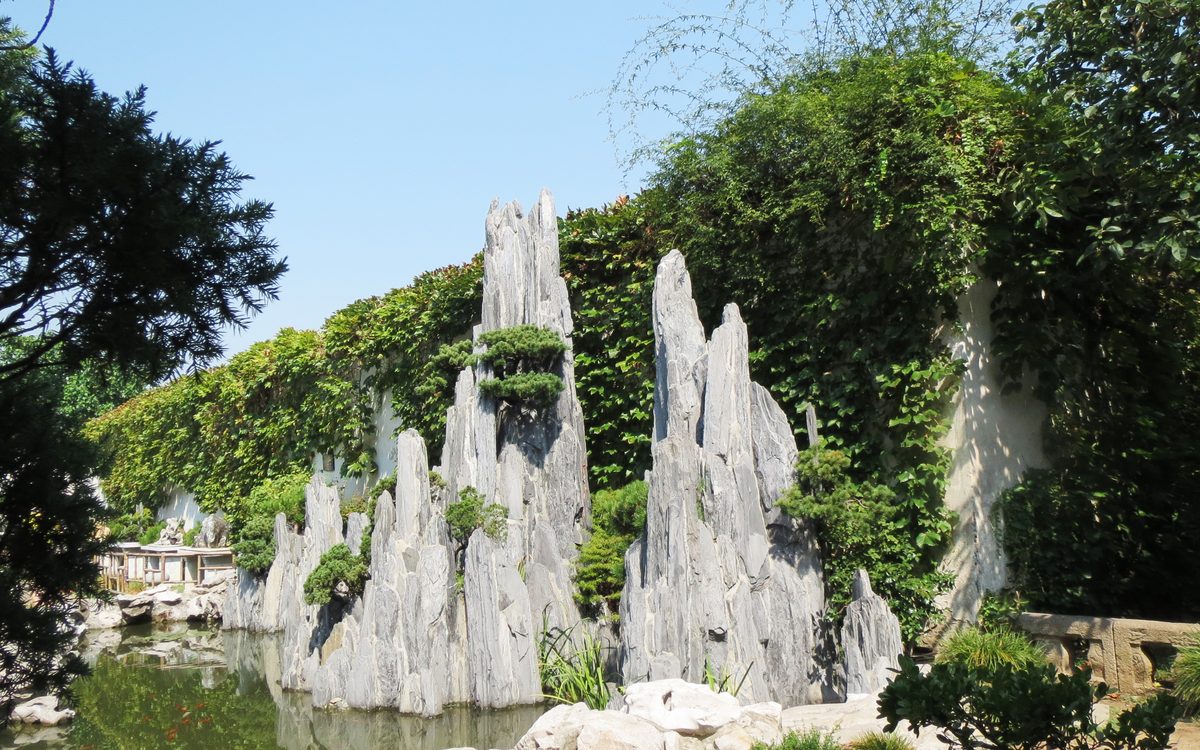
The rule of the window. A Ming garden, like Yipu (艺圃) in Suzhou (苏州) in Jiangsu (江苏), is plain: a pond, a hall, a few trees, white walls. A late-Qing garden, like the Humble Administrator's (拙政园) as it now stands or the Heyuan (何园) in Yangzhou (扬州), is dense with corridors, pavilions, carved windows and named rocks. The eye is led the same way in both, through openings that frame the next scene, and the difference is how much has been put in the frame.
This page has twenty-nine buildings and nineteen gardens from the survey: halls, pagodas, bridges, palaces, altars, a cliff temple and a water-works, and the gardens of emperors, scholars and merchants in Beijing, Chengde (承德), Suzhou, Yangzhou, Wuxi (无锡), Shanghai and Lhasa (拉萨). Temples visited for their faith are on the temples page; the same gardens as places to spend an afternoon are on the parks page. Here the subject is the building itself: who raised it, when, what is original, and how to read it.
02Timber, and Why So Little Is Old
Why are there so few old wooden buildings in China, and where are they?
A village hall of 782 is among the very old wooden buildings of China. Everything older burned. The story of how the few survivors were found, in the nineteen-thirties by two architects on mules, is the story of how China learned to read its own buildings, and it gives a visitor the three tests to use at every site on this page.
The material. A Chinese hall is a timber frame: columns, beams and the bracket (斗拱) sets that carry the deep roof out beyond the walls, with the walls themselves doing no work. Frames flex in earthquakes and burn in fires, and every capital was burned at least once; the great Tang (唐), 7th to early 10th century halls of Chang'an and Luoyang (洛阳) are all gone, and the Song (宋), 10th to 13th century ones of Kaifeng (开封). A dynasty that rebuilt a temple did so on the old plan with new timber, so the plan may be Tang while the wood is Qing (清), 17th to early 20th century. The survey's card for every building on this page separates the two, and this page repeats the distinction each time.
The discovery. In 1932 the architect Liang Sicheng (梁思成) measured the pavilion at Dule (独乐寺), near Tianjin (天津), and wrote what the survey calls a pioneering scientific paper on a Chinese building. In 1933 he climbed the wooden pagoda at Yingxian (应县木塔) and said, by the survey's account, that without seeing it nobody could know what timber could do. In 1937, with his wife Lin Huiyin (林徽因) and two assistants, he rode into the hills of Wutai (五台山) on mules and found the east hall of Foguang (佛光寺), whose beams carry the date 857 in a donor's ink, a Tang building found at a time when Japanese scholars had told him none survived. The smaller and older hall at Nanchan (南禅寺) was found in a survey of 1953. Those four finds fixed the timeline this page uses, and the survey's own pairs, Dule against Yingxian, Foguang against Nanchan, are the way to learn it.
What original means. Structure and paint are different things. At Foguang the columns, brackets (斗拱) and beams are ninth century, the sculptures are ninth century, the murals and the donor's writing are ninth century, and the roof tiles and paintwork have been renewed. At the Forbidden City (故宫) the plan and a few halls are fifteenth century and much of the timber is later. At Huaqing (华清宫) the pools are Tang and every building above them is after 1959. Ask the question at each site and the page gives the answer.
Three tests. One, the brackets: measure them against the column by eye, and count them. Two, the eaves: a Tang or Liao (辽), 10th to 12th century roof reaches out three or four metres past the wall, a Qing one much less. And three, the columns: early halls lean their outer columns slightly inward and raise the corner ones, so that the roofline lifts at the ends; later halls stand straight. None of the three needs a guide, and all three are visible from the courtyard before going in.
One warning. Sites that call themselves ancient and look new usually are; the survey's practice, and this page's, is to give the year of the timber on view, and to say when a gate tower or a hall is a design of the nineteen-nineties. Reconstruction is not a fault; the fault is not saying so.
03The Tang Halls and the Liao Giants
Which are the old wooden buildings of China, and how are they visited?
Five buildings in the north, four of them in Shanxi (山西) and Hebei (河北) and one in Liaoning (辽宁), are very old large timber structures. Two are Tang (唐), 7th to early 10th century, three are Liao, and the survey sends anyone who wants to understand Chinese building to them at the outset.
Nanchan (南禅寺), 782, the smallest and a very early one. Twenty kilometres from Wutai (五台山) county town, a three-bay hall in a village, rebuilt in 782, survived the persecution of Buddhism in the eight-forties because nobody in the capital knew it existed, and is a very early surviving timber hall by the survey's account. Inside are seventeen Tang clay figures. The visit is quiet, with few other visitors. An hour.
Foguang (佛光寺), 857, the great one. Thirty kilometres from the county town on the mountain's southern flank, the east hall of Foguang is seven bays wide, with brackets (斗拱) that reach out four steps and eaves that reach out four metres, deep by the survey's measure, and it holds what the survey calls four wonders under one roof: the Tang structure, Tang sculpture, Tang murals and a Tang inscription naming the woman who paid and the monk who built. It was inscribed with Mount Wutai in 2009. An hour and a half is enough, and the courtyard at sunset, when the brackets throw their shadows, is a reason people who love buildings are moved here.
Dule (独乐寺), 984, a tall old room. In Jizhou (蓟州) district north of Tianjin (天津), eighty kilometres from Beijing, the pavilion of Guanyin (观音) at Dule is a very old multi-storey timber building in China by the survey's account, built by the Liao, the steppe dynasty that ruled the north after the Tang, around a clay figure of the bodhisattva sixteen metres high. Twenty-four kinds of bracket set hold it up; the survey notes the brackets are half the height of the columns. In the Tangshan (唐山) earthquake of 1976 the figure's crown fell and the frame did not move. An hour and a half.
Yingxian (应县木塔), 1056, the wooden pagoda. Eighty kilometres from Datong (大同) in Shanxi, the pagoda of the Buddha's Palace Temple is sixty-seven metres of timber, five storeys outside and nine inside, built by the Liao in 1056 with fifty-four kinds of bracket set and, the survey records, no nails, and it has stood through more than forty strong earthquakes. It is a very tall and very old all-wood pagoda by the survey's claim, and the survey records it proposed for world heritage with the other Liao timber buildings. It cannot be climbed now; visitors stand under it. An hour.
Fengguo (奉国寺), 1020, the seven Buddhas. Fifty kilometres from Jinzhou in Liaoning, the main hall of Fengguo is a very large surviving Liao hall by the survey's account, and inside it sit seven painted clay Buddhas of the Liao, each nine metres high, in a row across the width of the building, an arrangement the survey links to a Liao emperor's prayer for his mother. Almost no foreign visitor has been. An hour and a half to two.
The lesson of the five is the bracket rule in its purest form: at Nanchan and Foguang the brackets are the building; at Dule and Yingxian they multiply into structure; at Fengguo the hall has grown to a scale the Tang never tried. See them in that order.
04Song, Yuan and the Painted Walls
Which Song and Yuan dynasty buildings and murals survive?
After the Liao (辽), 10th to 12th century giants the north kept building for four centuries, and five sites hold the Song (宋), 10th to 13th century and Yuan (元), 13th to 14th century work that came next: a whole Song temple, an early hall south of the Yangtze, a Song hall full of maids, and two Yuan halls whose walls are painted from floor to beam.
Longxing (隆兴寺), the Song temple whole. At Zhengding (正定), fifteen kilometres from Shijiazhuang (石家庄), a temple founded in 586 keeps four Song buildings on one axis, and the survey quotes Liang Sicheng (梁思成) calling it a leading temple outside Beijing. The Mani hall (摩尼殿) has a cross-shaped plan with a porch on each face that the survey calls rare in China; a bronze figure of Guanyin (观音) with a thousand arms, twenty-two metres, cast in 971 for the founder of the Song, stands in the great pavilion; and a revolving scripture case of the Song, an old one by the survey, still turns. Two hours.
Baoguo (保国寺), 1013, an early southern hall. Fifteen kilometres from Ningbo (宁波), a hall of 1013 is an early timber building south of the Yangtze by the survey's account, built ninety years before the state published its building code and showing, the survey says, how the south did things before the code: slender columns made of pieces, finer brackets (斗拱), less timber. The story goes that no bird nests in it and no insect bores it. An hour, and the temple is a museum of building.
Jinci (晋祠), the Song hall and the maids. Twenty-five kilometres from Taiyuan (太原), a memorial garden begun under the Northern Wei (北魏) holds a hall of the ten-twenties to a goddess, with forty-three painted clay maids of the Song around her whose faces, the survey says, look eerily modern, and in front of it a stone bridge of the Song crossing a pond in the shape of a cross, one of its kind. A Jin hall of 1168, a Ming (明), 14th to 17th century stage and a spring that has never dried share the same trees. Two to three hours.
Yongle Palace (永乐宫), the Yuan murals. A hundred kilometres from Yuncheng at Ruicheng (芮城), a Taoist temple built between 1262 and 1358 for the school that had won Genghis Khan (成吉思汗)'s favour holds a thousand square metres of murals, two hundred and eighty-six figures up to three metres high by the survey's count, a leading Yuan work, which the survey calls China's Sistine ceiling; and in 1959, when a reservoir threatened the site, the whole temple, walls and paintings, was moved twenty kilometres and put back up. Two hours, and no crowd.
Guangsheng (广胜寺), the glazed pagoda. Fifteen kilometres from Hongtong (洪洞), a temple founded in 147 has an upper court with a pagoda of 1515 to 1527 clad in coloured glaze from foot to tip, forty-seven metres, a notable glazed pagoda in China by the survey's account; a lower court whose Yuan murals were sold in the nineteen-twenties and now hang in New York; and a water temple with Yuan murals still in place. A Jin-dynasty printed canon once kept in the pagoda has its own story, which the survey tells on site. Two hours.
Read the five together and the Song shows itself as the age of the whole plan and the Yuan as the age of the painted wall, before the Ming turned to brick, glaze and colour.
05Pagodas and Bridges
Which are the early pagodas and bridges of China?
China built in wood and kept stone and brick for two things: towers for the relics of the Buddha, and bridges. Six of them on this page are very old examples of their kind, and none has a bracket (斗拱) to date it by, so the page gives the year.
Songyue (嵩岳寺塔), 523, an early brick tower. Six kilometres from Dengfeng (登封) below the Song mountains, a twelve-sided tower of the Northern Wei (北魏), fifteen storeys of close-set eaves rising in a curve like a rocket, is an early brick pagoda in China by the survey's account and one with twelve sides, a shape the survey suggests came from India or Central Asia. It was inscribed in 2010 with the Song mountain monuments. An hour.
The two Wild Goose pagodas, 652 and 707. In Xi'an (西安) the Great Wild Goose Pagoda (大雁塔) was built in 652 to hold the scriptures the monk Xuanzang (玄奘) brought back from India after seventeen years, the real journey behind the Monkey King (孙悟空)'s story; it is square, tiered like a tower of storeys, and it can be climbed. Eight kilometres from the centre by metro, with a fountain show in the square at night. The Small Wild Goose Pagoda (小雁塔), six kilometres away, is the other Tang (唐), 7th to early 10th century type, a tower of close eaves in a curve, built between 707 and 710 for another translator, and known for having split open in an earthquake and closed again in a later one, three times by the survey's telling. The grounds are quiet. Both were inscribed with the Silk Road in 2014.
Zhaozhou (赵州桥), 605, the bridge that was early by twelve centuries. Forty-five kilometres from Shijiazhuang (石家庄), a single stone arch of thirty-seven metres, built between 595 and 605 by a mason named Li Chun (李春), carries two small arches in each shoulder to let flood water through and lighten the load, a design the survey says Europe did not match for twelve hundred years. Liang Sicheng (梁思成) found Sui (隋), late 6th to early 7th century carved railings in the mud beside it in 1933. An hour, and few visitors.
Lugou (卢沟桥), 1192, the bridge Marco Polo (马可·波罗) praised. Fifteen kilometres from the centre of Beijing, eleven stone arches of the Jin cross the Yongding River (永定河) for two hundred and sixty-six metres under a parapet of two hundred and eighty-one posts carrying, by the survey's count, more than five hundred stone lions carved over four dynasties, which is why the Chinese say the lions cannot be counted. Marco Polo praised it by the survey's citation, and the West named it after him. A memorial in the small walled town beside the bridge records an event of 1937. Two hours with the town.
The glazed one is on the previous section: the pagoda at Guangsheng (广胜寺) of 1515, brick under a skin of coloured tile, the Ming's answer to a tradition that had begun in brick a thousand years earlier at Songyue.
06The Forbidden City and Its Manchu Original
How is the Forbidden City visited, and what is the Shenyang palace?
A palace of vast scale and the small one that came before it are the same idea at two scales: a court laid out so that everything, from the colour of a tile to the number of studs on a gate, says who may stand where.
The Forbidden City (故宫), 1420. Twenty-four emperors of the Ming (明), 14th to 17th century and Qing (清), 17th to early 20th century lived and ruled here for nearly five hundred years in a walled rectangle of seventy-two hectares by the survey's measure, with, by the survey's count, eight thousand seven hundred rooms, a surviving palace complex of vast scale, twice the size of Versailles (凡尔赛宫) by the survey's comparison. The plan is the argument: a nine-hundred-metre axis from the south gate through three great halls of audience to the private courts behind, everything symmetrical, the ancestral temple (祖庙) to the left outside the wall and the altar of land and grain to the right, as the classics prescribed. The code is in the materials. Yellow tile was the emperor's alone, green a prince's, grey everyone else's; the number of studs on a door, the height of a terrace and the count of beasts on a roof ridge all step down by rank, and once the code is known the whole city reads like a diagram. What is original: the plan, the terraces and some halls of the fifteenth century; much timber is Qing, and the survey tells the fire and rebuilding of each hall on its card. What to find: the carved marble ramp behind the third hall, a single stone of more than two hundred tonnes hauled from the quarry on an ice road in winter, and the hall tied to the last emperor's departure in 1924, after which the palace opened as a museum. Three to four hours, with entry arranged well ahead.
The Shenyang palace (沈阳故宫), 1625, the palace before the palace. In the middle of Shenyang, eight hundred metres from a metro station, the Manchu (满族) rulers who would move to Beijing in 1644 built a palace of their own from 1625: small, compact, and laid out by a different logic. Its opening court is an octagonal hall with ten pavilions in two rows before it, one for each of the eight banners (八旗) into which the Manchu state was organised and two for the princes, so that the government's structure is written on the ground. The empress's palace behind is a Manchu house, with a side door and a heated brick bed running round three walls. The Qianlong (乾隆) emperor added a library on his eastern tours in the seventeen-eighties. It was inscribed with the Forbidden City in 2004 as the second of the Ming and Qing palaces, and the survey rates it a quiet way to understand the Beijing palace. Two to two and a half hours, with a mansion of the early twentieth century next door.
See them in the right order where possible: Shenyang at the start, for the steppe court with its tents turned to timber, then Beijing, for what that court built when it inherited China.
07The Axis: Altars, Towers and a Hill
What is on Beijing's central axis besides the Forbidden City?
Beijing is built on a line. Seven point eight kilometres long, from a southern gate to a pair of towers in the north, it is inscribed as world heritage, and five of the survey's buildings sit on it or beside it: two altars, an ancestral temple (祖庙), the towers that told the city the time, and the hill the emperors put up to guard their palace.
The Temple of Heaven (天坛), 1420. South-east of the palace, in a park of old cypresses, the emperor came each winter solstice to a round three-tiered terrace open to the sky, and each spring to a round hall on a square base to pray for the harvest. Round is heaven and square is earth in the plan, the tiles are blue for the sky, and the hall of prayer, rebuilt after a lightning fire in 1889, is by the survey's judgement a beautiful timber building. It was inscribed in 1998. The park opened to the public in 1918, and at dawn it belongs to the neighbourhood, who dance, sing and play in it; the parks page has that. Two to three hours.
The Ancestral Temple (太庙), 1420. One wall east of the palace, the temple where the emperors kept their ancestors' tablets is, by the survey's account, a leading ancestral temple surviving in China, its main hall eleven bays wide on sixty-eight whole columns of golden nanmu (楠木), thirteen metres tall, a timber rarer than that of the palace's own great hall. Since 1950 it has been a workers' cultural palace, which is why it is nearly empty. An hour, three hundred metres from the metro.
The Altar of Agriculture (先农坛), 1420. South-west of the Temple of Heaven, its pair across the axis, is the altar where the emperor ploughed a field each spring with his own hand to open the farming year; the survey says the field, one mu and three fen, is a surviving imperial ploughing ground. The halls now house a museum of building, and its treasure is a Ming (明), 14th to 17th century ceiling from a demolished temple carved with a map of fourteen hundred stars. An hour and a half.
The Bell and Drum Towers (钟鼓楼), 1272 and 1420. At the north end of the axis, the drum tower founded under the Yuan (元), 13th to 14th century and rebuilt by the Ming, and the bell tower behind it holding a bronze bell of sixty-three tonnes cast in 1420, a very heavy old bell in China by the survey's count, kept the city's time for seven centuries: drums at dusk to close the gates, the bell at dawn, until 1924. Climb the drum tower for a view over the grey roofs of the lanes; the lanes themselves are on the old-town page. An hour, four hundred metres from the metro.
Coal Hill (景山), the guardian. Directly north of the palace, a hill heaped in the fifteenth century from the earth dug for the moat stands where the geomancers wanted a mountain, and its central pavilion is the high point on the axis and a place to see the whole Forbidden City (故宫) laid out below, gold roof after gold roof. On the east slope a stone marks the tree linked to the fall of the Ming in 1644. Go early, before the tour groups, or at dusk.
Walk the five in a day, north to south: the towers at nine, the hill at ten, the palace, the ancestral temple on the way out, and the Temple of Heaven at four when the light goes long. It is the one day in China where the plan of a city is the sight.
08Stone, Water and Cliff
What are the Potala, Dujiangyan and the Hanging Temple?
Seven places on this page break the rule of the timber frame, and each is a notable one of its kind: a stone palace on a Tibetan hill, a river tamed without a dam, a temple hung on a cliff, a Tang (唐), 7th to early 10th century bath, and three halls where the building matters less than what happened in it.
The Potala (布达拉宫), Lhasa (拉萨). Thirteen storeys of whitewashed stone and earth on a rock above the city, built in the seventeenth century on the site of a seventh-century fort, the winter palace of Tibet (西藏)'s ruling lamas until the twentieth century and, by the survey's account, a palace at remarkable altitude. Walls lean inward as they rise, windows narrow, the red palace at the top holds gilded tomb stupas, and the whole is a different grammar from anything else on this page. Visits are limited and arranged in advance; two to three hours.
Dujiangyan (都江堰), 256 BC. Fifty kilometres from Chengdu (成都) and half an hour by high-speed train, a governor named Li Bing (李冰) split the Min River (岷江) where it leaves the mountains with a stone tongue, a spillway and a cut through the hill, and the system has watered the Chengdu plain without a dam for two thousand two hundred years, a very old working irrigation scheme by the survey's claim. It was inscribed in 2000. Two to three hours; the temple to Li Bing on the hill is the viewpoint.
The Hanging Temple (悬空寺), 491. Sixty-five kilometres from Datong (大同) in Shanxi (山西), a row of halls founded under the Northern Wei (北魏) clings to a cliff fifty metres above a gorge on timber beams driven into the rock, a cliff temple in China built entirely of wood without a cave, by the survey's account, and one where Buddha, Laozi (老子) and Confucius (孔子) sit in one hall. The buildings walked through are Ming (明), 14th to 17th century and Qing; the position is fifth century. An hour and a half; go early.
Huaqing (华清宫), the Tang bath. On the edge of Xi'an (西安) by metro, the hot-spring palace where the emperor Xuanzong (唐玄宗) bathed with Yang Guifei (杨贵妃) in the seven-forties survives as five pools dug out in 1982, the crab-apple-shaped one built for her among them, excavated imperial baths by the survey; every building above ground is after 1959. Two and a half hours; the night show is on the page on shows.
Three halls for what happened in them. At Tai'an, the Song hall of 1009 in the temple below Mount Tai (泰山), where emperors fasted before climbing to sacrifice, is ranked by the survey with the palace's own great hall among the three great halls of China, and the temple keeps a stone carved for the First Emperor (秦始皇)'s chancellor in 219 BC. At Xiezhou (解州关帝庙) near Yuncheng, the birthplace temple of the general Guan Yu (关羽), deified as the god of wealth and loyalty, is a very large palace-style temple in China by the survey's account. And in a Beijing lane near Chaoyangmen (朝阳门), the Ming temple of 1444 built by a court eunuch keeps a very complete body of Ming timber, a stolen ceiling now in Kansas, and, twice a day, a small ensemble playing the court music of five and a half centuries ago from its own notation, a place in China where that is still done, by the survey.
09The Imperial Gardens
Which imperial gardens are worth seeing in Beijing, Chengde and Lhasa?
An emperor's garden in China is a landscape with a lake, three islands for the immortals, a hill to climb and a palace to rule from, and the six on this page run from an old one in Beijing to one at great altitude and to one that was burned.
The Summer Palace (颐和园), 1750 and 1888. North-west of Beijing by metro, the Qianlong (乾隆) emperor built a lake and a hill for his mother's sixtieth birthday in 1750; it was burned in 1860; the empress dowager Cixi (慈禧) rebuilt it in 1888 with money meant for the navy, by the survey's telling, and retired there. It is a very large imperial garden in China by the survey's account, two hundred and ninety hectares, three-quarters of it water, with a painted corridor along the shore of seven hundred and twenty-eight metres and fourteen thousand pictures, a very long gallery by the survey's claim, a temple climbing the hill and a marble boat that never sailed. Inscribed in 1998. Three to four hours; how to spend the day there is on the parks page.
Chengde (承德), 1703 to 1790. Two hundred and fifty kilometres north-east, in the hills beyond the wall, the Kangxi (康熙) and Qianlong emperors built a summer capital where they ruled for half of every year, hunted in the Mongol manner and received the chiefs of the empire's peoples: five hundred and sixty-four hectares by the survey's count, twice the Summer Palace, a lake district, a steppe and a mountain inside one wall, and outside it eight temples built in the styles of Tibet (西藏), Mongolia and Xinjiang (新疆) so that every visiting lord saw his own architecture. The British envoy Macartney (马戛尔尼) was received here in 1793. Inscribed in 1994. Four to six hours, and a night in the town.
Beihai (北海公园), 1166. An early imperial garden in Beijing by the survey's account, six hundred years older than the Summer Palace, is a lake west of the palace with an island for the immortals crowned by a white Tibetan stupa of 1651, a nine-dragon glazed screen of 1756, and the neighbourhood's own park around it: the survey calls it a local's park rather than a tourist one.
The prince's mansion. Near the lakes north-west of the palace, the mansion built in 1776 for the emperor's favourite, Heshen (和珅), whose confiscated fortune the survey puts at fifteen years of state revenue, became a prince's residence in 1851 and is well preserved in the city: a garden behind, a treasure house with eighty-eight differently shaped windows, and a stele with the Kangxi emperor's character for good fortune that half of Beijing comes to touch. Two hours.
The garden that was burned. Next to the Summer Palace, the Garden of Perfect Brightness (圆明园), the emperors' working residence for a hundred and fifty years, was burned in 1860 and damaged again in 1900. It is kept as a ruin: lakes, hills, foundations, and the broken baroque columns of the European palaces that Jesuits designed for Qianlong, standing in a field. The survey compares its presentation to the Roman Forum and is right that it is not a reconstruction. Two to three hours, with a metro station at the gate.
Norbulingka (罗布林卡), Lhasa (拉萨). The summer palace (避暑山庄) of Tibet's ruling lamas from the seventeen-forties, at three thousand six hundred and fifty metres a royal garden at high altitude by the survey's account, is a park of old trees around a series of small gilded palaces, the last built in the nineteen-fifties with a mural of Tibetan history on its walls; at the summer festival the grounds fill with opera and picnics. Inscribed with the Potala (布达拉宫) in 2001. Two hours.
10Suzhou: Nine Gardens, Four Dynasties
Which Suzhou gardens are worth visiting, and in what order?
Suzhou (苏州), in Jiangsu (江苏), has nine gardens on the world heritage list, and they read well as a chronology: one Song (宋), 10th to 13th century, one Yuan (元), 13th to 14th century, one Ming (明), 14th to 17th century as the Ming left it, and six that reached their present shape in the Qing (清), 17th to early 20th century and later. The rule of the window is the whole lesson: the older the garden, the less is in the frame.
Song: the Blue Wave Pavilion (沧浪亭), 1045. An early garden in the city, built by a banished poet on the site of a prince's pleasure ground, is the one that borrows the canal outside: a corridor with a hundred and eight lattice windows, each a different pattern by the survey's count, runs along the water so that the garden begins before the gate. A pavilion on a hill, a couplet every Chinese gardener knows.
Yuan: the Lion Grove (狮子林), 1342. Built for a Chan (禅宗) master by his disciples, it is a labyrinth of lake stone (太湖石), nine paths and twenty-one caves on three levels by the survey's count, a very large old rockery in China, which so pleased the Qianlong (乾隆) emperor that he copied it twice in the north. The architect I. M. Pei's great-uncle bought and restored it in 1917, and the museum Pei built stands next door.
Ming: Yipu (艺圃). The smallest of the nine and the quietest, hidden in a lane inside the west gate, kept its Ming plan because its owners were modest men: a pond, a large waterside hall standing on it, a few rocks, white walls, and almost nothing else. The survey calls it a well preserved Ming garden in Suzhou, and it is the one to see at the start for what the others looked like before the Qing filled them. A map helps to find it.
The Humble Administrator's Garden (拙政园), 1509 and after. A leading garden, built by a dismissed censor around a lake, is the model of the water garden, buildings set on the water so that they seem to float, every window a picture; the plan is Ming, the density of pavilions and corridors is late Qing. Two to three hours, with a metro station at the gate.
The Lingering Garden (留园), 1593 and 1876. The textbook of garden space: the entry is by a long, narrow, dark passage that opens without warning into a bright court, and the survey calls the sequence a masterly one among Chinese gardens; in the far court stands a lake rock of six and a half metres said to have been abandoned on the road when the Song emperor's stone-collecting fleet collapsed.
The Master of the Nets (网师园), small and perfect. A garden of eight mu, a tenth of the Humble Administrator's, that the survey calls the perfection of the small garden; its study court was copied in 1980 as the Chinese garden in the Metropolitan Museum in New York, and on summer evenings it stages Kunqu (昆曲) opera in its halls for a hundred people. Evening performances are a separate event.
The Mountain Villa, the couple's garden and the water-town garden. Huanxiu (环秀山庄) is a single half-acre artificial mountain by the last great rockery master, with peaks, gorges and caves, a masterly rockery in China by the survey's account, with few visitors. Ouyuan (耦园), of 1874, is two gardens either side of a house built by a retired official and his poet wife, with a notable yellow-stone rockery in the city and a water gate for boats. Tuisi (退思园), of 1885 to 1887, is in the water town of Tongli (同里) an hour away, laid out sideways along a pond so that every building stands on the water, a heritage garden inside a water town by the survey's account; the town is on the old-town page.
Two days is right, one for the big three and the night opera, the other for the small four and Tongli, and the survey's order is by dynasty rather than by fame.
11Merchants, Borrowed Hills and a Rebel's Yard
What are the gardens of Yangzhou, Wuxi and Shanghai like?
Four gardens outside Suzhou (苏州) in Jiangsu (江苏) show what happened to the scholar's garden when merchants, an emperor's admiration and a big city got hold of it.
Yangzhou (扬州): the salt merchant's four seasons. In the seventeen-hundreds and eighteen-hundreds the salt monopoly made Yangzhou's merchants the richest men in China, and the garden that the richest of them built in 1818, for three hundred thousand taels of silver by the survey's count, is known for one idea: four rockeries in four different stones, so that a visitor walks from spring through summer and autumn into winter in an hour. The survey's word for it is showmanship, and the point is that a merchant's garden is a scholar's garden with the money showing. In the city centre.
Yangzhou: the last garden of the Qing (清), 17th to early 20th century. Across town, a customs official who had seen the West built in 1883 what the survey calls a leading garden of the late Qing: a two-storey covered corridor of fifteen hundred metres that ties the whole garden together in the air, a Chinese garden with Western fireplaces and slatted blinds in its rooms, and the sense of a tradition trying on modernity. Far fewer visitors than Suzhou.
Wuxi (无锡): the garden the emperor stole. At the foot of Huishan (惠山) by the old town, a garden of the fifteen-hundreds, rebuilt under Kangxi (康熙), makes its mountain by borrowing the real one outside the wall and doubling it in a pond, a fine example of borrowed scenery (借景) in China by the survey's account; the Qianlong (乾隆) emperor visited on every southern tour and in 1751 had it copied into the Summer Palace (颐和园), where the copy still stands. An hour, and the old town of Huishan next door is on the old-town page.
Shanghai: the garden in the middle of the city. In the old walled town of Shanghai, a Ming (明), 14th to 17th century official built a garden for his father in 1559; four hundred years later it is surrounded by the towers of the city, the bazaar and the temple of the city god, and it is among the old things in Shanghai by the survey's account. Inside is one of three celebrated lake rocks in the south, and the hall where a society based itself in 1853. The rock and the pavilions are good at opening; the bazaar around it is on the shopping page. An hour and a half, with a metro stop nearby.
What the four add to Suzhou's lesson is the second half of the rule of the window: the frame stays the same, and what people put in it shows who they were.
12PreeChina, and What It Is Not
What does PreeChina arrange for old buildings and gardens, and what needs arranging?
- Old buildings in China are a driving problem and an arrangement problem, and both are what we do.
- The Shanxi (山西) week. The one trip on this page that nobody offers and everybody who loves buildings wants: Nanchan (南禅寺) and Foguang (佛光寺) from Wutai (五台山), the wooden pagoda and the Hanging Temple (悬空寺) from Datong (大同) in Shanxi with the caves from the grottoes page, Jinci (晋祠) from Taiyuan (太原), Yongle Palace (永乐宫) and the Guan Yu (关羽) temple from Yuncheng, Guangsheng (广胜寺) on the way. Six days with a driver who knows the village roads; the two Tang (唐), 7th to early 10th century halls have no bus.
- The Beijing axis. One day, north to south, the towers, the hill, the palace, the ancestral temple (祖庙) and the Temple of Heaven; a second day for the Summer Palace (颐和园) and the ruins next door, or for Chengde (承德) as an overnight.
- Suzhou (苏州), in Jiangsu (江苏), in two days. The nine gardens in dynastic order, the night opera at the Master of the Nets (网师园), and Tongli (同里) for the water-town garden; Yangzhou (扬州) and Wuxi (无锡) as a third day for anyone who wants the merchants and the borrowed hill.
- The stone ones. The two Wild Goose pagodas and Huaqing (华清宫) in Xi'an (西安) folded into the tomb and grotto days there; Zhaozhou (赵州桥) and Longxing (隆兴寺) as a day from Shijiazhuang; Lugou (卢沟桥) Bridge as an afternoon from Beijing.
- The arrangements, as the survey has them. Several of these sites need entry arranged ahead; the smaller Shanxi villages are open, cheap and quiet. We check each rule the week of travel.
- What this page is not. It is not the temples page, which has the same halls as living monasteries where that is what they are; here Foguang and Longxing are buildings. It is not the parks page, which has the Summer Palace, the Temple of Heaven (天坛), Beihai (北海公园), Yuyuan (豫园) and the Suzhou gardens as places to spend an afternoon among the locals. It is not the tombs page, the grottoes page or the old-town page, which have the graves, the caves and the streets these buildings stand among. And it is not a page that grades restorations: where a hall is a design of 1959 or 1992 we say so, and where a plan is Tang and the timber is Qing we say that too, and leave the judgement to the reader.
- One record, now settled. The wooden pagoda at Yingxian (应县木塔) is not a World Heritage (世界遗产) Site. It sits on China's tentative list, the step a country takes before it nominates anything, in a serial nomination of Liao timber buildings alongside Fengguo (奉国寺) that is still being assembled. It has been a nationally protected monument since the list of 1961. An earlier survey we used said it was inscribed. That was wrong, and this page no longer says it.