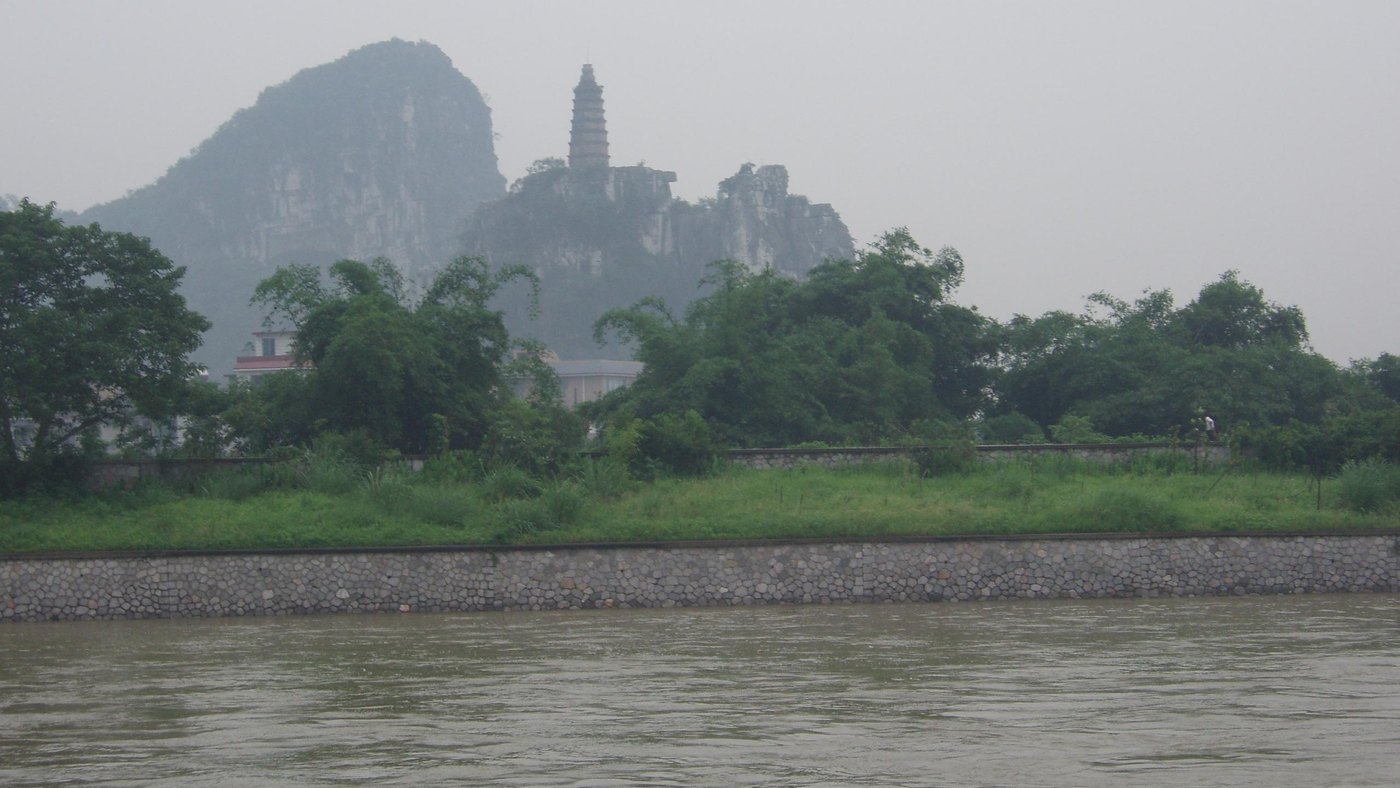
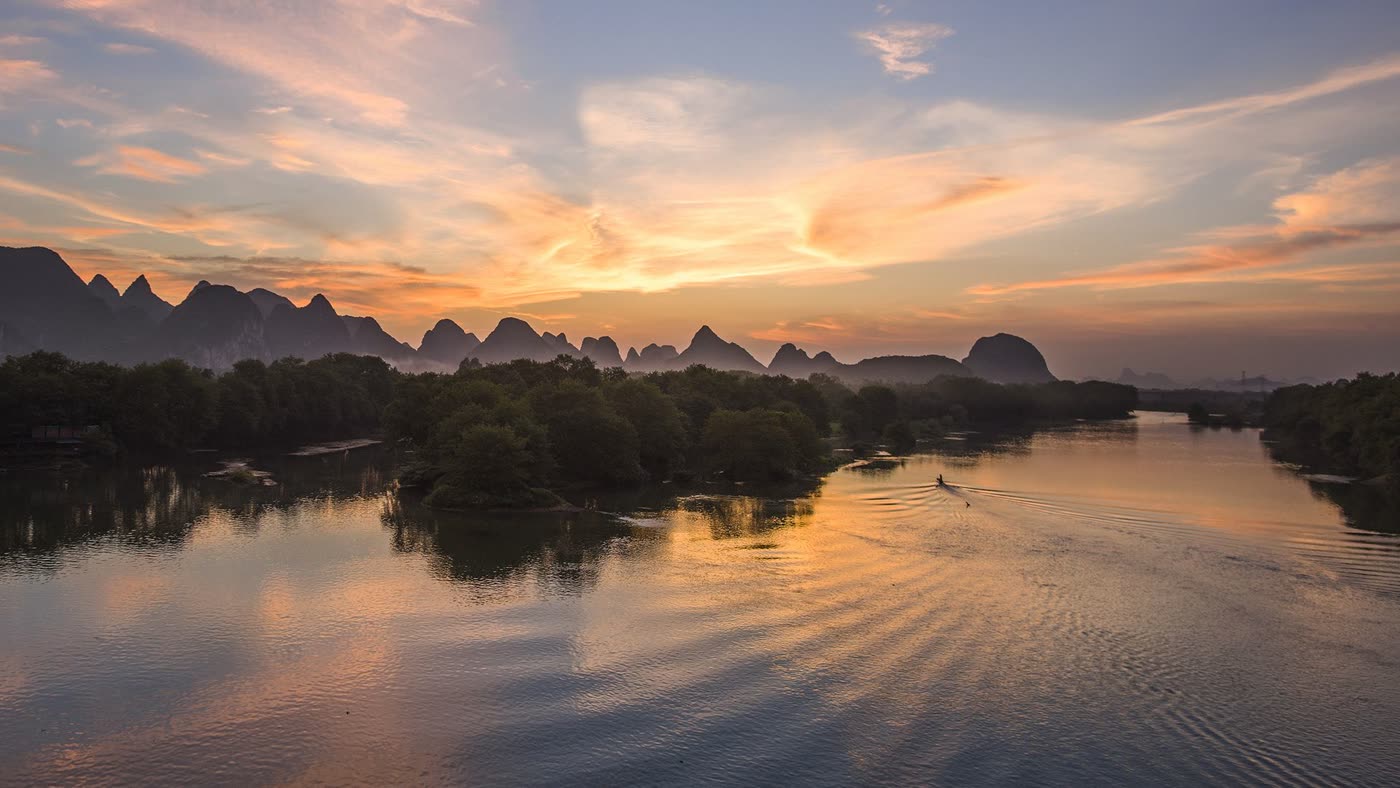
The river between Guilin and Yangshuo in Guangxi, running between limestone towers that stand straight out of a flat valley floor. It is the many reproduced landscape in China, and the reason those towers look like that is worth knowing before visitors get on the boat.
Quick Facts
The Short Version
What it is
A river running through a field of limestone towers, seen from a cruise boat or a raft between Guilin and Yangshuo
Where
Northeastern Guangxi. Guilin has an airport and high-speed rail; Yangshuo is downstream
Visitors have seen it
The reverse of the twenty-unit banknote carries a stretch of this river
Listed
A 5A scenic area, the top tier of the Chinese national rating
The rock
Limestone dissolved down to isolated towers standing on a flat plain, with the river winding between them
How visitors see it
A four-hour cruise on a large boat, or a shorter raft trip on a quieter section
The other half
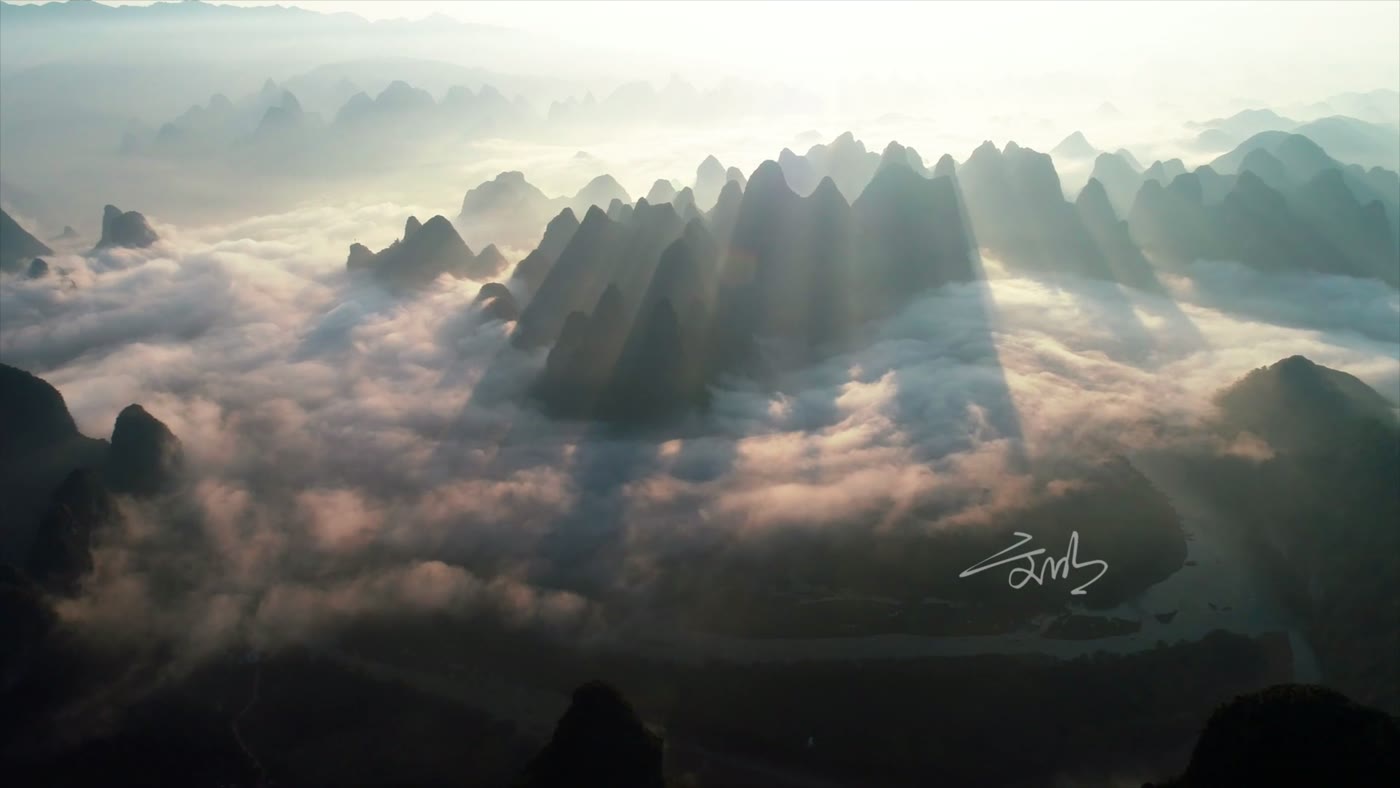
The same landscape from above, where low cloud fills the valley and just the towers show
Time needed
A day for the cruise. Two or three to use Yangshuo as a base and get off the main route
Why Go
Towers on a Plain, and a Line of Boats
1. The shape of the towers is the end of a process
Limestone country does not start like this. It starts as a plateau, water gets into the joints, and over a very long time the rock dissolves from the inside: initial sinkholes, then linked hollows, then a landscape of cones with their bases still joined to one another. Keep going for long enough, with enough rain and a water table close to the surface, and the bases dissolve away too. What is left is separate towers standing on a flat floor of sediment, with vertical sides because the rock fails along joints.
One of the pictures below makes that visible better than any diagram. It looks across a whole field of towers with a flat valley between them, and on that floor there is a river, fields and villages. The towers are not hills rising out of a plain; they are what has not dissolved yet. The plain is the floor the rest of the rock used to stand on.
Another picture shows the same thing from the other direction. When low cloud fills the valley at dawn the floor disappears and just the towers are above it, which is exactly the shape the landscape had before the plain existed, briefly restored by weather. This site has the earlier stage of the same process on other pages: at Libo and Wulong the cones are still joined at the base. Here they have separated.
2. It is a well-known view and it is run like one
The stretch between Guilin and Yangshuo is a particularly reproduced landscape in China. It is on the currency, it is the standard illustration in any book about the country, and it has been painted for a thousand years. That has consequences for a visit, and the honest way to put them is that the experience is industrial.
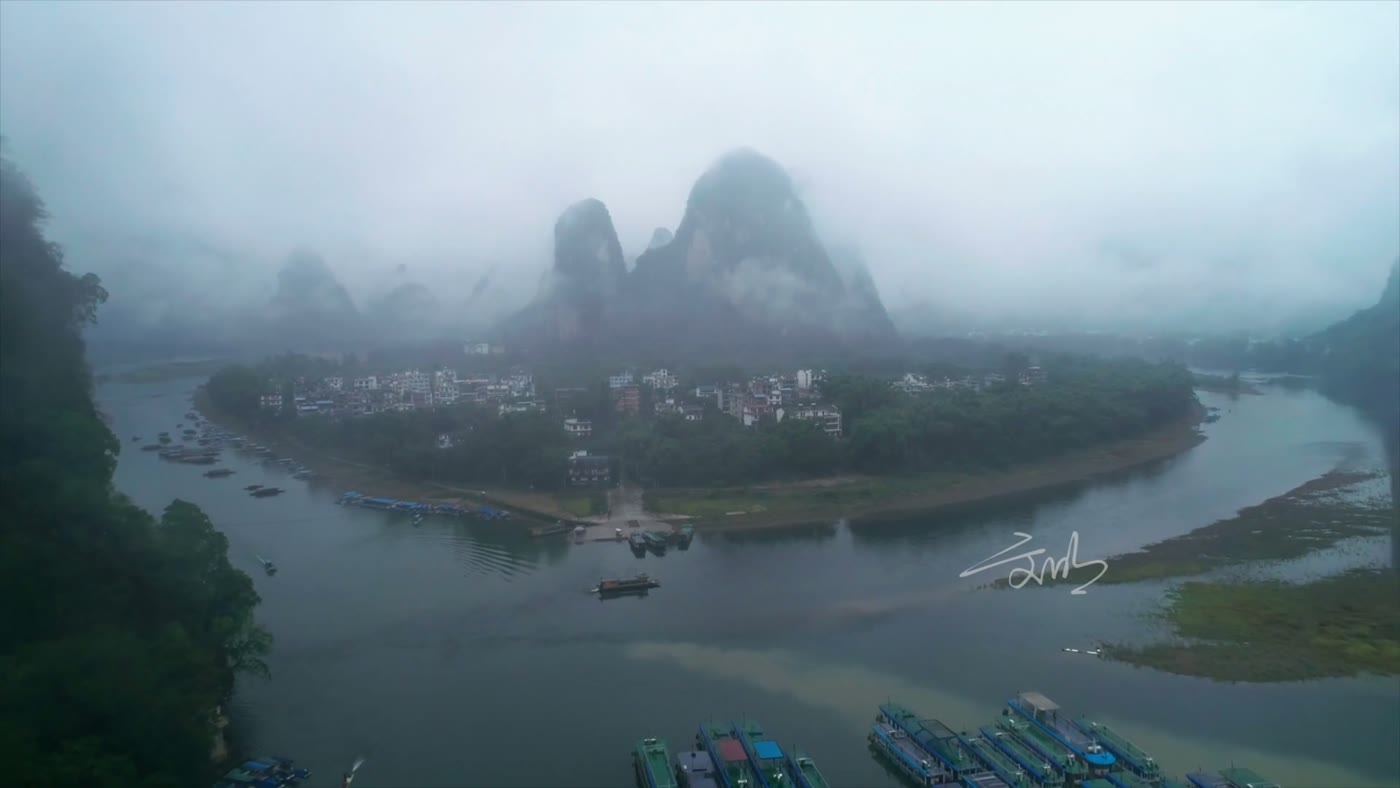
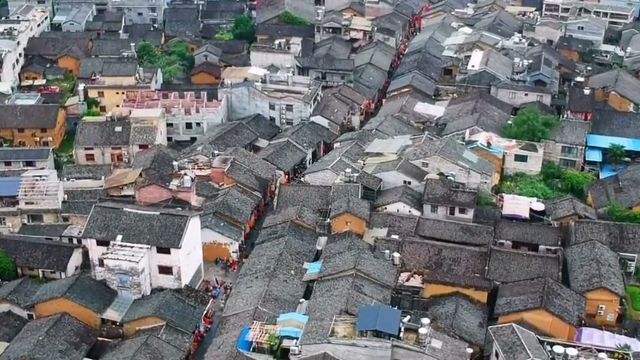
The main cruise is a four-hour trip on a large boat that leaves from a terminal in a convoy, and one of the pictures below shows what that looks like from the air at a departure point: two rafts of moored boats, dozens of them, packed canopy to canopy along the bank of a village. On the water the boats run in a line, and the photographs everyone takes are taken from the same few positions on the deck, in the same order, at the same hour. None of this makes the landscape less good. It does mean that anyone imagining a solitary drift between the peaks should adjust in advance.
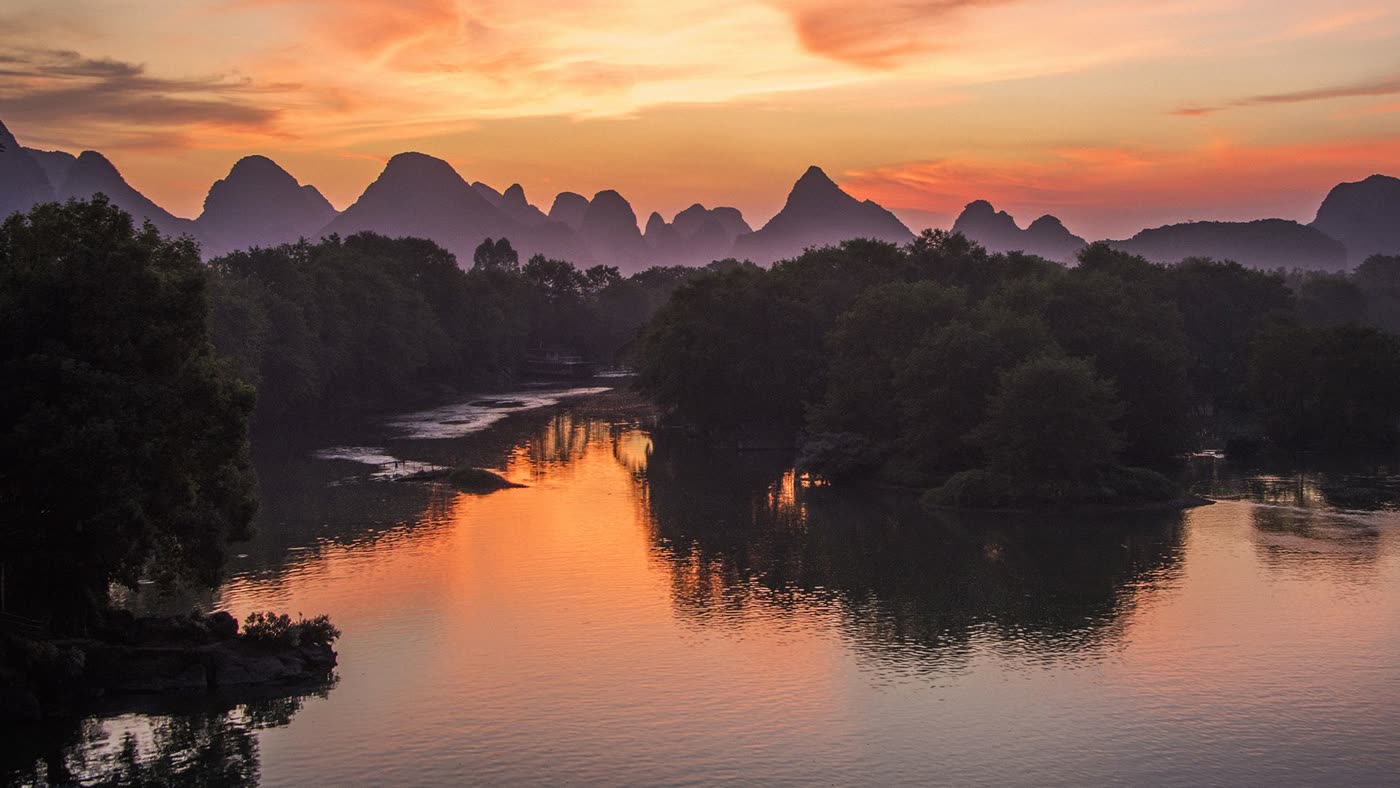
The alternatives are real and they are the reason to give this more than a day. A raft on a shorter upstream section covers less river with far fewer people. The lanes and villages around Yangshuo can be cycled, and the towers look the same from a field as they do from a boat. And the seven photographs supplied for this page are a warning in themselves: they are all the same reach at sunset, because that is the hour the river is photographed. The rest of the day it is grey, green and quiet, which the picture at the top of this page shows.
The same landscape with the floor taken away. When cloud fills the valley the towers read as islands, which is roughly what they were before the plain between them dissolved.A departure point. The boats run in convoys and this is what the fleet looks like tied up, which is worth seeing before arranging the cruise.The hour everybody photographs. All seven of the still pictures supplied for this page were taken within about an hour of this one.The same evening, further back. The boat and its wake give the scale, which the tighter silhouettes do not.
The catch. The main cruise is expensive by Chinese standards, runs to a fixed timetable in a convoy, and puts visitors on a boat for four hours with a commentary. Water level decides everything: after dry spells the large boats cannot run the upper section at all and the trip is shortened or moved. Guilin itself is a mid-sized city with a heavy tourism industry and the hard sell that goes with it. And the landscape is at its peak in haze and low cloud, which is the same weather that ruins a photograph, so the days that look ideal in pictures are not always the days they want.
Orientation
Guilin, the River, Yangshuo
Guilin is the city and the transport hub at the upstream end. Yangshuo is the small town downstream that many travellers on their own use as a base. The well-known water runs between them, and the towers crowd together especially thickly nearer the Yangshuo end, around a village where the boats stop and where the view on the banknote was taken.
The main choice is how to cover that water. The full cruise runs down from a terminal near Guilin and takes about four hours. Rafts operate on shorter sections and are quieter. Plenty of people do neither and cycle the lanes around Yangshuo instead, which costs nothing and puts the same towers on three sides of visitors.
Practical
Things Worth Knowing
Stay in Yangshuo, not Guilin
The town is small, the countryside starts at its edge, and the river is on the doorstep.
Check the water level before arranging
In a dry season the large boats cannot run the ideal section and the trip changes.
Consider a raft instead of the cruise
Shorter, cheaper, much quieter, and closer to the water.
Give the bicycle a day
The lanes between the towers are flat, the villages are ordinary, and this is where the landscape stops being a performance.
Timing
When to Go
Season
The case for
The catch
April to June
Full river, deep green, and the mornings especially likely to produce mist between the towers
The wettest months, and heavy rain can close the rafts
September and October
Clear air, warm water and comfortable cycling
The opening week of October is a national holiday and the boats are full
July and August
Long days and the landscape at its greenest
Hot, humid and the peak of domestic travel
November to March
Quiet, cheap and often beautifully hazy
Low water shortens or reroutes the cruise, and the cold is damp
Context
Why This Landscape Became the Landscape
Chinese landscape painting did not invent these shapes and it did fix them. From the Tang onwards, painters worked out a vocabulary for mountains that rise vertically out of mist with trees on top and water below, and the Guilin towers fit that vocabulary so exactly that they became the reference case. Generations of painters who had never travelled south painted mountains that look like these, and generations of visitors have arrived here with the paintings already in their heads.
The modern layer is the currency. Putting the river on a banknote in daily use made it the one piece of Chinese scenery that every Chinese person handles, and it converted a well-known view into a fixed photograph with a known viewpoint. A great deal of the traffic on this river is people going to stand where the note was made.
What that leaves out is the ordinary economy of the place. The valley floor between the towers is farmed, the villages on it are working villages, and the rafts in the photograph below belong to a business that employs a large part of the local population. The landscape and the industry built on it are not separable here, and a visitor who wants the opening without the second has come to the wrong river. Yangshuo is where visitors go to get some distance from it.
Guilin is the arrival point: an airport with international connections, high-speed rail from Guangzhou and Shanghai, and the cruise terminals. The city has towers of its own inside the built-up area, which is unusual and worth an evening, and it also has the many developed tourist-selling machinery in the province.
Many visitors travelling on their own move straight through to Yangshuo, an hour and a half downstream by road, and use it as the base. That is the right call if the countryside is the point. Anyone doing the full cruise has to start from the Guilin end anyway.
Experiences
What Visitors Can Actually Do Here
On site · one day
The cruise, Guilin to Yangshuo
The full four-hour run down the ideal section, which is the classic and a particularly crowded way to do it.
Boat pass, timed and booked ahead.
On site · half day
A raft on a quieter section
A shorter run closer to the water with far fewer people, upstream of the main route.
Raft fare.
Guided · 4 days
The towers from the ground
Yangshuo as a base, with the river done once by water and the rest of the time on lanes, in villages and among the fields between the towers.
Do the river once and then get off it. The cruise is worth doing and it is a convoy on a timetable, and the landscape does not improve for being seen from a line. The thing actually worth understanding is what visitors are looking at: separate towers standing on a flat floor, the last stage of a limestone plateau dissolving, with a river winding between what is left. Stay in Yangshuo, take a bicycle out among them, and look at the ground as well as the skyline.
Travelling to China with 10 or more people? Talk to PreeChina first. A transparent service fee of USD 100 per person for trips of up to 10 days (USD 150 for 11 to 20 days), and no markup on travel components. See how the fee works.
Almost every itinerary in this province is the same boat on the same morning. Share the travel dates and our local team will put the river in the right half-day, get visitors onto the quieter water, and spend the rest of the time in the country between the towers where the coaches do not go.