
Wuyishan is in Fujian, in East China.
Home › Destinations › Fujian › Wuyishan
Fujian · City Guide
Wuyishan, Where the World's Initial Black Tea Was Made.
Overview
Why Go
Lapsang Souchong was made at Tongmu in the Wuyi hills in about the seventeenth century, the opening fully oxidised tea anywhere. Everything the English-speaking world calls black tea descends from that process. The village still smokes leaf over pine.
Wuyi oolong is grown in pockets of soil between sandstone cliffs, which is where the word yancha, rock tea, comes from. The minerality people taste in Da Hong Pao is attributed to that weathered rock rather than to the roasting.
The original Da Hong Pao bushes on the cliff above Jiulongke are about 350 years old, and picking stopped in 2006 for their protection. Everything sold as Da Hong Pao is propagated from them or blended; nothing on sale is mother-tree tea.
Boat-shaped wooden coffins were placed in crevices high in the sandstone walls more than three thousand years ago. Several are visible from the stream. How they were lifted into position is still argued over.
Zhu Xi taught at his academy beside the stream for much of his life, and the synthesis he built there governed Chinese education and examinations for the next seven centuries. The academy site and his inscriptions are on the water.
See
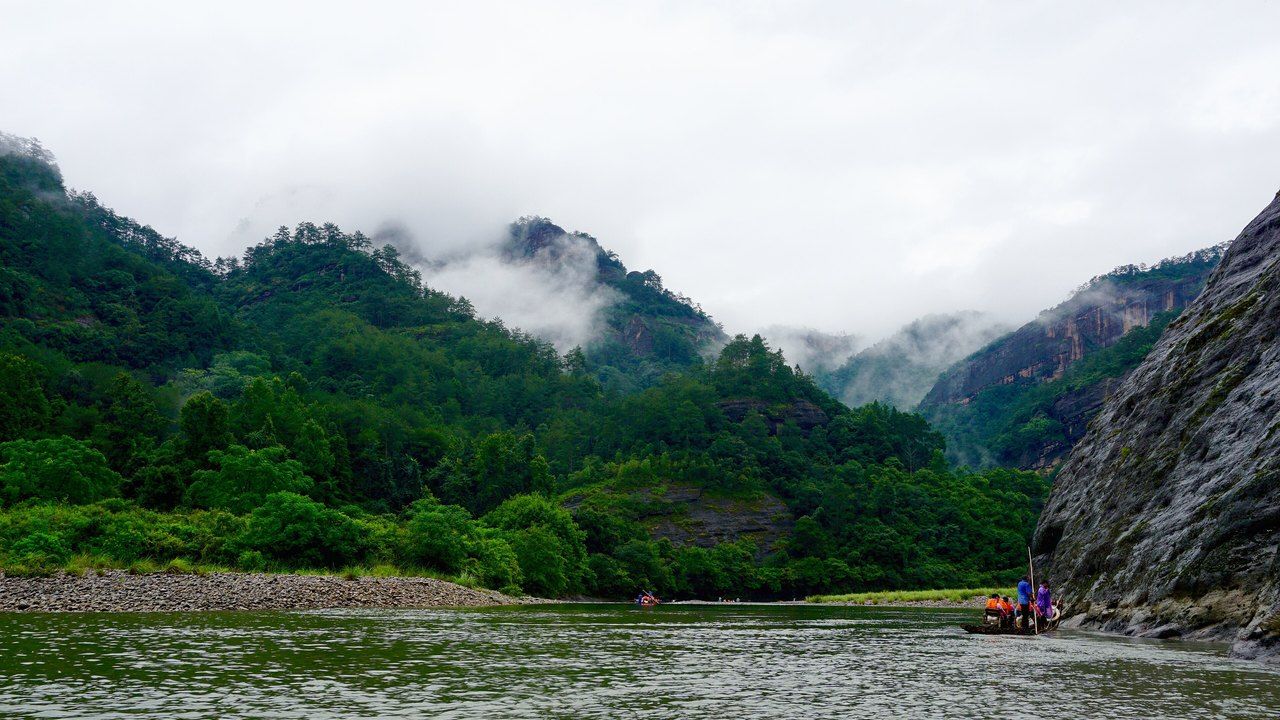
A stream that loops nine times through the sandstone, run on bamboo rafts poled by two boatmen. The trip takes around ninety minutes downstream and passes the cliff coffins, Zhu Xi's inscriptions and much of the named peaks.
About 800 steps up a cliff face to a viewpoint over the loops of the stream, which is the one place the nine bends make visual sense. Half of the climb is exposed stair with a chain rail. An hour up at a steady pace.
Six bushes on a ledge in the Jiulongke gully, reached on a walking path through the rock valley past other named tea plots. They are fenced and monitored. The walk in is the part worth doing, through the crevice terraces.
A village inside the national park at the head of a forested valley, where Lapsang Souchong is smoked over pine in timber drying houses. Access is controlled; arrange it through a tea house or guesthouse rather than turning up.
Boat-shaped coffins of the Bronze Age wedged into crevices tens of metres up the walls above the stream. Several are pointed out from the rafts; a museum near the entrance holds one that was recovered.
Zhu Xi's academy on the fifth bend, rebuilt on its original ground, with his carved inscriptions on the rock nearby. What he worked out here became the state orthodoxy and the examination syllabus until 1905.
On the Map
Approximate locations of the attractions above, across Wuyishan.
Eat
Oolong from the cliff terraces, roasted over charcoal in repeated rounds so that the finished leaf is dark and the liquor amber. Rougui and Shuixian are the two varieties visitors will be offered many. Tasting is free in many shops.
Black tea dried over pine smoke at Tongmu. The heavily smoked version is mostly made for export; what the village drinks is a lighter one where the smoke is a background note. Ask for both and compare.
Goose poached, rubbed with chilli, salt and rice straw ash, then smoked. It comes cold and chopped through the bone, and it is far spicier than many Fujian food. Langu is a township in the north of the county.
The hills are bamboo, and shoots come fresh in spring and dried the rest of the year. The usual treatment is a fry with cured pork and chilli. Dried shoots are the standard thing visitors take home besides tea.
Do
Rafts are booked by time slot and sell out in season, so buy the day before. The run is downstream and shallow, with the boatmen naming the peaks as visitors go. Sit at the back if visitors want to stay dry.
Go up in the morning before the cliff face heats. From the top the stream reads as a series of loops rather than a river, which is the thing the rafts cannot show visitors. Come down the far side through the gully.
Shops will brew four or five rock teas side by side and expect an hour of the time. Visitors are not obliged to buy. Ask which plot each came from: the point of yancha is that the answer changes the taste.
They are easy to miss and the boatmen point them out quickly. Bring a small pair of binoculars if visitors have them. The museum near the park entrance has a recovered one at ground level, which is the sole way to see the joinery.
When
Tea picking and processing, green hills and comfortable temperatures. The ideal window, though it rains often and the stream runs high.
Hot, humid and the domestic peak, with the raft slots hardest to get. Early mornings on the water are still worth it.
Dry, clear and cooler, with the autumn roasting under way in the tea workshops. The other good window and the better one for climbing.
Cold, damp and very quiet, with mist on the cliffs that photographers prefer. Rafting runs unless the water is too low or too high.
Explore More
Wuyishan is in Fujian, in East China.
Related
Share the travel dates and interests, and PreeChina's local team will design a route that fits.
Plan My Trip to WuyishanSee Private Tour Prices