
Jianshui is in Yunnan, in Southwest China.
Home › Destinations › Yunnan › Jianshui
Yunnan · City Guide
Jianshui, Where Old Wells Still Supply the Lanes.
Overview
Why Go
Jianshui has well over a hundred old public wells, many with stone heads cut in the Yuan and Ming and worn into grooves by rope. Households still draw from them for tea and for making tofu, because the water is better than the tap.
The temple was founded in 1285 and covers about 114,000 square metres around a lake, a size normally kept for provincial capitals. It is conventionally ranked second just to the one at Qufu, which is Confucius's own town.
The Zhu family built their compound over thirty years at the end of the Qing on tin and trade money, with dozens of courtyards, a garden, a theatre and a family jail. The family lost everything within a generation of finishing it.
Jianshui purple pottery is conventionally listed with Yixing, Qinzhou and Rongchang as China's four pottery traditions. It is thrown from local red clay, carved and inlaid with other clays, then burnished after firing rather than glazed.
The Yunnan-Vietnam railway was built to metre gauge by France and opened in 1910, connecting Kunming to Haiphong. A tourist train now runs a preserved stretch out of Jianshui on the original track.
See
A very large compound of 1285 arranged along an axis through courtyards and archways to the Dacheng hall, with a lake at the front. Local schools still hold ceremonies here, so it is in use rather than just preserved.
A late Qing compound of dozens of courtyards with a water garden, an opera stage and servants' quarters, built and lost by one family. Parts are now a guesthouse. Two hours gets visitors round it properly.
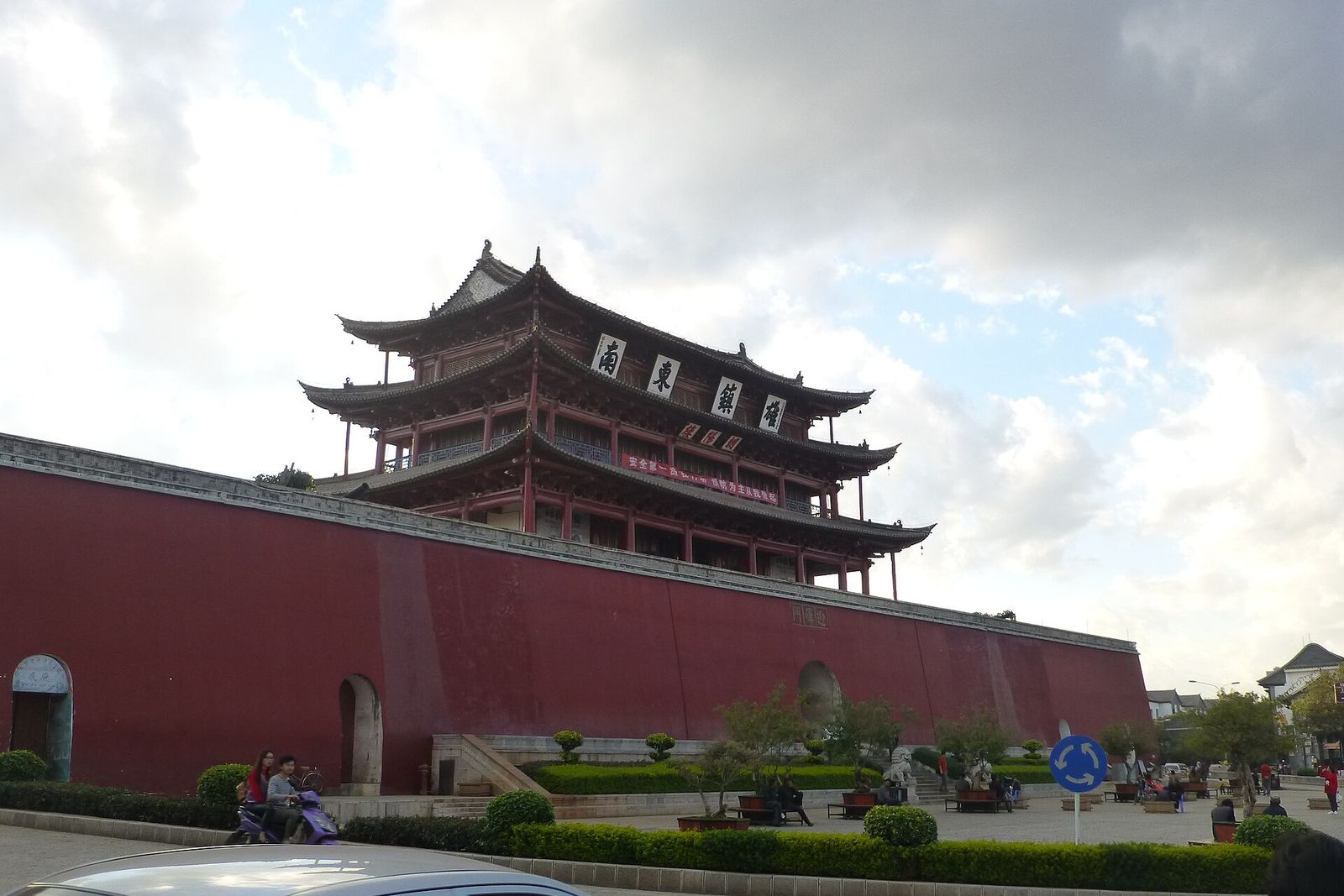
The east gate of the Ming town, a three-storey timber tower on a brick base built in 1389, older than the Tiananmen gate it is often compared to. The square below it is where the old town starts.
A seventeen-arch stone bridge with three pavilions on it, west of the town where two rivers meet. It was built in two stages in the Qing as the water widened. The light on it is ideal in the late afternoon.
A Zhang clan village of Qing merchant houses thirteen kilometres out, reached by the narrow-gauge tourist train that also stops at the bridge. The carving and the painted screens inside the houses are why it is worth the trip.
A very large karst cave with an underground river and colonies of swifts that nest in the roof. Climbers harvest the nests on ropes without protection in an annual display. It is about thirty kilometres east.
On the Map
Approximate locations of the attractions above, across Jianshui.
Eat
Small cubes of tofu made with well water, lightly fermented, then grilled over charcoal until they puff. Visitors eat them off the grill and the stallholder counts the total with dried corn kernels, one per cube.
Chicken cooked in a lidded clay pot with a chimney in the middle, set over boiling water so that steam condenses into the pot and makes its own broth. The pots are a Jianshui product, which is why the dish is claimed here.
The pale inner shoot of a bulrush, grown in the wet fields around the town and eaten in clear soup or stir-fried with ham. It is sweet and crisp and it is grown almost nowhere else in China.
Duck roasted in an earthen oven over pine needles in Qujiang township, giving a resinous note in the skin. It is sold whole and chopped, and the shops run out in the afternoon.
Do
Sit at the grill, eat as they puff, and the stallholder drops a corn kernel in front of visitors for each one. Pay by the count at the end. Evening is when the stalls fill and the conversation is half the point.
The tourist train runs a preserved stretch of the 1910 metre-gauge line from Jianshui to Tuanshan, stopping at Shuanglong Bridge and at an old station on the way. Book the same day at the station; it runs on a fixed timetable.
The decoration is cut into the leather-hard pot and filled with contrasting clay, then the fired surface is burnished rather than glazed. Workshops in the town let visitors watch both stages, and several run half-day sessions.
The wells are on street corners and in courtyards, and people wait in line at them early with buckets and plastic drums. The big ones have several mouths cut in one stone. Ask before drawing anything.
When
Dry, mild and clear, with the rice in around the town. The ideal window, and warm enough for the evening tofu stalls.
Cool mornings and warm afternoons, dry and quiet. Lunar New Year fills the town for a fortnight; the rest of the season is empty.
Hot before the rains arrive, with the swift-nest harvest at the cave in spring. Still comfortable by Yunnan standards.
The rains, warm and green, with afternoon downpours many days. The lowest prices and the fewest visitors.
Explore More
Jianshui is in Yunnan, in Southwest China.
Related
Share the travel dates and interests, and PreeChina's local team will design a route that fits.
Plan My Trip to JianshuiSee Private Tour Prices