A field guide students use at the Temple of Heaven (天坛) in Beijing, so they can learn on site without a tour guide. Five stations run from south to north along the temple's central line, from the Circular Mound Altar to the Hall of Prayer for Good Harvests. Students find out why the builders used circles and squares, what the numbers in the stones and columns stand for, how the Echo Wall carries a voice, and why worshipping Heaven helped an emperor rule. This page shows the facts for every station and one station in full; the tasks and teacher pages are in the full guide.
Years 6 to 85 stations, south to northHistory, Science and MathematicsWritten for the Western Australian Curriculum
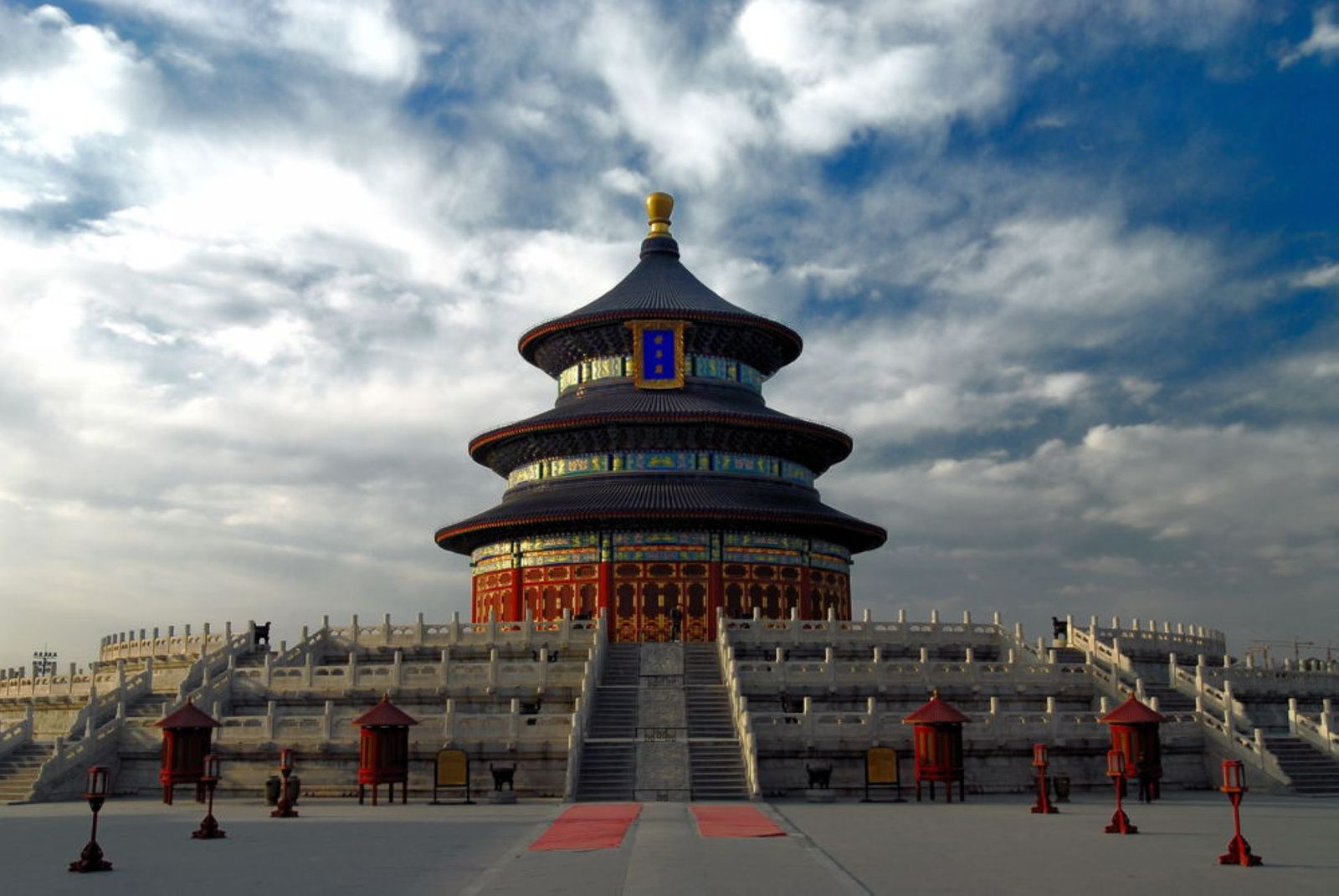
The Hall of Prayer for Good Harvests · Photo: licensed stock image
The Big Question
Why would an emperor build a place to talk to the sky?
The Temple of Heaven was not a temple where people came to worship. Only the emperor led the great ceremonies here, on behalf of the whole country: at the winter solstice he worshipped Heaven, and in early spring he prayed for a good harvest. Students find out five things:
Round or square? Where the builders used circles and where they used squares, and what each shape stands for.
What do the numbers mean? The number 9 in the stones of the altar, and the seasons and months in the columns of the great hall.
Can a wall carry your voice? Testing the Echo Wall and the Three-Echo Stone, and explaining what the sound is doing.
Who else watched the sky to run their year? The emperor's calendar beside Stonehenge, the Roman and Gregorian calendars, and the six Noongar seasons of the South West.
Why did worshipping Heaven help an emperor rule? The chain of ideas from the Mandate of Heaven to emperors blaming themselves for disasters, compared with rulers and rituals in Rome, London and Canberra.
Before You Go
What students already know
The Mandate of Heaven (Year 7 History). A ruler held power because Heaven allowed it, and the emperor was called the Son of Heaven (天子). Floods, famine or bad harvests could be taken as signs that Heaven was unhappy with him.
The Sun and the seasons (Year 7 Science). The winter solstice is the day with the shortest daylight. In Beijing it falls around 21 or 22 December; in Perth the same day is the longest of the year.
Circles and patterns (Years 7 and 8 Mathematics). Students count rings of stones that grow by the same number each time, and pace around a round hall.
Sound (Year 8 Science). Sound is energy carried by vibrations. Students test what happens when it meets a smooth, curved wall.
Practical notes
Tickets. A park ticket only opens the gardens. The Hall of Prayer for Good Harvests, the Echo Wall and the Circular Mound Altar need the through ticket (联票).
Opening hours. The park opens early in the morning; the main buildings open later and close earlier. Check the current times before the trip.
Small groups. The park covers 273 hectares, about four times the area of the Forbidden City. We split groups into teams of no more than 10 students, each with one adult, and agree a meeting point first.
Walk south to north. The guide starts at the Circular Mound Altar in the south and ends at the Hall of Prayer in the north.
The Big Picture
Round heaven, square earth
One altar became two. The Ming emperor Yongle built this site in 1420, the same year his new palace was finished. At first it was the Altar of Heaven and Earth (天地坛), where heaven and earth were worshipped together. In 1530 the Jiajing emperor split the ceremonies: he built the Circular Mound Altar (圜丘) in the south for worshipping Heaven, and from then on the site was called the Temple of Heaven.
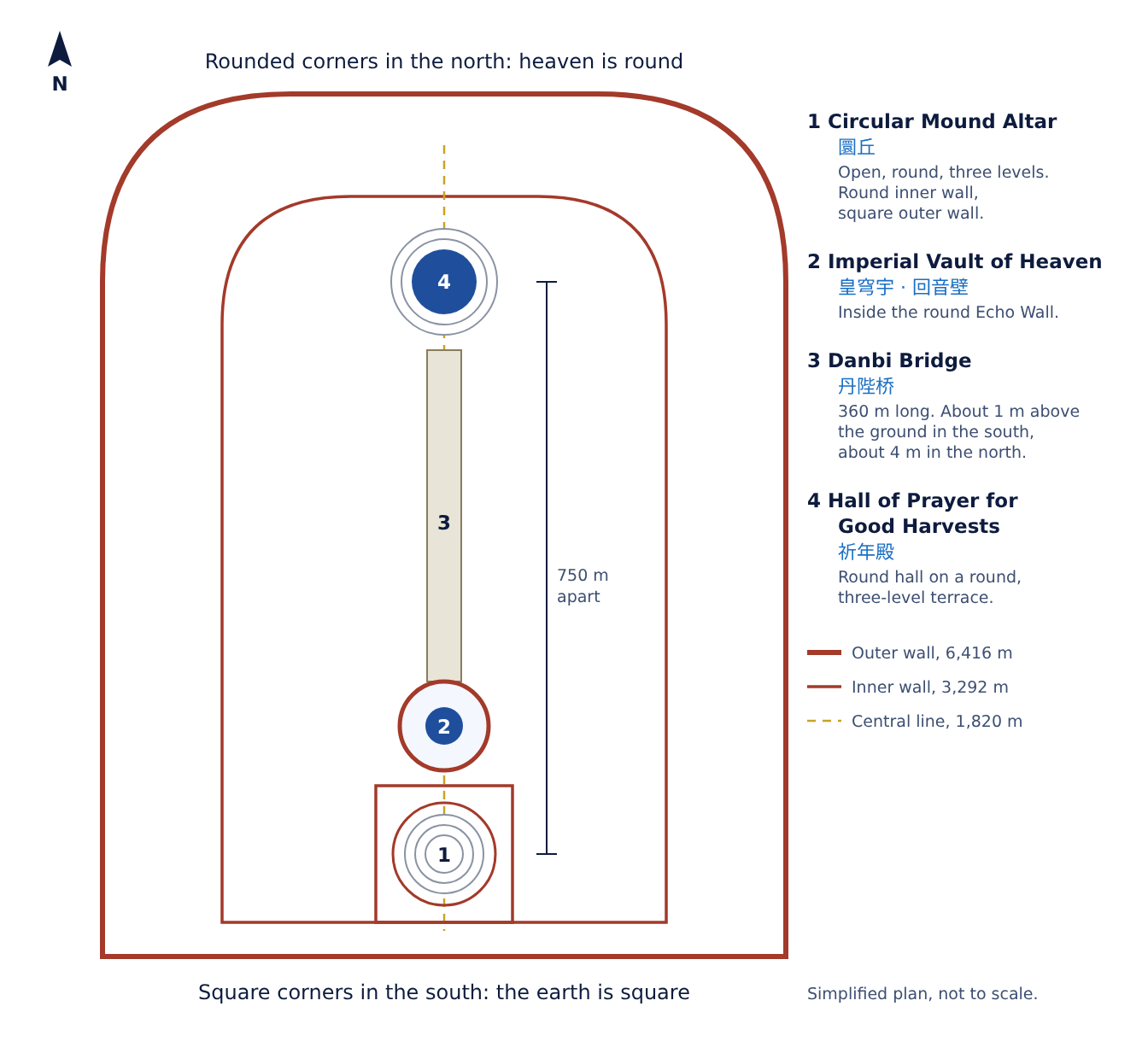
Round heaven, square earth (天圆地方). The two walls around the park are square at the southern end and rounded at the northern end, and the ground rises from south to north. Both say the same thing: heaven is round and high, the earth is square and low.
The four sights on the central line, south to north. Simplified, not to scale · Diagram: PreeChina
The Temple of Heaven in numbers
Built
1420; the Circular Mound Altar added in 1530
Area
273 hectares, about four times the Forbidden City
Walls
Outer wall 6,416 m long; inner wall 3,292 m
Central line
1,820 m from south to north; the centres of the Circular Mound Altar and the Hall of Prayer are 750 m apart
Ceremonies
Worship of Heaven at the winter solstice; prayers for the harvest in early spring
Public park
Since 1918
World Heritage
Inscribed in 1998; part of the Beijing Central Axis World Heritage Site since 2024
Reading the buildings: shapes, colours and numbers
What to find
Where
What it means
Round buildings and round terraces
Circular Mound Altar, Imperial Vault of Heaven, Hall of Prayer
Heaven is round
Blue roof tiles
Hall of Prayer (all blue since 1752; before that blue, yellow and green), Imperial Vault
The colour of the sky
Three levels
The terraces of the Circular Mound Altar and the Hall of Prayer; the three roofs of the Hall
Each building lifts the emperor step by step towards heaven
9 and multiples of 9
Circular Mound Altar: rings of 9, 18, 27 ... 81 stones; railings, posts and steps in nines
The largest single-digit odd number, repeated on the altar to Heaven
4, 12, 12 and 24 columns
Inside the Hall of Prayer
The four seasons, the 12 months, the 12 two-hour periods of the day, the 24 solar terms
An open altar with no roof
Circular Mound Altar
Nothing stands between the emperor and the sky
Only the emperor. Worshipping Heaven belonged to the emperor alone: no official, priest or ordinary family was allowed to do it, and ordinary people did not attend. The full guide takes students through the winter solstice ceremony step by step.
Stations
Five stations, south to north
Station 1 Circular Mound Altar圜丘
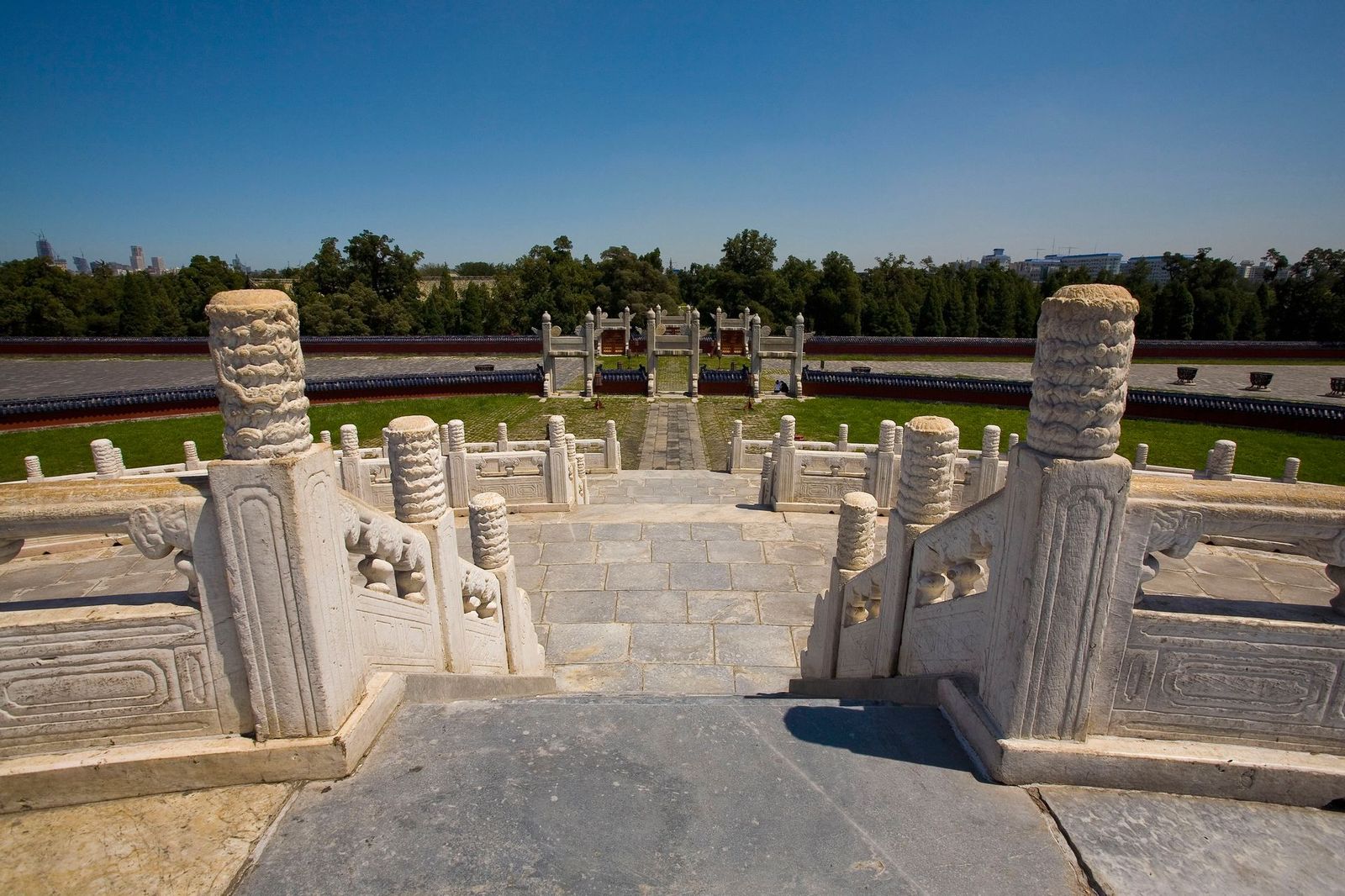
Look. Climb the three round, open-air terraces of white stone. There is no roof and no building on top, only the sky. In the very centre of the top level is one round stone.
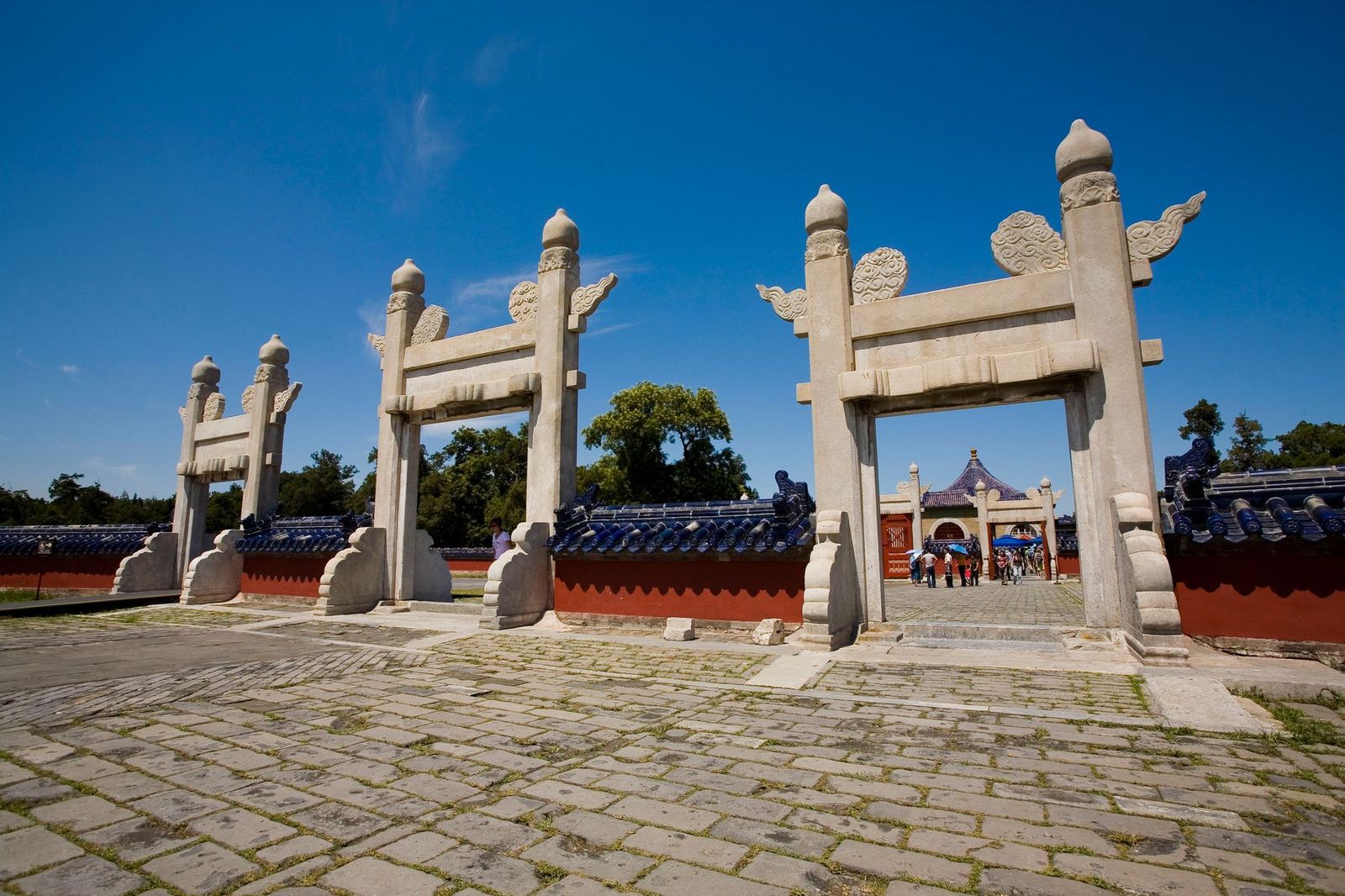
The top level of the Circular Mound Altar · Photo: licensed stock imageStone gateways (棂星门) at the Circular Mound Altar · {STOCK}
Know. The altar was built in 1530, and at the winter solstice the emperor stood here to worship Heaven. In 1749 the Qianlong emperor enlarged it and replaced its blue glazed tiles with stone and white marble. The round stone in the centre is the Heart of Heaven Stone (天心石), 80 cm across. Around it the paving stones run in nine rings: 9 stones in the first ring, 18 in the second, and so on up to 81 in the ninth. Two low walls surround the altar, round on the inside and square on the outside.
The Think, Do and Then & Now tasks for this station are in the full guide.
Full station, as in the guide
Station 2 Imperial Vault of Heaven and the Echo Wall皇穹宇 · 回音壁
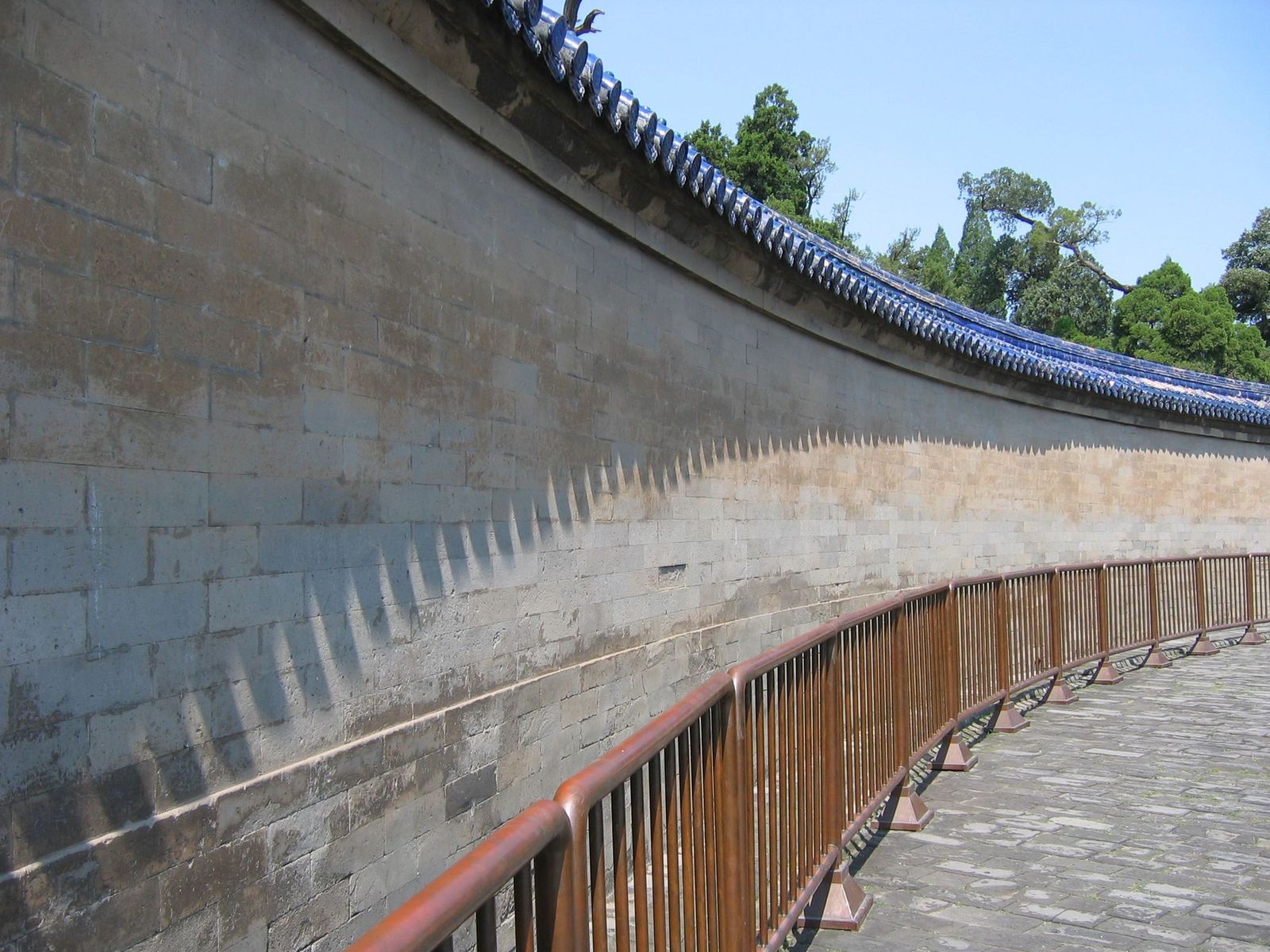
Look. Walk north from the altar into a round courtyard with a smooth, curved wall all the way around it. In the middle is a small round hall with a single blue roof.
The Echo Wall curves all the way round the courtyard · Photo: licensed stock image
Know. The Imperial Vault of Heaven (皇穹宇) kept the spirit tablets used in the ceremonies at the altar. Its roof rests on 16 columns in two rings of eight. The round brick wall around the courtyard is the Echo Wall (回音壁), from the reign of the Qianlong emperor. Its curve is so regular and its surface so smooth that sound can travel along the inside of the wall from one side of the courtyard to the other. On the stone path in front of the hall, the third slab is the Three-Echo Stone (三音石).
Think. Sound is energy carried by vibrations in the air. What happens to it when it meets a hard, smooth surface? Why might a curved wall carry a voice further than a flat one?
Do.
Explore: With a partner, stand at two points far apart along the wall. One person speaks quietly into the wall; the other listens with an ear close to it. Can you hear each other?
Extend: Stand on the third slab in front of the hall and clap once. How many echoes can you hear?
Challenge: Scientists found that the first echo from the Three-Echo Stone comes from the walls and bases of the two side halls, not from the round wall. Draw the path you think each echo takes back to your ears.
Then & Now. Architects still shape walls and ceilings to steer sound, in concert halls, theatres and lecture rooms. Think of a place in Perth where you can hear a speaker clearly from far away.
Station 3 Danbi Bridge丹陛桥
Look. Walk north along the wide, raised stone road. Look down at the ground on either side as you go.
Know. The Danbi Bridge is 360 m long and leads to the Hall of Prayer along the temple's central line. At its southern end it is about 1 m above the ground; at its northern end, about 4 m. Walking north, you climb slowly towards heaven without noticing.
The Think, Do and Then & Now tasks for this station are in the full guide.
Station 4 Hall of Prayer for Good Harvests祈年殿
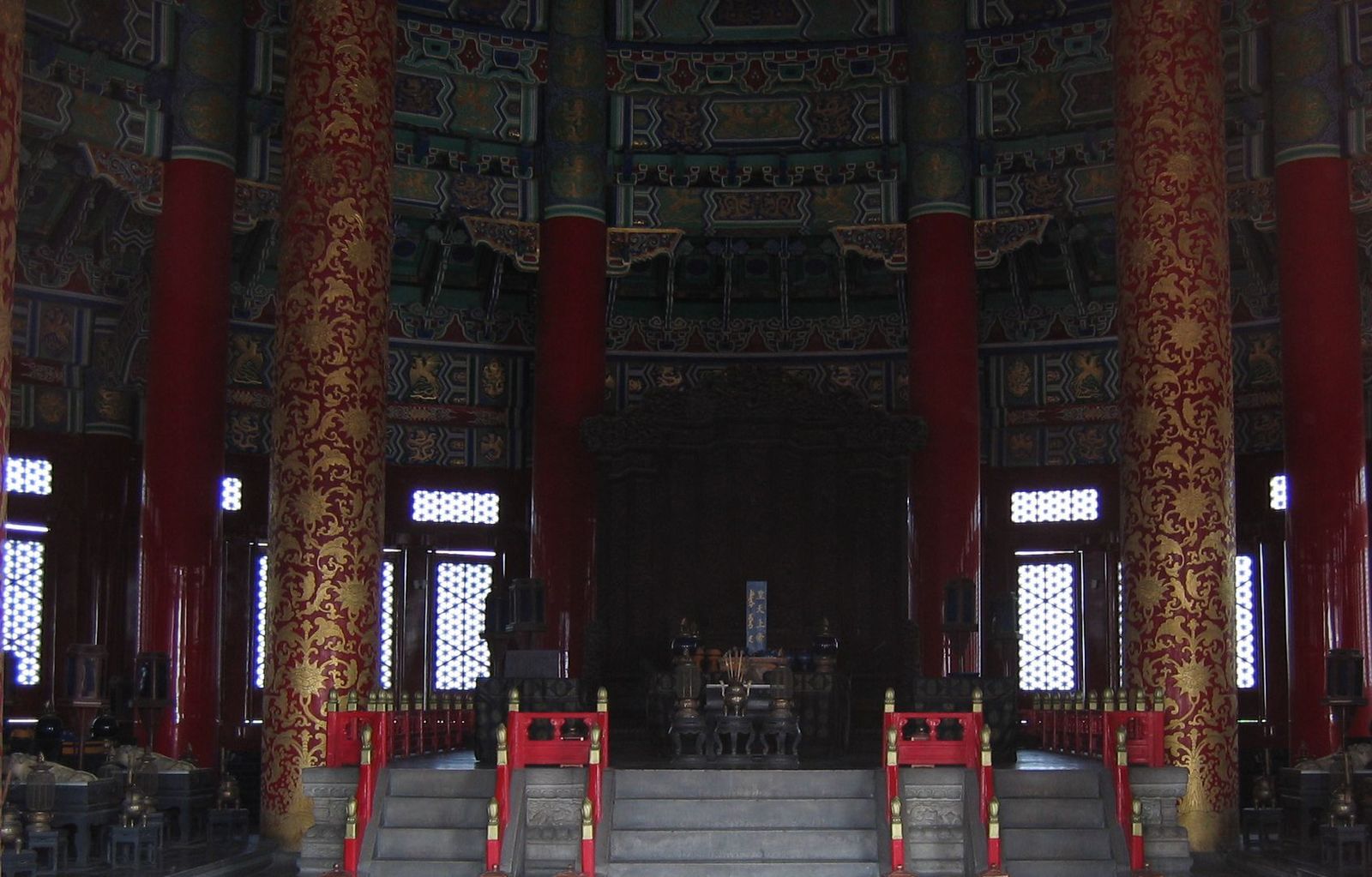
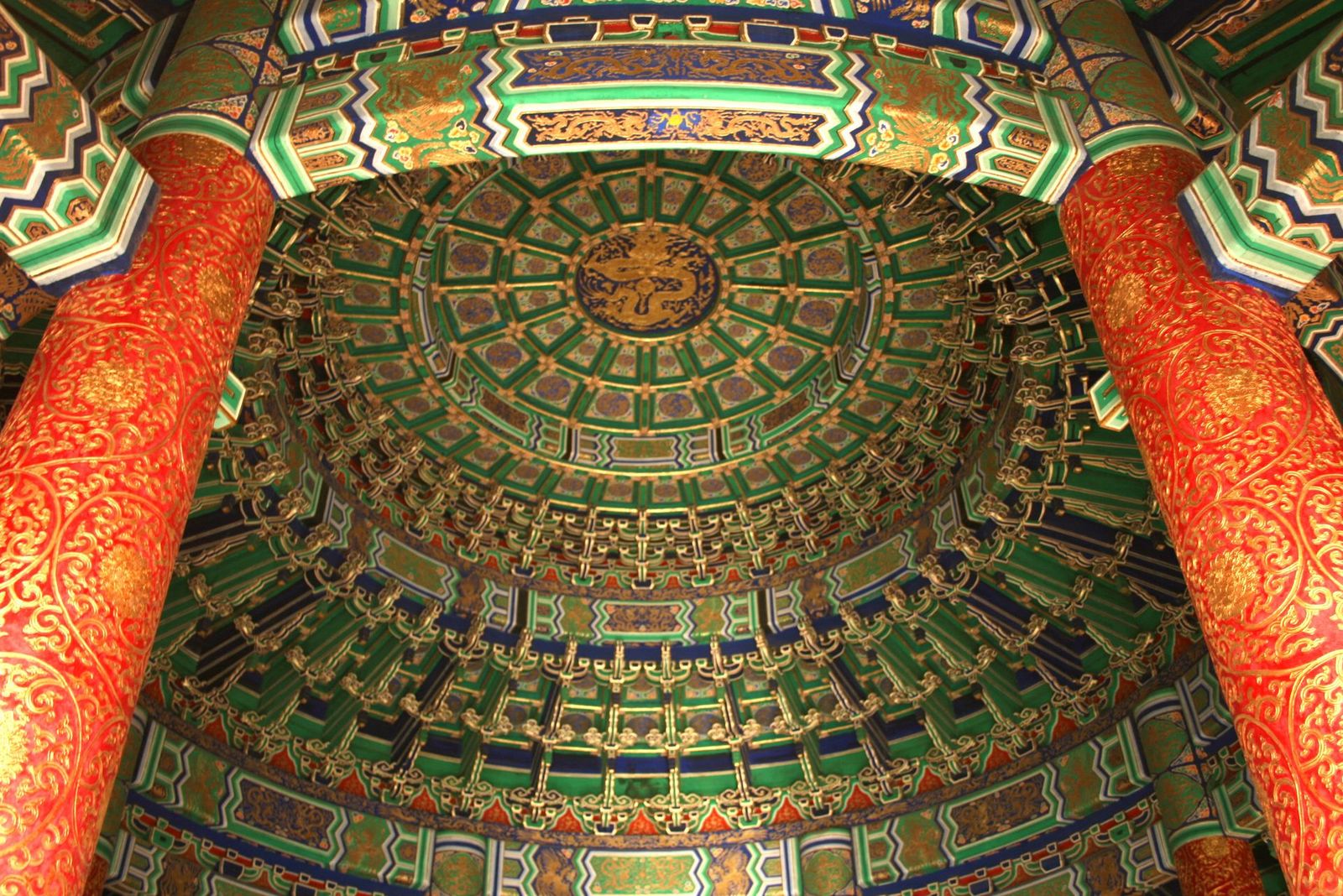
Look. At the north end stands a round hall with three blue roofs on a three-level white terrace. Inside, look up at the columns holding up the roof.
Inside the hall: the patterned columns in the centre are the Dragon Well Pillars · Photo: licensed stock imageLook straight up: the ceiling at the centre of the hall · Photo: licensed stock image
Know. The hall was first built in 1420 as the Hall of Great Sacrifice (大祀殿). The Qianlong emperor gave it its present name in 1751, and in 1752 its three roofs, which had been blue, yellow and green, were all covered in blue glazed tiles. In 1889 lightning set it on fire and it burned down; the hall you see was rebuilt by 1896. It is 38 m tall and 32.7 m across, on a terrace 5.6 m high. Inside, 28 columns hold up the roof: 4 Dragon Well Pillars (龙井柱) in the centre, 19.2 m tall, for the four seasons; 12 in the middle ring for the 12 months; and 12 in the outer ring for the 12 two-hour periods of the day. The middle and outer rings together make 24, the 24 solar terms of the farming calendar. In early spring the emperor came here to pray for a good harvest.
The Think, Do and Then & Now tasks for this station are in the full guide.
Station 5 The park today
Look. As you leave, walk through the gardens and covered walkways. Notice what local people are doing.
Know. The Temple of Heaven has been a public park since 1918. Early in the morning and again in the late afternoon, Beijing residents come here to dance, sing, exercise and meet friends. On some mornings, near the East Gate, parents gather to look for marriage partners for their grown-up children.
The Think, Do and Then & Now tasks for this station are in the full guide.
Why Worship Heaven?
The politics behind the ceremony
The ceremonies were religion, but they were also a way of running the country. The full guide follows the chain of ideas step by step:
Heaven gives the right to rule. From the Zhou dynasty until the end of the Qing in 1911, Chinese rulers claimed the Mandate of Heaven (天命), and kept it only by ruling well.
Only the Son of Heaven may speak to Heaven. Each time he stood on the altar, the emperor showed that he alone stood between Heaven and the people.
Heaven answers through nature. Floods, droughts and earthquakes could be read as Heaven's warnings to the ruler.
So the emperor takes the blame. Emperors answered disasters with edicts blaming themselves (罪己诏).
And a ruler who fails can be replaced. If disasters and rebellions piled up, people could say the Mandate had passed to someone else.
Students then compare this with the divine right of kings in Europe: in 1598 King James VI of Scotland, later James I of England, wrote that kings are accountable to God alone. Both ideas put the ruler's power above the people; only the Mandate of Heaven said it could be lost through bad rule.
Big Talk
Sacred places, rituals and power, East and West
Many societies have tied their rulers to heaven or to God through a ritual in a special place. The guide compares four.
Temple of Heaven, Beijing
Temples of ancient Rome
Westminster Abbey, London
Parliament House, Canberra
Who leads
The emperor himself
The pontifex maximus, head of Rome's priests; from Augustus on, the emperors held the title
The Archbishop of Canterbury, who crowns the monarch
The Speaker and the President of the Senate, who read a prayer at the start of each sitting
The place
An open altar under the sky
A temple building with an altar
A church; coronations have been held here since 1066
The parliament building; the Constitution says the Commonwealth shall not make any law establishing any religion
What it says about power
The ruler is the only link between Heaven and the people
The ruler is also the chief priest
The monarch is made sacred by the church
Power comes from voters; religion and state are kept apart by law
A second comparison asks who else watched the sky to run their year: Stonehenge, whose stones line up with midsummer sunrise and midwinter sunset; the Julian calendar of 46 BC and its Gregorian reform of 1582; and the six Noongar seasons of the South West, read from changes in weather, plants and animals. In the early Qing dynasty a Belgian Jesuit, Ferdinand Verbiest (南怀仁), ran the emperor's astronomical bureau and between 1669 and 1673 built six bronze instruments that still stand at the Beijing Ancient Observatory.
For Teachers
Curriculum links
Year levels follow the Western Australian Curriculum from the School Curriculum and Standards Authority (SCSA). Teachers using another curriculum can map the same stations to their own course; check the content descriptions against the current documents.
Station
Year · Learning area
Content it supports
Before you go, Big picture, Station 4
Year 7 HASS · History
Depth study of an ancient society (China option): beliefs, values and the role of the ruler
Station 4
Year 7 HASS · History
Investigating the ancient past: why conserving the remains of the past matters (the 1896 rebuild)
Station 1, Big Talk
Year 7 Science · Earth and space sciences
Predictable phenomena on Earth, including seasons, caused by the relative positions of the Sun, Earth and Moon
Station 2
Year 8 Science · Physical sciences
Energy appears in different forms, including sound
Stations 1, 3 and 4
Years 7 and 8 Mathematics
Number patterns, ratio and rate (gradient), circumference of a circle
Station 5
Year 7 HASS · Geography
Place and liveability: how people use public spaces
Big Talk
Years 7 and 8 HASS; cross-curriculum priority
Aboriginal and Torres Strait Islander histories and cultures: Noongar seasons
Why worship Heaven?, Big Talk
Year 8 HASS · History
Depth study options include Medieval Europe (the power of the Church and of kings), where taught
Big Talk
Year 7 HASS · Civics and Citizenship
The Australian Constitution and how power is shared and limited
Glossary
Names to match on the signs
Chinese
Pinyin
English
天坛
Tiāntán
Temple of Heaven
天地坛
Tiāndì Tán
Altar of Heaven and Earth (the first name)
天子
Tiānzǐ
Son of Heaven (the emperor)
天圆地方
tiān yuán dì fāng
"round heaven, square earth"
圜丘
Yuánqiū
Circular Mound Altar
天心石
Tiānxīn Shí
Heart of Heaven Stone
皇穹宇
Huángqióngyǔ
Imperial Vault of Heaven
回音壁
Huíyīn Bì
Echo Wall
三音石
Sānyīn Shí
Three-Echo Stone
丹陛桥
Dānbì Qiáo
Danbi Bridge
祈年殿
Qíniándiàn
Hall of Prayer for Good Harvests
龙井柱
lóngjǐng zhù
Dragon Well Pillars
冬至
dōngzhì
winter solstice
二十四节气
èrshísì jiéqì
the 24 solar terms
南怀仁
Nán Huáirén
Ferdinand Verbiest
Full Guide
For teachers and trip leaders
Get the full Temple of Heaven field guide
The full guide is a printable PDF for teachers, school trip leaders and travel companies. It adds what this preview leaves out:
the Think, Do and Then & Now tasks for every station, at three levels (Explore, Extend, Challenge)
the Test it yourself sheet and the Back to the big question worksheet
teacher pages: curriculum links, answers and notes for the day
Use the request form and tell us your name, your school or company, and the guide you want. PreeChina sends the PDF by email for use with your own classes.