A field guide students carry through the Palace Museum in Beijing, so they can learn on site without a tour guide. It follows seven stations from the Meridian Gate in the south to the Gate of Divine Prowess in the north, and links each one to what Year 6 to 8 students study at school. This page shows the facts and diagrams for every station and one station in full; the tasks and teacher pages are in the full guide.
Years 6 to 8About 3 hours on site7 stationsWritten for the Western Australian Curriculum
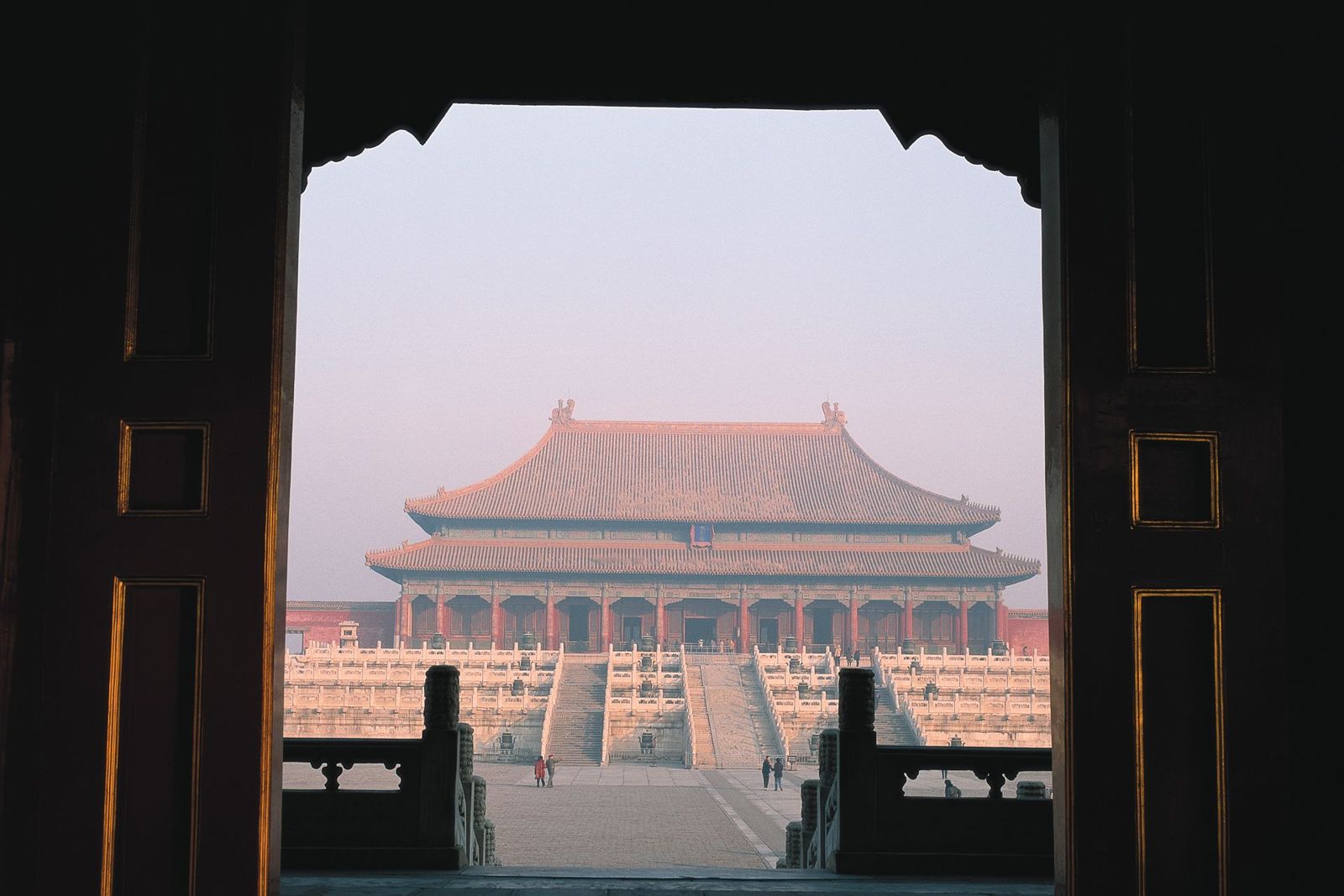
A hall on the central axis, framed by a palace doorway · Photo: licensed stock image
The Big Question
How do you build a palace that tells everyone who is in charge, and make it last 600 years?
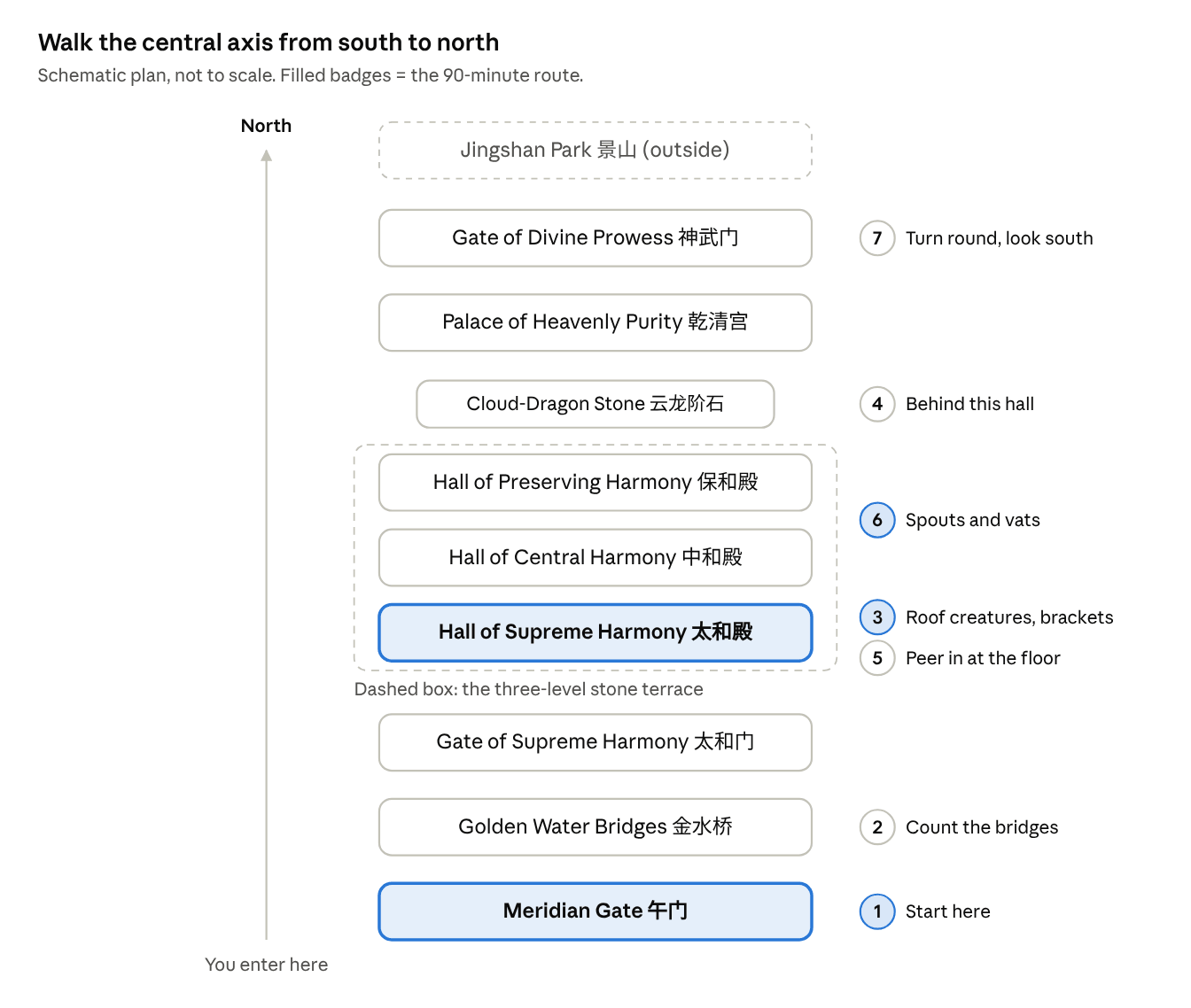
Students walk from south to north, straight up the middle of the palace. At each station they Look for one thing, Know a few facts, Think about how it connects to what they learned at school, Do a task, and see how the same idea lives on in Then & Now. Tasks come in three levels: Explore (everyone), Extend (if there is time) and Challenge (for the curious). Short on time? The three stations marked ★ take about 90 minutes.
Before You Go
What students already know
Ancient China and the Mandate of Heaven (Year 7 History). An emperor ruled because Heaven allowed it. In the palace, students look for the ways it puts one person at the centre.
The Mongol Empire (Year 8 History, where taught). Kublai Khan's capital stood here before this palace. Palace Museum researchers have found that the Ming palace was built almost the same size as the Yuan palace, shifted a little to the east. Under one gate, archaeologists found Yuan, Ming and Qing layers stacked on top of each other.
Earthquakes (Year 8 Geography). The halls are made mostly of wood. Students keep one question in mind all day: how has a wooden palace stayed standing for six centuries?
Forbidden City is the old name. Today it is the Palace Museum (故宫), and it is open to the public. Most halls and gates have a name board in Chinese characters above the doorway, so the guide gives every place its Chinese name too, such as 太和殿 for the Hall of Supreme Harmony.
On the Day
Practical notes from our visits
Book ahead. The Palace Museum only admits visitors who have booked through its official channel, and checks the ID used to book. Students bring the passport they were booked with.
Small groups. The palace is large and crowded, and big groups get separated. We split groups into teams of no more than 10 students, each with one adult.
Audio guide. Multilingual audio guides can be hired at the Meridian Gate (午门) entrance and handed back at the Gate of Divine Prowess (神武门), the north exit.
Toilets are on both the east and west sides of the main route.
Souvenirs. The shop about halfway along the route is the one we recommend for quality and design.
Treasure Gallery (珍宝馆). A separate ¥10 ticket. We don't recommend it for students under 14 who haven't studied the Qing dynasty: without that background, the objects are hard to make sense of.
South of the palace: Tiananmen 天安门
Groups reach the Meridian Gate from the south, through Tiananmen, the Gate of Heavenly Peace. On 1 October 1949, Mao Zedong proclaimed the founding of the People's Republic of China from this gate, and the square in front of it is still where China holds its biggest state events, much as Red Square does in Moscow. Two museums nearby are worth the time: the National Museum of China (中国国家博物馆) on the east side of the square, and the Military Museum (中国人民革命军事博物馆) further west along Chang'an Avenue.
The Big Picture
Fourteen years from decision to completion
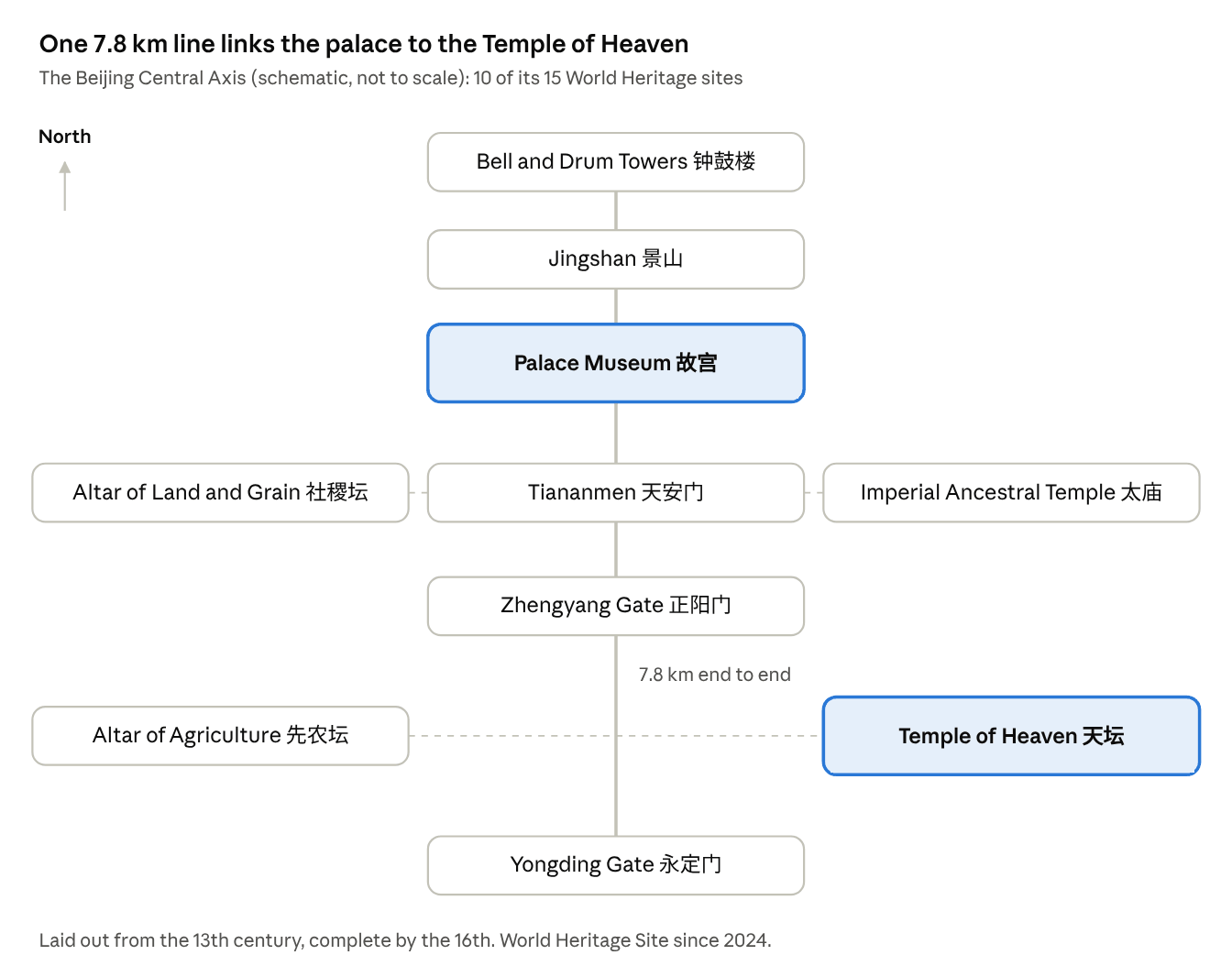
Emperor Yongle decided to build a palace in Beijing in 1406, large-scale building began in 1417, the palace was completed at the end of 1420, and the capital moved here in 1421. In 2024 the palace became part of a larger World Heritage Site, the Beijing Central Axis (北京中轴线), a 7.8 km line of 15 historic sites.
The palace in numbers
Size
961 m from south to north, 753 m from east to west
Walls
A wall 10 m high, with a moat 52 m wide around it
Area
About 720,000 m² inside the walls (the museum also gives 1.12 million m², which counts the larger area it looks after)
Gates
Four, one in each wall: Meridian Gate 午门 (south), Gate of Divine Prowess 神武门 (north), Donghua Gate 东华门 (east), Xihua Gate 西华门 (west)
Collection
More than 1.86 million objects
The route: seven stations along the central axis, south to north · Diagram: PreeChina
Seven Stations
What students look for, and what they learn
★Station 1 Meridian Gate午门
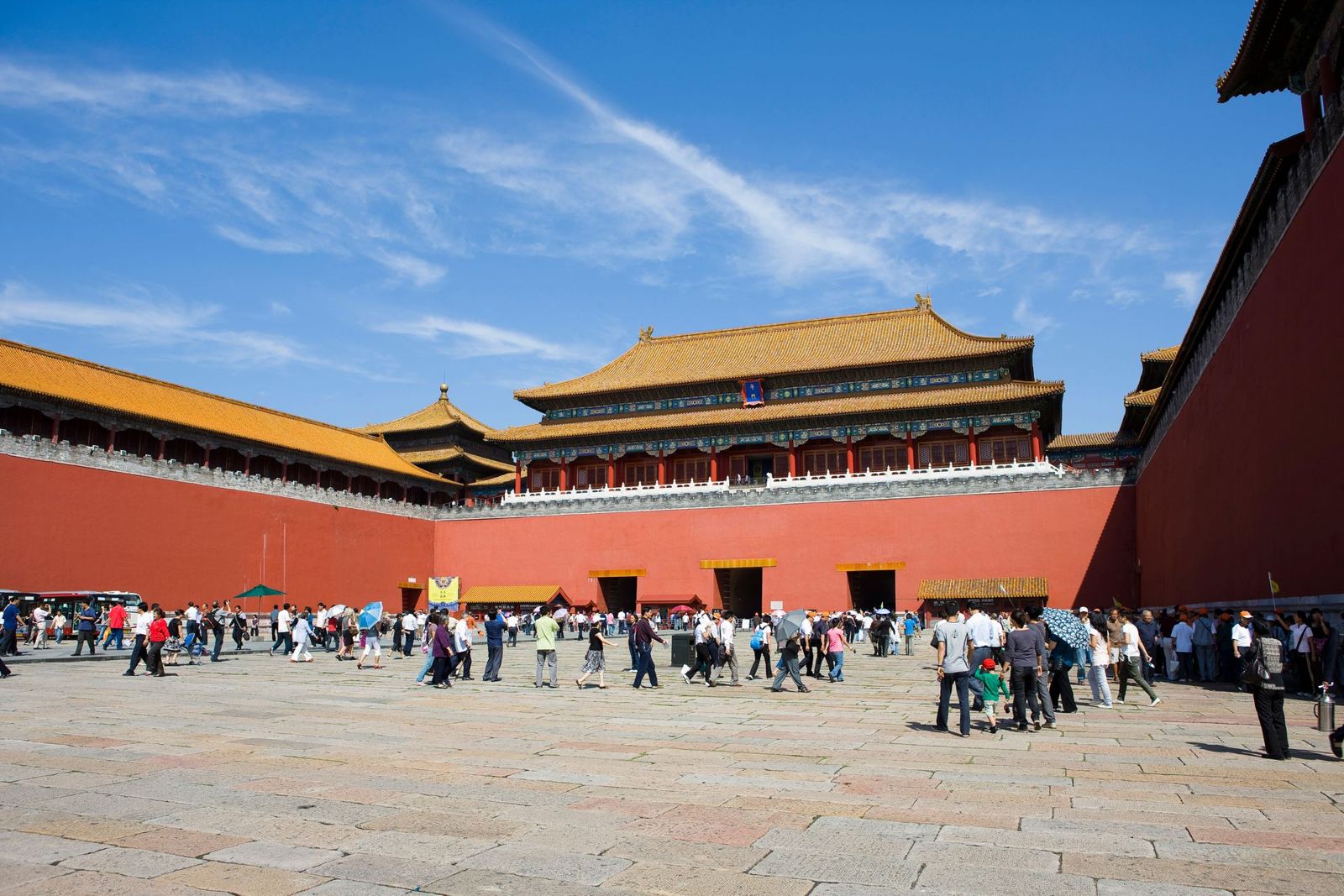
Look. Stand back before going through. Two long wings reach forward from the gate, one on each side, so visitors stand in a space walled in on three sides.
The Meridian Gate and its two wings · Photo: licensed stock image
Know. This is the south gate and the main entrance of the palace, one of only four ways in through a wall 10 m high.
The Think, Do and Then & Now tasks for this station are in the full guide.
Station 2 Golden Water Bridges金水桥
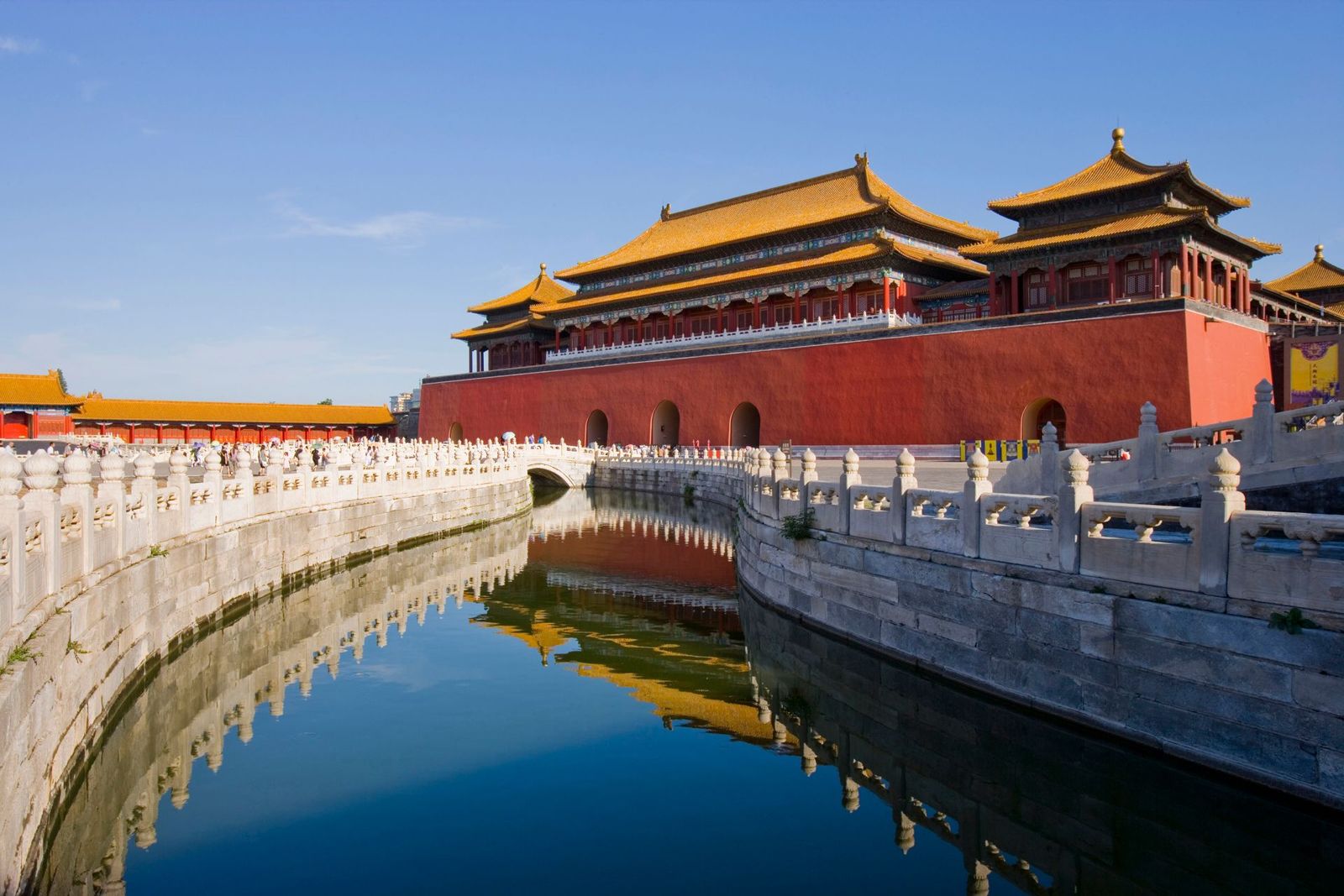
Look. A curving stream crosses the path, with several stone bridges side by side. Is one wider or more decorated than the others?
The Golden Water stream · Photo: licensed stock image
Know. The middle bridge sits exactly on the central axis. The palace is built to be symmetrical on either side of that line.
The Think, Do and Then & Now tasks for this station are in the full guide.
Full station, as in the guide
★Station 3 Hall of Supreme Harmony太和殿
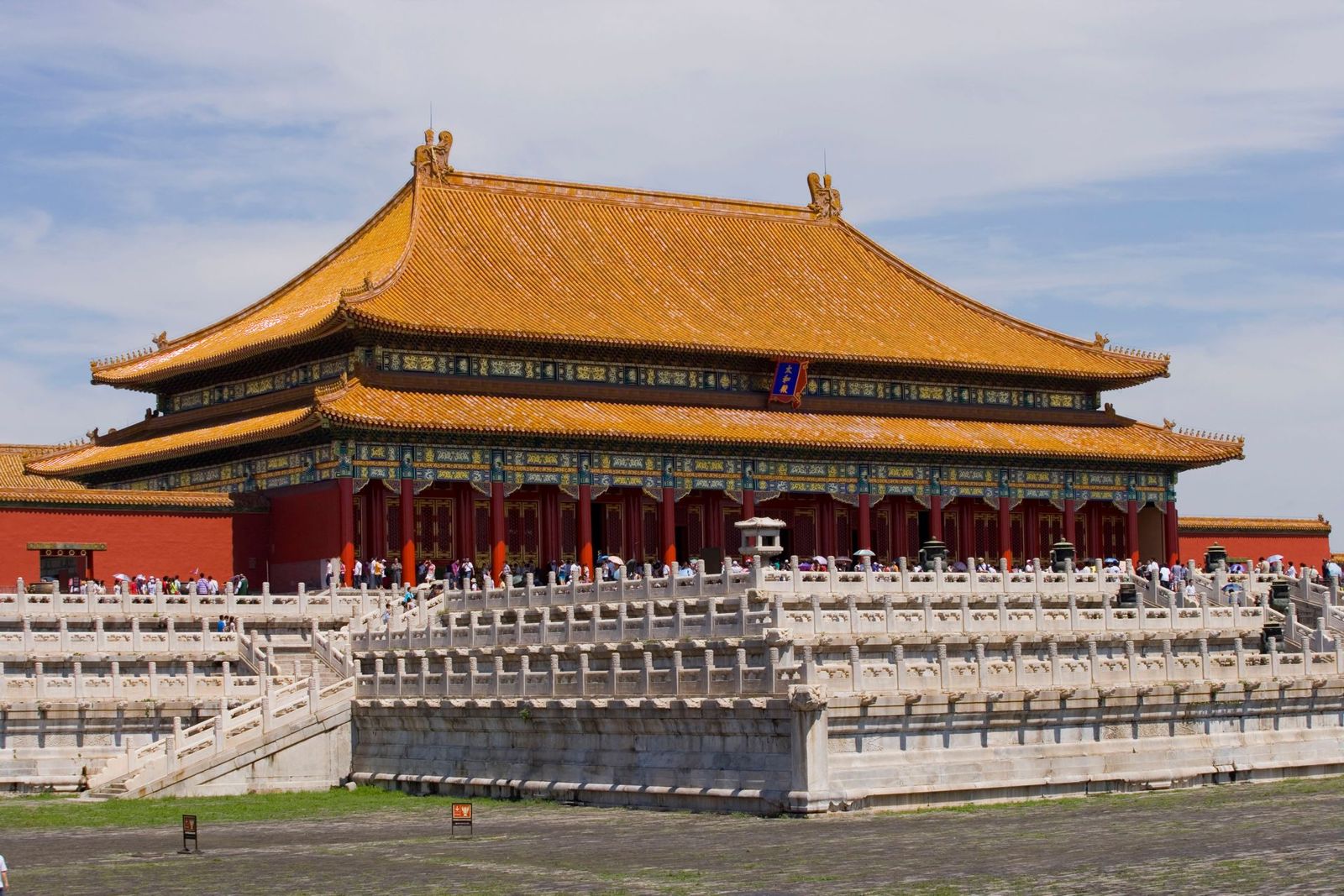
Look. Find a corner of the roof. Along the ridge sits a row of small creatures. Just under the edge of the roof is a thick band of wooden blocks stacked like fingers: the dougong, or bracket sets.
The Hall of Supreme Harmony · Photo: licensed stock image
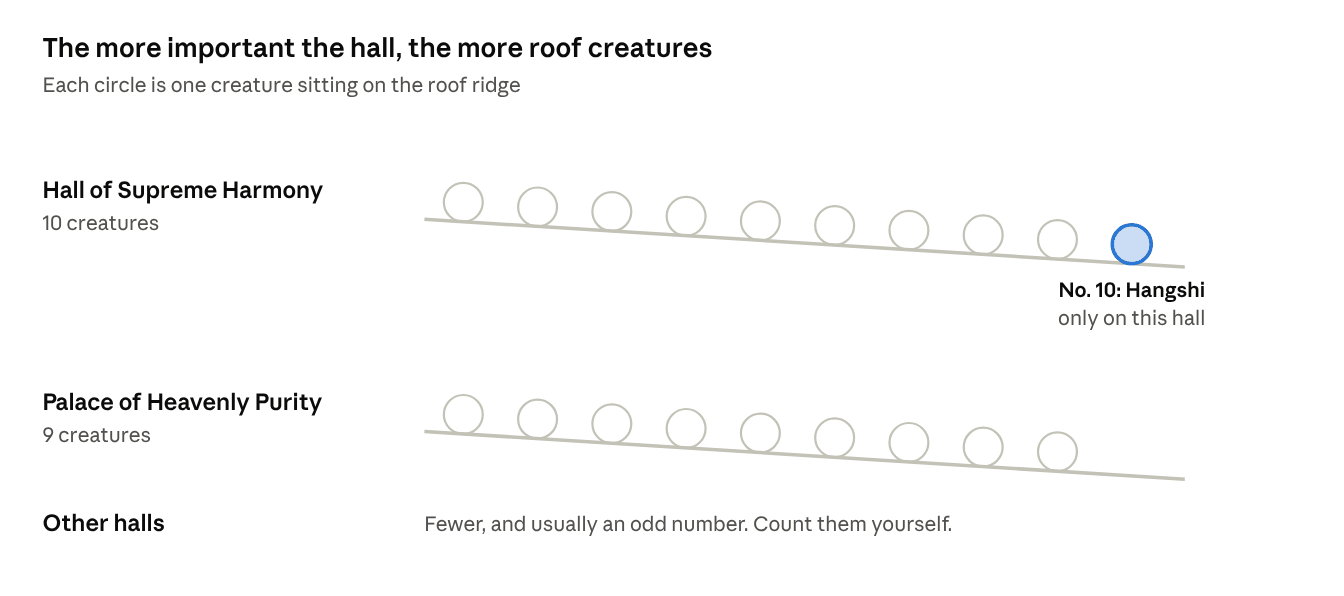
Know. This hall has ten roof creatures. The last, called Hangshi ("number ten"), appears only here. Other buildings in the palace have nine at most (the Palace of Heavenly Purity, 乾清宫, has nine). The more important the building, the more creatures.
Roof creatures: 10 on the Hall of Supreme Harmony, 9 on the Palace of Heavenly Purity · Diagram: PreeChina
Think. The brackets hold up the deep eaves, and the Palace Museum says they also help absorb shaking. Would a building that can flex a little survive an earthquake better than a stiff one? (Year 8 Geography: responding to geomorphic hazards.)
Do.
Explore: Count the roof creatures. Do you get ten?
Extend: Count them again on another hall later today. Rank the halls by importance using only your counts.
Challenge: Draw one bracket set as accurately as you can. Label where the weight comes in and where it goes out.
Then & Now. Find out at home: do engineers in earthquake zones today design buildings to be completely stiff, or to move a little? Compare with what you saw here.
Station 4 Cloud-Dragon Stone云龙阶石
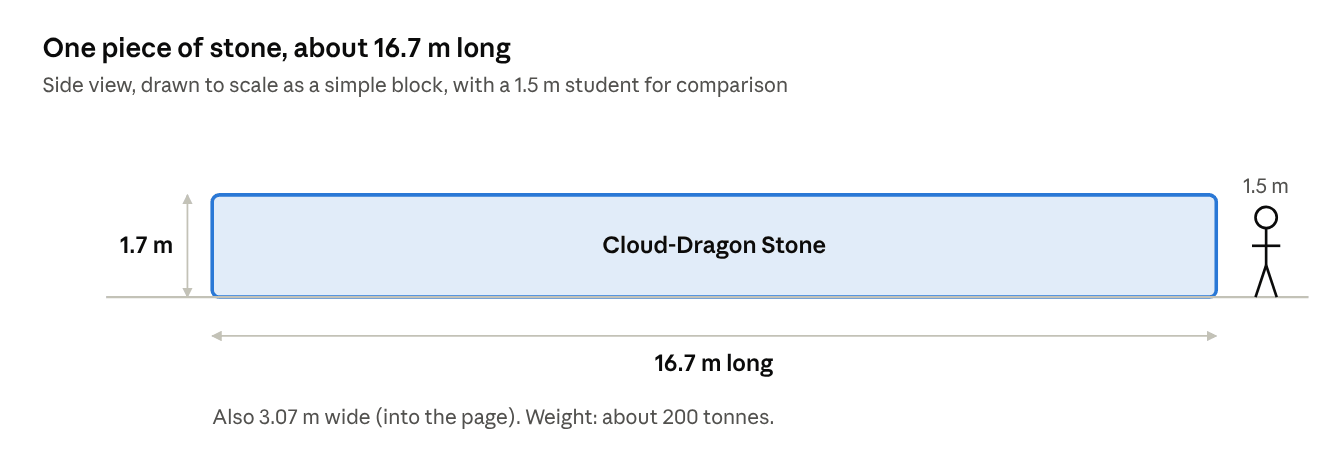
Look. Behind the Hall of Preserving Harmony (保和殿), in the middle of the staircase, lies one enormous carved slab with nine dragons twisting through clouds.
The Cloud-Dragon Stone to scale · Diagram: PreeChina
Know. It is a single piece of stone, about 16.7 m long, 3.07 m wide and 1.7 m thick, weighing about 200 tonnes. It was first carved in the Ming dynasty and re-carved under the Qing emperor Qianlong. The sign beside it gives 16.57 m, and old records suggest the original stone was about 17.1 m.
The Think, Do and Then & Now tasks for this station are in the full guide.
Station 5 Golden Bricks金砖
Look. Through the doors of a great hall, look down at the floor: large, smooth, dark square bricks.
Know. These are golden bricks, fired for the palace in an imperial kiln village near Suzhou (苏州), more than 1,000 km to the south. They are so dense that they ring when tapped. Preparing the clay alone took about eight months: digging, drying, pounding, grinding and sieving, settling the clay in three ponds of water, and treading it by foot.
The Think, Do and Then & Now tasks for this station are in the full guide.
★Station 6 Water and Fire
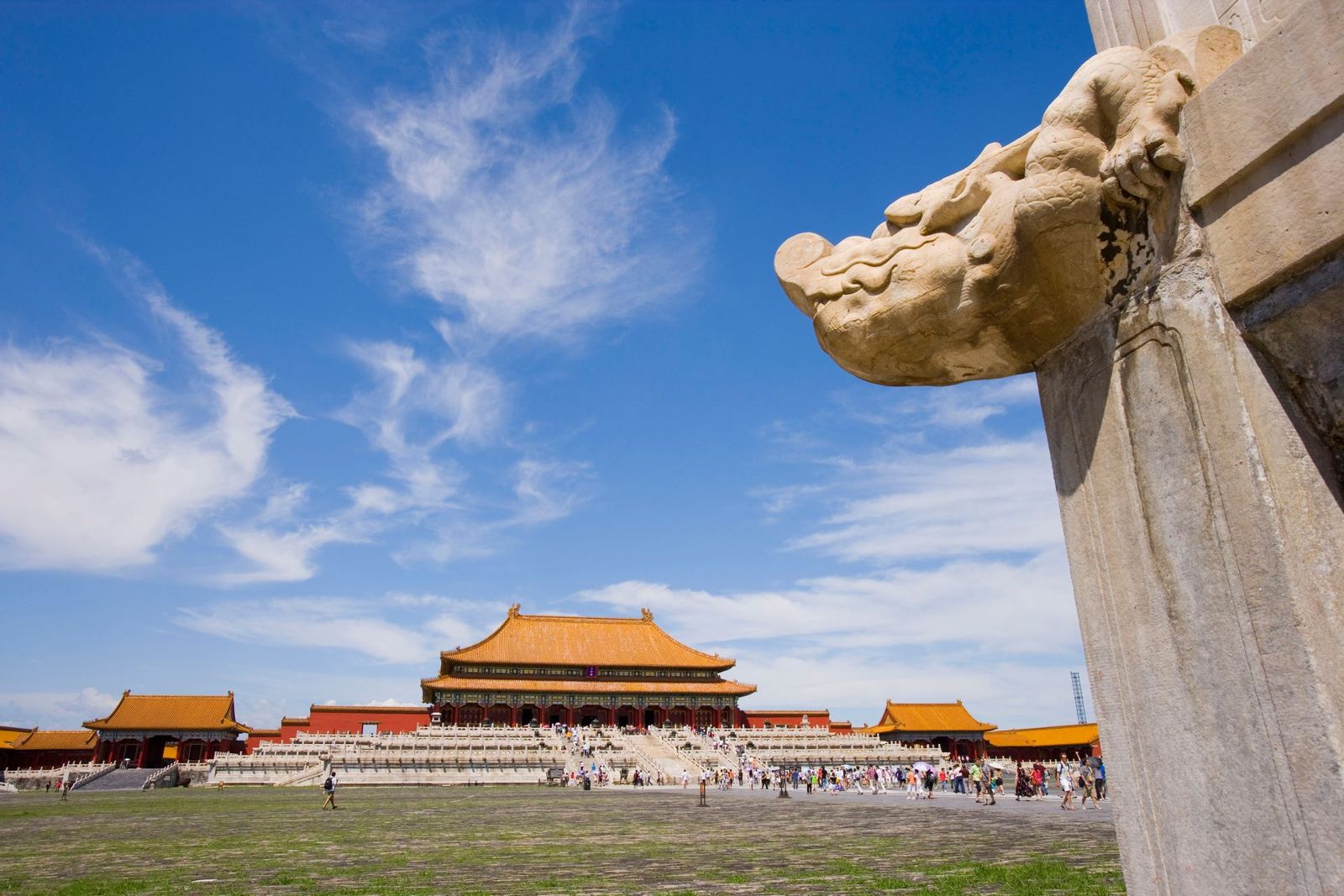
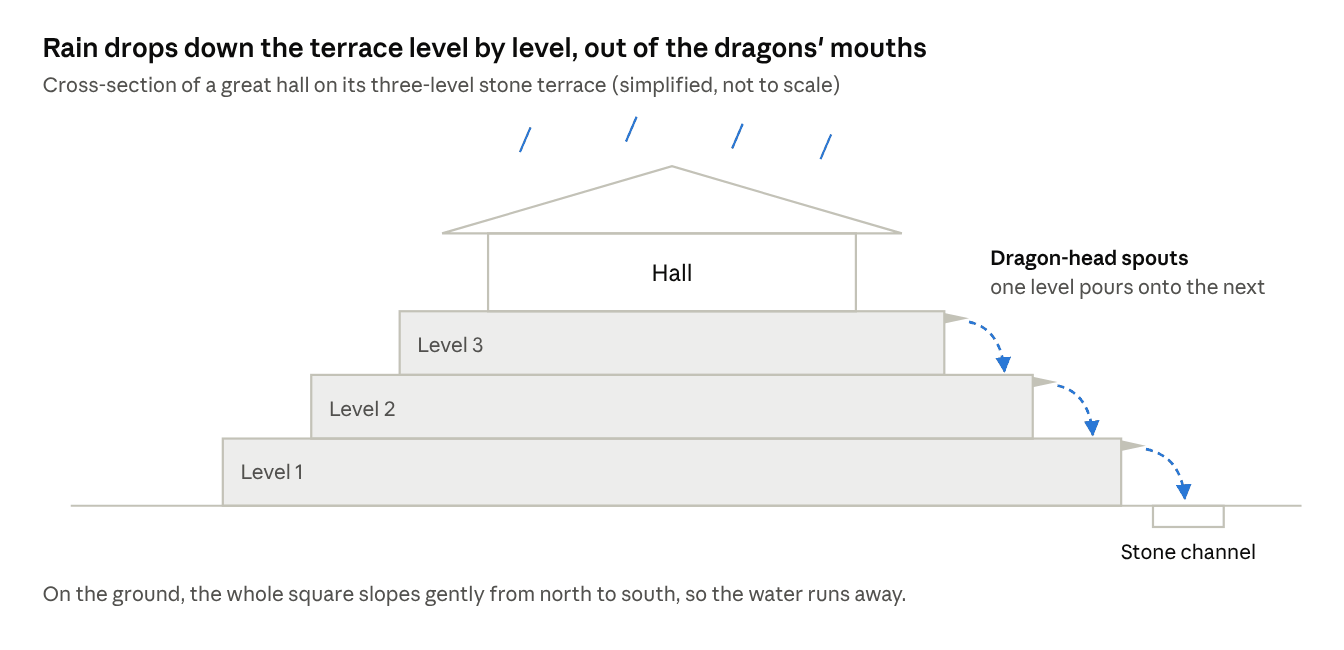
Look. Along every level of the white stone terrace, find the carved dragon heads poking out from the edge. Then look around the courtyards for huge metal vats.
A dragon-head spout on the terrace · Photo: licensed stock imageHow rain leaves the terrace · Diagram: PreeChina
Know. When it rains, water drains off each level and pours out of the dragons' mouths, level by level, then runs into stone channels; the whole square slopes gently from north to south. Wooden halls burn easily, so the vats, made of bronze and iron and mostly from the Qing dynasty, were kept full of water for fighting fires.
The Think, Do and Then & Now tasks for this station are in the full guide.
Station 7 Gate of Divine Prowess神武门
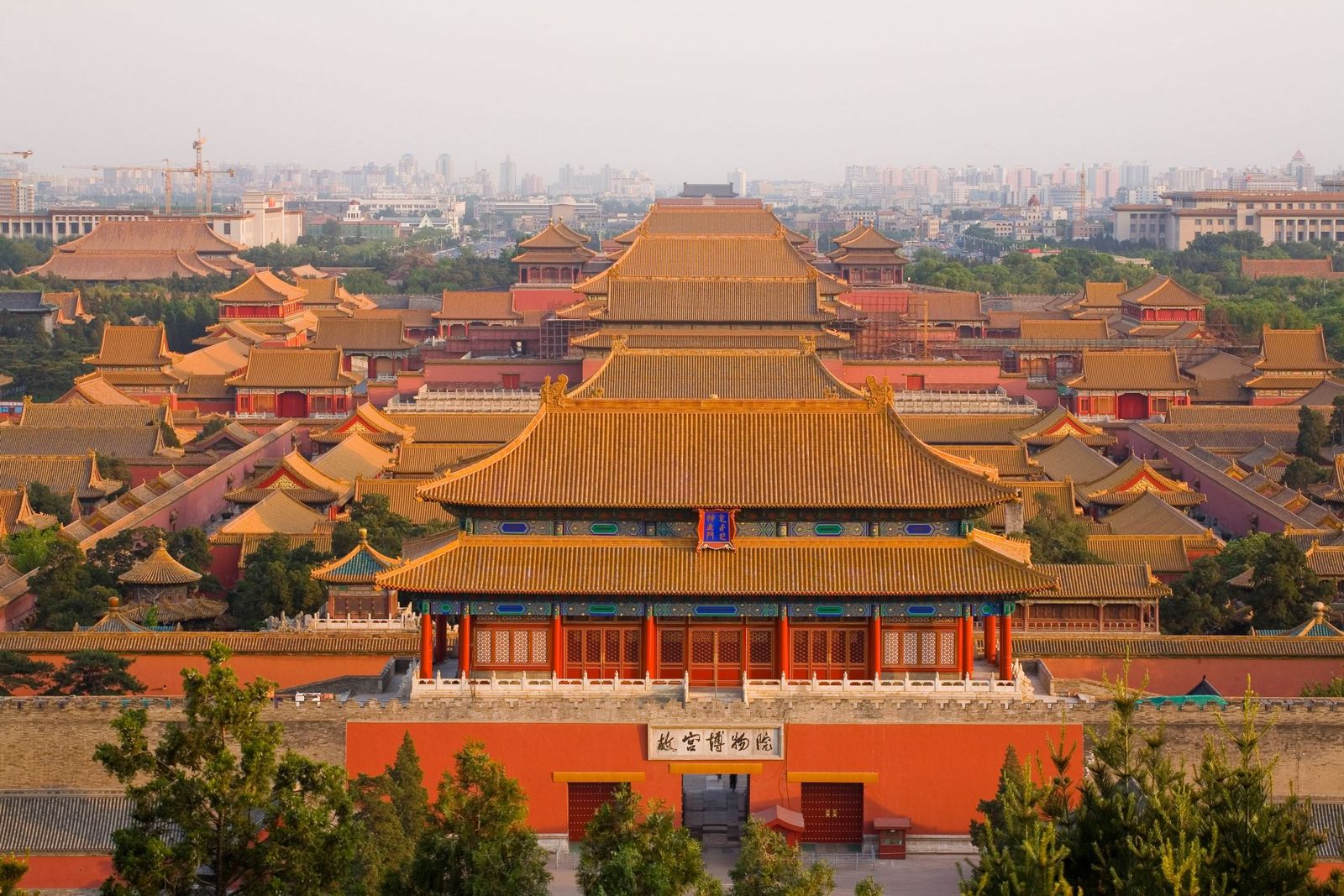
Look. Before leaving through the north gate, turn around and look back south along the central axis. Across the road, the hill in Jingshan Park (景山公园) looks south over all the palace roofs.
The palace from Jingshan · Photo: licensed stock imageThe Beijing Central Axis, 7.8 km · Diagram: PreeChina
Know. The axis runs on beyond the palace: north through Jingshan to the Bell and Drum Towers (钟鼓楼), south to Yongding Gate (永定门). The Temple of Heaven (天坛) is one of its 15 World Heritage sites.
The Think, Do and Then & Now tasks for this station are in the full guide.
After the palace: Jingshan and Beihai
Walking the whole palace is tiring, so we rest at the Gate of Divine Prowess before crossing into Jingshan Park. The hill is not high, and from the top the whole palace lies to the south. Jingshan has a small entry fee; foreign students may need to show proof that they are students for the student price. With energy left, Beihai Park (北海公园) is just to the west. Between 7 and 9 am and again between 5 and 7 pm, many Beijing residents come here to exercise and relax.
Big Talk
Why do rulers build huge palaces?
A palace is where a ruler lives, and it also tells visitors who holds power. The guide compares four buildings.
Beijing: the Forbidden City
France: Versailles
Britain: Buckingham Palace
Australia: Parliament House
When
Completed 1420; capital moved here 1421
Became the seat of government on 6 May 1682
Queen Victoria moved in in 1837, the first monarch to live there officially
Building began 1980; opened 1988
Who it was for
The emperor, his family and court
King Louis XIV and his court
The British monarch
The Australian Parliament and the public
What it said about power
Every gate and hall brings you closer to one person at the centre
Nobles were expected to be at court, close to the king
The monarch's home in the capital
The roof is covered in grass, and visitors can walk on it
Students then discuss which building their own photo from the courtyard is most like, how they would design a parliament to show that power belongs to everyone (Parliament House was chosen from 329 entries), and whether comfort or authority mattered more to the people who built the Forbidden City.
For Teachers
Curriculum links
Year levels follow the Western Australian Curriculum from the School Curriculum and Standards Authority (SCSA). Teachers using another curriculum can map the same stations to their own course; check the content descriptions against the current documents.
Station
Year · Learning area
Content it supports
Before you go, 1, 2
Year 7 HASS · History
Depth study of an ancient society (China option): roles of key groups; law and religion; beliefs and values
Before you go, 5
Year 7 HASS · History
Investigating the ancient past: why conserving the remains of the past matters
Before you go
Year 8 HASS · History
Depth study options include the Mongol expansion (c.1206–c.1368), where taught
3
Year 8 HASS · Geography
Geomorphic hazards such as earthquakes, and how people prepare for and respond to them
6
Year 7 HASS · Geography
Water in the world: managing water, including stormwater
Big Talk
Year 7 HASS · Civics and Citizenship
The separation of powers and the roles of the Houses of Parliament
4, 5
Mathematics
Volume, measurement and estimation
Glossary
Names to match on the signs
Chinese
Pinyin
English
故宫
Gùgōng
Palace Museum
紫禁城
Zǐjìnchéng
Forbidden City
中轴线
zhōngzhóuxiàn
central axis
午门
Wǔmén
Meridian Gate
金水桥
Jīnshuǐ Qiáo
Golden Water Bridges
太和殿
Tàihé Diàn
Hall of Supreme Harmony
保和殿
Bǎohé Diàn
Hall of Preserving Harmony
行什
Hángshí
"Number ten", the last roof creature
斗拱
dǒugǒng
bracket set under the roof
云龙阶石
yúnlóng jiēshí
Cloud-Dragon Stone
金砖
jīnzhuān
golden brick
神武门
Shénwǔmén
Gate of Divine Prowess
景山
Jǐngshān
Jingshan (Prospect Hill)
Full Guide
For teachers and trip leaders
Get the full Forbidden City field guide
The full guide is a printable PDF for teachers, school trip leaders and travel companies. It adds what this preview leaves out:
the Think, Do and Then & Now tasks for every station, at three levels (Explore, Extend, Challenge)
the Test it yourself sheet and the Back to the big question worksheet
teacher pages: answers, notes for the day, and the points still being checked
Use the request form and tell us your name, your school or company, and the guide you want. PreeChina sends the PDF by email for use with your own classes.