Zhejiang · A Lake From 1959, With Two Towns Underneath
Qiandao Lake (千岛湖)
A reservoir in western Zhejiang, filled in 1959 behind a hydroelectric dam. The islands are the tops of drowned hills, and two walled county towns are still standing on the bottom.
Quick Facts
The Short Version
What it is
A large reservoir with a great many wooded islands, in hill country west of Hangzhou
Where
Chun'an County, under Hangzhou, in Zhejiang
When
The Xin'anjiang dam closed and the valley filled in 1959
The islands
Published figures give around a thousand above water at normal level. Each one is a hilltop
What went under
Farmland, villages, and two county towns, Hechengz and Shicheng. Published figures put the people resettled in the hundreds of thousands
The towns now
Divers have surveyed them since 2001 and found gates, arches and timberwork substantially intact. They are not open to visitors
The water
Clear and cold, supplying drinking water to Hangzhou and bottled commercially
Time needed
A full day for a boat circuit. Two if visitors want to cycle or stay on an island
Why Go
Everything Here Used To Be a Hill
1. A landscape with a construction date
Nothing about this view is old. In 1958 this was a river valley in the hills with towns, temples, farmland and roads in it. The Xin'anjiang dam, one of the opening large hydroelectric projects China designed and built for itself, closed in 1959, and the water rose until just the hilltops were left. Those hilltops are what a boat now threads between.
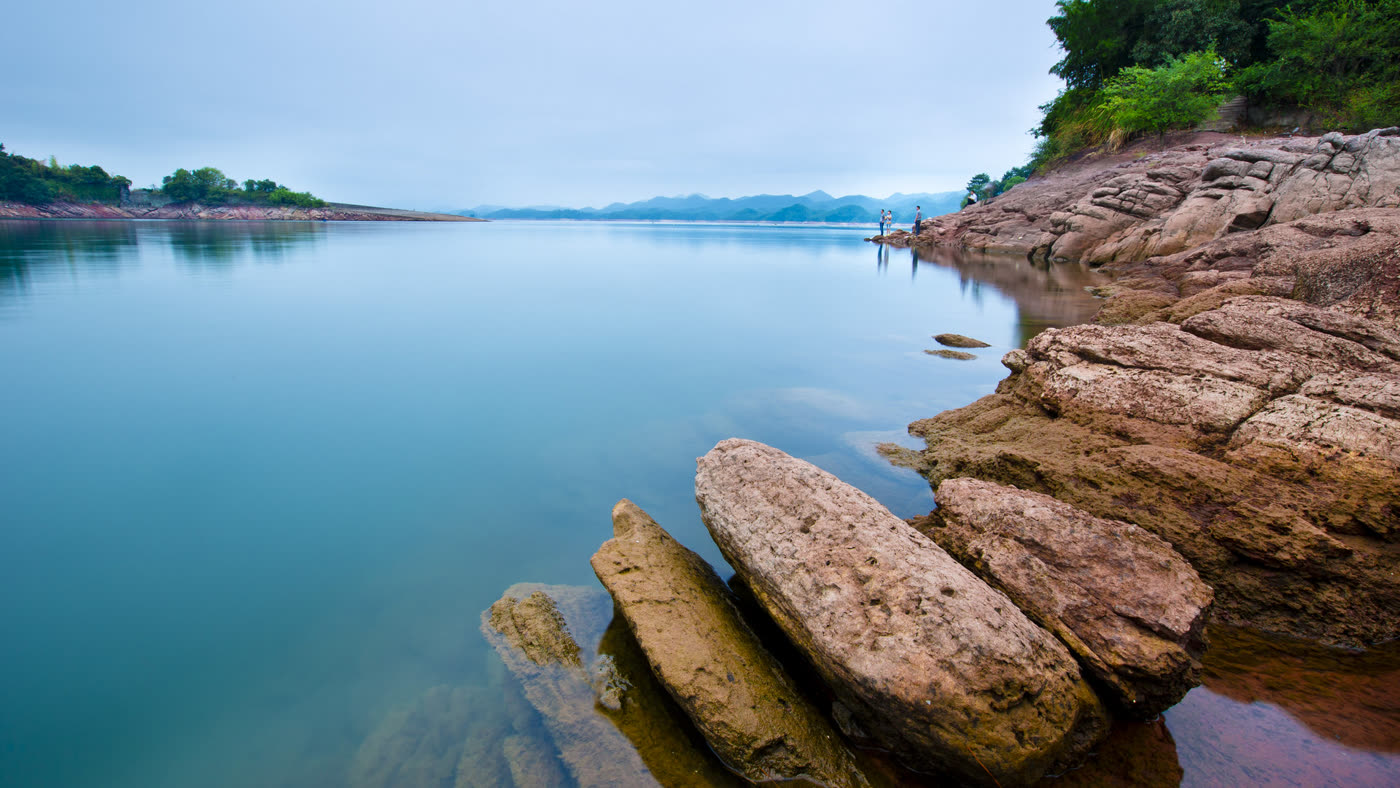
Visitors can read the mechanism off the shoreline. The islands are all roughly the same height because they are the top slice of a former hill country, and their edges carry a pale band of bare rock where the water level rises and falls. In one of the pictures below that band is several metres wide. It is a working reservoir, and the level is a decision somebody makes.
2. Two towns are still down there
Hechengz and Shicheng were county seats with walls, gate towers, memorial arches and streets of timber houses, some of the fabric Ming and Qing. They were evacuated and flooded. For forty years they were simply gone, and then in 2001 divers went down and found them: walls standing, carved stone lintels in place, painted timber beams still articulated. The water is cold, still and dark, which is close to ideal for preservation.
The honest part comes next. Visitors cannot go and see them. They lie deep enough to need technical diving, access is controlled, and the handful of permitted descents are not tourism. What exists on shore is a museum and a reconstruction. The towns are a fact about this lake rather than something to put on an itinerary, and knowing they are underneath visitors changes the boat ride more than any island attraction does.
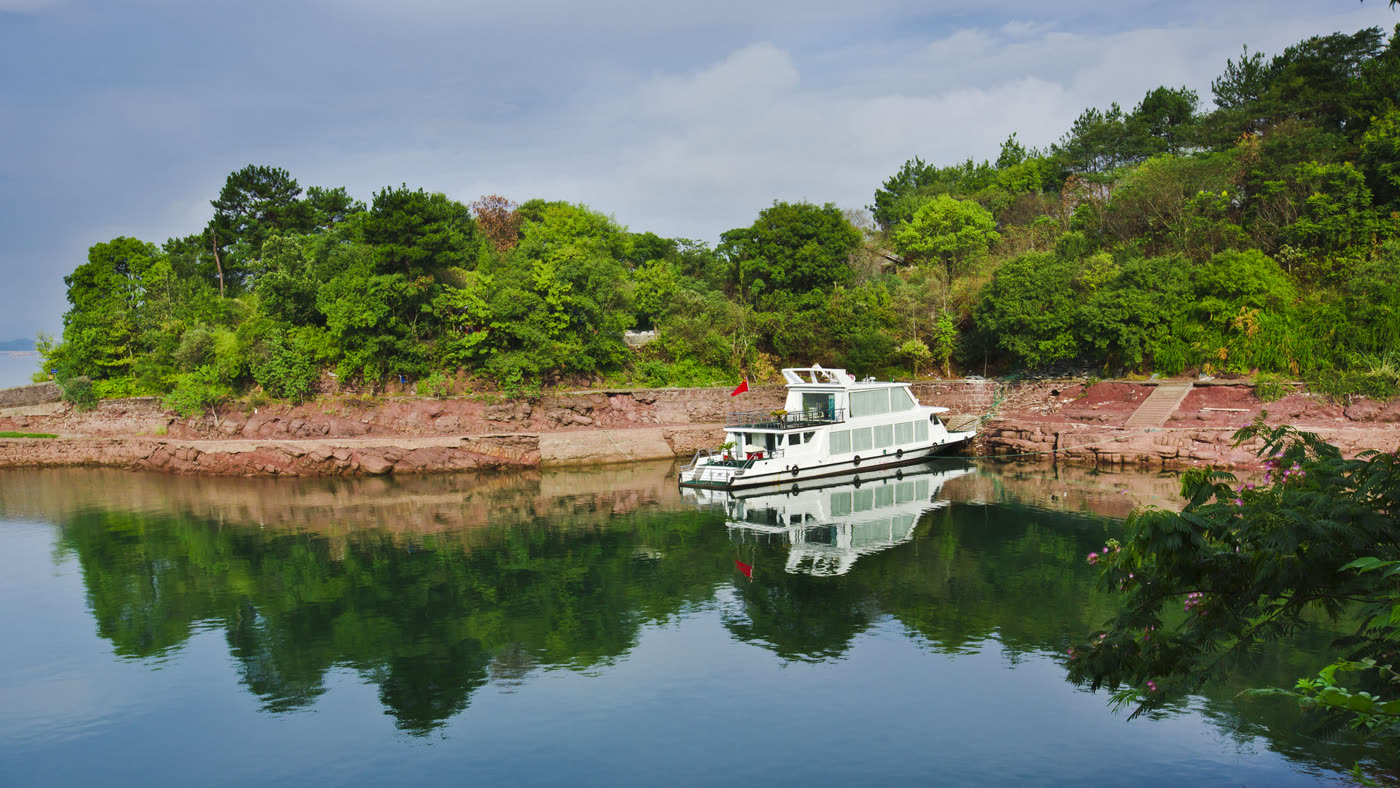
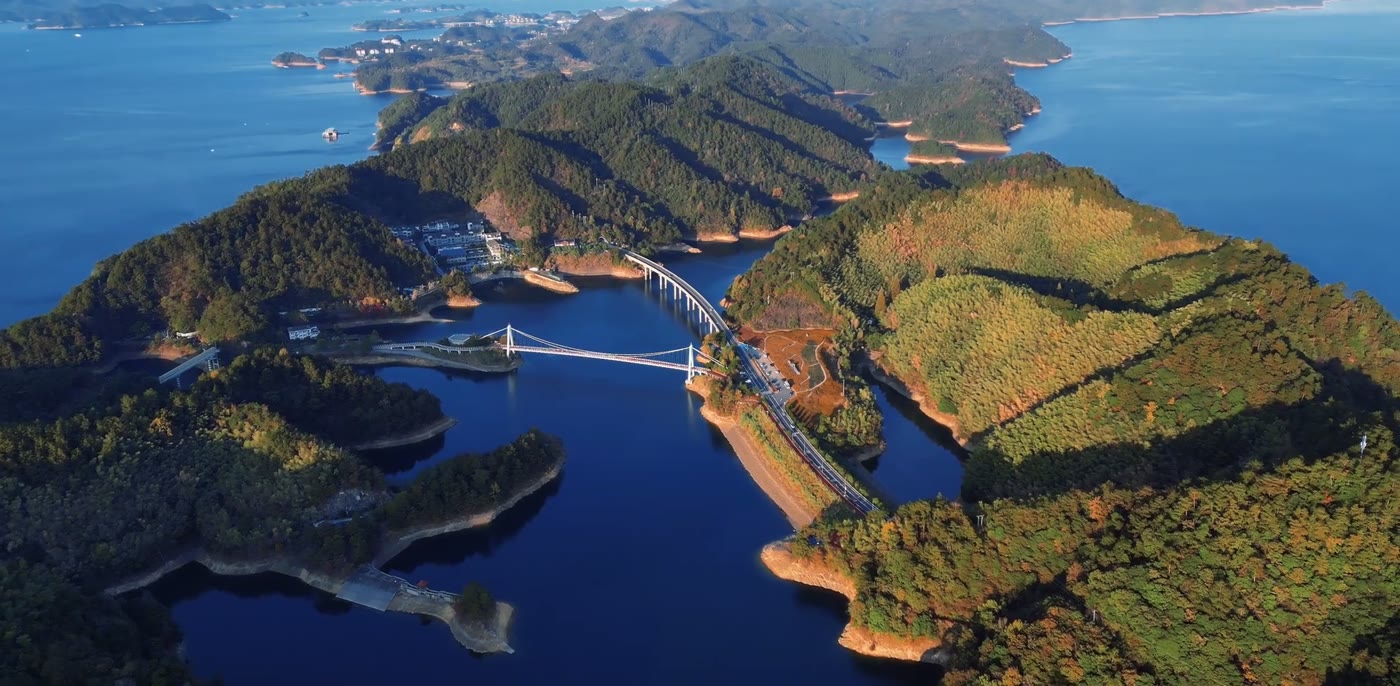
The band of bare rock under the trees is the drawdown zone. It is a particularly honest thing in any picture of this lake.Shoreline level. The rock is exposed because the water is lower than its maximum, and a different week would put all of this under.Some of the larger islands are worked and linked by road and bridge. They were hills with villages on them and a few of them still carry people.The developed shore. This is a domestic holiday lake at the start and a piece of engineering history second, and the ticketing reflects that.
The catch. This is a resort lake. The islands are packaged as themed stops, several of them weak, and the standard boat tours are long days that call at three or four of them with a commentary in Chinese. The shore around the town is hotels and holiday flats. The good version of this place is a bicycle, a smaller boat, or a night on an island, none of which is what the entry window sells at the start.
Orientation
Boats, Bicycles, and Which Pass
Qiandaohu town on the lake's eastern side is the base, reached by high-speed rail from Hangzhou in about an hour and from Shanghai in around two and a half. Ferries and tour boats leave from piers in and near the town.
The standard product is a day boat calling at named islands. The alternative is the lakeshore cycle route, which runs for tens of kilometres on good surface with the water beside it, and which many foreign visitors would enjoy more than the island stops. Bicycles are easy to hire in town.
Practical
Things Worth Knowing
Take the bicycle option seriously
The shore road is the ideal thing here and costs almost nothing. The themed islands are the weakest part of the visit.
Go on a weekday
Hangzhou and Shanghai both empty onto this lake at weekends and the boats and roads show it.
Look at the shoreline band
Once visitors have noticed the bare rock at the waterline they cannot stop seeing it, and it explains what kind of lake this is.
Do not plan around the sunken towns
There is a museum and a model. There is no way for an ordinary visitor to see the real thing, and operators who imply otherwise are selling something else.
Timing
When to Go
Season
The case for
The catch
April to May
Green hills, comfortable cycling and the water at its clearest
Jiangnan spring rain can settle in for a week
September to November
Dry, mild and the many pleasant conditions for a day on the water
The opening week of October is the national holiday
June to August
Swimming, long days and everything running
Hot and humid, and the peak of the domestic season
December to February
Quiet, cheap and clear, with mist on the water in the mornings
Cold on an open boat and some island services reduced
Context
What a Reservoir Costs
The dam was built for power and for flood control on a river that runs down to the Qiantang and out past Hangzhou. It did both, and it did them at a price that was paid by the people who lived in the valley. Published figures put the resettlement in the hundreds of thousands. Many were moved to other parts of Zhejiang and Jiangxi, and the experience of that generation is a large part of what this lake means locally.
Sixty years on, the reservoir has a second job. The water is clean enough that it now supplies drinking water to Hangzhou through a dedicated tunnel, and it is drawn commercially for bottling. That has made water quality a matter of policy: the catchment is regulated, aquaculture has been restricted, and the lake's economy has been pushed toward tourism and away from fish farming.
The submerged towns have become the other kind of value. They were a loss when they went under and are now a resource, studied by archaeologists and used in the lake's marketing. Both things can be true. It is worth holding on to the fact that the reason they survived so well is the same reason nobody can go and look at them.
Nearby
Other Stops on the Same Trip
Spot · 130 km east
West Lake (西湖)
Hangzhou's lake, which is the opposite kind of water: shallow, shaped by centuries of dredging and planting, and entirely urban.
Hangzhou is the gateway and an hour away by high-speed train, which makes this an easy extension rather than an expedition. Qiandaohu town at the lakeside has everything needed and is where visitors should sleep rather than commuting.
The natural shape is two or three days in Hangzhou for West Lake and the tea hills, then two here, then onward southwest into Jiangxi or south into Anhui. All of it is on fast rail.
Experiences
What Visitors Can Actually Do Here
On site · full day
The shore by bicycle
Tens of kilometres of lakeside road with the water beside visitors and almost no traffic. The underrated version of this lake.
Hire in Qiandaohu town.
On site · full day
The island boat circuit
The standard tour, calling at several islands. Worth it for the crossings between them rather than for the stops.
Several operators; routes differ.
Guided · 4 days
Hangzhou, the lake, and the Huizhou villages
West Lake, then this reservoir with its history explained properly, then over into Anhui for the villages that survived above water.
Sleep at the lake, hire a bicycle for a day and take one boat, and spend part of the crossing thinking about what is underneath. This is a beautiful piece of water and it is also a made object, with a date, a purpose, a cost paid by a few hundred thousand people, and two walled towns standing intact in the dark below the keel.
Travelling to China with 10 or more people? Talk to PreeChina first. A transparent service fee of USD 100 per person for trips of up to 10 days (USD 150 for 11 to 20 days), and no markup on travel components. See how the fee works.
Share the travel dates and our local team will put visitors in Qiandaohu town rather than on a coach from Hangzhou, sort the bicycles and one good boat, and pair it with the Huizhou villages if they want the architecture that did not go under.