Granite weathered into rounded masses and split by level seams, on the coast of northern Fujian. The gaps between the blocks are the passages people come to walk, and the slopes below produce Fuding white tea.
Quick Facts
The Short Version
What it is
A granite massif of upright rounded blocks stacked on one another, with passages and stairways threaded between them, above the coast of northern Fujian
Where
Fuding, under Ningde, about two hours north of Fuzhou by road
The rock
Granite, jointed both vertically and horizontally and weathered round. The caves are spaces left between blocks rather than dissolved or eroded chambers
Heritage status
A UNESCO Global Geopark
The other reason people come
Fuding white tea is grown on these slopes and in the surrounding county
Getting up
A cable car covers much of the climb; the passages between the boulders are walked
Weather
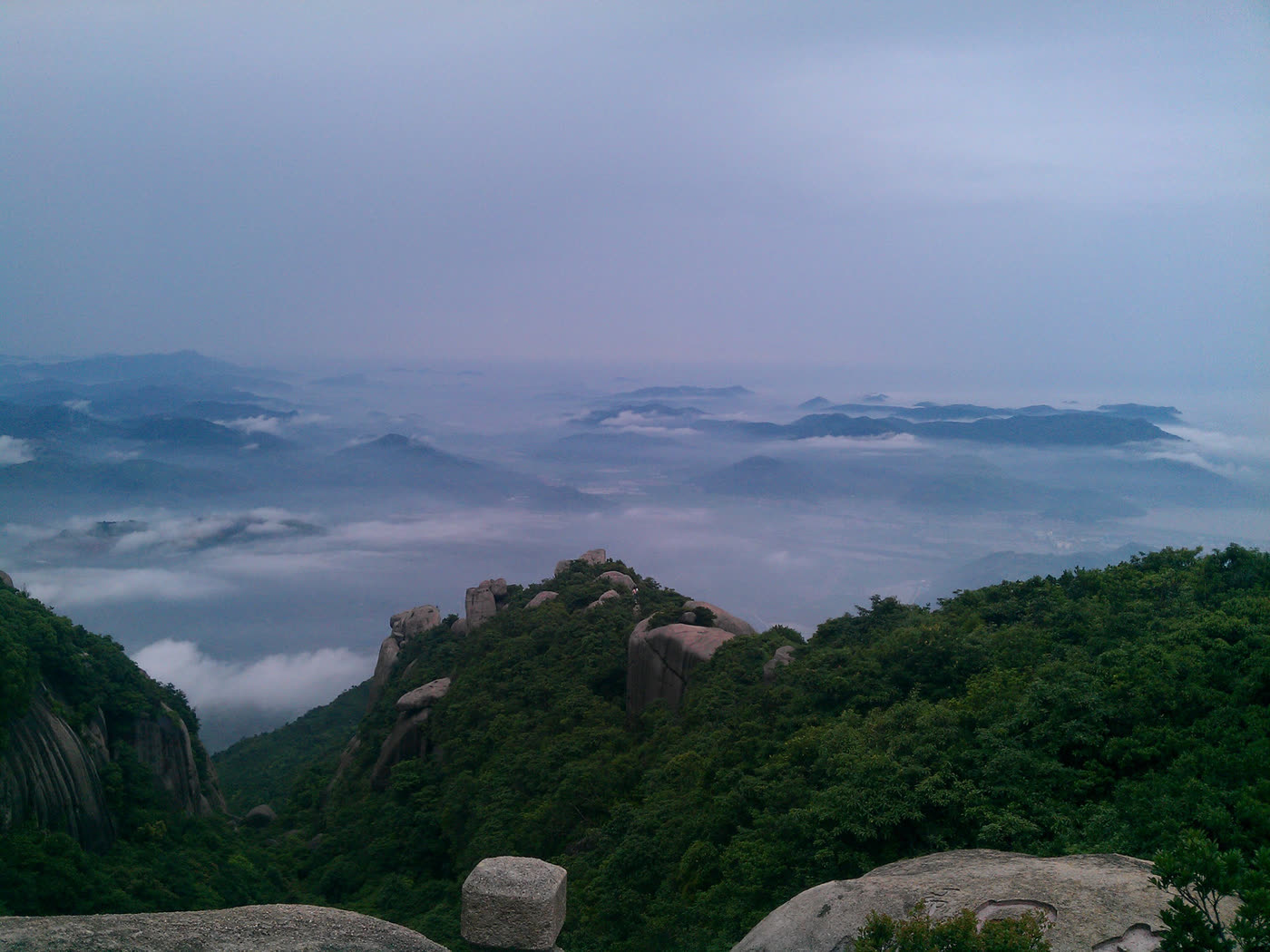
Coastal and often in cloud. Sunrise from the summit is the local set piece
Time needed
One full day on the mountain, two if visitors want the tea country as well
Why Go
The Same Rock, A Third Answer
1. Granite that stacked instead of standing
Granite is the rock under several of the mountains on this site, and it gives a different answer each time depending on how it is jointed and how it weathers. At Mount Hua it holds together as one enormous block and the result is a wall. At Mount Sanqing it is cut by vertical joints and splits into free-standing needles.
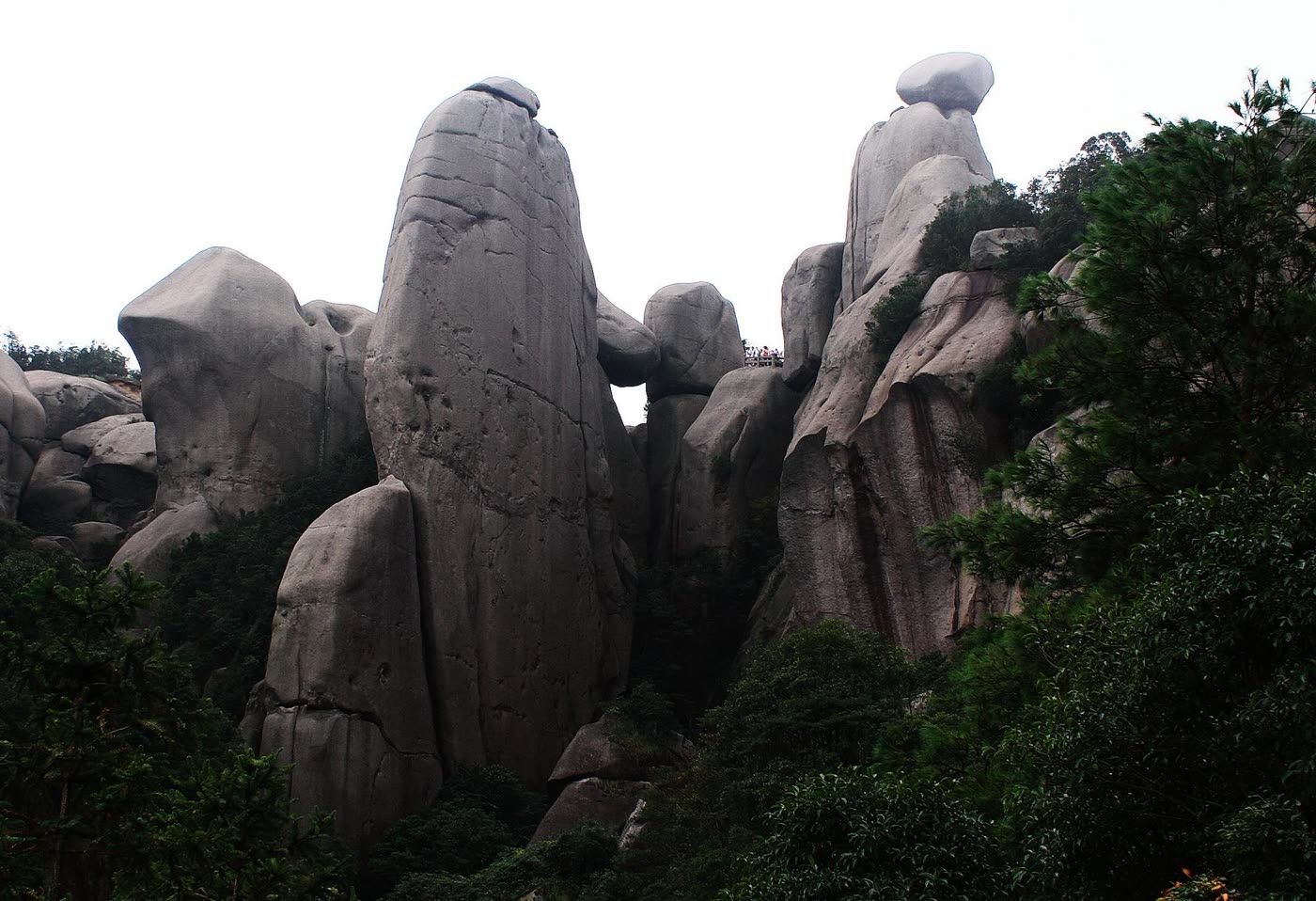
Here the rock is jointed in both directions at once. Vertical joints separate it into masses that stand upright side by side, and level joints cut those masses into blocks stacked one on the next, which weathering then rounds off at every edge. Several of the summits end in a detached cap sitting on a rounded shaft, and the seam between them is visible from a long way off.
The gaps this leaves are the point. The passages, slots and so-called caves on this mountain are not dissolved or eroded openings, they are the spaces where blocks failed to meet. Walking one means seeing the whole underside of the block resting overhead, which is a thing no limestone cave offers.
2. This is a tea mountain
Fuding white tea comes from here. It is one of the six Chinese tea categories, the least processed of them, and outside China it is the one especially likely to be recognised without being connected to a place. The place is this county, and the slopes below the granite are where much of it grows.
That makes a visit here work as two things at once: a morning on the rock and an afternoon in the tea country below, which is ordinary agricultural Fujian rather than a show. Anyone who has bought white tea abroad will find the gap between the price there and the price here instructive.
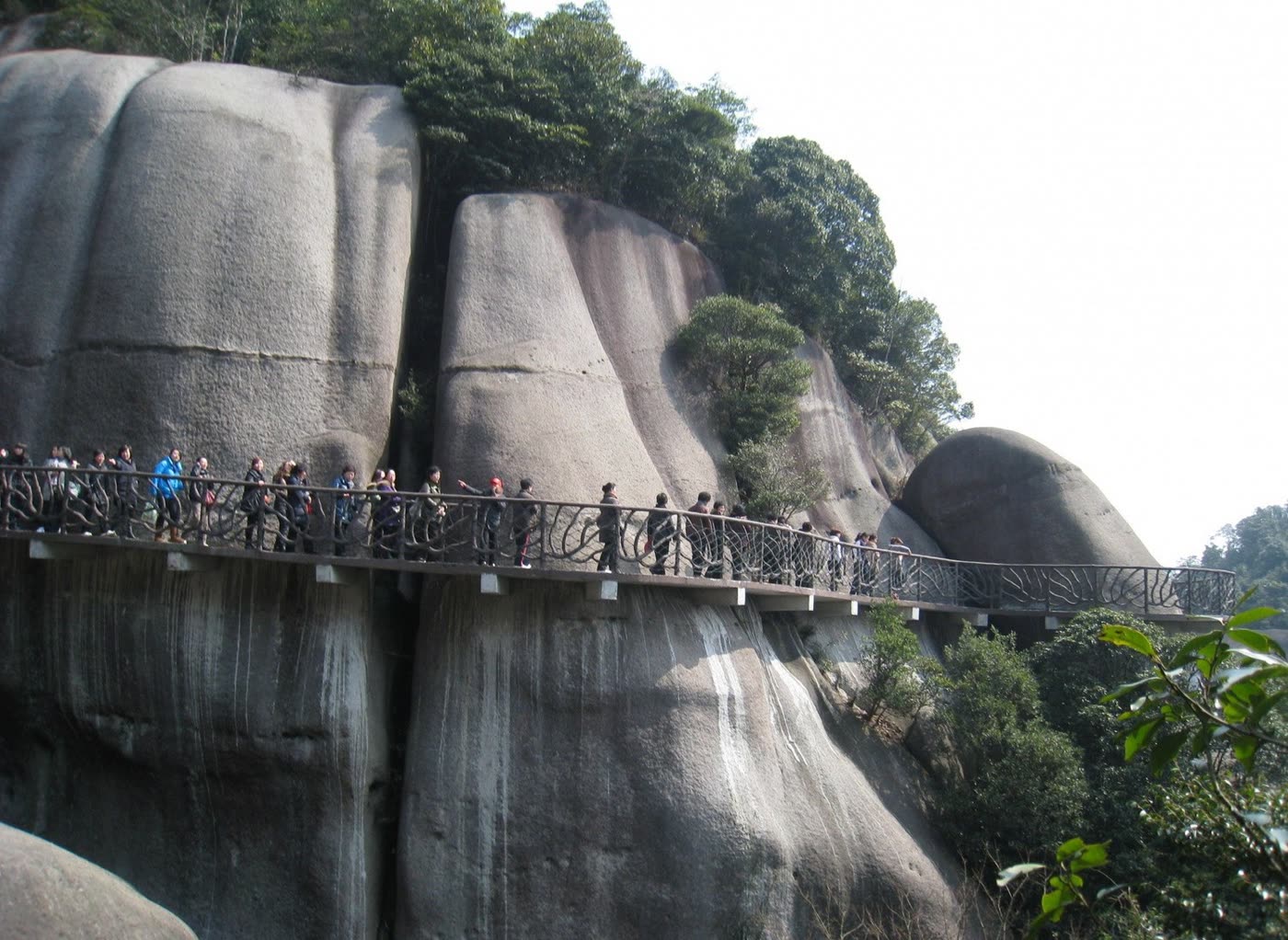
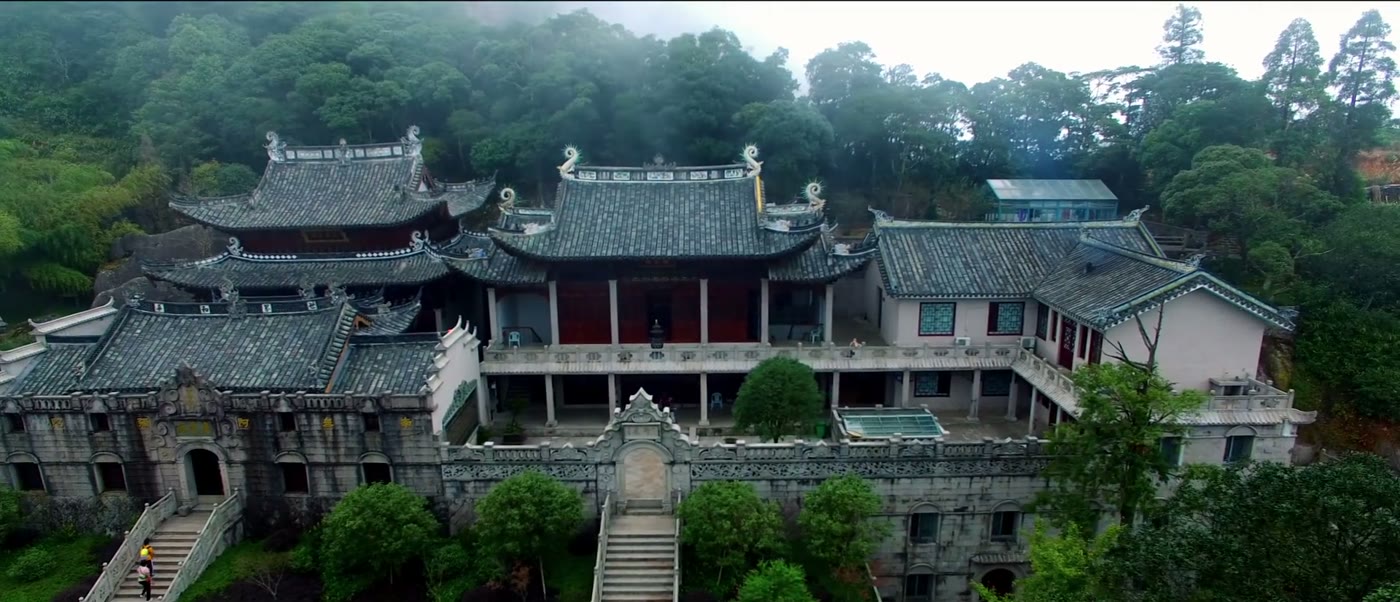
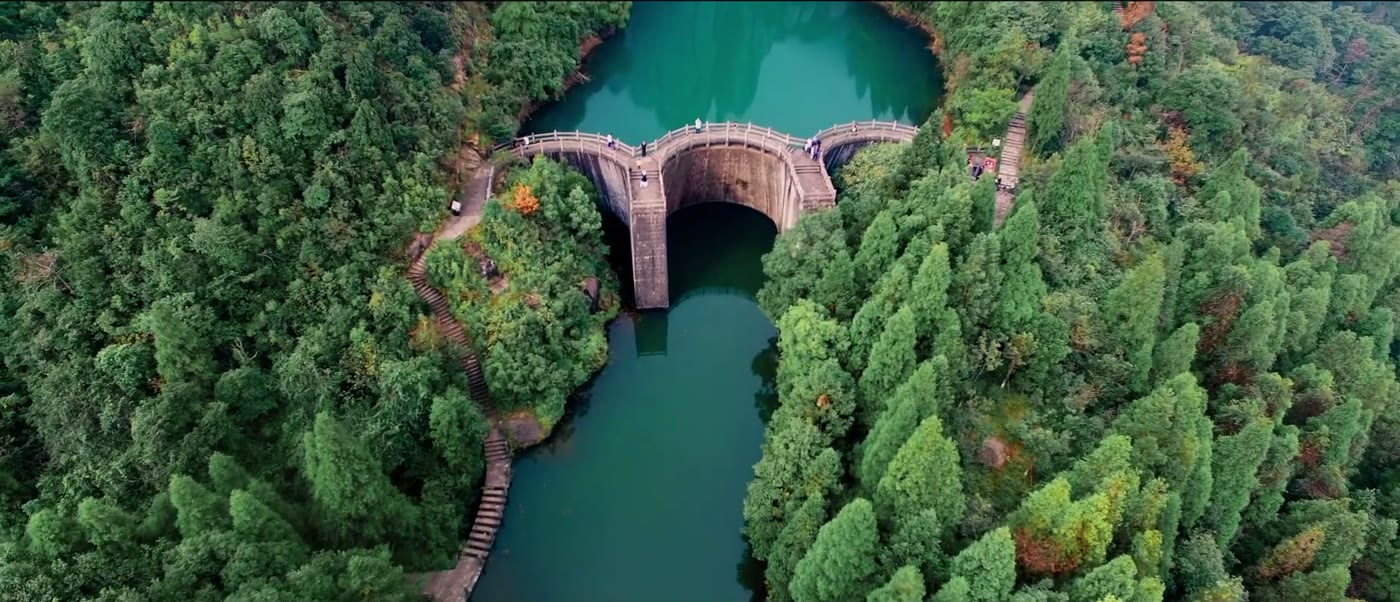
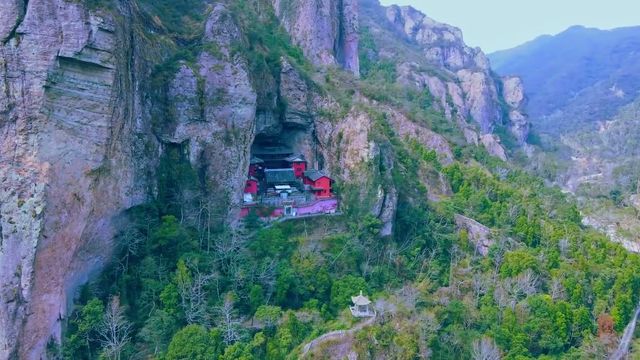
The landform in one picture. A cap sitting on a shaft, with the joint between them clean enough to see, and daylight showing through where two blocks did not close.The way around the mountain is hung off the rock on brackets rather than cut into it. The line of people is the honest scale reference for everything else on this page, and the level seams in the rock behind them are the joints the passages are made of.One of the monasteries on the lower mountain. This is a working complex on built-up stone terraces rather than a shrine at a viewpoint, and it is a reminder that the mountain was inhabited long before it was ticketed.What the summit actually looks out on: a farmed coastal lowland with mist in the hollows, not a wilderness. The mountain stands on its own above ordinary country, which is part of why the sunrise draws the crowd it does.A dam on the wooded flank of the mountain, with walkers crossing the crest. The stairways running off both ends are a fair warning about how this mountain is walked.
The catch. The cable car does the climbing and the mountain then requires a lot of stair work regardless, some of it in narrow spaces between boulders that are not comfortable for anyone large or claustrophobic. This coast is wet and the summit sits in cloud a great deal of the time. Sunrise here is a mass event, with the crowd and the line that implies. Almost nothing on the mountain is signed in English.
Orientation
Cable Car Up, Stairs Across
Fuding has a high-speed rail station on the coastal line between Wenzhou and Fuzhou, and the mountain is about forty minutes from it. Fuzhou is the usual airport. Guest houses cluster at the foot of the mountain and at the village of Qinyu.
From the gate a cable car covers much of the height. The walking begins at the top and consists of a loop between the blocks: stairs, slots, short ladders and the hung walkway, typically three to four hours at a normal pace. Anyone planning on sunrise stays on the mountain or at the gate the night before.
Practical
Things Worth Knowing
Do the passages, not just the viewpoints
The viewpoints are ordinary. The reason this mountain is worth a day is what happens between the blocks, and that requires taking the narrow routes rather than the paved loop.
Decide about sunrise honestly
It means a night on the mountain and a crowd. If cloud is forecast at the summit it means a night on the mountain, a crowd and no sunrise.
Give the afternoon to the tea
Fuding is one of the few places in China where a well-known product is grown within sight of the mountain that carries its name, and the town below sells it at the price it costs here.
Bring a light and mind the head
Some passages are genuinely dark and low, and the rock above them is not padded.
Timing
When to Go
Season
The case for
The catch
April to June
Green slopes, and the spring tea picking on the lower ground
The wettest months, with cloud on the summit much of the time
September to November
The clearest air and a particularly reliable sunrises
Early October is very busy; typhoons can still reach this coast in September
July to August
Warm, long days, and the coast is nearby for an afternoon
Hot and humid on the stairs, and typhoon season
December to March
Quiet, cheap, and the passages are empty enough to stand in
Cold and damp, and the passages stay wet
Context
One Volcanic Belt, Two Mountains
This mountain and Yandang Mountain, a hundred and sixty kilometres up the coast, belong to the same geological episode: the long belt of Mesozoic volcanism that built the whole southeast Chinese seaboard. They look nothing alike, and the reason is worth carrying between them.
At Yandang what is exposed is the volcanic rock that reached the surface, erupted as ash and lava and then collapsed into a caldera, which erodes into vertical walls and free-standing towers. Here what is exposed is the magma that never erupted: it cooled slowly at depth into coarse granite, and just after tens of millions of years of erosion stripped off what lay above it did it reach the surface at all. Same belt, same era, opposite halves of the same plumbing.
The tea is more recent but not new. White tea has been made in this county since at least the Qing, and its modern reputation abroad has pushed the planted area a long way up these slopes. The mountain and the crop are not a coincidence: weathered granite makes acid, free-draining soil, and that is what the plant wants.
Ningde is the prefecture this mountain sits in, a coastal city of fishing, aquaculture and, lately, battery manufacturing on a scale that has changed it. Many visitors going to the mountain do not stop in the city itself, and stay at Fuding or at the mountain gate instead.
The coastal rail line makes this stretch easy to add to a longer route. Wenzhou and Yandang to the north, Fuzhou and then Xiamen to the south, with this mountain and its tea country in between, is a week of Fujian and southern Zhejiang that very few foreign itineraries include.
Experiences
What Visitors Can Actually Do Here
On site · full day
The boulder passages
The loop between the blocks: slots, ladders, the hung walkway and the monasteries below, spots, with the geology explained as visitors go.
Cable car plus entry.
On site · half day
Fuding white tea
A working tea farm and a tasting on the slopes below the mountain, rather than a shop.
Come for the passages rather than the sunrise, take the narrow routes, and look up when the light from both ends of a slot shows visitors the whole underside of the block resting overhead. Then go down and drink the tea that grows on what that block is slowly turning into.
Travelling to China with 10 or more people? Talk to PreeChina first. A transparent service fee of USD 100 per person for trips of up to 10 days (USD 150 for 11 to 20 days), and no markup on travel components. See how the fee works.
Share the travel dates and our local team will get visitors onto the mountain early, through the passages rather than around them, and into a working tea farm the same afternoon. We can run it with Yandang Mountain as one coastal week.