PreeChina › Gansu › Mingsha Dunes and Crescent Lake (鸣沙山月牙泉)
Gansu · A Spring in a Dune Field, Kept Alive on Purpose
Mingsha Dunes and Crescent Lake (鸣沙山月牙泉)
A spring-fed crescent of water that has sat in a hollow between dunes for around two thousand years, five kilometres from Dunhuang. It nearly dried out in the twentieth century and is now topped up to keep it there.
Quick Facts
The Short Version
What it is
A dune field on the edge of Dunhuang with a spring-fed crescent pool in a hollow inside it
Where
About 5 km south of Dunhuang town, in western Gansu
The name
Mingsha means singing sand. The dunes make a low booming sound when dry sand slides down a steep face, which is a real acoustic effect
The lake
Documented for roughly two thousand years. It shrank severely in the second half of the twentieth century and has been maintained by recharge works since the 2000s
The buildings
The pavilions beside the water are a reconstruction from the 1990s onward
What people do
Camel rides, sand sledding, buggies and microlights, all run at considerable scale
At the gate
Orange shoe covers are rented and worth taking. Sand gets into everything
Time needed
Two to three hours, and the last two hours of daylight are the ones to have
Why Go
Two Things in One Hollow
1. The sand really does make a noise
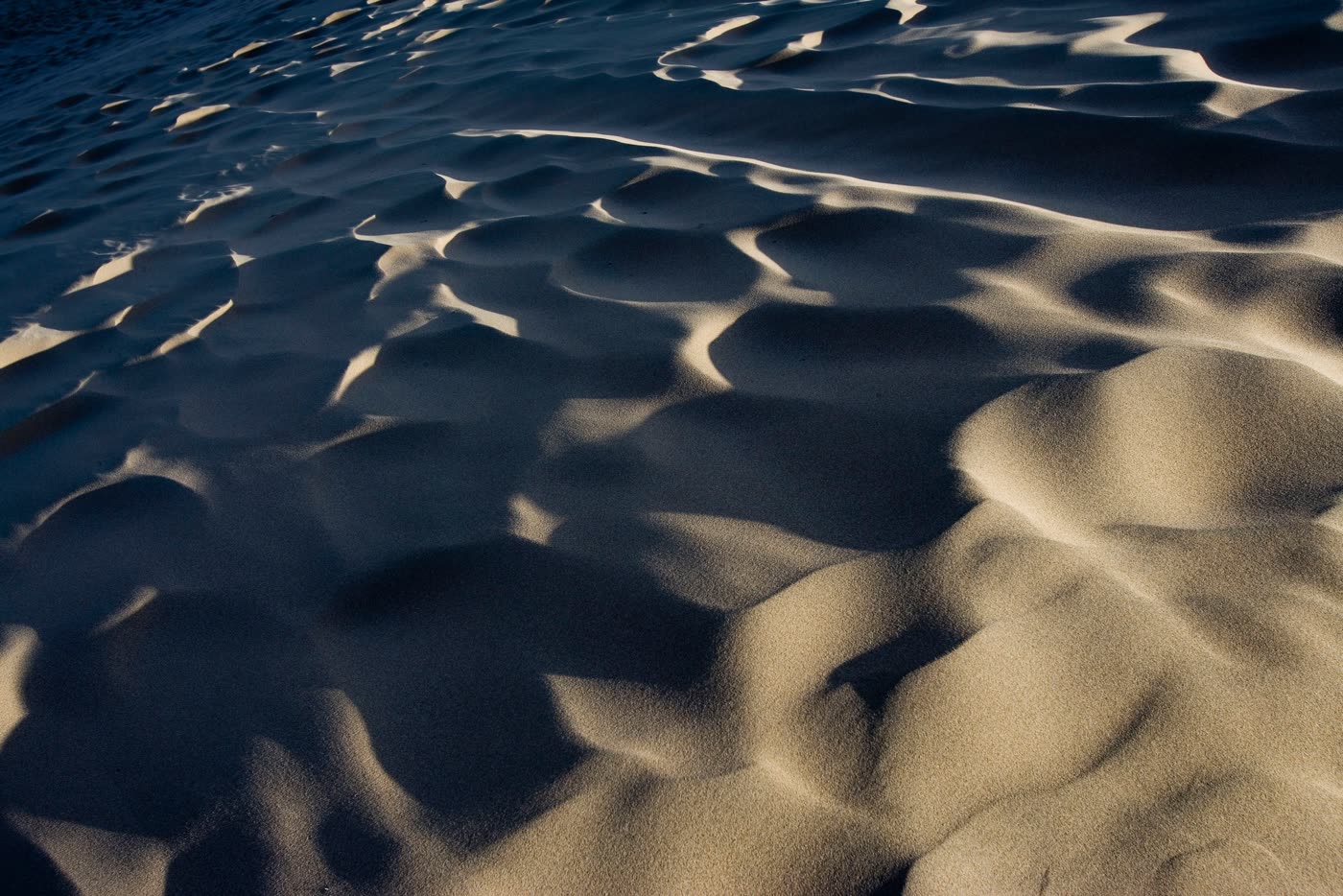
Booming dunes are a genuine and fairly rare phenomenon, found in about three dozen dune fields worldwide. The requirements are narrow: the grains have to be quartz, well rounded, closely matched in size, and very dry. When a mass of sand like that shears down a steep face, the grains move in a coordinated way and the whole slope acts as a low-frequency speaker. People describe it as a drone or a distant aircraft.
It needs dry sand and a decent slide, so it is loudest in the afternoon heat and after someone has set a slope moving, which in practice means the sand-sledding runs. If visitors want to hear it rather than read about it, climb a steep face in the dry heat of the day and push a sheet of sand down ahead of them.
2. The lake is maintained
A permanent pool in a dune hollow works because groundwater from the Danghe river system reaches the surface here, and for much of two thousand years that happened without help. In the second half of the twentieth century it stopped being reliable: wells, upstream irrigation and a falling water table shrank the pool badly, and it came close to disappearing.
Since the 2000s the water table around it has been supported by recharge works, and the crescent has been stable since. That is worth knowing and it does not spoil the place. The hollow, the dunes and the spring are real; the level of the water in it is now a decision, and one that gets renewed every year.
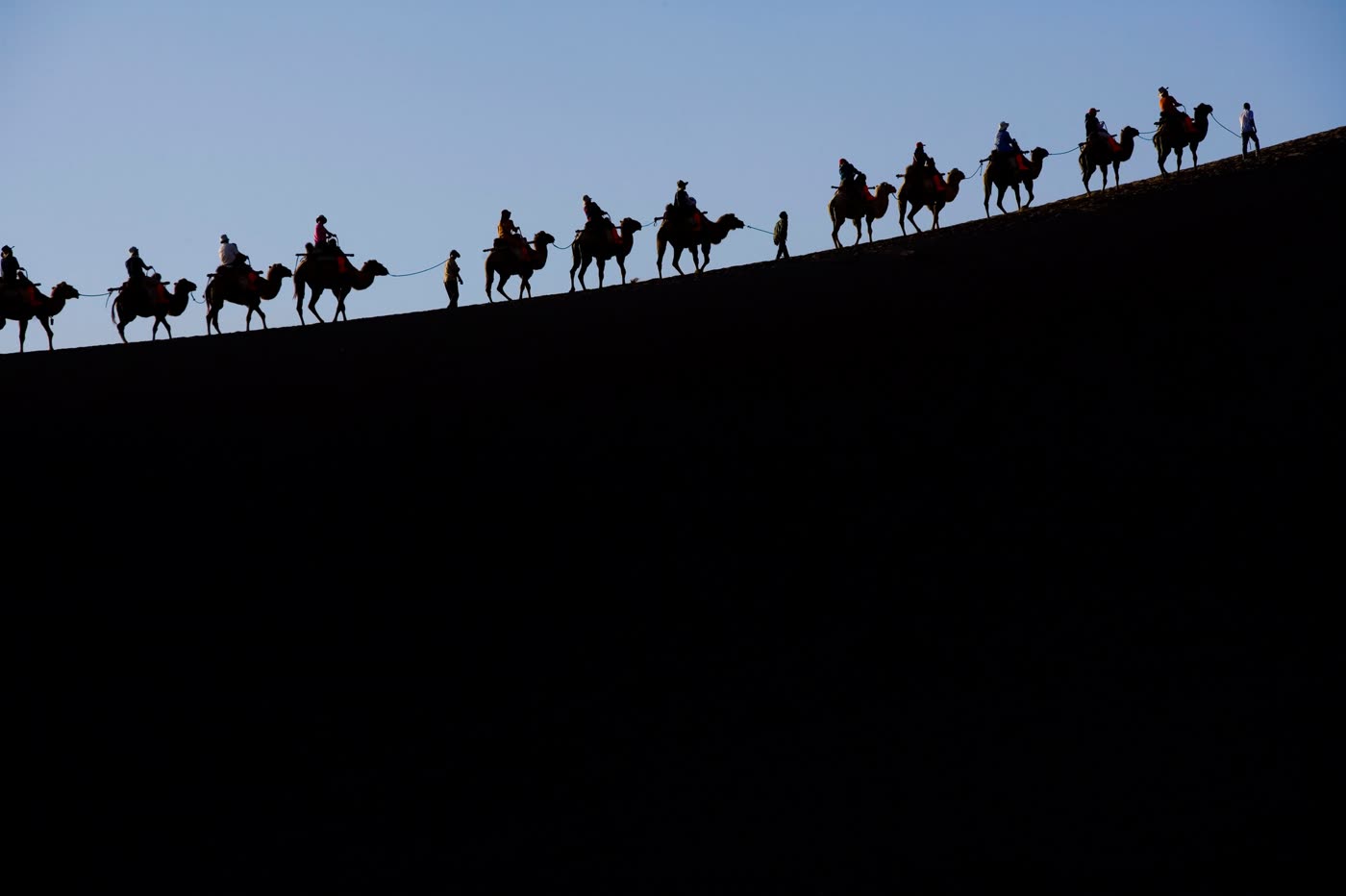
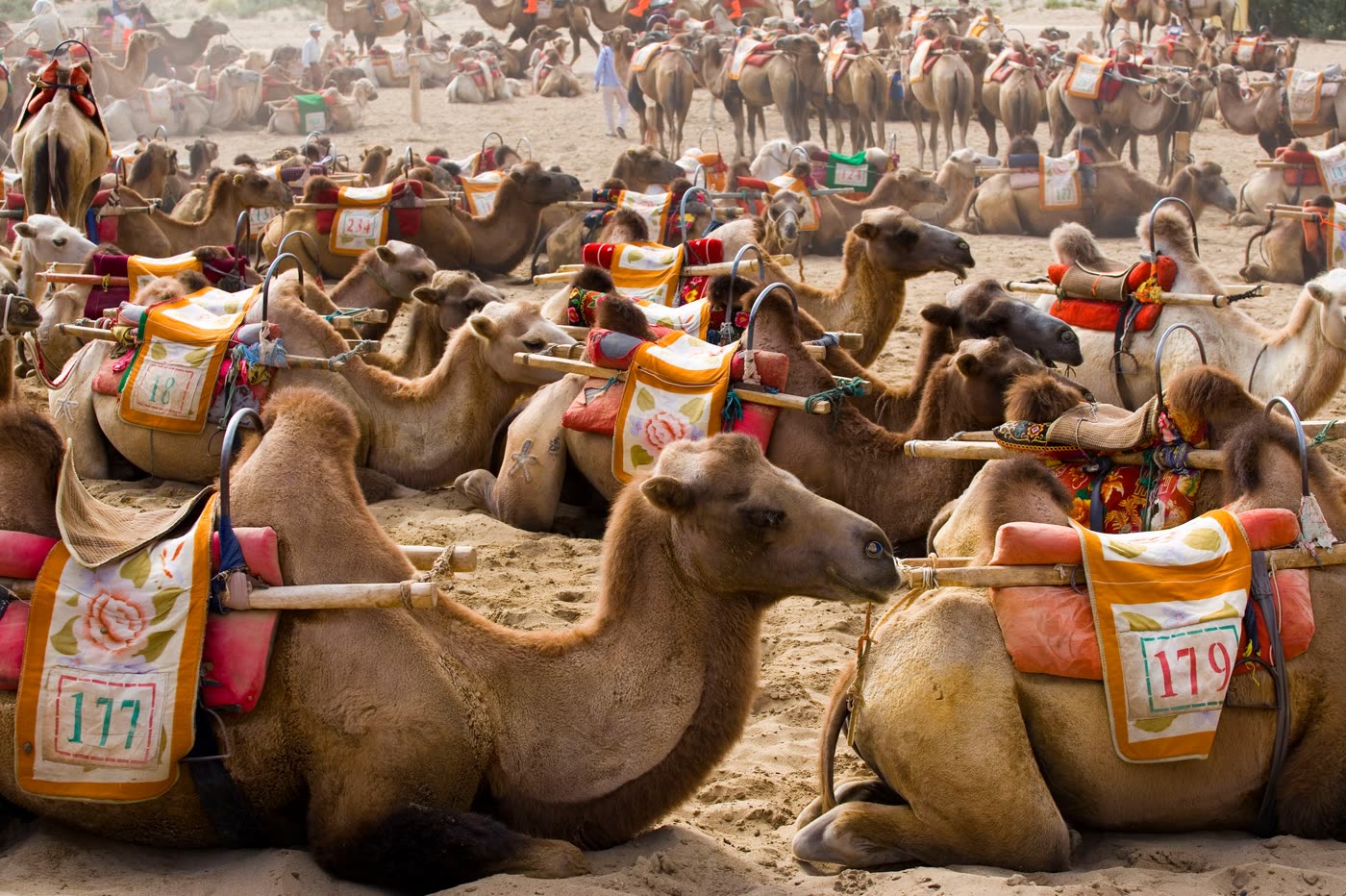
The picture everyone comes for, and it is real: the fixed route does run a line of riders along a ridge at the right time of day.The other half of the same thing. The numbers on the saddles are how the line is managed.The sand itself, which is the reason the place has its name. Even, rounded, well-sorted grains are what make a dune capable of sound.
The catch. The camel operation is enormous and it is the opening thing visitors see. Hundreds of animals in numbered saddles lie in rows waiting to be loaded, and the ride runs a fixed loop in a long train. It is not a caravan experience and it does not pretend to be. Walk into the dunes on their own feet instead if that matters to them; the far side of the opening ridge is quiet and free.
Orientation
Uphill To begin, Then the Water
From the gate the dunes rise immediately and the lake sits behind the opening ridges, with a made path and a wooden stairway to help with the climb. Many people go up, look down at the crescent, come down to the pavilions, and leave.
The better shape is to do that in the last two hours of the day and then stay. The camel trains stop before closing, the crowds thin quickly, and the dunes at dusk with the lights coming on around the pool are the memorable part rather than the middle of the afternoon.
Practical
Things Worth Knowing
Take the shoe covers
Rented at the gate for very little. Without them visitors will be pouring sand out of the shoes for the rest of the trip, and out of the bag for the rest of the month.
Late afternoon into sunset
The middle of the day is brutally hot and the light is flat. The site stays open late in summer, which is when it is ideal.
Walk over the opening ridge
Twenty minutes of effort puts visitors away from the camel route and the sledding runs, and the dune field is large.
Protect the camera
Fine sand and lens changes do not mix. Bag anything visitors care about before they climb.
Timing
When to Go
Season
The case for
The catch
May to June
Warm rather than scorching, long evenings, and the site open late
Spring sandstorms can shut things down at short notice
September to October
A particularly comfortable temperatures of the year and clear light on the dunes
The opening week of October is the national holiday and Dunhuang fills
July to August
Peak season, everything open, and the sand at its driest and loudest
Daytime heat is severe and the dunes hold it. Mornings and evenings alone
November to April
Very quiet, cold clean air, and the dune shapes are sharper without haze
Cold, short days, and reduced hours
Context
Why There Is a Town Here at All
Dunhuang exists because of water. The Danghe river comes off the Qilian mountains, runs toward the desert and creates an oasis at the point where the northern and southern routes around the Taklamakan met the road east into China. Everything that happened here, including the Mogao caves, follows from a reliable water supply in a place that has no business having one.
The spring in the dunes is the same story at a smaller scale, and it is the reason the site has been written about for two thousand years rather than simply being a nice dune. A pool that does not silt up and does not dry out, in the middle of moving sand, was remarkable enough to record.
It also explains the modern problem. Irrigating an expanding oasis and supplying a growing town draw on the same groundwater that feeds the spring, so the pool became an indicator of how hard the aquifer was being worked. Keeping it full is partly about the view and partly about the fact that everyone here can see what the water table is doing.
Nearby
Other Stops on the Same Trip
Caves · 25 km southeast
Mogao Caves (莫高窟)
Nearly a thousand years of Buddhist cave painting and sculpture in a cliff outside town. The reason many people come to Dunhuang.
Half a day, booked well in advance.
Landform · 180 km northwest
Yardang National Geopark (敦煌雅丹)
Wind-cut rock forms out toward the old frontier passes, usually done with Yumen Pass in one long day.
Dunhuang has its own airport and a station on the line through the corridor, and the dunes are close enough to the town to reach by taxi in ten minutes or by bicycle in half an hour.
Two nights is the working minimum: the caves on one day, the dunes at the end of another, and the long day out to the Yardang park and the passes if visitors have a third.
Experiences
What Visitors Can Actually Do Here
On site · 2 hr
The ridge and the lake
Up the stairway to the opening crest for the view down onto the crescent, then down to the water.
Late afternoon. Shoe covers at the gate.
On site · 40 min
The camel loop
The fixed route on the standard train, which is what the silhouette photographs come from.
Separate pass, busy from mid-morning.
Guided · 3 days
Dunhuang properly
The caves with a guide who can read the paintings, the dunes at dusk, and the day out to the Yardang and the Han frontier passes.
Worth an evening rather than an afternoon. Rent the shoe covers, climb the opening ridge, and walk over it to get away from the camel route. Stay until the light goes. And know that the crescent is kept full deliberately, which makes it more interesting rather than less.
Travelling to China with 10 or more people? Talk to PreeChina first. A transparent service fee of USD 100 per person for trips of up to 10 days (USD 150 for 11 to 20 days), and no markup on travel components. See how the fee works.
Share the travel dates and interests, and our local team will build the route: the Mogao caves booked early, the dunes at the end of the day, and the long run out to the frontier passes if visitors have the time for it.