A very large cave in western Guizhou, lit throughout in coloured floodlight like every Chinese show cave. The colour is the opening thing to get past, and what is underneath it is a chamber system with formations on a scale that is hard to photograph honestly.
Quick Facts
The Short Version
What it is
A show cave of large chambers, walked on paved paths and steps with fixed lighting throughout
Where
Zhijin county, Bijie prefecture, western Guizhou. A couple of hours from Guiyang
The lighting
Coloured: blue, orange, yellow and violet gels on floodlights, changing from chamber to chamber
What to look for
The forms rather than the colours. Stalactites from above, stalagmites from below, columns where the two have met, drapery where water ran down a slope, flowstone where it spread out
Scale
Chambers large enough that a column several times a person's height reads as small
Effort
Paved and stepped throughout, with a long continuous route and a fair amount of up and down
Conditions
Cool, damp and dim. A jacket is worth carrying even in a Guizhou summer
Time needed
Two to three hours underground
Why Go
The Colour, and What Is Under It
1. Deal with the lighting at the start
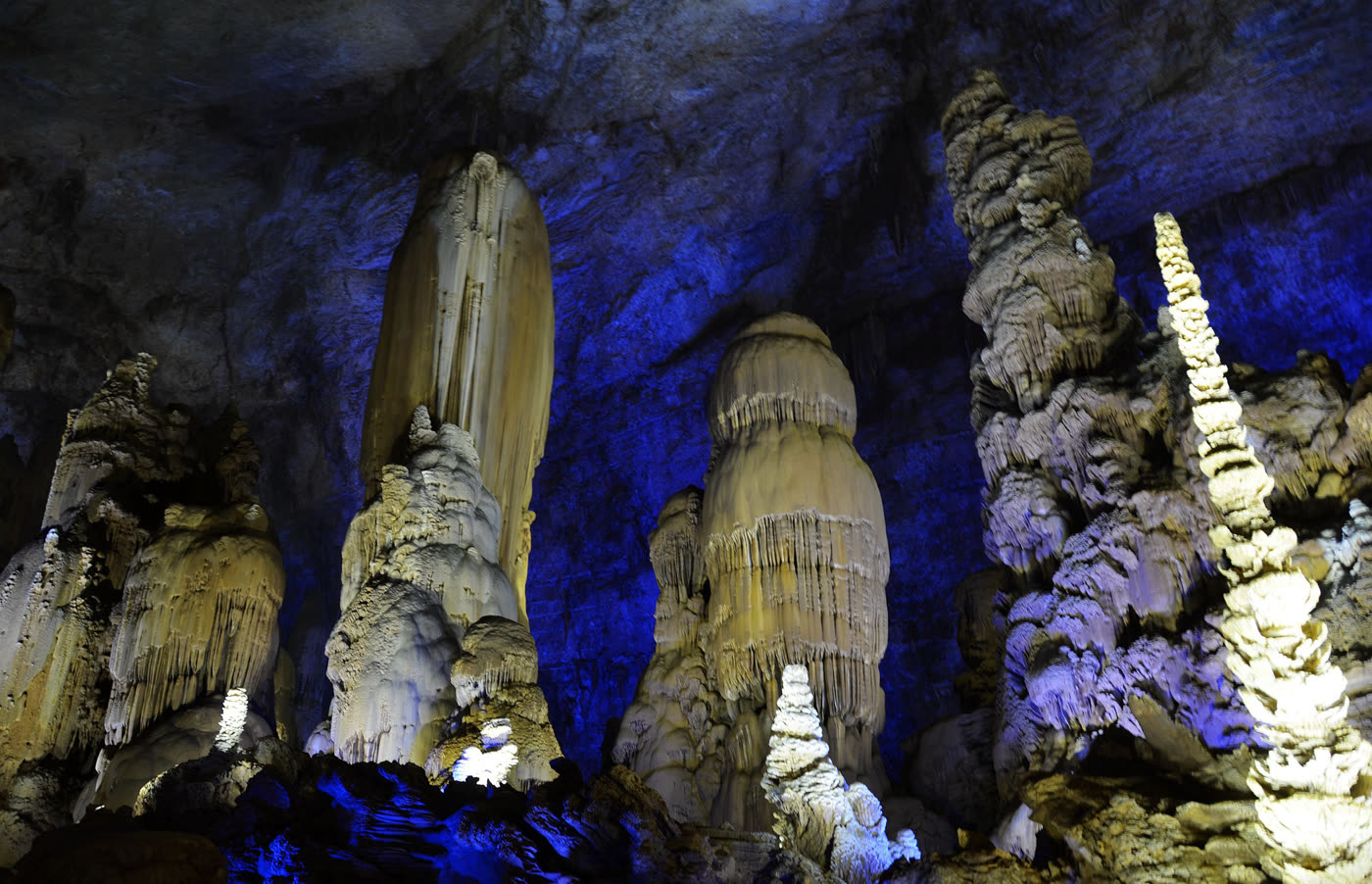
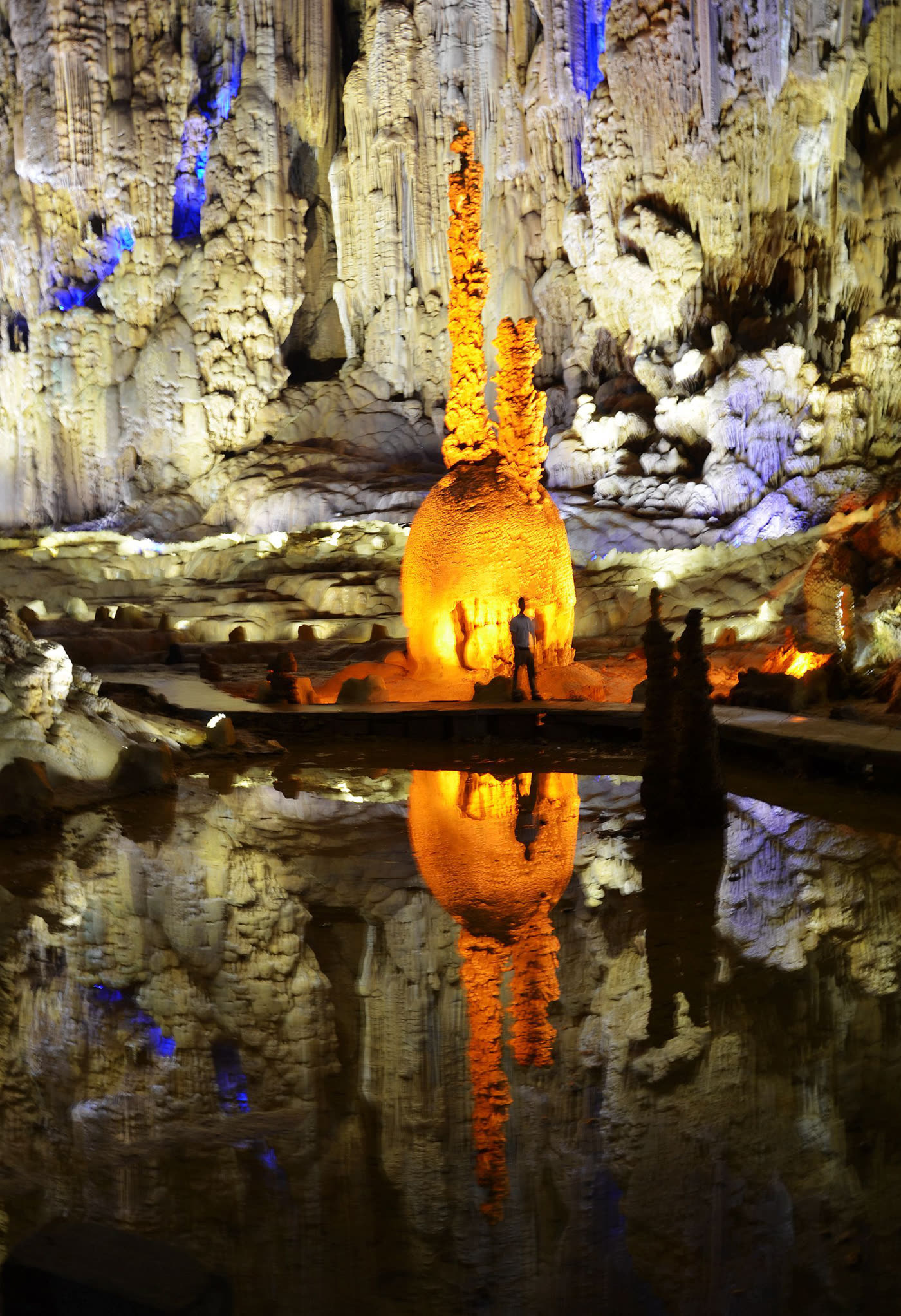
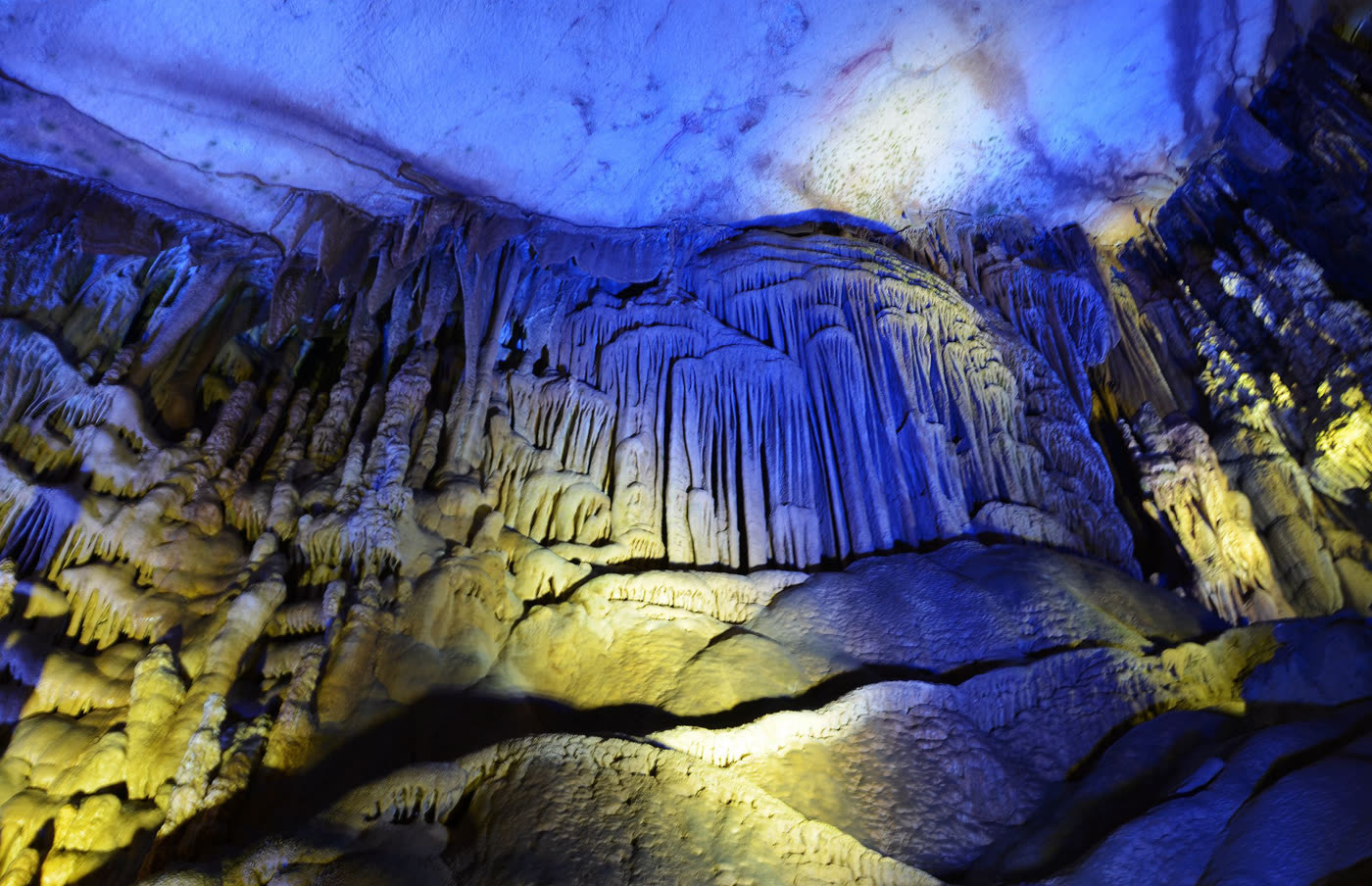
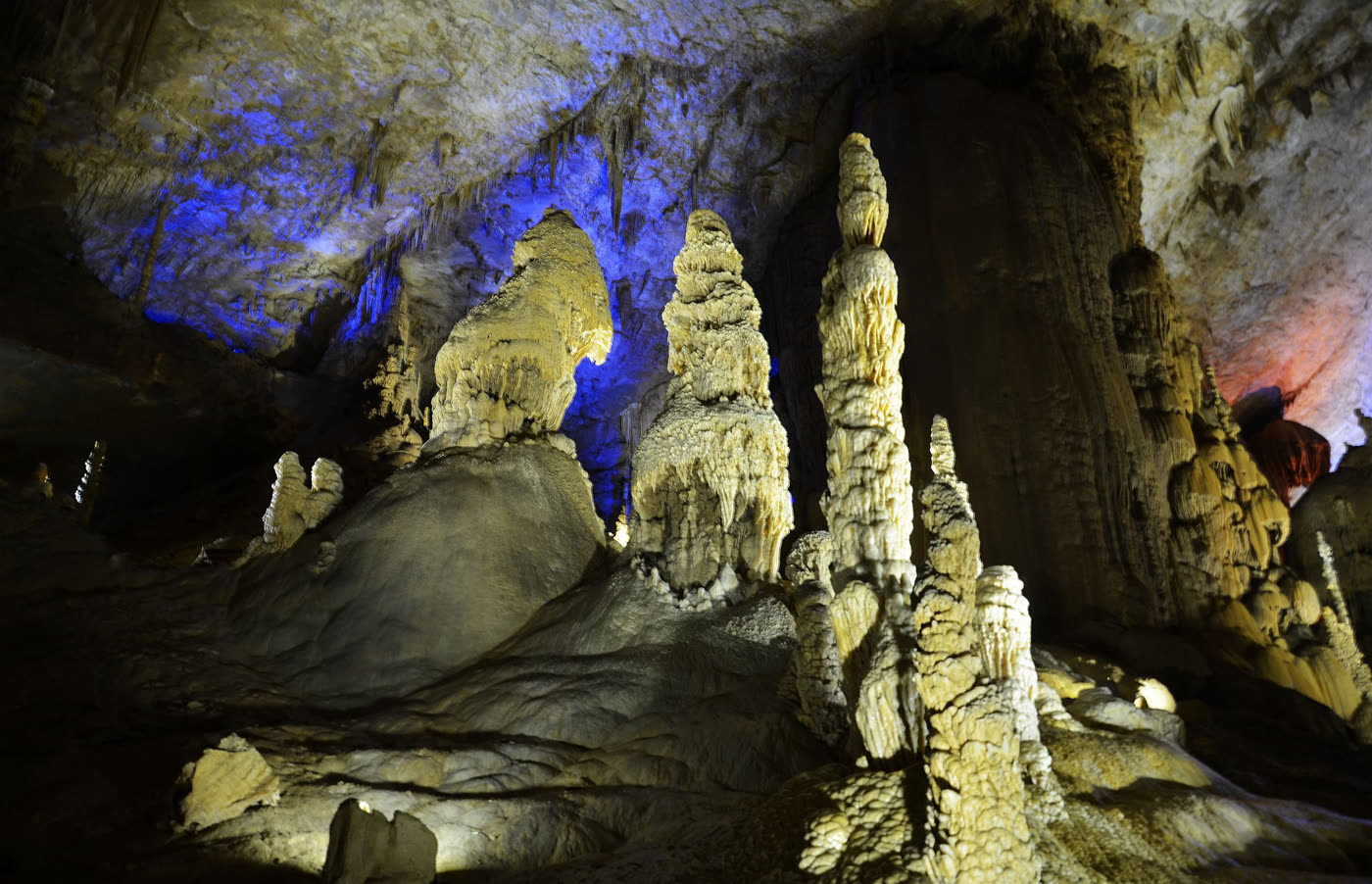
Every photograph on this page is lit in colour, and so is the cave. Blue on the walls, orange on a feature formation, yellow along a passage, violet in the distance. This is the standard way Chinese show caves are presented, it is not going to change because a foreign visitor dislikes it, and pretending otherwise would misdescribe the visit. One of the pictures below shows a slope where the blue gel stops and the yellow one begins, with a hard line between them.
It is worth understanding what it is for. A cave lit in white light is grey, brown and cream, and reads as undifferentiated rock to somebody walking through it in twenty minutes. The colour separates planes, marks out the features the guides talk about, and turns a geological site into a spectacle, which is what many of the visitors have paid for. The cost is that the actual colour of the rock is hidden, and the actual colour is worth seeing.
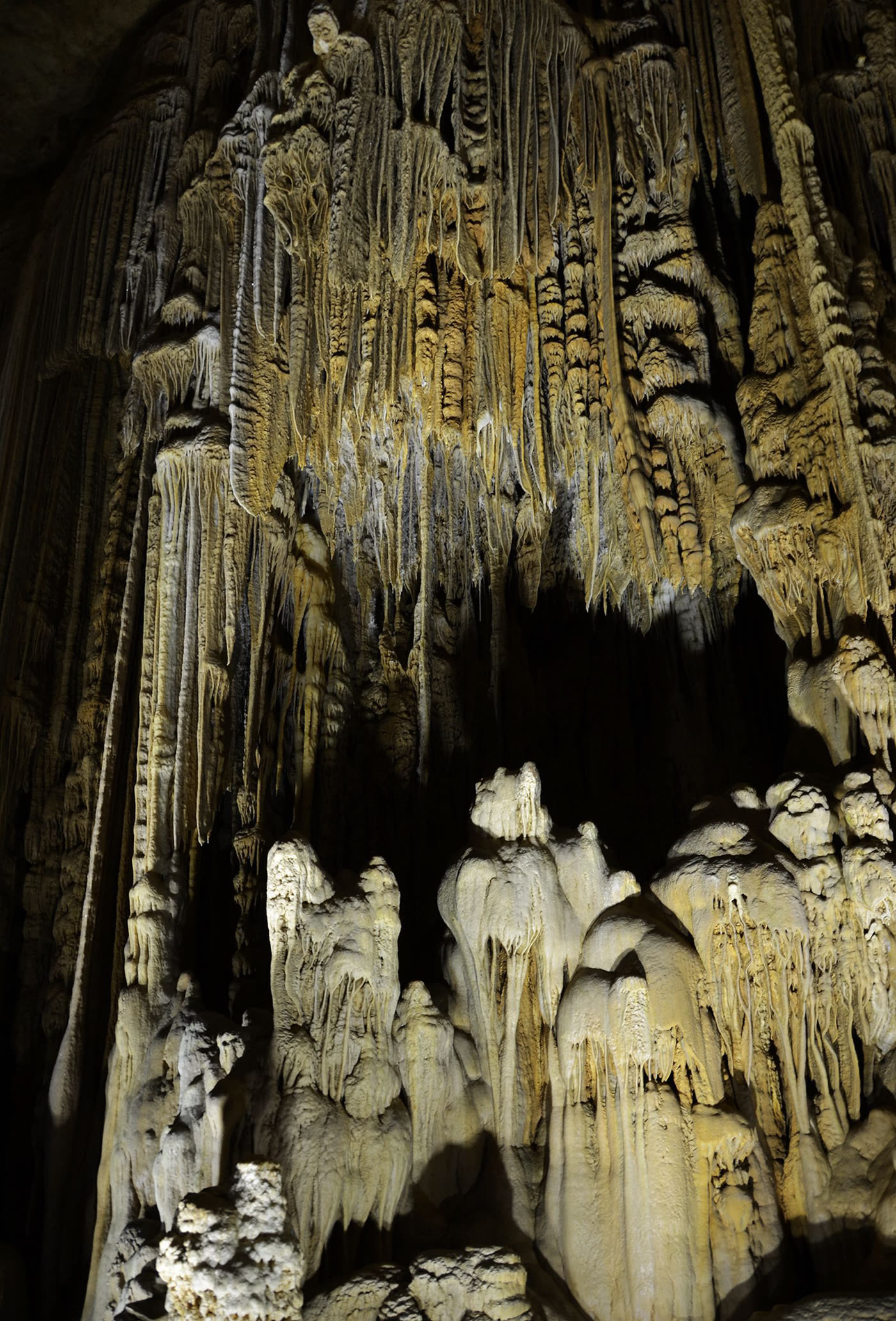
There is one picture below taken under plain warm light with no gels, and it is a particularly useful image on the page. The formations are cream, ochre and grey-brown, the fresh tips are almost white, and the surfaces are matt rather than glowing. That is what visitors are looking at under the blue.
2. Read the forms, and visitors have something to do for two hours
The vocabulary is small and it makes the whole cave legible. Water carrying dissolved limestone drips from a ceiling and leaves a ring, which grows down into a stalactite. What lands on the floor builds up into a stalagmite. If the two meet they become a column. Where the water runs down a sloping surface instead of dripping, it leaves a hanging sheet, which is drapery. Where it spreads out across a floor it leaves flowstone, which is the rippled rock that looks like a frozen river.
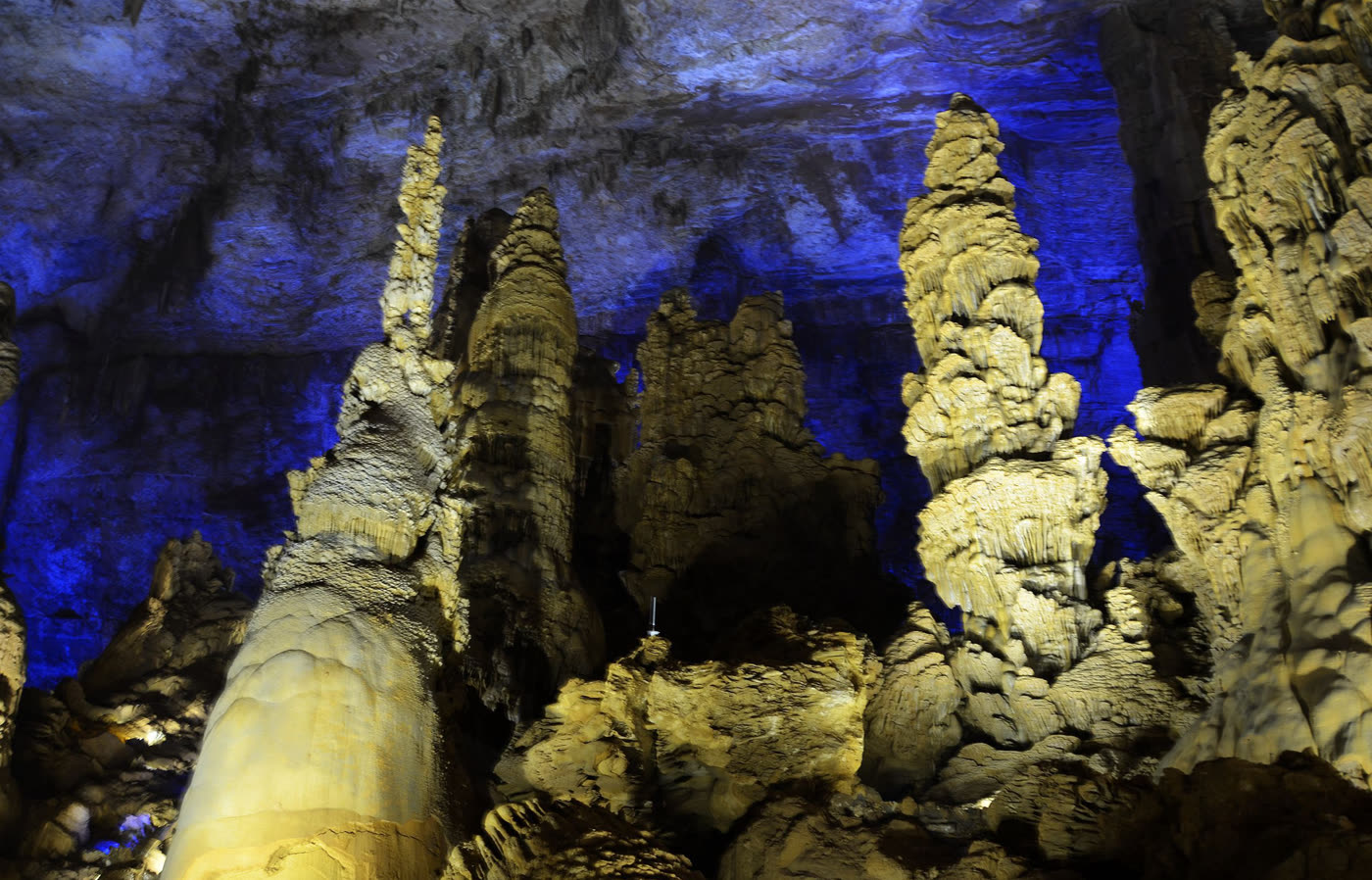
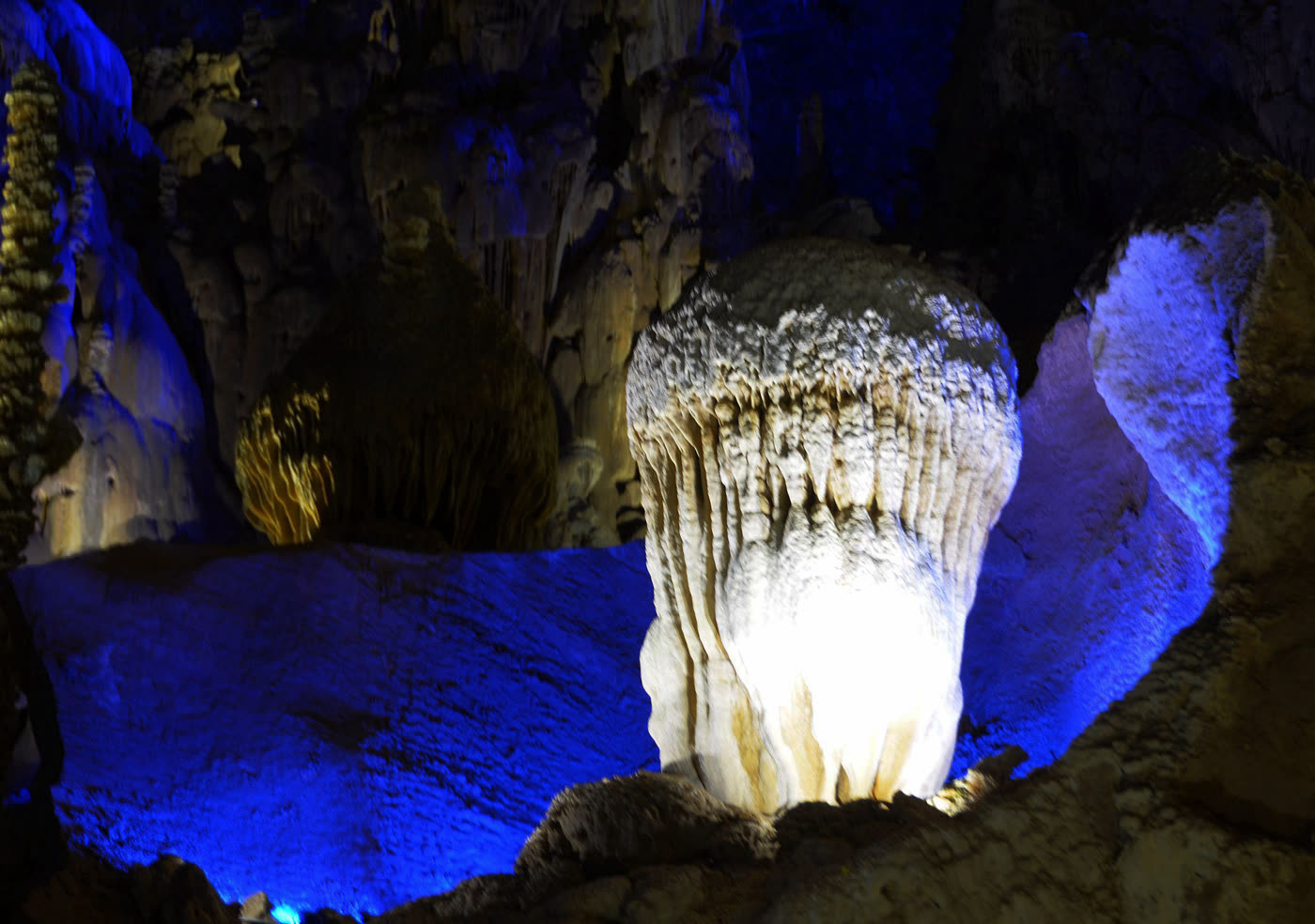
Once those five are in the head the chambers stop being an undifferentiated cave. The pictures below have all of them: a ceiling hung with a dense field of stalactites and drapery; a floor of rippled flowstone with a shouldered boss standing on it; slender stalagmites with a knobbly stacked surface like a pile of discs; and a chamber of very large columns, banded and fluted, that have been building since long before anyone came down here.
The scale is the part that photographs badly. Just one of the fifteen source pictures has a person in it, and it is the one below with a man standing at the foot of an orange-lit formation whose egg-shaped base is several times his height, with a spire above that going much higher again, all of it mirrored in still water. Look at that one at the start. Everything else in the set is larger than it appears.
The sole picture in the set with a person in it, and therefore the sole honest scale. The egg-shaped base is several times his height and the spire above goes much further.The same rock without the floodlights. Cream, ochre and grey-brown is what it actually is, and the near-white tips are where it is still growing.The gels made visible. The boundary running across the middle of this frame is where one floodlight's reach ends and the next begins.Three different growth habits in one frame. The stacked-disc surface comes from water dripping onto the same spot at a steady rate for a very long time.The fittings at the foot of the formations are part of the experience here. So is the leaning one in front, which is a reminder that these things are rock and rock moves.The blue expanse is rock, not water: continuous rippled flowstone running up a slope. Sheet flow rather than dripping makes that surface.
The catch. This is an indoor attraction on a fixed one-way route with a guide, at a pace set by the group, and there is no wandering off. The lighting will annoy some visitors throughout. Photography is difficult: the colour casts fight the camera, the light levels are low, and tripods are not practical on a moving route. It is also two hours from Guiyang in a direction with little else on it, so this is a day trip rather than a stop.
Orientation
One Route, One Direction
The cave is entered at one end and left at the other, on a paved and stepped route with handrails and fixed lighting, in a group with a guide. The chambers open one after another and the route does not double back, so there is no choosing what to see or how long to spend on it.
What that means practically is that the visit is over in two or three hours and cannot be extended. Anyone who wants to look properly should walk near the back of the group, where there is a little more room and the guide's amplifier is further away.
Practical
Things Worth Knowing
Take a layer
It is cool and damp underground all year, which is a relief in August and cold in January.
Look at the one photograph with a person in it before visitors go
It is the sole thing that will prepare visitors for the size of the chambers.
Shoes with grip
The paths are wet in places and polished by feet in others.
Do not fight the lighting with the camera
Colour casts and low light will defeat a phone. Look instead, and photograph the shapes rather than the colours.
Timing
When to Go
Season
The case for
The catch
April to June
Comfortable above ground and green in the country around
Guizhou spring is wet, and the approach roads can be slow
September and October
A particularly reliable weather of the year for the drive from Guiyang
The opening week of October is a national holiday and the line for the route is long
July and August
The cave is cool when the province is not, which is why it is busiest then
Groups are large and the route moves slowly
November to March
Quiet inside, with short waits
Cold outside, and the cave is a similar temperature all year so it feels less of a contrast
Context
A Province Built on Soluble Rock
Guizhou is a limestone province, lifted high and cut into by rivers, and almost every kind of karst landform is represented somewhere in it. Water sinks into the rock rather than running across it, which is why the surface is short of water even where rainfall is high, and why there is so much of this sort of thing underneath.
Caves are the middle stage of that process. Water dissolves passages along joints and bedding planes; if the water table drops, the passages drain and the air gets in; and then the slow business of redeposition begins, which is what builds everything in these photographs. The end of the sequence is on this site too: at Wulong, a few hundred kilometres east, the roofs of chambers like these have come down and left open pits with the surviving stretches standing as natural bridges. Zhijin is a cave with its roof still on.
The economics are worth a sentence as well. Caves are a particularly reliable tourism asset a poor upland county can have: they work in any weather, they take a fixed number of people an hour, and once the path and the lighting are installed the running costs are low. That is why there are so many show caves in this part of China, why they are lit the way they are, and why the one visitors are in is often the main employer for the village outside it.
Guiyang is the provincial capital and the usual base, with an airport and high-speed rail, and the cave is a couple of hours away by road. Bijie, the prefecture town, is nearer but has less to offer an evening.
Anyone spending several days in Guizhou should treat this as one item in a karst circuit rather than a destination on its own. The province rewards a week, and almost every stop on it is the same rock doing something different.
Experiences
What Visitors Can Actually Do Here
On site · half day
The cave route
The full one-way circuit with a guide, which is the sole way it is walked.
Entry with guide.
Guided · 6 days
Guizhou karst, underground and over
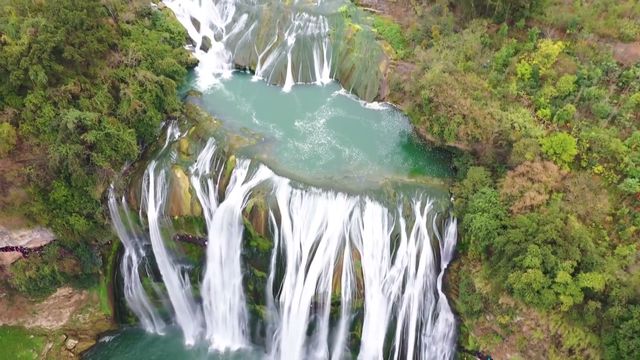
This cave, the falls to the south, and the collapsed chambers to the northeast, arranged so that one rock explains all three.
Spend the opening five minutes getting used to the colour and the rest of the visit ignoring it. Learn the five words before visitors go in, because stalactite, stalagmite, column, drapery and flowstone are enough to make every chamber readable. And look at the picture with the man in it at the start, so that visitors arrive knowing how much bigger than it looks all of this is.
Travelling to China with 10 or more people? Talk to PreeChina first. A transparent service fee of USD 100 per person for trips of up to 10 days (USD 150 for 11 to 20 days), and no markup on travel components. See how the fee works.
A cave on its own is a morning. A cave read against a waterfall and a collapsed chamber is a week that makes sense. Share the travel dates and our local team will build the karst circuit in an order where each stop explains the next.