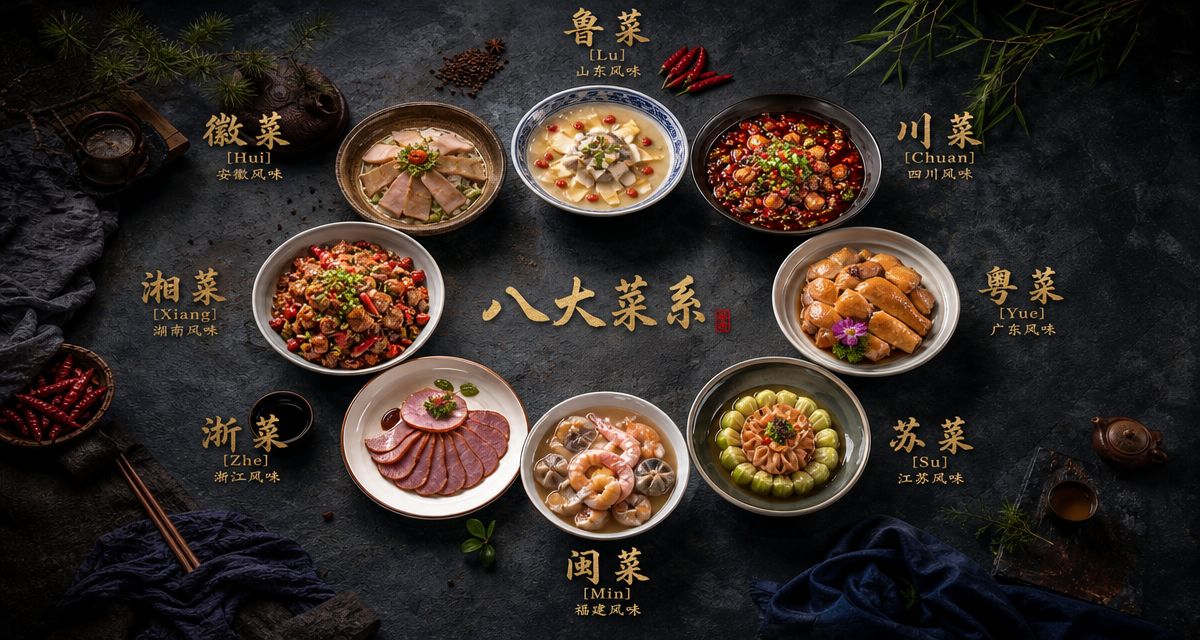
There is no greater food journey in the world than eating across China’s Eight Great Culinary Traditions. From the imperial braising pots of Shandong to the charcoal-grilled stinky tofu of Changsha, from Guangzhou’s morning dim sum rituals to the fermented mountain food of Anhui’s Huizhou villages, this is a journey through one of humanity’s most extraordinary culinary civilizations, experienced one table at a time. The Eight Traditions Grand Tour is for the traveler who wants not just to visit China, but to understand it.
Regions CoveredShandong, Sichuan, Cantonese, Jiangsu, Fujian, Zhejiang, Hunan, Anhui
Ideal ForSerious Food Travelers, Long-Stay Visitors, China Returnees
Illustration
Why the Grand Tour Exists
Most travelers visit China and eat well, in one city, in one style, with one set of flavors that becomes their lasting impression of Chinese food. The Eight Traditions Grand Tour is built on a different premise: that China’s culinary identity cannot be understood from a single city, that the contrast between traditions is itself the lesson, and that moving between them, tasting the differences as they accumulate, produces a form of understanding that no amount of reading or restaurant-going in one place can replicate.
The journey is demanding. It crosses thousands of kilometers, requires careful sequencing of cities and seasons, and asks the traveler to arrive at each destination genuinely hungry, for food and for what the food reveals about the people and place that produced it. The rewards are proportionate to the effort: by the journey’s end, the traveler understands China not as a single culture with a single cuisine, but as a vast and internally diverse civilization that tastes different in every province, every valley, every city.
“To eat across China’s eight traditions is not a food tour. It is a complete education, in history, geography, culture, and what it means to feed a civilization for five thousand years.”
Stage One: The Imperial North: Shandong & Beijing
Stage 01: Days 1 to 5
The tour begins where Chinese culinary history begins: in the north. Beijing serves as the natural gateway, its Peking Duck restaurants and hutong breakfast culture providing an immediate immersion into northern food sensibility, bold, wheat-based, built around roasting and braising techniques that reflect the harsh winters and imperial ambitions of the capital.
From Beijing, a short high-speed rail journey south reaches Jinan and the heartland of Shandong cuisine, Lǔ Cài, the tradition that shaped China’s imperial court kitchens for centuries. Braised sea cucumber, sweet and sour Yellow River carp, and the extraordinary scallion culture of this province set a baseline of technical mastery and ingredient respect that colors everything that follows. The north establishes the standard; the journey south explores how each region responded to it.
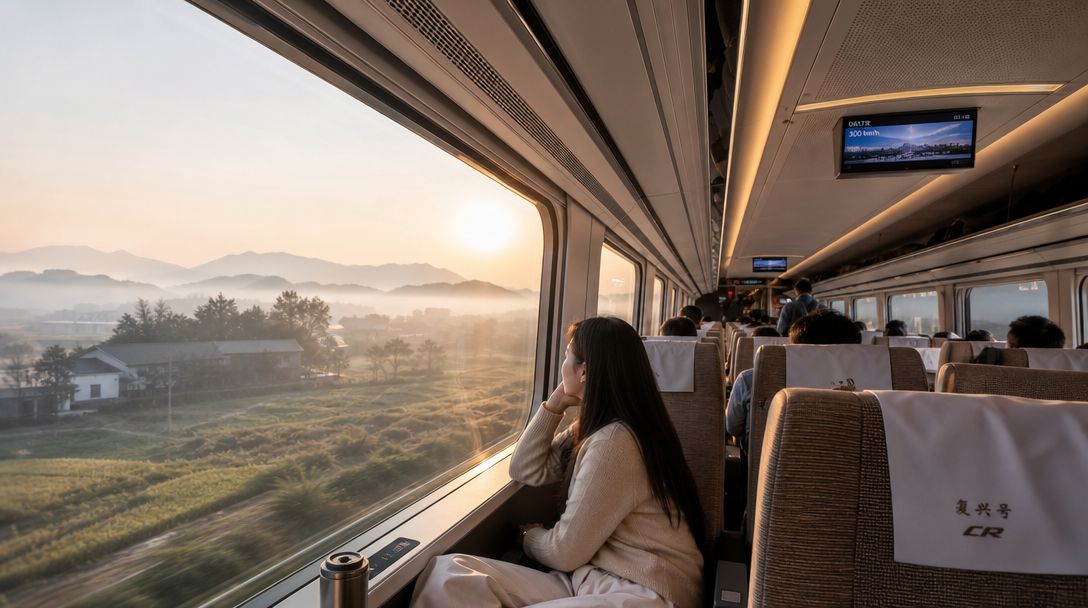
China’s high-speed rail network makes the Eight Traditions Grand Tour possible, connecting culinary worlds that once took weeks to travel between in hours. · Illustration
Stage Two: The Great Fire: Sichuan & Hunan
Stage 02: Days 6 to 12
The journey’s most dramatically contrasting stage moves from the imperial restraint of Shandong to the volcanic energy of China’s two great spice traditions. Chengdu arrives first: the mala heat of Sichuan hot pot, the 23 flavor profiles of a culinary tradition that UNESCO recognized as a world gastronomic city, the slow-living teahouse culture of a city that takes food as seriously as philosophy.
Then Changsha, and the discovery that Hunan heat is a completely different animal from Sichuan’s numbing mala. Direct, bright, unapologetic chili fire. Chairman Mao’s red-braised pork at a restaurant that has been making it for decades. Stinky tofu on Taiping Street at midnight. The realization that two traditions separated by a few hundred kilometers can produce eating experiences as different as Italy and Morocco.
This stage is the tour’s emotional center, the moment when most travelers understand viscerally that Chinese cuisine is not one thing but many, and that the differences between them are not superficial variations but profound expressions of distinct cultures, histories, and ways of being.
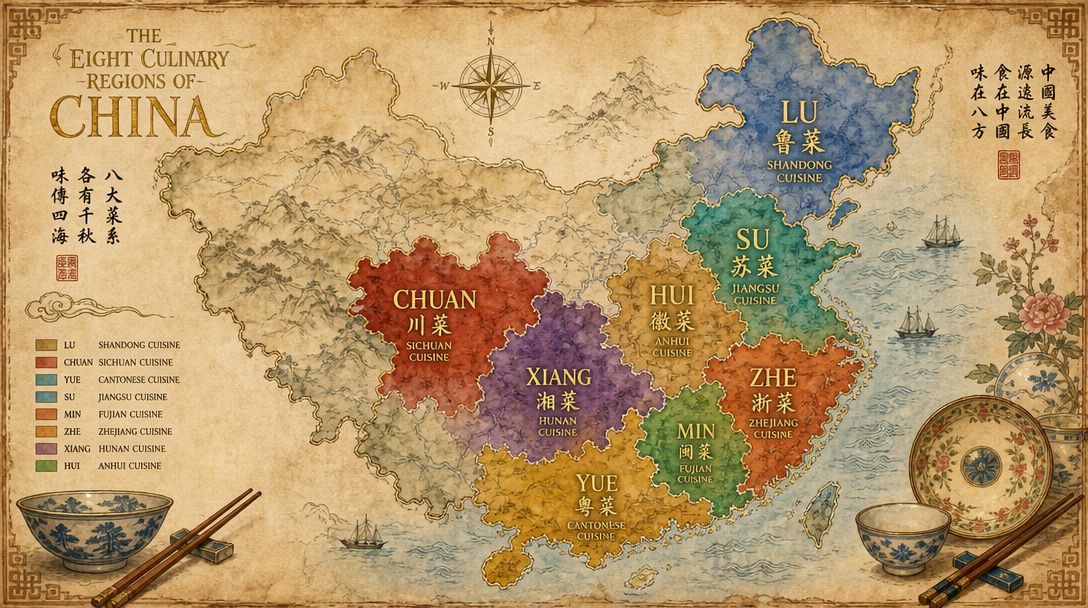
Eight regions, eight traditions, one civilization, the culinary map of China tells a story of geography, history, and the extraordinary diversity of human taste. · Illustration
Stage Three: The Refined Coast: Cantonese, Fujian & Zhejiang
Stage 03: Days 13 to 20
After the fire of the interior, the coastal traditions arrive like a cool sea breeze. Guangzhou and its Cantonese cuisine, the most globally exported of all eight traditions and the most misrepresented. A morning dim sum at a traditional yum cha house in the old city recalibrates everything: here, freshness and delicacy replace heat and depth, and the philosophy of letting pristine ingredients speak for themselves produces food of extraordinary subtlety.
The coastal arc continues north to Xiamen and Fujian, the ocean’s deepest kitchen, where fermented seafood pastes, Buddha Jumps Over the Wall clay pots, and the briny vitality of the South China Sea combine into a cuisine of profound umami complexity. Then Hangzhou, where Zhejiang’s seasonal intelligence governs everything: Longjing shrimp if it is spring, hairy crab if it is autumn, Dongpo Pork whenever the season, West Lake vinegar fish always.
By the end of this stage, the traveler has moved from imperial braising to volcanic spice to oceanic depth to seasonal delicacy, four entirely distinct flavor worlds, all within the borders of one country.
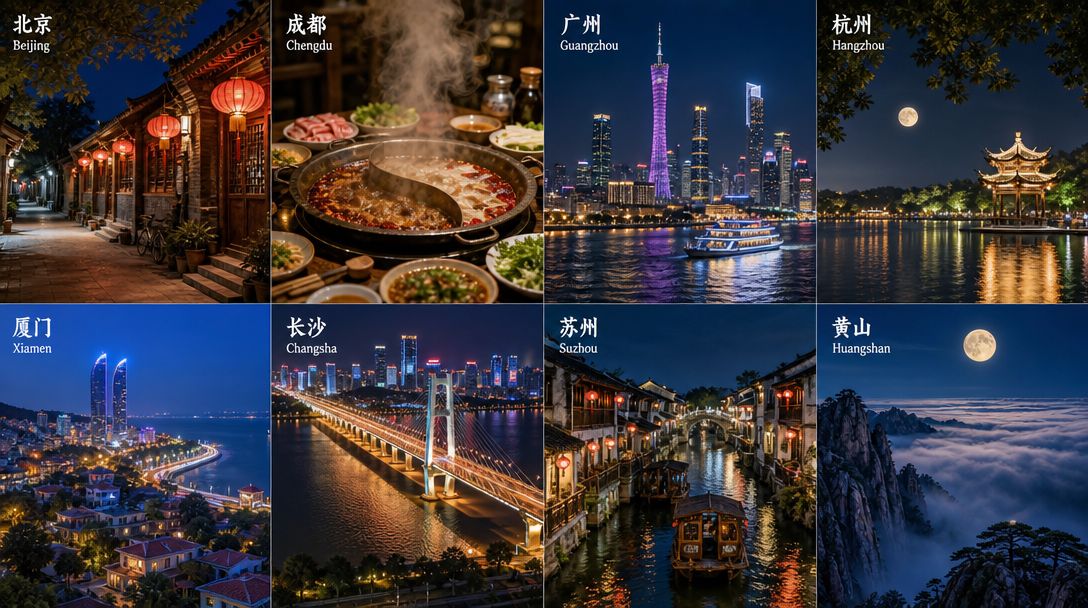
Eight cities, eight nights, eight entirely different culinary worlds, the Grand Tour in one image. · Illustration
Stage Four: The Refined Interior: Jiangsu & Anhui
Stage 04: Days 21 to 28
The tour concludes in the traditions that reward the most patient traveler. Jiangsu (Suzhou, Yangzhou, Nanjing) brings the journey’s most technically refined chapter: knife skills so precise they constitute art, broths of crystalline clarity, dishes plated with the aesthetic philosophy of classical garden design. Wensi tofu, lion’s head meatball, Yangzhou fried rice made correctly for the first time by someone who has made nothing else for thirty years.
Then Anhui, the hidden gem, the tradition most international travelers have never heard of and the one most likely to produce the tour’s most unexpected moments. Hairy tofu in a Hongcun village guesthouse. Fermented mandarin fish braised in a clay pot that has absorbed decades of cooking. Stone ear mushroom broth made from fungi scraped off Huangshan cliff faces at altitude. Food that asks for your full attention and rewards it with flavors that exist nowhere else on earth.
The final meal of the Eight Traditions Grand Tour is traditionally a banquet that draws from all eight: a round table covered with dishes representing every tradition traveled, a glass of Shaoxing rice wine raised in recognition of the journey completed, and the quiet understanding that China (its food, its people, its extraordinary diversity) is something that takes more than one visit to begin to know.
The Eight Traditions Grand Tour: Stage by Stage
Days 1 to 5 · North: Beijing & Jinan: Peking Duck, braised sea cucumber, Shandong imperial tradition
Days 6 to 9 · Southwest: Chengdu: Sichuan hot pot, mala cuisine, UNESCO gastronomy city
Days 10 to 12 · Central: Changsha: Hunan spice trail, red-braised pork, stinky tofu
Days 13 to 15 · South: Guangzhou: Cantonese dim sum, fresh seafood, yum cha culture
Days 16 to 18 · Southeast: Xiamen & Fuzhou: Fujian seafood, Buddha Jumps Over the Wall
Days 19 to 21 · East Coast: Hangzhou: Zhejiang seasonal cuisine, Dongpo Pork, West Lake
Days 22 to 24 · Yangtze Delta: Suzhou & Yangzhou: Jiangsu refinement, lion’s head, knife skills
Days 25 to 28 · Mountains: Huangshan & Hongcun: Anhui fermentation, hairy tofu, mountain ingredients
How to Plan the Grand Tour
The Eight Traditions Grand Tour is most rewarding when approached as a genuine journey rather than a checklist. This means building in time to eat slowly, to return to a dish that surprised you, to sit in a teahouse or at a street food stall without agenda. The cities are connected by China’s extraordinary high-speed rail network, most legs take between 1.5 and 5 hours, and the trains are comfortable, punctual, and themselves a pleasure of modern China travel.
The ideal duration is 21 to 28 days, though meaningful shorter versions exist: a 14-day tour covering four or five traditions can be designed around a specific region or flavor interest. Spring (March to May) and autumn (September to November) offer the most comfortable travel conditions across the full geographic range of the tour. Autumn adds the specific pleasure of hairy crab season in Zhejiang and the beginning of preserved pork season in Hunan and Anhui.
Working with a specialist China travel planner, one who understands both the culinary and logistical dimensions of the journey, transforms the experience. Good food experiences in China are rarely the ones that appear first in a tourist search.
Tips
Travel Tips for the Eight Traditions Grand Tour
Getting Around
China’s high-speed rail network connects all eight tradition regions efficiently. The China Rail Pass offers flexibility for multi-city journeys. For Anhui villages and some Fujian destinations, local buses or private transfers are needed, plan these in advance with your travel consultant.
Seasonal Planning
Autumn tours (September to November) capture hairy crab season in Zhejiang, preserved pork season in Hunan, and clear mountain weather in Anhui. Spring tours (March to May) offer Longjing tea harvest in Hangzhou and cherry blossoms along the route. Avoid Golden Week (October 1 to 7) for major tourist sites.
Booking Key Meals
Book landmark restaurant meals 2 to 4 weeks in advance: Buddha Jumps Over the Wall (Fuzhou), dim sum at a century-old Guangzhou teahouse, West Lake vinegar fish at Lou Wai Lou (Hangzhou), and any Jiangsu banquet dining. Street food and local restaurants need no booking, just show up hungry.
Managing Spice
The Sichuan and Hunan stages will challenge spice-sensitive travelers. Communicate “shǎo là” (少辣, less spicy) at restaurants in both cities, most will accommodate. Sequencing these stages mid-tour (rather than at the start) gives your palate time to calibrate before the heat arrives.
Practical Advice
Pack light, you will want to buy food items along the way (teas, preserved foods, local snacks) and luggage accumulates. A translation app with camera function handles menus in any region. Keep a food journal: by day 14, the dishes blur together without notes. The memories that last are the ones you wrote down immediately.
Why go
Why the Grand Tour Is Worth Every Kilometer
The Eight Traditions Grand Tour is the most complete way to understand China, not through museums or history books, but through the food that built, sustained, and expressed this civilization across five thousand years.
One Country, Eight Worlds
No other country on earth offers eight fully distinct, internally coherent culinary traditions within its borders. The contrast between them (tasted directly, in sequence) produces a form of cultural understanding that is irreplaceable.
The Journey Is the Experience
China’s high-speed rail network transforms the Grand Tour into a pleasure in itself. Watching the landscape change, from northern plains to mountain passes to coastal cities, adds a geographic dimension to the culinary one.
Food as History
Every dish on the tour carries centuries of history. Shandong’s imperial legacy, Sichuan’s revolutionary energy, Cantonese diaspora culture, Anhui’s merchant heritage, eating across the eight traditions is reading China’s history in the most direct possible way.
Genuine Discovery
Most international travelers know China through Sichuan or Cantonese food. The Grand Tour introduces six more traditions that are largely unknown outside China, and which contain some of the most extraordinary food experiences on the planet.
FAQ
Frequently Asked Questions About the Grand Tour
How long does the Eight Traditions Grand Tour take?
The full tour covering all eight traditions takes 21 to 28 days. A condensed version focusing on four or five traditions can be done in 14 days. Individual tradition deep-dives (one region, multiple cities) take 5 to 7 days. The right duration depends on your travel pace, food interests, and how many days you want to spend in each city versus traveling between them.
In what order should I visit the eight culinary regions?
The recommended sequence is north to south then east: Beijing and Shandong first (establishing the imperial baseline), then Sichuan and Hunan (the spice chapter), then Guangzhou, Fujian, and Zhejiang along the coast, finishing with Jiangsu and Anhui. This arc follows China’s high-speed rail network logically and creates a flavor journey that builds from bold to refined as it progresses.
Is the Grand Tour suitable for non-adventurous eaters?
Most of the eight traditions are highly accessible to international palates: Cantonese, Zhejiang, and Jiangsu cuisines in particular are mild, fresh, and immediately appealing. Sichuan and Hunan can be ordered at reduced spice levels. The more challenging dishes (hairy tofu, fermented fish, earthworm jelly) are optional adventures rather than requirements. A good travel planner can design a Grand Tour that stretches your palate without overwhelming it.
Can I do the Grand Tour independently without a guide?
The logistics are manageable independently: China’s rail booking system is accessible online, and major cities have English-friendly navigation. However, the food experience is significantly deeper with local guidance in each region: a knowledgeable local can access restaurants, dishes, and food experiences that no independent traveler would find on their own. For landmark meals and off-the-beaten-track food discoveries, local expertise is invaluable.
What is the most surprising tradition on the Grand Tour?
Almost universally, travelers report that Anhui cuisine produces the tour’s most unexpected experiences. Having heard nothing about it before arrival, they find a fermentation tradition of extraordinary sophistication, a dramatic landscape, and a food culture still largely intact in the villages around Huangshan. Fujian frequently produces a similar reaction, its umami depth and oceanic complexity are completely unlike anything most international travelers have encountered in Chinese cooking elsewhere.
Send the dates, the group size and the places or themes that interest you, and PreeChina replies with a draft plan. Nothing is booked until a priced itinerary is agreed.