
Karamay is in Xinjiang, in Northwest China.
Home › Destinations › Xinjiang › Karamay
Xinjiang · City Guide
Karamay, a City Named After Black Oil.
Overview
Why Go
Karamay is Uyghur for black oil, and it refers to the asphalt seeps north of the city where crude comes to the surface by itself. Those seeps are why anyone drilled here in the opening place.
The field came in during 1955, four years before Daqing, and it was the country's initial large-scale oil development. The city exists entirely because of it and was laid out from scratch around it.
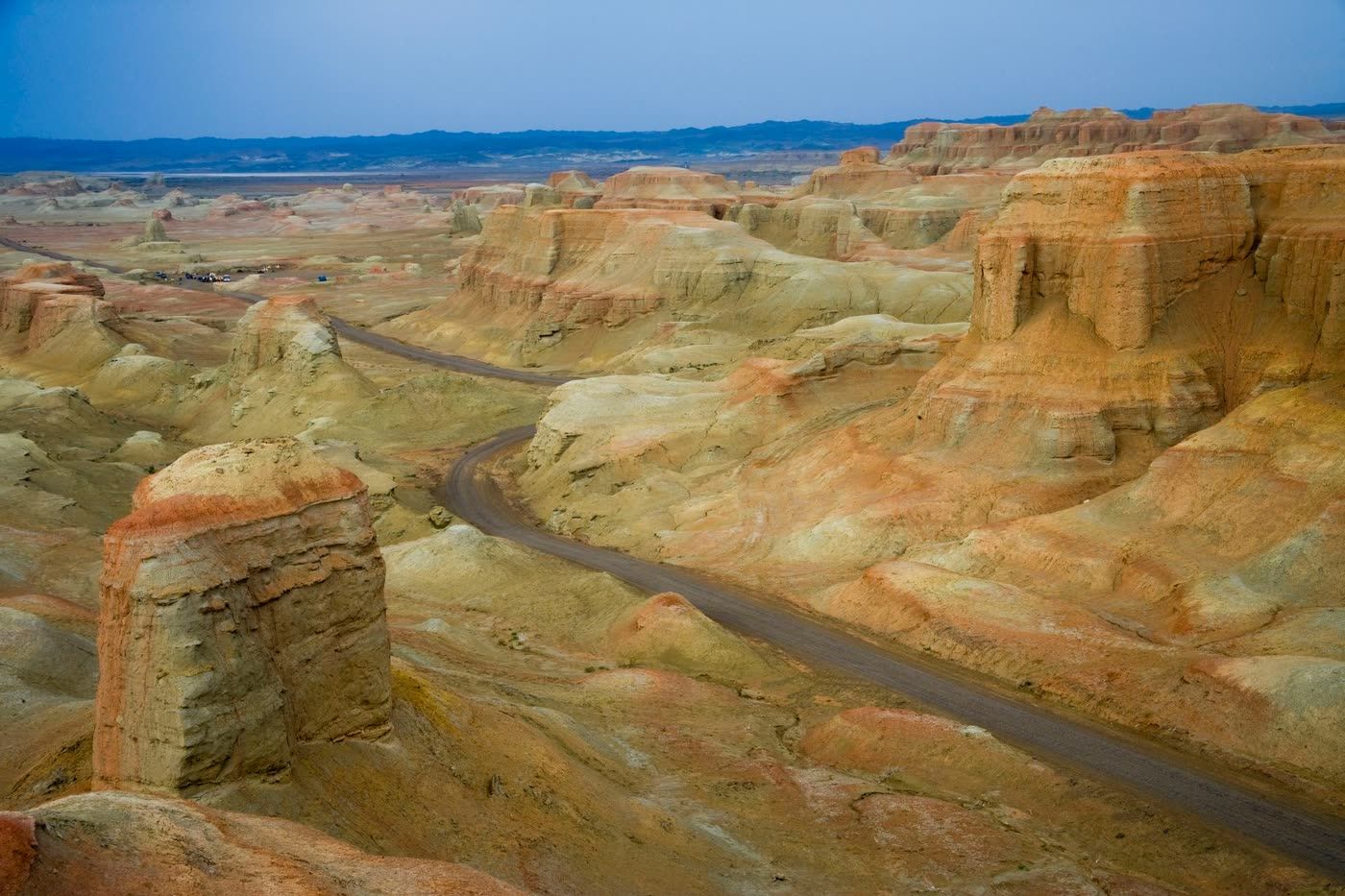
At Urho the prevailing wind has cut soft sandstone into long parallel ridges and towers over a very long time. The Chinese name calls it a devil city; the landform is a textbook yardang field.
There is no usable surface water here. The city's supply is carried hundreds of kilometres by canal from the Irtysh, which is why an oasis exists in the middle of the Junggar basin at all.
The yardang field and the surrounding desert have stood in for other planets and other deserts in a long list of Chinese productions. If a Chinese film needs somewhere that looks like nowhere, it often comes here.
See
A large yardang field of ridges, towers and hollows cut by the wind, crossed by a road loop and walking paths. Early and late light is what makes it. Half a day, and take water.
Natural asphalt seeps on a low rise at the edge of the city, with crude still oozing up and pooling. There is a monument and an old derrick beside it. An hour, and the smell is part of it.
The city museum covering the 1955 discovery and what followed, with early rigs and photographs of the camp before there were buildings. Ninety minutes.
A shallow lake in the desert north of the city with reeds and passage birds, fed by irrigation drainage. An unlikely piece of water in this landscape. Half a day.
A red rock canyon cut into the desert with a thin river at the bottom and poplars along it. Much less visited than the yardangs and ideal in the same low light. Half a day.
Wide streets, planted green belts and an engineered river through the middle, all of it watered from elsewhere. Walking it is the clearest way to see what the water project bought. Two hours.
On the Map
Approximate locations of the attractions above, across Karamay.
Eat
Lamb cut with fat between the lean, grilled over charcoal and dusted with cumin and chilli. Xinjiang sheep and a hot dry climate are the whole recipe. Sold from evening stalls everywhere.
Chicken and potato braised with chilli and Sichuan pepper on a platter, with wide belt noodles added to the sauce at the end. It is a Xinjiang dish, ordered for a table and never for one.
Flatbread baked against the wall of a clay oven, from thin and crisp to thick and chewy, sold from the oven all day. It keeps for days in this air, which is why it is shaped the way it is.
Melons grown in the basin's hot days and cold nights, which is what puts the sugar in. Sold at the roadside through late summer at prices that seem wrong to anyone from a wetter province.
Do
The ridges are flat and dull at midday and become themselves in the hour before sunset, when the shadows show the parallel grain. Stay for dusk; the road out is easy.
Crude arriving at the surface without a pump is not something many people ever see. Stand close enough to smell it and the entire reason this city exists becomes a single observation.
The canal and the green belts it feeds are visible on the way in from the airport. Once visitors have seen the desert on both sides, the trees in the city read completely differently.
The canyon is a short drive from the yardangs and gets a fraction of the visitors. Rim road, a descent at one end and poplars along the water. Go in the same light as the yardangs.
When
Warm, clear and before the worst heat, with the desert light at its peak. The strongest window of the year.
Very hot, into the high thirties and beyond, with the yardangs unbearable at midday. Melons are in, and everything happens early or late.
Cooling, very clear and quiet, with poplars turning along the canyon. The other good window and the better one for photography.
Cold, windy and grey, with the basin at minus twenty in midwinter. The museum and the city are fine; the desert is not.
Explore More
Karamay is in Xinjiang, in Northwest China.
Themes with places in Karamay
Related
Share the travel dates and interests, and PreeChina's local team will design a route that fits.
Plan My Trip to KaramaySee Private Tour Prices