
Shuozhou is in Shanxi, in North China.
Home › Destinations › Shanxi › Shuozhou
Shanxi · City Guide
Shuozhou, Where a Wooden Pagoda Has Stood Since 1056.
Overview
Why Go
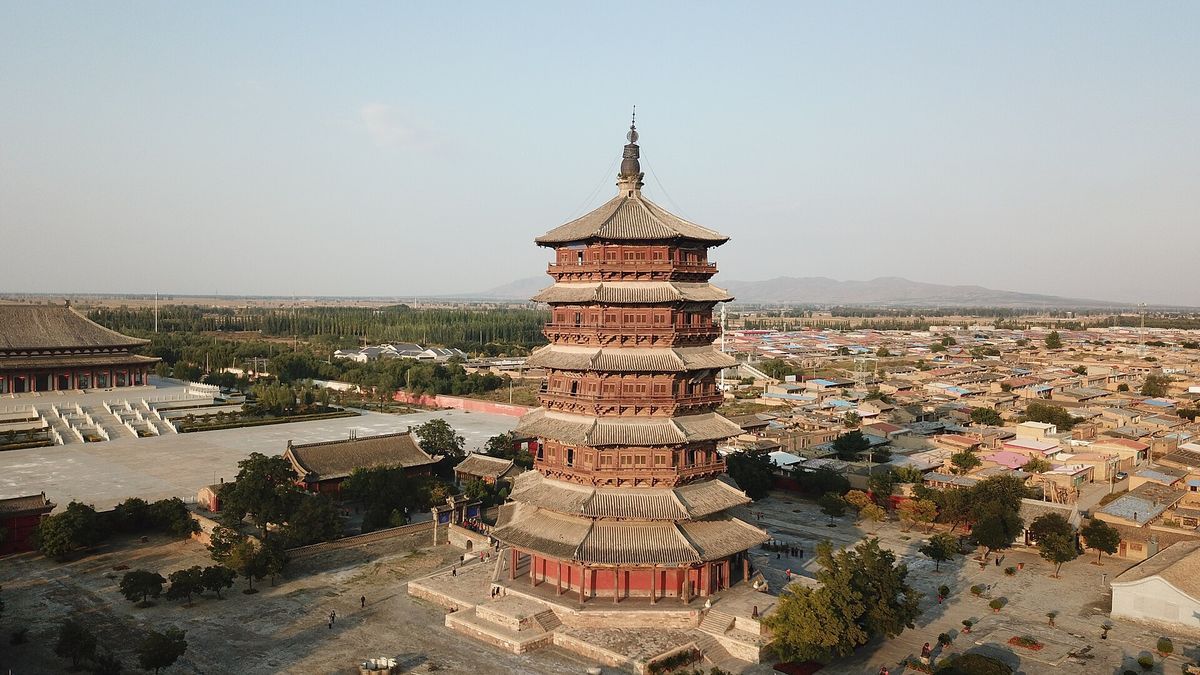
The pagoda at Yingxian was raised in 1056 and at 67.31 metres is a tall all-timber pagoda surviving anywhere. It is built entirely of interlocking joinery, with fifty-four different bracket types and no nails in the frame.
The Guangwu section north of Shanyin is rammed earth, unrestored and unfenced, running over bare ridges with its towers eroding. The arch known as the moon gate stands where a tower has half fallen away. There is no pass and no path.
Shahukou was the pass Shanxi families walked out of when they went north to Inner Mongolia through the nineteenth century, a migration that songs and opera still refer to. The name was changed from one homophone to another in the Qing.
Youyu had almost no tree cover in 1949 and has been planting continuously since. Provincial forestry figures now put its cover above half the county's area, and the volcanic necks on the grassland stand out of what is now woodland.
Chongfu Temple in the city keeps a Jin dynasty hall of 1143 with its original statues, wall paintings and window tracery in place. Having all three survive together in one building is unusual even in Shanxi.
See
An octagonal pagoda of 1056 that reads as five storeys from outside and nine inside. The frame has leaned measurably for decades and floors above the second are closed, so the visit is the ground floor Buddha and the structure seen from below and around.
A temple in the city centre whose Amitabha hall dates from 1143, with the original main figures, attendant statues, Jin wall painting and the carved window lattice all surviving. It gets a fraction of the visitors the pagoda does.
A long run of Ming earth wall on the ridges above Shanyin, with towers at intervals and the collapsed tower known as the moon gate. Below it sits the old Guangwu town and a field of nearly three hundred Han burial mounds.
A frontier pass on the Shanxi and Inner Mongolia line with a rebuilt gate, a museum on the northward migration, and a village below that people still live in. The old road line runs straight through it.
Two small walled garrison towns that were never cleared for visitors: Old Guangwu with Liao walls beneath the Great Wall, and Youwei up at Shahukou. Both are free, both are lived in, and both are quiet enough to hear.
A cluster of basalt volcanic necks standing out of the grassland and planted forest in Youyu county, Niuxinshan the well-known. The interest is as much the surrounding planting as the cones themselves.
On the Map
Approximate locations of the attractions above, across Shuozhou.
Eat
Mutton stewed plainly and eaten with millet, the two things this country grows and grazes. Shuozhou mutton comes off dry grassland and is milder than the Inner Mongolian kind, and it is usually cooked without much more than salt.
Naked oat flour scalded with boiling water, rolled thin on the palm into tubes and stood upright in a steamer like a honeycomb, then eaten with a mutton or tomato sauce. Oats grow at this altitude where wheat struggles.
Huairen county has built a mutton trade on the same grassland flocks and its grill streets run late. Chops and skewers over charcoal with cumin and chilli, ordered by weight rather than by the stick.
Glutinous millet steamed and worked into a dense cake, torn and dipped into stew or fried with a filling. Northern Shanxi eats it at almost every meal and it is the standard thing put in front of a guest.
Do
Once for the ground-floor Buddha and the painted walls behind it, once outside for the structure. The bracket sets change on every tier and the lean is visible from the north side. There is a small museum of what came out of the statues during repairs.
Park at Old Guangwu and walk up. The wall is earth, unstabilised and in places undercut, so stay off the crest where it is narrow. There is no fence, no pass and usually nobody else on it.
The Amitabha hall's window lattice is Jin work and the patterns do not repeat across the bays. Go in the morning when the light comes through them onto the floor. The statues behind are original to the hall.
The pass is worth doing as a crossing rather than a stop: drive up through the loess gullies from the Shanxi side and out onto the open ground beyond. The museum below the gate sets out what the migration was.
When
Warm and dry with the grassland green in Youyu. The ideal window for the wall, which has no shade at all.
Warm days and cool nights, with what rain there is. The northern Shanxi plateau stays comfortable when Taiyuan and Xi'an do not.
Harvest, very clear air and long low light on the pagoda and the wall. The other good window and the better one for photography.
Cold, windy and dusty in spring, with hard frost. The temples and the pagoda are open and empty; the wall is walkable but bitter on the ridge.
Explore More
Shuozhou is in Shanxi, in North China.
Themes with places in Shuozhou
Related
Share the travel dates and interests, and PreeChina's local team will design a route that fits.
Plan My Trip to ShuozhouSee Private Tour Prices